Wozu werden Ringkerntransformatoren verwendet? Ein umfassender Leitfaden
Veröffentlicht: Autor: Lisa
A toroidal transformer is a ring-shaped transformer built on a continuous strip of grain-oriented silicon steel, and it is used wherever compact size, high efficiency, quiet operation, and low electromagnetic interference (EMI) matter most. You will find toroidal transformers inside audio amplifiers, medical devices, industrial control systems, LED lighting drivers, solar inverters, and UPS units — basically any application where clean, stable power has to fit into a small space. This guide explains what a toroidal transformer is, why engineers prefer it, where it is actually used, and where its limits are, so you can decide whether it is the right choice for your equipment.
What Is a Toroidal Transformer?
A toroidal transformer is an electrical transformer wound around a doughnut-shaped (toroidal) core instead of the stacked laminated E-I core used in conventional transformers. The core is made from a single continuous strip of grain-oriented silicon steel, tightly wound into a ring, so the magnetic flux travels in a closed loop with no air gaps and always follows the grain of the steel.
The primary and secondary windings are wrapped evenly around the outside of the ring. This construction keeps the magnetic field almost entirely inside the core, which is the root cause of nearly every advantage that follows: less leakage flux, less EMI radiated to nearby circuits, lower core losses, and less mechanical hum.
If you are new to transformer basics — how primary and secondary windings transfer energy by electromagnetic induction — it may help to start with a plain-language introduction to what a transformer is before reading further.
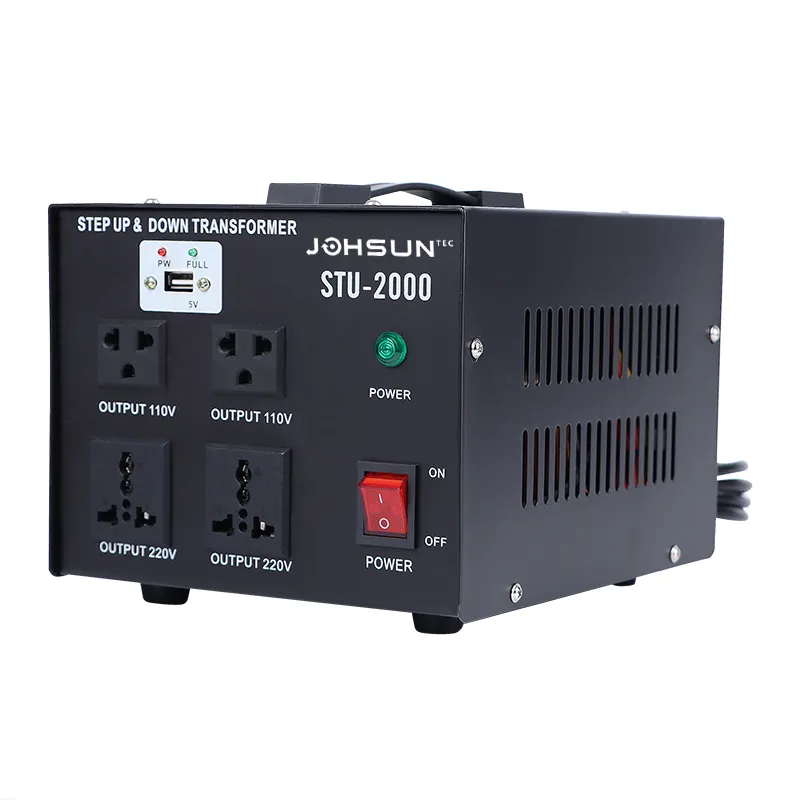
The photo above shows a typical commercial toroidal unit — in this case an STU series toroidal step-up/step-down transformer rated from 100VA to 5kVA, used to convert between 110V and 220V AC power systems.
Why Toroidal Transformers Are Preferred
Four properties explain most of the design decisions engineers make in favor of toroidal construction:
Höhere Effizienz. The closed magnetic path and grain-oriented steel reduce core losses, so more of the input power reaches the load and less becomes heat.
Low EMI and stray magnetic field. Because leakage flux is roughly one-tenth that of an equivalent E-I transformer, toroidal units can sit next to sensitive circuitry — audio signal paths, sensors, measurement boards — without inducing hum or noise.
Quiet, low-vibration operation. There are no laminations to buzz and no air gap to vibrate, which is why toroidal transformers dominate noise-sensitive products.
Compact and lightweight. For the same power rating, a toroidal transformer is typically about half the size and half the weight of an E-I unit, and it mounts with a single center bolt.
These advantages are not free — cost, power capacity, and inrush behavior all have trade-offs, which we cover honestly later in this guide. But for the majority of low- and medium-power applications, the balance tilts clearly toward the toroid.
Common Applications of Toroidal Transformers
So what are toroidal transformers used for in practice? The short answer: any product where the power supply must be quiet, small, efficient, and electromagnetically clean. The six sectors below cover the overwhelming majority of real-world uses.
1. Audio and Hi-Fi Equipment
Amplifiers, preamps, subwoofers, and active studio monitors almost universally specify toroidal transformers. Low stray flux means no 50/60Hz hum induced into the signal path, and quiet operation means no mechanical buzz audible during quiet passages. This is the single most recognizable toroidal application, and the reason many consumers first encounter the term.
2. Medical and Laboratory Devices
Patient monitoring equipment, diagnostic instruments, and laboratory analyzers require isolated, low-noise power that will not interfere with sensitive sensors. The low leakage field and high insulation capability of toroidal designs, combined with their compact footprint, make them a natural fit for medical power supplies built to strict safety standards.
3. Industrial Control and Automation
Control panels, PLCs, robotics, and motion-control systems need stable control-voltage supplies in crowded cabinets. A toroidal control transformer delivers the required secondary voltage while taking up minimal panel space and not injecting noise into adjacent signal wiring. For machine-tool and control-circuit duty specifically, dedicated control transformers are often specified, and toroidal versions serve where space and EMI constraints are tight.
4. LED Lighting and Power Supplies
Low-voltage lighting systems, dimming supplies, and architectural LED drivers use toroidal transformers because they run cool, fit into slim enclosures, and can be located near lighting controllers without causing interference.
5. Renewable Energy and Inverters
Solar inverters and wind-power conversion equipment use toroidal transformers for efficient energy transfer in a compact enclosure. Their low no-load losses are especially valuable in systems that idle for long periods.
6. UPS Systems and Battery Chargers
Uninterruptible power supplies and quality battery chargers rely on toroidal transformers for efficient power transfer and low standby loss, which extends battery life in always-on installations.
The table below summarizes which requirement drives the choice in each sector:
Anmeldung
Key requirement that favors a toroid
Audio & Hi-Fi
Zero audible hum, no EMI in the signal path
Medical & lab devices
Low leakage field, isolation, compact size
Industrial control
Small footprint, low noise in dense panels
LED lighting
Cool operation, slim enclosure fit
Solar / wind inverters
High efficiency, low no-load loss
UPS & chargers
Efficient transfer, low standby drain
Toroidal vs. EI Transformers: When to Use Each
The conventional alternative is the E-I laminated transformer, which remains the default for cost-driven and high-power designs. A direct comparison makes the boundary clear:
Attribute
Toroidal
E-I Laminated
Effizienz
Higher (lower core loss)
Mäßig
Stray field / EMI
Very low (~1/10)
Höher
Audible noise
Sehr niedrig
Noticeable hum possible
Size & weight
~Half of E-I at same rating
Bulkier
Unit cost
Higher (winding labor)
Unter
Practical power range
Best below ~2–3 kVA
Economical to high power
In plain terms: choose toroidal when noise, EMI, or space is the constraint; choose E-I when unit cost or power rating dominates. For a broader look at how transformer families differ, see the differences between transformer types — and remember that capacity is always rated in VA or kVA, not watts, for the reasons explained in why transformers are rated in kVA.
Limitations You Should Know Before Choosing
An honest guide has to cover the downsides. Toroidal transformers have three, and all three are manageable if you plan for them:
High inrush current at switch-on. The air-gap-free core that makes a toroid efficient also lets it saturate for the first few cycles after power is applied, drawing an inrush current that can reach many times the steady-state current. The standard mitigations are slow-blow (type T) fuses, NTC thermistor soft-start circuits, or delayed-action breakers — routine engineering, but it must not be skipped on units above roughly 1.5 kVA.
Limited economical power range. Every winding turn must be passed through the center of the core during manufacturing, which makes winding labor-intensive. As a result, toroidal transformers are rarely economical above a few kVA, where E-I or other core types take over.
Higher unit cost. That same winding labor, plus higher-grade core steel, makes a toroid more expensive than an E-I transformer of equal rating. The payback comes from efficiency, size, and silence — worth it in premium equipment, not in commodity designs.
How to Choose the Right Toroidal Transformer
Selection comes down to a short checklist:
Spannungsverhältnis — input voltage and required secondary voltage(s), e.g. 220V to 110V for imported equipment.
Nennleistung — the load’s VA requirement, with headroom for inrush and duty cycle.
Frequenz — match the supply (50Hz or 60Hz); power frequency toroids are not interchangeable with high-frequency ferrite designs.
Physical envelope — diameter, height, and mounting method (center bolt, bracket, or potted assembly).
Protection and compliance — fuse type for inrush, insulation class, and the certifications your market requires (CE, UL, RoHS as applicable).
Toroidal transformers are used wherever power conversion has to be quiet, compact, efficient, and electromagnetically clean: audio and Hi-Fi, medical and lab equipment, industrial control, LED lighting, renewable-energy inverters, and UPS systems. Their limits — inrush current at switch-on, a practical ceiling of a few kVA, and a higher unit price — are real but well understood, and none of them changes the verdict for noise- and space-sensitive applications.
If you are evaluating toroidal transformers for a specific product, Johsun Tec’s STU series toroidal step-up/step-down transformers (100VA–5kVA, 110V/220V) are a proven starting point, and the full transformer product range covers control, variable, and step-up/step-down types for every voltage-matching scenario. Send your voltage, VA, and compliance requirements to get a matched specification and quotation.
FAQ
Can a toroidal transformer handle high-power loads?
Not economically. Because winding a toroid is labor-intensive, practical designs top out at a few kVA. Above that range, E-I or other core constructions are usually more cost-effective for the same rating.
Why do audio amplifiers use toroidal transformers?
Because their stray magnetic field is around one-tenth that of an E-I transformer and they produce virtually no mechanical hum. Both qualities keep the power supply from imprinting noise onto the audio signal.
Is a toroidal transformer the same as a variac?
No. A variac is an adjustable autotransformer — usually built on a toroidal core — with a sliding brush that gives a continuously variable output voltage. A standard toroidal transformer has fixed windings and a fixed output. You can explore variable transformers (variacs) here.
Why does my toroidal transformer trip the breaker at switch-on?
That is inrush current, not a fault. The core can saturate for the first few AC cycles and draw a momentary surge. Use a slow-blow fuse, an NTC soft-start thermistor, or a transformer-rated delayed breaker to solve it.
Are toroidal transformers more expensive than E-I types?
Yes, typically, due to winding labor and premium core steel. The trade-off is smaller size, higher efficiency, and quieter, cleaner operation — usually worthwhile in professional and premium equipment.
Recommended Models for Toroidal Transformer Applications
If you are specifying a unit rather than reading theory, start here. These models cover the capacity bands most often requested for toroidal transformer applications, and each links straight to its specification and price range.
Tell us the input voltage, output voltage, phase and continuous kVA you need, and we will confirm the matching model, price and lead time within one business day. Non-standard ratings are handled through OEM/ODM custom transformer manufacturing.
230-V-auf-110-V-Transformator für die Niederlande: NEN 1010, 30-mA-Fehlerstromschutzvorschriften, „Aardlekschakelaar“ versus „Aardlekautomaat“ und Sekundärerdung.