How to Choose Step Up Voltage Converter 110V to 220V
Publicado: Autor: Lisa
To choose a step up voltage converter De 110 V a 220 V, first confirm that your wall supply is approximately 100–120V and your appliance requires 220–240V AC. Then select a converter whose continuous VA rating exceeds the appliance’s real demand, including power factor and startup surge. Finally, verify 50/60Hz compatibility, grounded sockets, overload protection, ventilation, and continuous-duty capability.
The most common selection mistake is buying by voltage alone. Correct voltage direction is essential, but an undersized converter can overheat or trip, while a frequency-sensitive appliance may still operate incorrectly even when the output voltage is right. This guide gives you a practical, nameplate-first process.
Do You Really Need Step Up Voltage Converter 110V to 220V?
Read the appliance label near its power inlet or on its AC adapter. If it says “INPUT: 100–240V, 50/60Hz,” the device is already designed for worldwide voltage. You normally need only a plug adapter that fits the local socket, not a voltage converter.
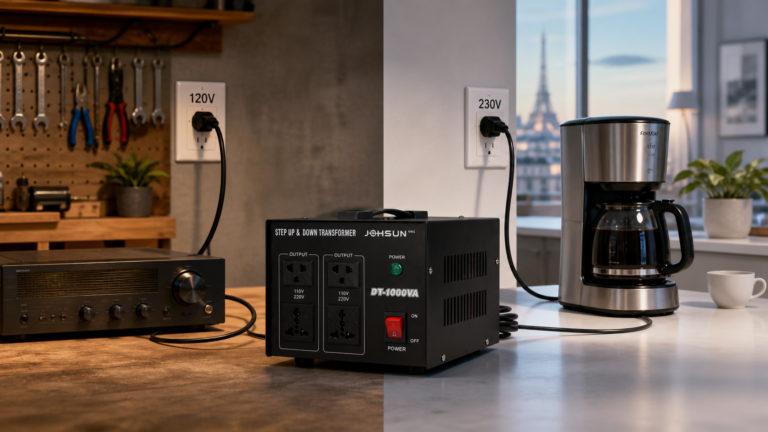
If the appliance says “220–240V only” and you are connecting it to a 110–120V supply, you need a step-up transformer or converter. If the appliance is marked “110–120V only” and the wall supply is 220–240V, you need the opposite direction—a step-down unit.
Wall supply
Appliance input
Correct solution
110–120V
220–240V only
110V to 220V step-up converter
220–240V
110–120V only
220V to 110V step-down converter
Either region
100–240V, 50/60Hz
Usually a plug adapter only
“110V” and “120V” are often used informally for the same nominal market range, just as “220V,” “230V,” and “240V” commonly describe the higher-voltage range. Always use the actual acceptable ranges printed on the converter and appliance rather than assuming every product tolerates every value.
How a Step Up Voltage Converter 110V to 220V Works
A traditional AC step-up transformer has primary and secondary windings around a magnetic core. Alternating current in the primary creates changing magnetic flux, which induces voltage in the secondary. A secondary with roughly twice as many turns as the primary can raise approximately 110V to approximately 220V.
Voltage increases, but available current decreases for the same power. The transformer does not create energy; real output power is also slightly below input power because losses become heat. That is why capacity, cooling, and load characteristics matter.
How to Choose a Step Up Voltage Converter in 7 Steps
1. Record the source and appliance voltage ranges
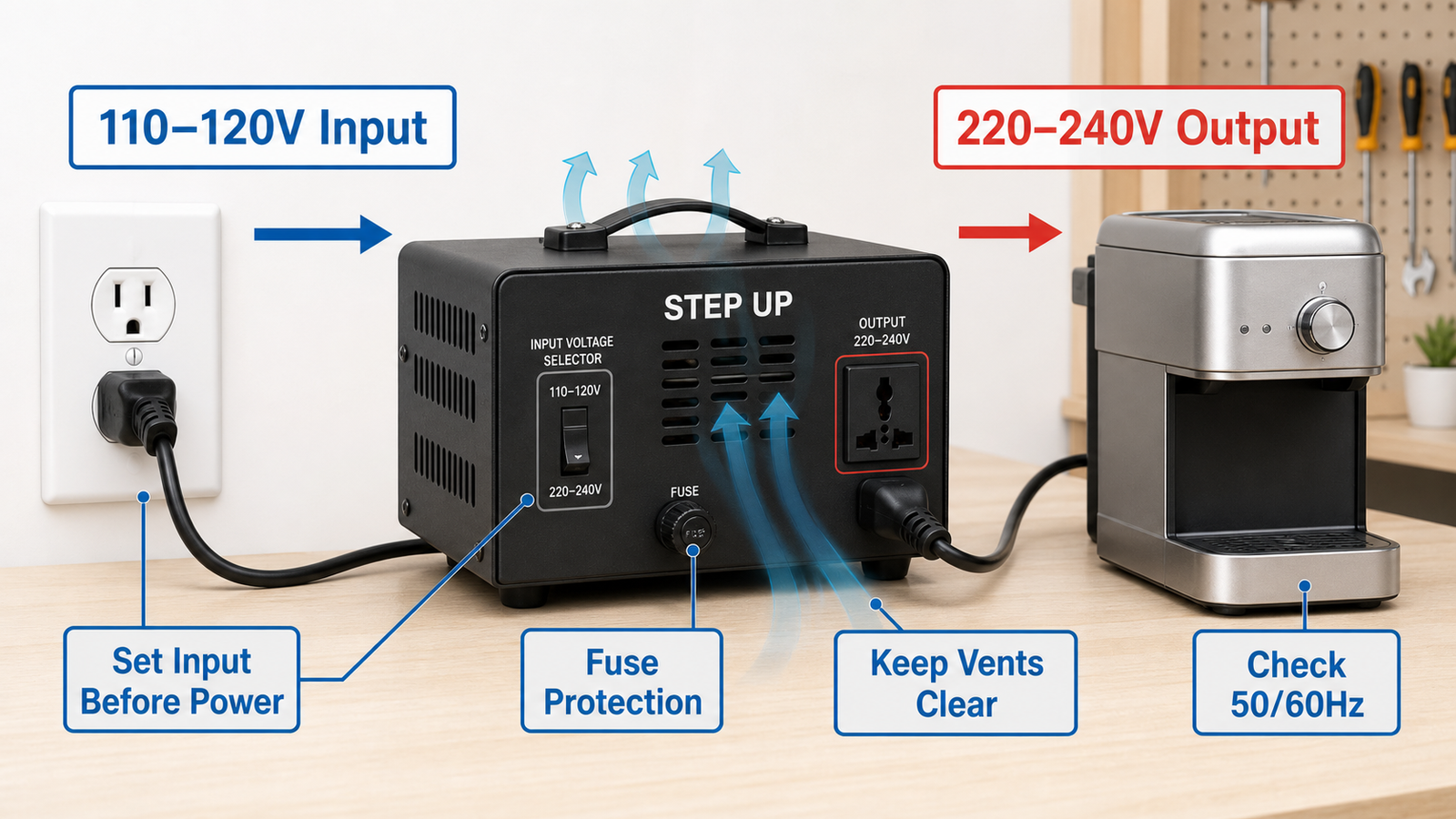
Confirm the local wall voltage and the appliance input range. The converter input must accept the wall supply, and its output must fall inside the appliance’s permitted range. If the unit has an input selector, it must be set to the source voltage before the converter is plugged in.
2. Find the maximum appliance wattage
Use the rated watts shown on the nameplate or in the manual. If the appliance lists voltage and current but not watts, estimate its real power using W = V × A when appropriate. For several appliances, add the maximum power of every device that may run at the same time.
Do not use an average energy-consumption figure when the converter must support a higher operating load. A heating appliance, motor, or amplifier may draw near its nameplate maximum even if its long-term energy use is lower.
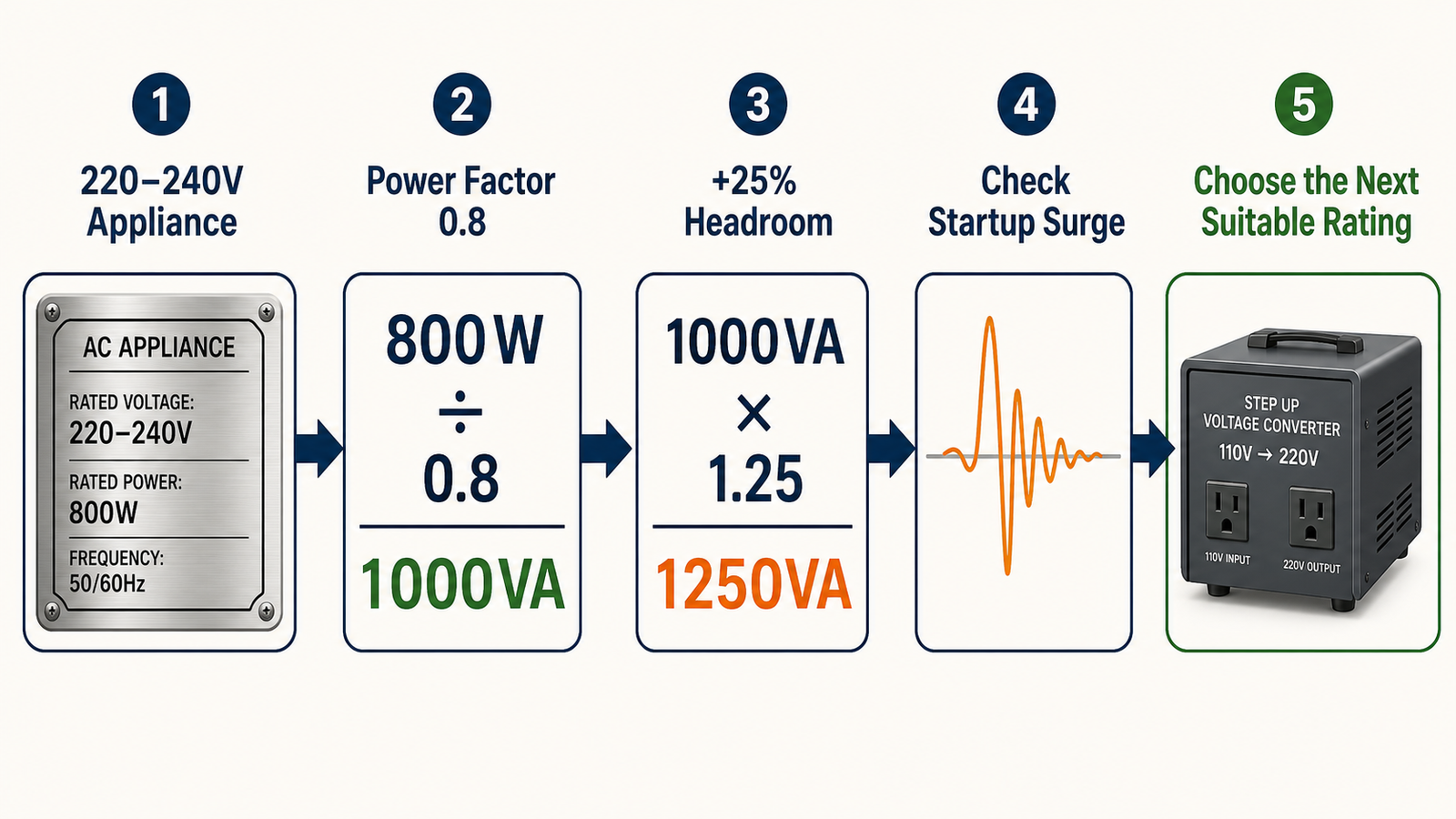
3. Convert watts to VA when power factor matters
Transformer capacity is usually stated in volt-amperes. For a resistive load such as a basic heater, watts and VA may be close because power factor is near 1. Motors and some electronic power supplies can require more VA than their watt rating suggests.
VA ≈ watts ÷ power factor
For example, an 800W load with a power factor of 0.8 represents about 1000VA. If the manufacturer gives both watts and VA, size the converter using the more demanding applicable value.
4. Add continuous-load headroom
A converter should not operate continuously at the edge of its rating. For a simple load with no major starting surge, at least 20–25% headroom is a practical starting point. An 800VA continuous requirement therefore points toward a converter rated at least 1000VA. Use the converter manufacturer’s continuous rating, not an unclear “maximum” or short-duration figure.
5. Allow for startup surge and inrush current
Refrigerators, pumps, power tools, mixers, compressors, and other motor-driven appliances may briefly draw several times their running current. Large transformers and electronic power supplies can also have inrush current at switch-on. Obtain the appliance’s starting watts or inrush specification and select a converter that can support it without excessive voltage drop or nuisance tripping.
There is no reliable universal multiplier for every appliance. A transformer that is adequate for an 800W heater may be unsuitable for an 800W motor. If surge information is missing, ask the appliance manufacturer or a qualified transformer supplier.
6. Check frequency compatibility
A standard step-up transformer changes voltage but normally does not convert 60Hz to 50Hz. If the wall supply is 60Hz, the output remains 60Hz. Devices marked “50/60Hz” are designed for both common frequencies. Frequency-sensitive motors, clocks, turntables, tape machines, pumps, and timing equipment may run at the wrong speed or overheat.
If an appliance is marked “220V 50Hz only,” do not assume a Step Up Voltage Converter 110V to 220V makes it compatible with a 60Hz grid. Confirm with the appliance manufacturer or use a genuine frequency-conversion solution when required.
7. Verify sockets, grounding, protection, and duty
The output receptacle must accept the appliance plug and preserve any protective earth connection. Useful safety features include a fuse or circuit breaker, overload protection, thermal protection, a grounded metal enclosure, and adequate ventilation. Confirm whether the converter is rated for continuous operation or only intermittent travel use.
Step Up Voltage Converter 110V to 220V Sizing Examples
Appliance example
Known load
Selection approach
Small audio component
200W, low surge
Add continuous margin; confirm noise and grounding needs
Resistive appliance
700W, PF near 1
At least about 875VA, then move to the next standard rating
Motor-driven appliance
600W running
Use the specified starting VA, not running watts alone
Multiple devices
Combined 1200VA
Add simultaneous loads, surge, and continuous headroom
These examples illustrate the method rather than guaranteeing a size. Ambient temperature, duty cycle, power factor, starting behavior, and the converter’s published test conditions can all change the correct selection.
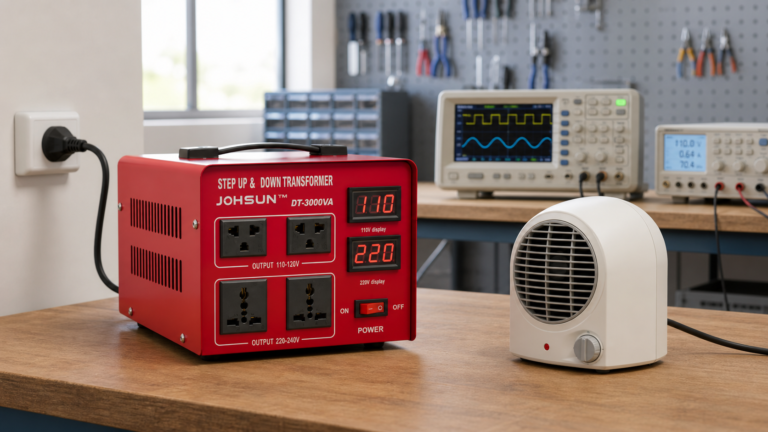
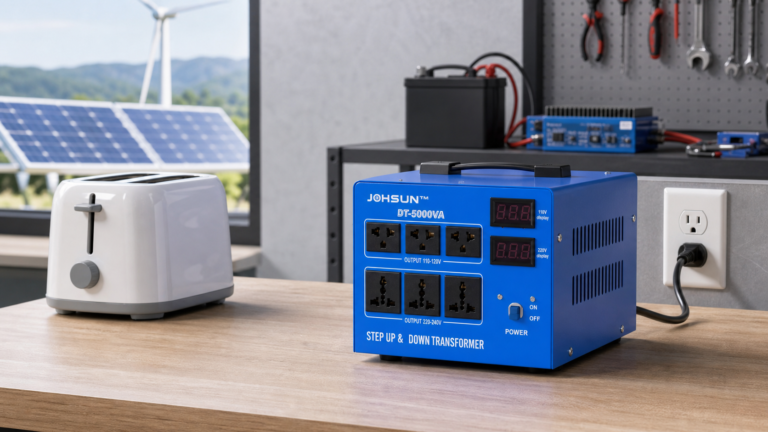
Higher-demand equipment can be evaluated against the DT-3000VA transformer o DT-5000VA voltage converter transformer. Select from the calculated continuous and surge requirements rather than choosing a model only because its nominal number is familiar.
Loads That Need Extra Caution
Hair dryers and heating appliances: high wattage can approach the limit of a household branch circuit.
Refrigerators and compressors: startup current may be much higher than running current.
Microwaves: input demand and frequency sensitivity may make international use impractical.
Audio equipment: consider grounding, magnetic leakage, hum, and continuous duty.
Medical devices: use only solutions approved by the device manufacturer and applicable regulations.
Fixed industrial equipment: require professional electrical assessment and installation.
Safe Connection Checklist
Switch off and unplug both the converter and appliance.
Set the converter input selector to the local 110–120V supply if applicable.
Confirm the chosen output is 220–240V and matches the appliance label.
Place the converter on a dry, stable, nonflammable surface with open vents.
Connect it to a correctly grounded outlet on a circuit with adequate capacity.
Connect the appliance to the correct output socket.
Switch on the converter first, then the appliance.
Stop immediately if you notice unusual heat, odor, noise, smoke, or repeated breaker trips.
Never change the voltage selector while energized, connect to an output marked for the wrong voltage, or daisy-chain multiple voltage converters. High-power or permanently installed systems should be handled by a qualified electrician.
Final Selection Advice
The right step up voltage converter 110V to 220V begins with the appliance nameplate. Confirm voltage direction, calculate continuous VA, add headroom, check inrush current, verify frequency, and insist on suitable grounding, protection, sockets, ventilation, and duty rating.
Explore Johsun Tec’s power solutions, learn about Johsun Tec, or review available ODM and OEM services. For a model or customized specification, contact the team with your input voltage, appliance voltage, maximum watts or VA, power factor, startup current, frequency, and socket standard.
Preguntas frecuentes
Can I convert 110V to 220V with a plug adapter?
No. A plug adapter changes only the connector shape. A single-voltage 220V appliance needs a genuine step-up voltage converter when the source is 110–120V.
What size converter do I need for a 1000W appliance?
Start by checking power factor and surge. A simple resistive 1000W load needs more than a 1000VA continuous rating after headroom is added. A motor or compressor may require substantially more capacity.
Will extra VA damage my appliance?
No. A correctly connected appliance draws the current it requires. The output voltage must match, while extra converter capacity provides operating headroom.
Can a 110V to 220V step-up converter run all day?
Only if it is rated for continuous duty at the actual load and has adequate cooling. Follow the manufacturer’s load, ventilation, and ambient-temperature limits.
Does a step-up transformer change 60Hz to 50Hz?
No. Standard transformers change voltage, not frequency. Verify that the appliance supports the frequency of the local supply.