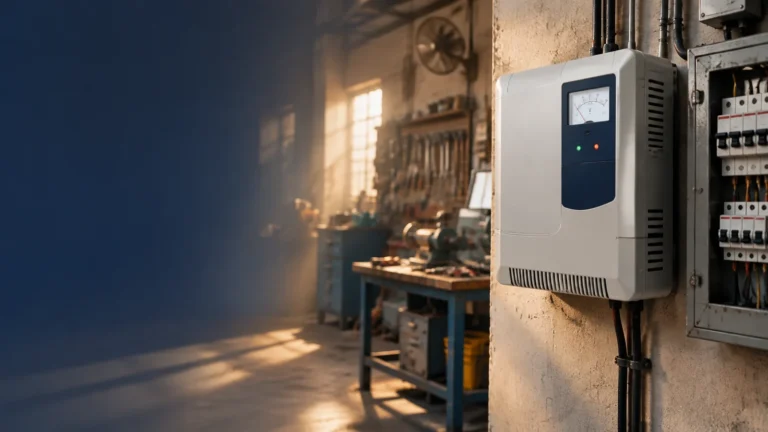
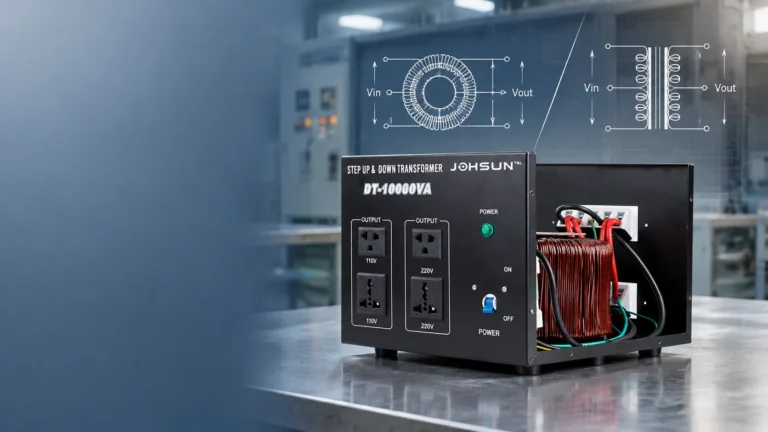
A 110V machine on a 240V Gulf site is one of the most common jobs we quote. The supply is 230/240V at 50Hz, the equipment was bought in the US or Japan at 110/120V, and the contractor needs it running the same week. A step-down transformer solves the voltage half of that problem completely — and does nothing at all about the frequency half, which matters as soon as the load has a motor, a compressor or a mains-referenced timer inside it.
This guide covers what the Gulf supply actually looks like across the year, how to size a 240V to 110V step-down on real load data rather than the nameplate wattage, how the unit should be wired at a site cabin or plant room, and what fails first when the ambient sits at 50°C. If you already know the capacity you need, the step-up and step-down transformer range runs from 100VA to 10kVA.
What the supply in the Gulf actually looks like
Across the UAE, Saudi Arabia, Qatar, Kuwait, Oman and Bahrain the nominal single-phase supply is 230V or 240V at 50Hz, with 400/415V three-phase available at larger premises. That nominal figure is a design target, not a measurement. Three things vary in practice and each one changes the transformer you should buy.
| What you will measure |
Why it happens |
What it means for the transformer |
| 240V to 250V at a low-load site, dropping to 215-225V under load |
Distribution transformer taps set for a lightly loaded feeder that then carries a heavy summer load |
Size on the low end of the range. A unit sized for 240V running at 220V draws more current for the same output |
| Visible dips of 10-20V lasting one to three seconds |
Chiller and pump starts on the same feeder, or a generator transferring on a compound |
Motor loads on the secondary will see the dip through the transformer. Contactor coils may drop out — check the holding voltage |
| 52-55°C inside a site cabin or unshaded plant room in July |
Solar gain and no mechanical ventilation |
The transformer is rated for a 40°C ambient. Above that, derate — see below |
A step-down transformer changes voltage, not frequency
The US equipment you are installing was designed for 60Hz. Gulf power is 50Hz. A transformer is a magnetic device with no moving parts and no switching electronics — it cannot create cycles that are not there. What comes out is 110V at 50Hz, not 110V at 60Hz.
Whether that matters depends entirely on the load:
- Switch-mode power supplies, chargers, LED drivers, laptops, telecom equipment. Most are marked 100-240V, 50/60Hz and work on either frequency. Many need no transformer at all — check the label before you buy one.
- Resistive loads: heaters, ovens, incandescent lamps, soldering irons. Frequency is irrelevant. A 110V heater on a 240V-to-110V transformer runs exactly as designed.
- Induction motors, compressors, pumps, fans. Frequency sets the speed and the impedance. A 60Hz motor on 50Hz runs about 17% slower and draws more current for the same mechanical output, so it runs hotter. Running it at 110V is the correct derating (the voltage-to-frequency ratio is preserved), but a motor that was marginal at 60Hz will not survive long at 50Hz at full load.
- Equipment with a mains-referenced timer or clock. Anything that counts cycles to keep time will run 17% slow on 50Hz. That includes some battery chargers, timers and older control boards.
If the load is a motor and the application cannot tolerate a slower shaft, the fix is not a transformer — it is a variable frequency drive or a rotary frequency converter. Where the load is electronic or resistive, which is most of what a contractor installs, a DT/ST series step-down transformer is the whole solution.
How to size a 240V to 110V step-down
Capacity is quoted in VA, not watts. For a resistive load the two are the same. For everything else they are not, and three factors move the number:
- Power factor. A motor at 0.8 PF needs 1.25VA of transformer capacity for every watt of real power. A switch-mode supply with no power-factor correction can be worse, around 0.6, though its inrush behaviour is usually the bigger issue.
- Starting current. A compressor or pump draws three to six times running current for a fraction of a second. A transformer tolerates this better than an electronic converter, but it must have the thermal mass. Plan on roughly three times running watts for a single motor start.
- Diversity. If five items share one transformer and never all run at once, size on the realistic simultaneous load plus 20%, not the sum of every nameplate.
| Load you are powering |
Nameplate |
Transformer size to specify |
| Laptop, monitor, small charger |
150 W |
ST/DT-300 (300VA) |
| US bench instrument, oscilloscope |
400 W |
ST/DT-750 (750VA) |
| Kettle, coffee machine, microwave |
1,200-1,800W |
ST/DT-2000 (2,000VA) |
| Single power tool, 1.5kW grinder |
1,500W |
ST/DT-3000 (3,000VA) for inrush |
| 110V air compressor, 1.5kW motor |
1,500W |
ST/DT-5000 (5,000VA) |
| Whole cabin: lights, AC unit, fridge, tools |
6-8kW mixed |
ST/DT-10000 (10,000VA) with fixed wiring |
Sizes shown are the model whose rated capacity covers the load with inrush margin at a 40°C ambient. The full model list with carton quantities and indicative FOB bands is on the DT/ST series page.
Wiring a 240V to 110V step-down on site
Sub-3kVA units are normally supplied with a lead and can sit on a shelf. Above 3kVA, treat the unit as fixed plant. The wiring points that catch people out:
- Breaker on the primary, sized to the primary current. A 5kVA unit on 240V draws 20.8A — fit a 25A MCB. On the 110V side the full-load current is 45.5A, so the secondary circuit needs its own protection sized for the cable and the socket, not for the transformer.
- Use the terminal block, not a plug, above 5kVA. At 10kVA the secondary current approaches 47A. A domestic 110V outlet cannot carry that, and a plug-top connection on a 10kVA unit is a fire risk.
- Earth the enclosure and bond the secondary neutral. An autotransformer shares a winding between input and output, so the output is not isolated from the supply. If the load requires isolation — wet areas, medical equipment, or where a fault could put line voltage on exposed metal — specify a double-wound isolation transformer instead.
- Keep the input selector on the correct tap. The DT/ST units select 110, 120, 220 or 240V by a rotary switch. Selecting 110V as the input on a 240V supply will destroy the unit in seconds. Label the switch position after commissioning and cover it.
- Ventilation clearance. Natural convection needs 100mm clear above and below the case. A transformer boxed into a closed steel cabinet in a plant room will run 15-20°C hotter than the same unit on a shelf.
For a wider treatment of single-phase to three-phase questions and panel-level wiring, see the single-phase to three-phase guide.
What fails first in Gulf conditions
Heat is the dominant failure mode, and it is cumulative rather than dramatic. Every 10°C above the rating temperature roughly halves the insulation life of the winding. A unit rated at 40°C ambient running in a 52°C plant room is not immediately broken — it just ages three times faster than the datasheet implies.
| Condición |
Effect |
Mitigation when specifying |
| Ambient above 40°C |
Winding runs hotter; insulation life shortens sharply |
Derate to about 85% of rated VA above 45°C, 75% above 50°C — or buy one frame larger |
| Fine dust and sand |
Blocks convection paths, insulates the case, can bridge terminals |
Specify a unit with a filtered or louvred case; blow out the windings at each service interval |
| Condensation after a chiller shutdown |
Moisture inside the winding, tracking across terminals |
Keep the unit powered during off-hours in humid plant rooms so the winding stays warm, or fit anti-condensation heaters |
| Repeated voltage dips |
Contactor chatter, motor stalls, inrush stress |
Size one frame up and keep motor starts staggered; consider a stabilizer ahead of the transformer |
What to put in the enquiry
Procurement teams in the Gulf usually need three documents with the quotation: the datasheet for the consultant, the CE and RoHS declaration for customs, and the routine test report for the handover file. All three are available for the DT/ST range. Send the input and output voltage, the destination country standard, the load list in watts with motors flagged, and the first order quantity, and the model comes back priced within a working day.
En DT/ST datasheet (PDF) has the full model table, carton quantities and FOB bands. For 110V-to-220V projects in the other direction, the 240V/120V selection guide covers the same frame from the opposite side.
Frequently asked questions
Can a 240V to 110V transformer run a 60Hz appliance on 50Hz power?
It will deliver 110V at 50Hz, which is fine for switch-mode power supplies, heaters and most electronics. Motors will run about 17% slower and hotter, and any device that counts mains cycles to keep time will run slow. If the appliance’s rating plate says 60Hz only and it contains a motor, a transformer is not enough.
Do I need a 240V to 110V transformer for a US laptop charger in Dubai?
Usually not. Most laptop chargers are marked 100-240V, 50/60Hz and plug straight into a Gulf socket with an adapter. Check the small print on the charger before buying a transformer — it is the most common unnecessary purchase we see.
What size transformer do I need for a 110V air compressor?
A 1.5kW compressor typically needs 5kVA because of starting current, not because of running load. Measure the running current, multiply by the supply voltage to get running VA, then multiply by three for a single motor start. If two compressors can start together, size for both.
Will a step-down transformer work in a 50°C plant room?
It will run, but it will age faster. Standard units are rated for a 40°C ambient. Above 45°C, derate to about 85% of nameplate; above 50°C, about 75%. Buying one frame larger is usually cheaper than the downtime from a failed winding.
Is a step-down transformer the same as a voltage converter?
In the trade the words are used interchangeably for the same autotransformer. What matters is whether the unit is an autotransformer (shared winding, no isolation, smaller and cheaper) or a double-wound isolation transformer (separate windings, galvanic isolation, larger and more expensive). The DT/ST range is autotransformer; specify isolation separately if the load needs it.
Can I use one transformer for several 110V sockets around a cabin?
Yes, as long as the total simultaneous load plus 20% fits the rating and the secondary circuit is protected for the cable you use. In a site cabin the practical limit is usually cable length and voltage drop rather than transformer capacity: at 110V, a 30m run of 2.5mm² cable drops more than 5% at 20A.
Need a capacity confirmed against your load list? Send the details to our engineering team — input voltage, output voltage, country standard and the load list is enough to quote.