XFMR Meaning in Electrical Drawings: A Quick Guide for Engineers and Buyers
Publicado: Autor: Lisa
XFMR Meaning in Electrical Drawings: A Quick Guide for Engineers and Buyers
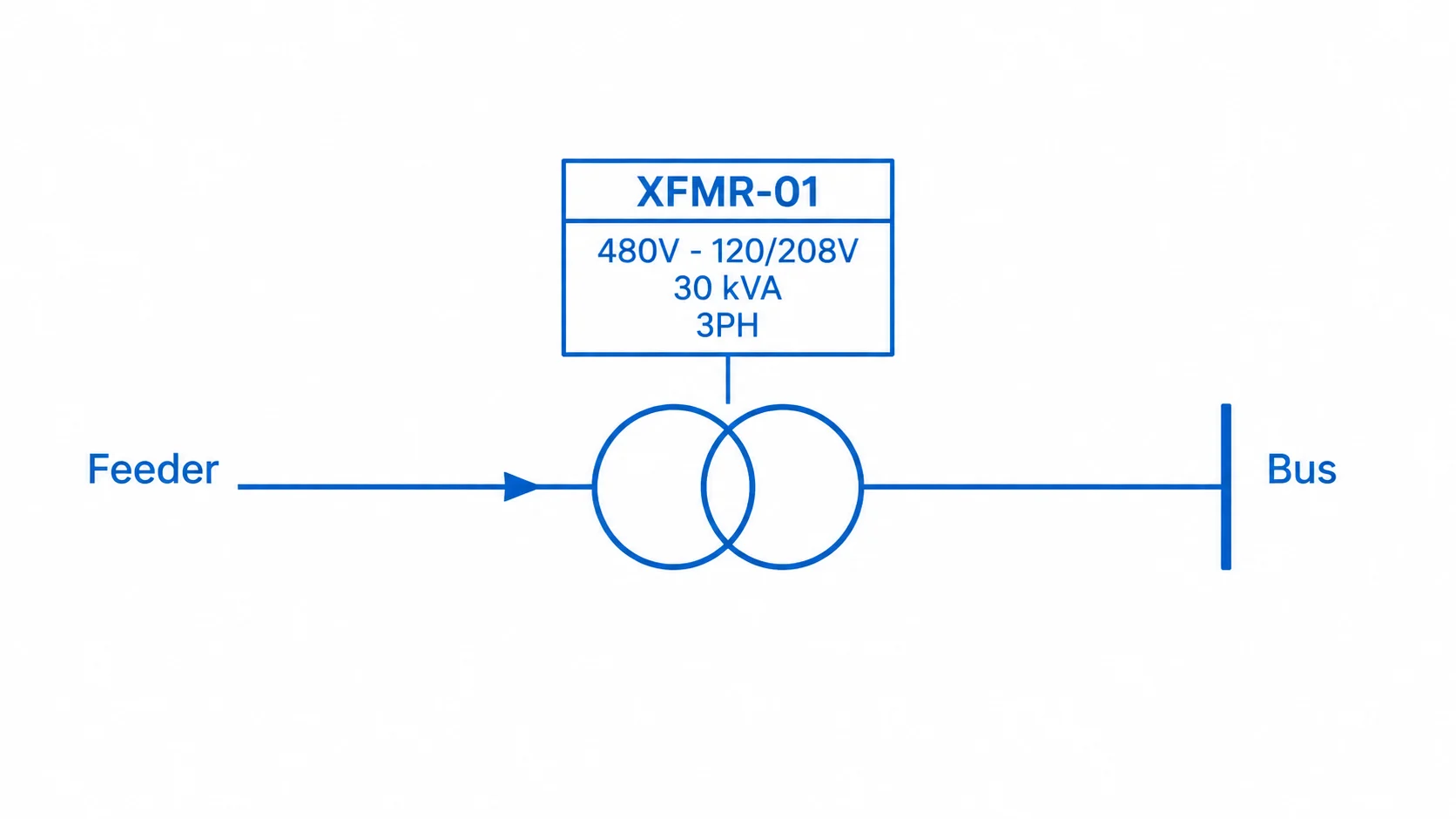
You are halfway through a drawing set and the tag XFMR-01 appears next to two circles on a single-line diagram. The same letters then show up on a panel schedule, a BOM line, and an RFQ. What does Xfmr meaning actually cover in electrical drawings — and what are you expected to do with it? We are Johsun Tec, a maker of low-voltage dry-type step-up/step-down transformers (100 VA–10 kVA), and we decode this shorthand on customer RFQs every week. Below: what XFMR stands for, where it appears, which tags get confused with it, and how to convert it into an orderable specification without an email round-trip.
Short answer first: Xfmr is simply an abbreviation for “transformer.” It names the component class only — never the rating, the type, or the wiring. Everything you need to actually buy or install one lives in the schedule, the nameplate, or the specification attached to that tag. Our transformer catalog shows how many different devices hide behind that one label.
What XFMR Stands For — and Where the “X” Comes From
XFMR is a phonetic-style contraction of transformador: the X carries the “trans-” sound (the convention behind XMTR for transmitter and XLAT for translate), and FMR compresses the rest. It is read letter by letter and appears on North American ANSI-style drawings far more often than on IEC documents, where the letter code T1, T2 is standard for a transformer symbol. The variants X-mer, XFRMR and TR/TRF on older documents mean the same component.
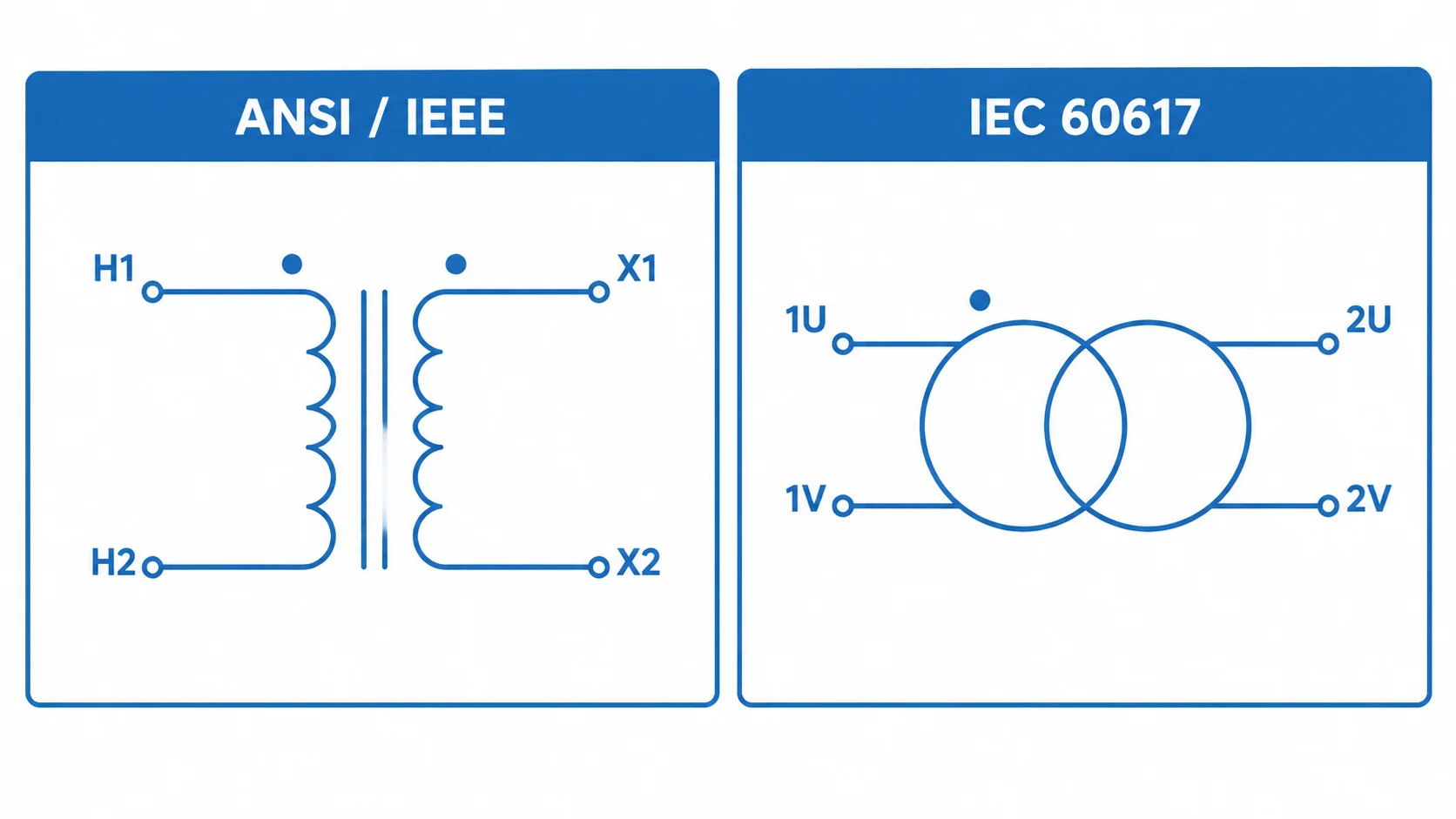
Two things the abbreviation is no: it is not a rating — “XFMR” marks a position, nothing about kVA, voltage, or phase — and it is not a standard symbol. The graphic (two coils, two circles, two boxes) is governed by IEEE 315/ANSI Y32.2 or IEC 60617; XFMR is drafting shorthand layered on top. Treating the label as complete information is where the most expensive drawing mistakes begin.
Where XFMR Appears in a Drawing Set
The same three letters show up in four very different documents, and the context changes what the tag tells you:
Document
What the XFMR tag carries
What you should do with it
Single-line diagram (SLD)
Tag plus headline ratings, e.g. “XFMR-01, 480V–120/208V, 30 kVA, 3Ø”
Feeder sizing, breaker coordination, space planning
Control / ladder schematic
Xfmr at the top-left feeding the control voltage rail (24 VAC or 120 VAC typical)
Check the secondary fuse and coil ratings downstream
Panel schedule or equipment schedule
Full technical data: kVA, taps, impedance, enclosure, temperature rise
This is your ordering document — details below
BOM / wiring diagram
Manufacturer part number or “per schedule” reference
Cross-check against the schedule revision, not the drawing revision
On utility-scale drawings you will also see XFMR with role prefixes such as GSU (generator step-up) or AUX (station auxiliary). In the 100 VA–10 kVA industrial range we serve, the tag almost always refers to a dry-type isolation or step-up/step-down unit in a control cabinet or beside a machine.
The XFMR Tag Family: Abbreviations That Get Mixed Up
Most procurement errors around this abbreviation come from assuming every “transformer-looking” tag orders the same box:
Tag
Meaning
Role
Risk if misread as a power XFMR
Xfmr / TX / T1
Transformador
Power conversion between voltage levels
— (this is the unit you order)
CPT
Control power transformer
Feeds control circuits only (typically 100–1000 VA)
Ungrounded output mistaken for a safe isolated secondary
The CT and PT entries deserve emphasis: both are instrument transformers, not power transformers. A circle on a conductor labeled CT 400:5 is a metering component — ordering a power unit because the letters overlap is a real-world mistake.
XFMR on ANSI vs IEC Drawings: Reading the Symbol Around the Label
The abbreviation travels with a graphic symbol, and the two dominant conventions look different:
ANSI/IEEE (North America): two coil “humps” facing each other across a core line. Terminals use voltage tiers — H1/H2 for high voltage, X1/X2 for low voltage.
IEC 60617 (Europe, Asia, most of the world): two overlapping circles, or two boxes on schematics. Terminals use 1U/1V/1W and 2U/2V/2W, numbers indicating the voltage tier.
Three small marks change the meaning of either symbol. A polarity dot shows instantaneous phase alignment — critical when paralleling transformers or wiring push-pull circuits. A tap arrow indicates a variable or multi-tap winding. And a single continuous coil with a tap is an autotransformer, not an isolation transformer — its output is referenced to its input, which matters for grounding. The full graphic language is covered in our guide to step-up and step-down transformer symbols.
What the Label Does Not Tell You: Turning XFMR into an Orderable Spec
Here is the core of the Xfmr meaning for buyers: the tag is a pointer, not a purchase order. Even a schedule that repeats “XFMR-01” leaves the buying decision open. These twelve fields turn the tag into something a manufacturer can quote:
Field
Example value
If you omit it
Rated power (kVA or VA)
1 kVA
Undersized unit overheats; oversized wastes panel space
Primary / secondary voltage
230 V / 115 V
Wrong ratio — the most common complaint we hear
Fase
Single-phase
Three-phase frame quoted for a single-phase circuit
A practical shortcut: quote from the schedule page, not the drawing page — schedules carry the technical columns; drawings carry the tag. When a customer sends only “XFMR, 1000VA” with a note like “for a US machine on a 230 V site,” we can usually propose a matching DT-series step-up/step-down transformer the same day.
Drawing vs Schedule vs BOM: Which Document Governs?
When the drawing and the schedule disagree, the schedule governs — but get the conflict confirmed in writing before you release the purchase order. The classic failure: the drawing is at revision C, the schedule at revision B, and a voltage change made on one sheet never reached the other. The transformer arrives correct per the paper you ordered from and wrong for the machine it feeds. This mismatch is the most frequent cause of transformer rework we see, and one line in your RFQ prevents it: “Quote per schedule rev. D; drawing rev. C is superseded.” The same rule protects you inside the BOM — verify the listed part number against the schedule revision in force on the day you order.
How to Write the RFQ So the First Quote Is the Right Quote
You now know the twelve fields behind the tag. Compress them into five lines and any competent manufacturer can quote without follow-up questions:
Duty: “Step-up/step-down transformer, single-phase” — or isolation / control power, naming the family from the table above.
Ratings: “1 kVA, 230 V primary to 115 V secondary, 50/60 Hz.”
Construction: “Dry type, class F insulation, 100% copper, wall-mount enclosure.”
Environment and compliance: “40°C ambient, CE required.”
Drawing reference: “Tag XFMR-01, schedule rev. D — drawings available on request.”
That five-line block is exactly the information a bare XFMR tag cannot carry — and the difference between a same-week quotation and a week of clarification emails. If you would like a second pair of eyes on a schedule, our team at johsuntech.com reviews drawing tags against specs for free.
Preguntas frecuentes
Is XFMR the same as a transformer?
Yes. XFMR is an engineering-drawing abbreviation for “transformer.” It identifies the component class only; the type, rating and wiring come from the schedule and the symbol around the tag.
Why is transformer abbreviated with an X?
The X stands in for the “trans-” prefix, following a long drafting convention (XMTR for transmitter, XLAT for translate).
What is the difference between XFMR and TX?
Both mean transformer. XFMR dominates on North American ANSI-style drawings; TX (and T1/T2) is common on IEC drawings, telecom documents and PCB silkscreens. On RF schematics TX can occasionally denote a transmitter, so confirm from context.
Is a CT or PT a type of XFMR?
Technically both are instrument transformers, but on drawings they are tagged CT and PT/VT — never XFMR. Those tags mark metering and protection components, ordered to completely different specifications than a power conversion unit.
Does the XFMR tag tell me what type of transformer to buy?
No. The tag only marks the position. Check the equipment schedule for kVA, voltages, phase, frequency, insulation class and enclosure, then verify the schedule revision matches the drawing revision before ordering.
The reduced-voltage starting method that gives the most torque per line amp: how the 50/65/80% taps work, how to wire and size a Korndorfer starter, and the five faults that show up at commissioning.
Percent impedance (%Z) on a transformer nameplate is the voltage needed to drive rated current through a shorted secondary. Here is what it means for 100 VA-10 kVA units.
A transformer cannot create cycles the supply does not have. What actually changes inside a 60Hz machine on 50Hz power, which loads genuinely do not care, and the three ways to convert frequency properly.