O que é um conversor de tensão? Tipos, usos e como escolher
Publicado: Autor: Lisa
A voltage converter is a device that changes the voltage supplied by a power source into the voltage required by electrical equipment. A common example converts 220–240V mains power to 110–120V for an appliance made for North America, or steps 110–120V up to 220–240V for equipment designed for other markets. Depending on its design, a converter may also change AC to DC, DC to AC, or one DC voltage to another.
The essential buying rule is simple: the input voltage must match the local supply, the output voltage must match the equipment, and the converter must safely support the load. However, voltage alone is not enough. Frequency, power rating, waveform, isolation, duty cycle, and the appliance’s startup demand can all affect whether a converter is suitable.
How Does a Voltage Converter Work?
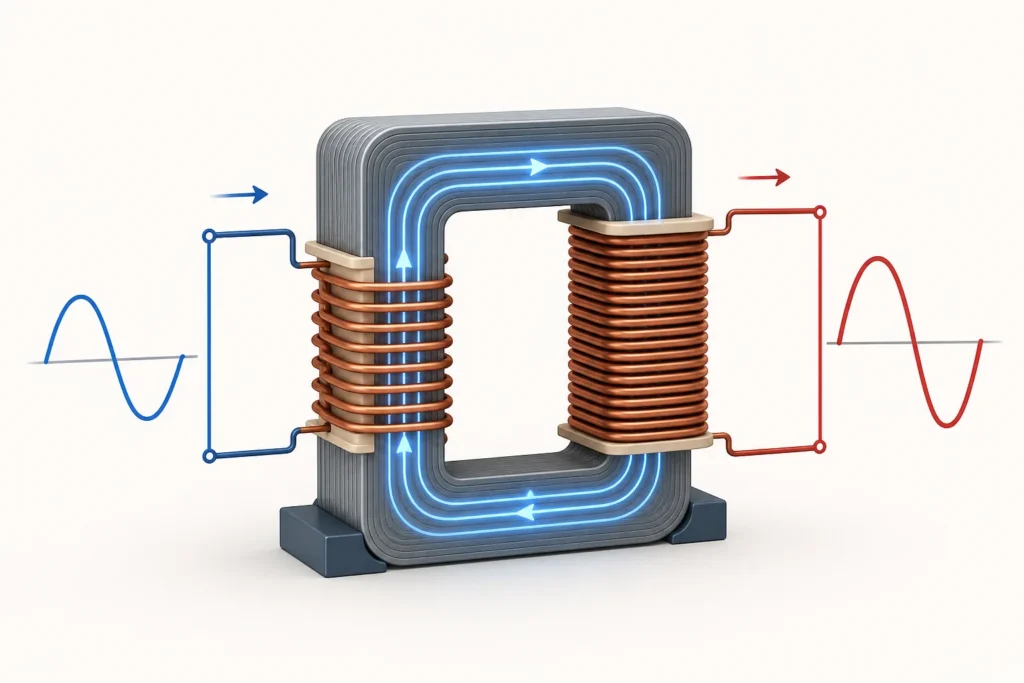
A converter receives electrical power at one voltage and produces an output at another. In a traditional AC voltage converter, a transformer uses electromagnetic induction between windings. The ratio of turns in those windings determines whether the output is lower or higher than the input. A step-down unit might turn 230V AC into 115V AC, while a step-up unit does the reverse.
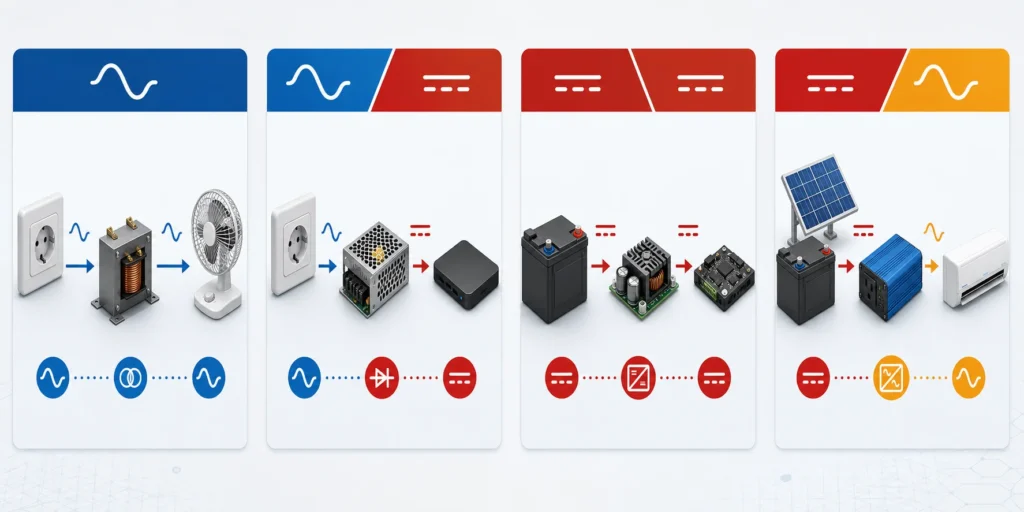
Electronic converters use switching components, inductors, capacitors, rectifiers, and control circuits. They repeatedly switch and regulate energy to produce the required output efficiently. The exact conversion stages depend on the input and output:
AC to AC: changes an alternating-current voltage, commonly with a transformer.
AC to DC: rectifies mains AC and regulates it into DC for electronic devices.
DC to DC: steps a DC source up, down, or both, as required by a circuit.
DC to AC: uses an inverter to create AC power from a battery or solar DC source.
A converter changes voltage or power form; it does not automatically solve every power-quality problem. For example, a basic transformer does not normally change 50Hz into 60Hz. It also should not be confused with a surge protector or an automatic voltage regulator.
What Are the Main Types of Voltage Converters?
Converter type
Função típica
Aplicações comuns
Key consideration
Step-down transformer
Higher AC voltage to lower AC voltage
Using 110V appliances on 220–240V supplies
Must be sized for running and startup load
Step-up transformer
Lower AC voltage to higher AC voltage
Using 220–240V equipment on 110–120V supplies
Does not normally change frequency
AC-DC converter
AC input to regulated DC output
Chargers, controls, LED systems, electronics
Output voltage, current, polarity, and ripple
DC-DC converter
One DC voltage to another
Vehicles, batteries, embedded electronics
Input range, efficiency, and isolation
Inversor
DC input to AC output
Solar systems, backup power, mobile power
Waveform, frequency, surge capacity, and load type
Step-up and step-down converters
For international appliances and industrial equipment, “voltage converter” often means a step-up or step-down transformer. Some models are bidirectional and provide both 110V-to-220V and 220V-to-110V conversion. You can compare the broader step-up and step-down transformer category to see the available power ranges and formats.
Electronic power converters
Electronic products frequently need more than a voltage change. A laptop adapter, for example, converts AC mains power into low-voltage DC. A solar inverter converts battery or photovoltaic DC into AC. These devices must control characteristics such as output regulation, ripple, waveform, and electromagnetic interference in addition to voltage.
Voltage Converter vs. Travel Adapter vs. Transformer
A travel adapter changes the physical plug connection so it fits a foreign socket. It normally does not change voltage. A transformer transfers AC energy magnetically and can step voltage up or down. “Voltage converter” is the broader functional term and may refer to a transformer-based unit or an electronic circuit.
Check the equipment label before buying anything. If it states an input such as “100–240V, 50/60Hz,” the device is designed for a wide mains range and may need only a plug adapter. If it states only “120V, 60Hz,” using it on a 230V supply requires a correctly sized step-down converter, and frequency-sensitive equipment may still be unsuitable.
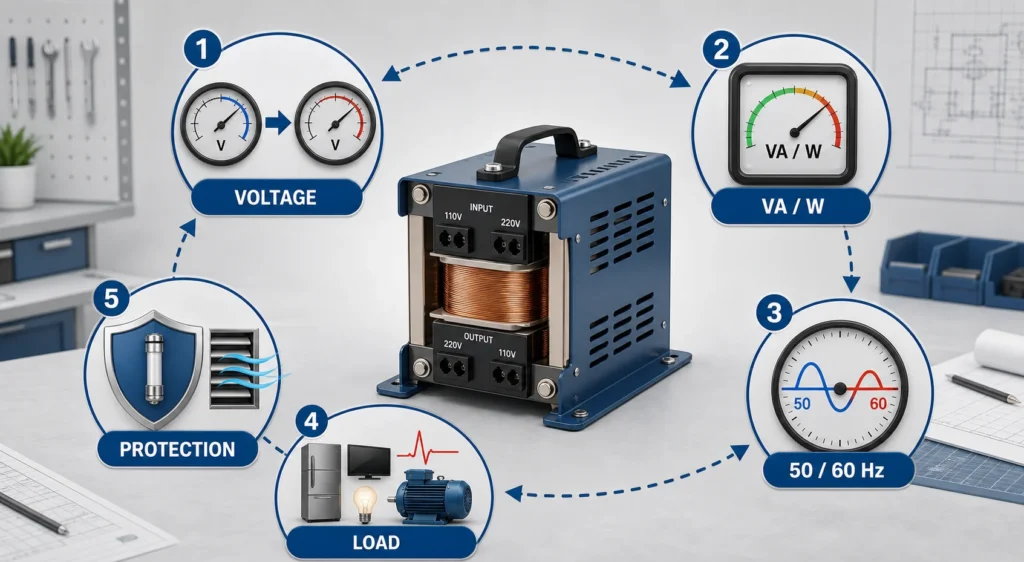
How Do You Choose the Right Voltage Converter?
1. Match the input and output voltage
Confirm the nominal supply voltage at the installation site and read the appliance nameplate. The converter’s input must accept the supply, and its output must fall within the appliance’s permitted range. Do not assume that a different plug shape means a different voltage, or that the same plug shape guarantees compatibility.
2. Check watts and volt-amperes
Watts (W) describe real power, while volt-amperes (VA) describe apparent power. They can differ for motors, transformers, and other reactive or nonlinear loads. If the appliance provides current rather than power, a basic single-phase estimate is:
VA = volts × amperes
Select a converter above the continuous requirement rather than exactly at it. Heating appliances may operate close to their nameplate wattage, while motors, compressors, pumps, and some power supplies can draw a much higher current when starting. Use the appliance manufacturer’s startup specification whenever possible.
3. Verify frequency compatibility
A 110V/220V transformer generally changes voltage but leaves frequency unchanged. Equipment containing induction motors, mechanical timers, turntables, or frequency-dependent components may run at the wrong speed, overheat, or behave unpredictably when moved between 50Hz and 60Hz systems. If the nameplate does not list both frequencies, consult the equipment manufacturer.
4. Consider load type and operating time
Identify whether the load is resistive, electronic, inductive, or capacitive. Then check whether the converter is rated for continuous operation, intermittent use, or short travel use. Enclosure ventilation matters because conversion losses appear as heat. Never cover ventilation openings, and keep the unit away from moisture and combustible materials.
5. Look for appropriate protection
Useful protections can include a fuse or circuit breaker, overtemperature shutdown, overload protection, short-circuit protection, grounding, and an enclosure suited to the environment. For commercial sourcing, documentation, quality controls, socket configuration, labeling, and market-specific certification may also be important. Johsun Tec’s ODM and OEM service explains the available customization route for project requirements.
Common Voltage Converter Mistakes
Buying a plug adapter instead of a converter: the plug fits, but the appliance still receives the wrong voltage.
Sizing only for normal running power: startup current can overload an undersized unit.
Ignoring frequency: correct voltage does not guarantee correct motor speed or timing.
Assuming every converter produces isolation: an autotransformer can change voltage without galvanically isolating input and output.
Using vague appliance ratings: the converter should be selected from the nameplate and manufacturer data, not from an estimate based only on appliance size.
Overlooking ventilation and duty cycle: excess heat reduces reliability and can trigger protection.
Where size, weight, noise, or installation format matters, construction also becomes part of the decision. The ZX Series 500VA–2000VA toroidal converter provides another form-factor option. For a specific higher-capacity reference, review the DT-5000VA 110V/220V converter transformer. Always confirm the final model’s detailed specifications against the actual load and installation conditions.
Final Takeaway
A voltage converter makes an electrical source compatible with equipment by changing its voltage, and sometimes its current form. The right choice depends on input and output voltage, AC or DC, frequency, continuous VA or watts, startup demand, load characteristics, and safety requirements—not voltage alone.
For more information about the manufacturer, visit the Johsun Tec home page e Sobre nós. If you need help matching a converter to an application, contact the team with the supply voltage, equipment nameplate, load type, and operating conditions.
Perguntas frequentes
Does a voltage converter change AC to DC?
Some do, but not all. An AC-DC converter changes both the type of current and usually the voltage. A step-up or step-down transformer changes AC voltage while keeping the output as AC.
Can a 220V appliance run on 110V?
Only if the appliance accepts 110V directly or is powered through a suitable 110V-to-220V step-up converter. The converter must support the appliance’s continuous power and any startup surge.
Can a voltage converter change 50Hz to 60Hz?
A conventional transformer-type voltage converter normally cannot. Frequency conversion requires equipment specifically designed to recreate an output at the required frequency.
How much converter capacity do I need?
Start with the appliance nameplate, calculate or identify its VA and watts, account for startup current, and add a suitable operating margin. Loads with motors, compressors, or transformers often need more headroom than simple resistive loads.
Is a voltage stabilizer the same as a voltage converter?
No. A stabilizer corrects fluctuations to keep output near a target voltage. A converter changes one nominal voltage level or power form into another. Some products combine functions, but the terms are not interchangeable.
Is a voltage converter safe for continuous use?
It can be when the manufacturer rates it for continuous duty, it is properly sized, grounded, ventilated, and used within its environmental limits. Follow the product instructions and applicable electrical requirements.
A practical guide to grounding the secondary of small dry-type step-up and step-down transformers — which conductor to bond, how to verify it, and mistakes to avoid.
A practical guide to transformer turns ratio testing on low voltage units - the applied-voltage method with a variac, tolerance limits, tap checks, and when to call for a ratio tester.
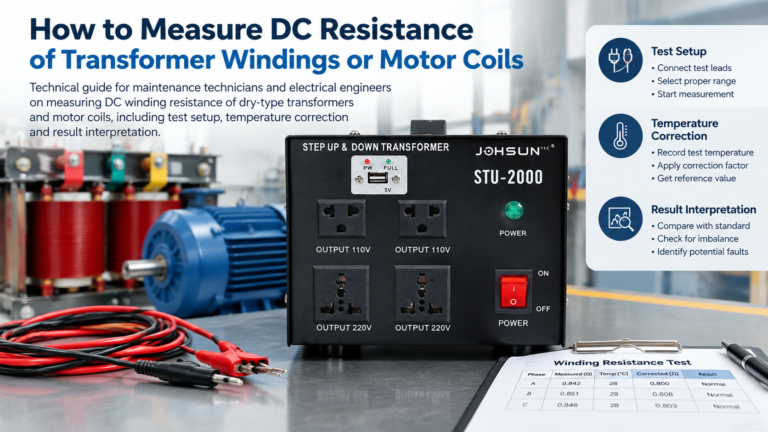
A practical guide to measuring the DC resistance of transformer windings and motor coils, covering four-wire setup, test current selection, temperature correction and pass/fail limits.