Um auto transformer starter is the reduced-voltage starting method that gives you the most torque for the line current you are allowed to draw. That one sentence explains why the Korndörfer circuit has survived since 1908 while dozens of other electromechanical starters disappeared — and why so many panels are still specified with the wrong tap, the wrong duty rating, or an overload relay in the wrong place. It is the workhorse of industrial motor starting wherever the supply is weak.
For the wider family of tapped-winding machines these starters are built around, see the linha de transformadores elevadores e redutores.
What an Auto Transformer Starter Does That a Supply Transformer Does Not
A supply transformer runs continuously, so its kVA rating is a continuous rating. A starter autotransformer runs for the two to fifteen seconds it takes the motor to accelerate, then sits idle until the next start; its rating is a short-time rating, usually expressed as the largest motor it can start. The two look identical and are not interchangeable.
The second difference is electrical, and it is the whole point of the circuit. Because the autotransformer sits between line and motor, there are two currents to keep straight:
- Motor current scales roughly linearly with the tap. At 65% the motor draws about 65% of its direct-on-line locked-rotor current.
- Line current is reduced again by the transformer ratio, so it scales with the tap squared. At 65% the supply sees roughly 42%.
For the underlying winding behaviour rather than the starter application, how an auto transformer works covers the shared-winding principle.
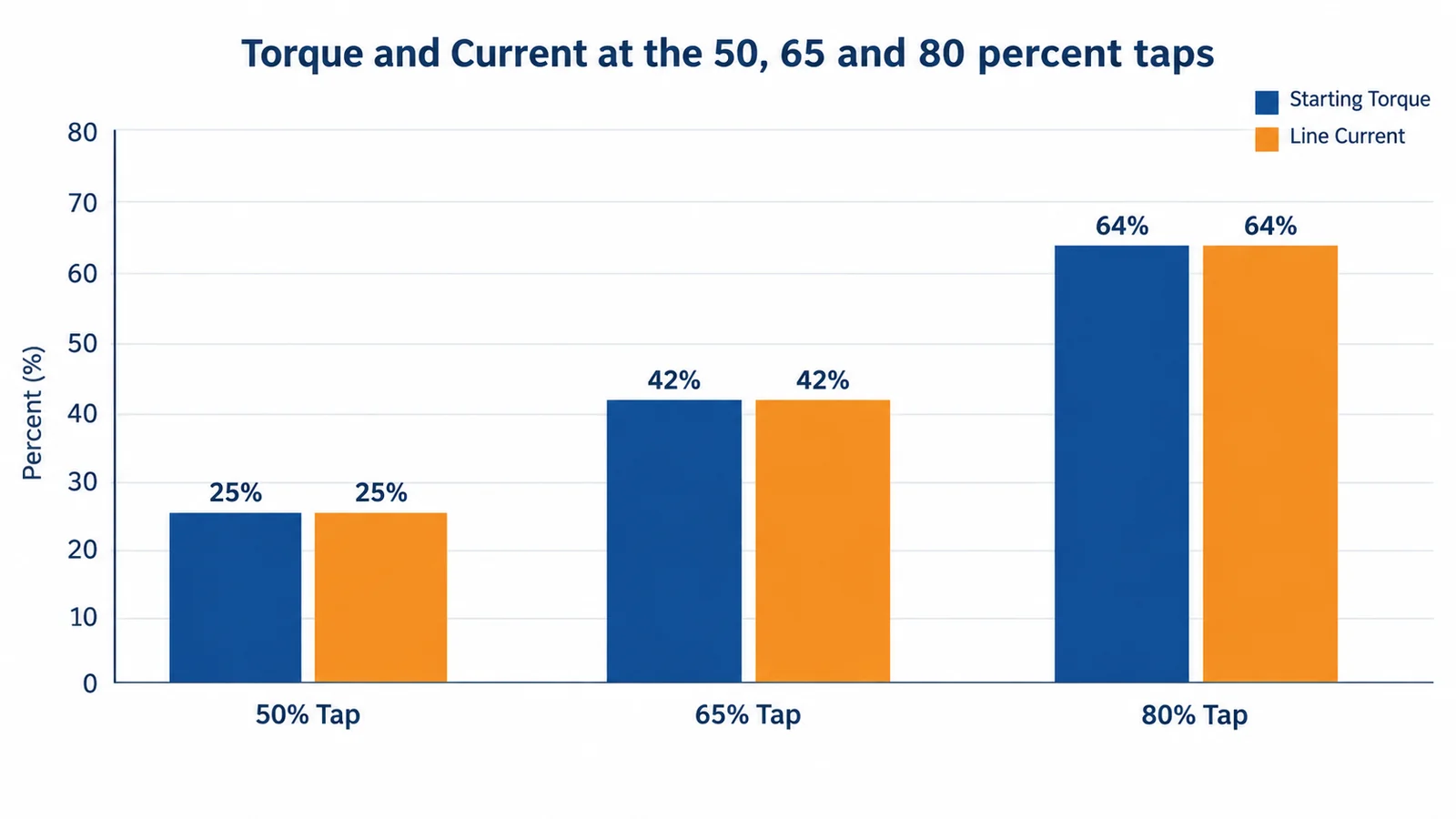
Torque and Current at the 50%, 65% and 80% Taps
Motor torque falls with the square of applied voltage, so the tap sets both current and torque in one decision. NEMA practice standardises on three taps:
| Tap | Voltage at motor | Starting torque (% DOL) | Line current (% DOL) | Typical load |
|---|
| 50% | 50% | 25% | 25% | Fans and centrifugal pumps with light breakaway |
| 65% | 65% | 42% | 42% | General-purpose default for most drives |
| 80% | 80% | 64% | 64% | Loaded conveyors, positive-displacement loads, high breakaway |
Note what the table does not say. It does not say the autotransformer gives more torque per line amp than a star-delta starter — at equal line current both give roughly equal torque, because both obey the same square law. What it says is that you get to pick the operating point, including an 80% tap delivering 64% torque.

Wiring: The Korndörfer Starting Sequence, Step by Step
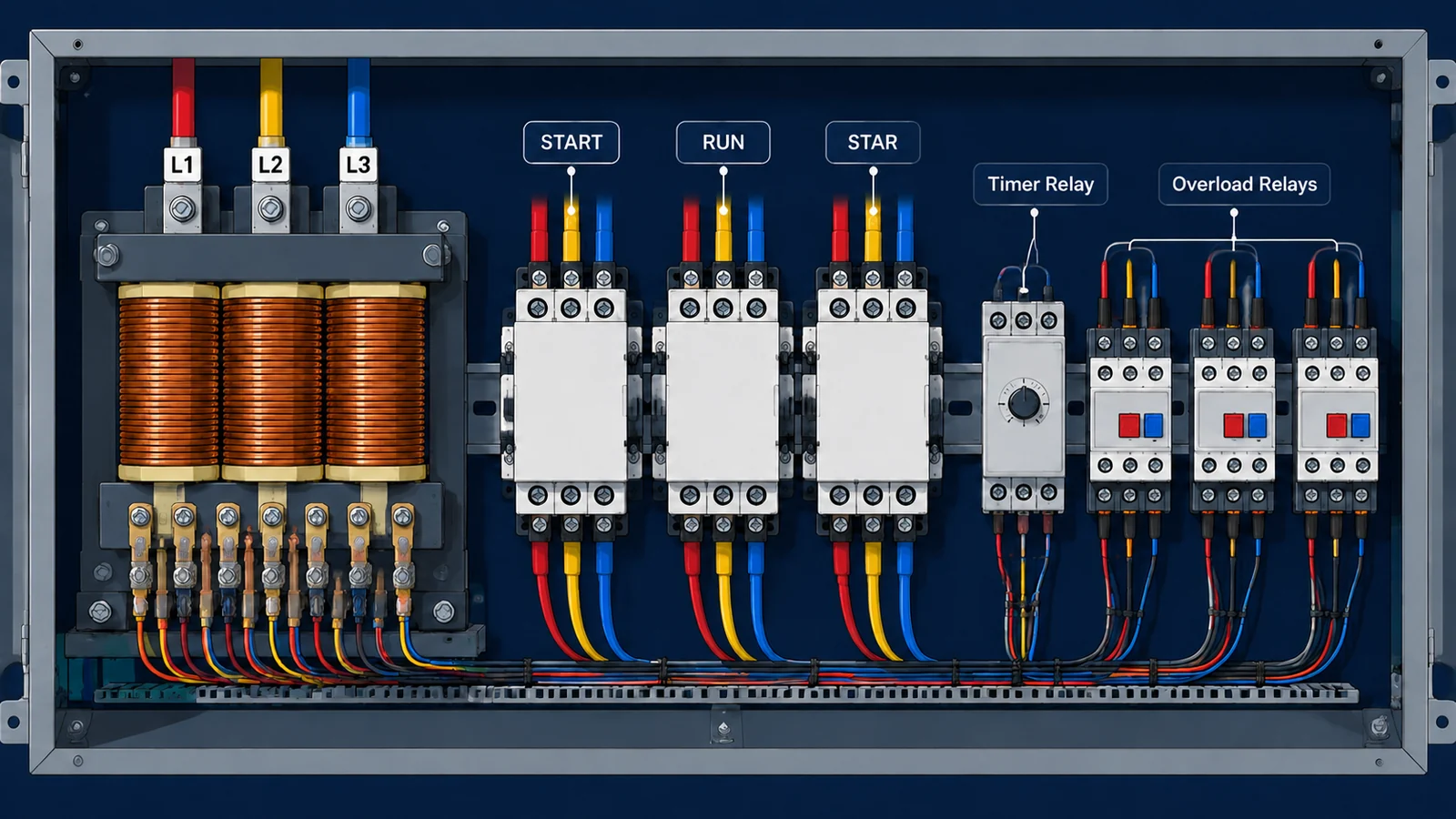
The closed-transition circuit patented by Max Korndörfer in 1908 uses three contactors and one autotransformer. The order matters.
- Star contactor closes. It ties the star point, completing the reduced-voltage source. Nothing is energised yet.
- Start contactor closes. The autotransformer is fed at line voltage and the motor connects to the selected tap, accelerating on reduced voltage.
- Timer expires. The star contactor opens, breaking the star point.
- Run contactor closes milliseconds later. The motor is now direct on line and finishes accelerating.
- Start contactor opens. The autotransformer is de-energised and the motor runs direct-on-line.
Open transition versus closed transition
Steps 3 and 4 are where the variants differ. In an open transition starter there is real dead time between opening the star contactor and closing the run contactor. The motor coasts, terminal voltage collapses, and reapplying full voltage draws a second inrush that can equal or exceed the original direct-on-line current.
A true Korndörfer closed transition overlaps the events, with resistors bridging the brief overlap so the autotransformer is not short-circuited — no dead time, no second inrush. If your specification says “Korndörfer” but the panel has three contactors and no transition resistors, you have an open-transition starter with a better name.
Two-coil versus three-coil construction
In a two-coil unit the 0–50% section is buried under the 50–100% section in one thermal mass. That is cheap and hides a failure mode: during the microsecond the star point contact separates, the winding momentarily behaves as a step-up transformer and induces a very high transient into the lower section. Three-coil construction separates that winding physically, spreading the heat and softening the transient.

Sizing the Starter Autotransformer: Duty, Not Continuous kVA
Because the autotransformer only works during acceleration, its limit is heat per start multiplied by starts per hour. Manufacturers express this as a duty class:
| Duty class | Starts per hour | Typical application |
|---|
| 0.03 | 3 | Process pumps and compressors started a few times a shift |
| 0.10 | 12 | General industrial drives, conveyors with moderate cycling |
| 0.30 | 30 | Frequent-cycling machinery, batch plant, test benches |
A starter chosen only on motor kW can be badly undersized for a high-inertia load: a centrifuge taking 30 seconds to accelerate doubles the heat per start and halves the permissible starts per hour. Ask for the acceleration time before accepting a duty class. The supply side of the same installation follows different rules — see sizing a transformer for motor loads — and when checking whether an existing unit has been abused, the reasoning in a transformer overload calculation applies, except the reference period is the start cycle.
Choosing the Tap for the Driven Load
Tap selection is a torque check, not a current check: the motor must out-produce the load at every speed between zero and full speed, not just at standstill. Centrifugal pumps and fans have load torque that rises with the square of speed, so at low speed the load is almost nothing and a 50% tap usually accelerates them comfortably while cutting line current to a quarter of the direct-on-line value. Loaded conveyors, crushers and positive-displacement compressors demand torque from the first revolution; a 50% tap gives only 25% and the motor will stall and cook. These need 65% or 80%, and if 80% is still not enough, reduced voltage starting is the wrong method.
The check is straightforward: plot motor torque at the chosen tap — the direct-on-line curve scaled by the tap squared — against the load torque curve and confirm the gap stays positive across the speed range. The worst point is rarely at standstill; for a fan it is often around 80–90% speed.
Protection and Commissioning: Five Things That Go Wrong
- Overload relay in the start circuit. It must sense motor current in the run path. In the reduced-voltage path it sees only 65% during start and either fails to protect in run or trips on long accelerations.
- Timer set too short. Transitioning before about 90% speed produces a second inrush far larger than the first. Set it from a measured acceleration.
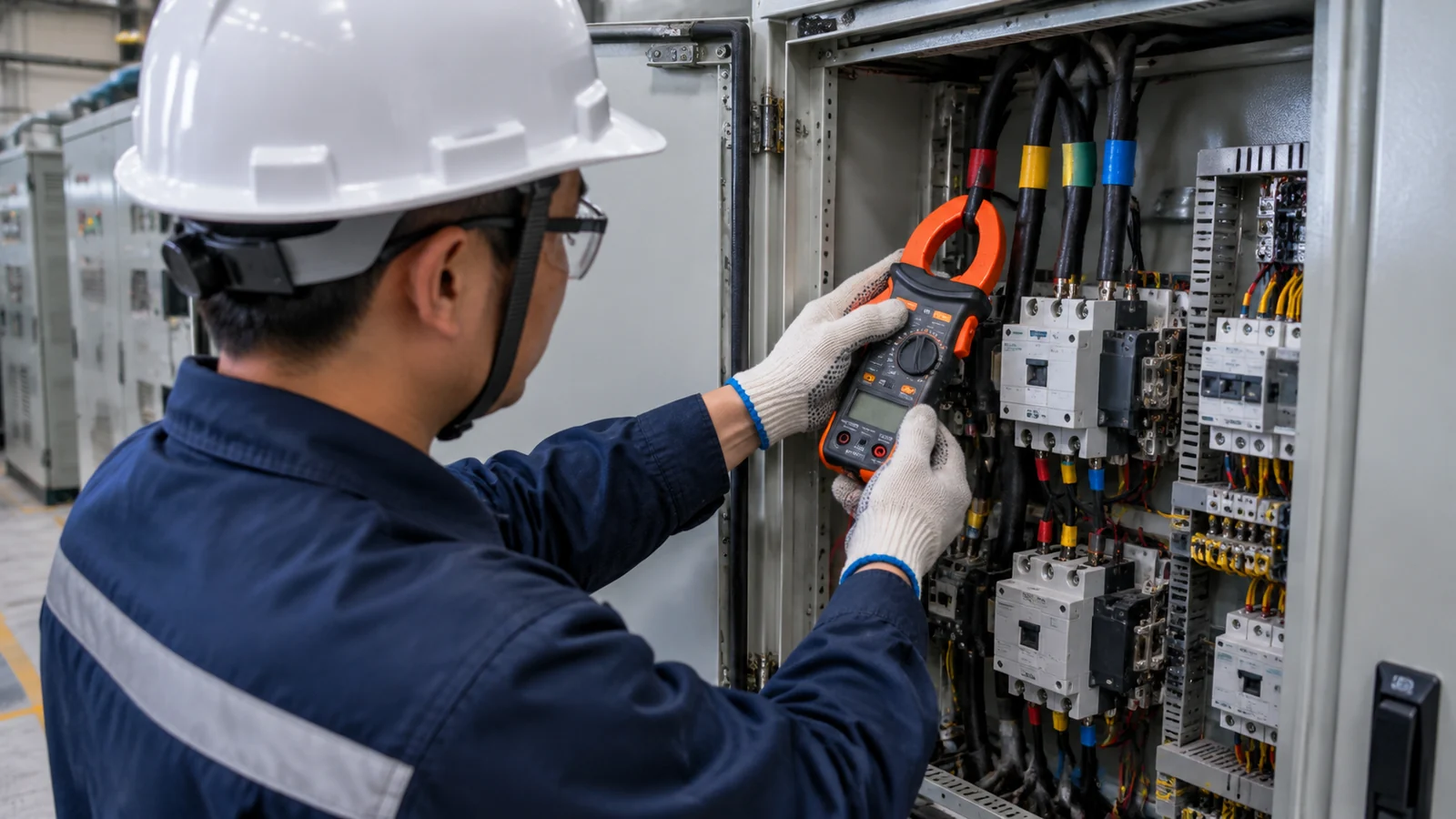
- Tap links on the wrong position. Verify continuity and ratio before first energisation — a turns ratio test across each tap takes ten minutes and prevents a stall.
- Welded star contactor. It keeps the autotransformer in circuit during run, and the motor still turns, so nobody notices until the winding fails.
- No allowance for voltage dip. Line current at the 65% tap is about 42% of direct-on-line, so the dip falls by more than half. If the site still complains, the tap is wrong, not the cable.

Autotransformer Starting versus Star-Delta, Soft Starter and VFD
| Método | Torque available | Line current | Transition | Melhor ajuste |
|---|
| Direct-on-line | 100% | 6–10× FLC | Single step | Small motors on a stiff supply |
| Star-delta | 33% fixed | 33% | Open, with a second inrush | Light-start loads, six-lead motors, tight budget |
| Auto transformer | 25 / 42 / 64% selectable | Same as torque | Closed transition available | Large motors, weak supplies, high inertia |
| Soft starter | Continuously adjustable | Adjustable, no transformer gain | Stepless | Pumps where the ramp shape matters |
| VFD | Up to 100%+ at low speed | Near running current | Stepless | Where speed control is also needed |
The autotransformer’s real advantage is durability rather than control. No power electronics means a clean sine wave, no harmonic distortion, no cable-length limits and no shielding — which matters on a remote site where a failed control board means a two-week wait. Specify it when the motor is too large for direct-on-line, the load tolerates 42–64% starting torque, and the site values a circuit any competent electrician can troubleshoot with a multimeter.
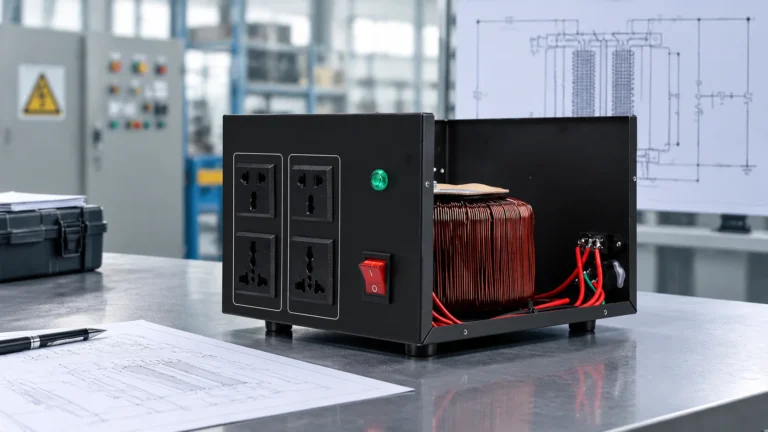
One note on the rest of the panel. The starter handles the power circuit, but the control circuit in the same enclosure usually needs its own 110–120 V or 220–240 V rail, and that is a plain single-phase conversion job. A unit such as the STU series 100 VA–5 kVA converter is built for that duty — passive, selectable input taps, no high-frequency ripple next to PLC supplies. It is not a starter autotransformer and should never be substituted for one; it feeds the timer, the contactor coils and the lamps.
Conclusão
The auto transformer starter is a fixed-tap device in a variable-speed world, and it keeps earning its place because the mathematics are unusually favourable: pick the tap, and torque and line current fall together by the same square factor, with no harmonics and nothing to fail silently. Get the duty class right, verify the transition is genuinely closed, put the overload relay where it can see motor current, and confirm the tap by test rather than by label. For where the shared-winding design stops paying, see the advantages and limitations of autotransformers.
Perguntas frequentes
What is the difference between an auto transformer starter and a star-delta starter?
Both cut inrush by reducing motor voltage. Star-delta is fixed at 57.7% voltage and 33% torque; an autotransformer offers 50%, 65% and 80% taps giving 25%, 42% and 64% torque, and can use closed transition to avoid a second inrush. Star-delta also needs a six-lead motor.
Why is starting current at the 65% tap 42% and not 65%?
Two reductions in series. The motor draws about 65% of locked-rotor current at 65% voltage, and the autotransformer ratio reduces that again on the supply side. 0.65 × 0.65 ≈ 0.42.
Can I use the 80% tap for every motor to be safe?
No. A higher tap means less current reduction, and on a weak supply the 80% tap can still cause an unacceptable voltage dip. Start from the lowest tap that reliably accelerates the load and step up only if the motor stalls.
How many starts per hour can an auto transformer starter handle?
It depends on duty class and acceleration time. Published classes typically cover 3, 12 or 30 equally spaced starts per hour at up to 15 seconds each; longer acceleration or high inertia reduces the count.
Does an auto transformer starter provide isolation?
No. Motor and supply share a winding, so there is no galvanic isolation — acceptable for a starter, which is de-energised after the start, but never acceptable where isolation is a safety requirement.