These are designed to increase voltage. A common example is converting 110В - 220В. This is useful if you’re using a device meant for a higher voltage supply than what’s available locally.
Понижающие трансформаторы
These do the opposite — they reduce voltage, like stepping down from 220В - 110В. Perfect for running appliances built for lower voltages in places with higher supply voltages.
Dual-Function Models: Step-Up and Step-Down in One
Some transformers combine both functions, letting you switch between stepping up or stepping down voltage. The benefits?
Versatility: Works for multiple regions or devices.
Space-saving: One unit does the job of two.
Экономически эффективный: No need to buy two separate transformers.
Key Transformer Components
Understanding what’s inside helps you pick the right supplier and model:
Компонент
Функция
Ядро
Magnetic path that supports induction.
Намотки
Coils of wire that step voltage up/down.
Enclosure
Protects internal parts and users.
Особенности безопасности
Fuses, thermal cutouts to prevent damage or hazards.
How They Differ from Other Transformers
Изоляционные трансформаторы: Mainly separate circuits for safety, not focused on voltage change.
Auto Transformers: Use a single winding for voltage change, lighter but less isolated and can be riskier for some uses.
In short, step-up and step-down transformers are your go-to devices when voltage levels don’t match your appliance needs. Choosing the right one means considering the function, safety, and build quality—all key when checking with step up and step down transformer suppliers.
How Step-Up and Step-Down Transformers Work
Step-up and step-down transformers operate on the basic principle of electromagnetic induction. When alternating current flows through the primary coil, it creates a magnetic field that induces voltage in the secondary coil. The voltage increase or decrease depends on the ratio of the number of turns in the primary coil to those in the secondary coil. Simply put, if the secondary coil has more turns than the primary, the transformer steps up the voltage (e.g., 110V to 220V). Conversely, fewer turns in the secondary coil mean the voltage is stepped down (e.g., 220V to 110V).
Another important factor is frequency compatibility. Transformers are designed to work efficiently with specific power frequencies, commonly 50Hz or 60Hz. Using a transformer with a mismatched frequency can lead to overheating and reduced lifespan, so matching this to your local power supply or appliance specifications is crucial.
Common voltage pairings vary globally. For instance, 110V/120V and 220V/240V systems are standard in different countries, so step-up and step-down transformers must accommodate these standards to ensure smooth operation. For more detailed insights on transformer basics and voltage regulation, you can also explore our guide on related knowledge of voltage stabilizer.
Области применения повышающих и понижающих трансформаторов
Step-up and step-down transformers play a crucial role in various settings by adjusting voltage levels to match device requirements. At home, a бытовой преобразователь напряжения is essential for running imported appliances like TVs, kitchen gadgets, and other electronics that don’t match local voltage standards. Travelers often rely on compact travel voltage transformers to safely power devices abroad without damage.
In commercial environments, these transformers support office equipment and audio systems, ensuring smooth operation and protecting sensitive gear from voltage fluctuations. Light industrial applications also benefit—tools and small machinery often require specific voltage inputs that step-up or step-down transformers provide reliably.
Specialized fields such as medical and lab equipment use transformers to maintain precise voltage levels, crucial for device accuracy and safety. When selecting from step up transformer manufacturers or suppliers, consider models designed to handle your specific application needs, whether portable, household, or industrial.
For larger or more demanding uses, explore robust options like the TSD Series transformers, which offer reliable performance across varying capacities.
Key Factors to Consider When Buying from Step Up and Step Down Transformer Suppliers
When choosing step up and step down transformers, wattage capacity is vital. Always select a transformer with a safety margin—ideally 100-200% above your appliance’s wattage—to handle power surges or startup loads smoothly.
Build quality matters too. Toroidal transformers typically offer better efficiency, lower noise, and a more compact design compared to traditional laminated-core models. Copper windings are preferred over aluminum for durability and conductivity, although aluminum options can be lighter and more cost-effective.
Efficiency affects both energy consumption and heat generation. Look for transformers that dissipate heat well and operate quietly, ensuring longer life and safer use.
Safety certifications such as CE, UL, and RoHS prove that the transformer meets international standards, which is especially important for household and commercial use.
Check the compatibility of input/output plugs—universal or region-specific designs make installation easier, especially for travel voltage transformers.
Lastly, don’t overlook warranty terms, durability, and built-in overload protection. These features ensure your transformer stays reliable and safe, giving peace of mind for daily or heavy-duty applications.
Transformer prices vary widely depending on capacity and features. For example, 500W household transformers tend to be more affordable and designed for lighter use, while higher kVA units made for industrial or commercial needs cost more due to their robust build and higher wattage capabilities.
Several factors influence the cost:
Materials: Copper windings usually cost more than aluminum but offer better efficiency and durability.
Customization: Tailor-made transformers with specific voltages, enclosures, or safety features add to the price.
Order Volume: Bulk purchases often reduce the per-unit cost when buying from reliable step up transformer manufacturers или step down transformer suppliers.
When choosing a transformer, focus on long-term value rather than just the initial price. Cheaper models might save money upfront but often lack the efficiency, safety certifications, or durability needed for consistent performance. Investing in quality reduces the risk of failure, overheating, or damage to your devices.
The global market for step-up and step-down transformers is led by Chinese manufacturers, known for offering affordable models that meet basic voltage conversion needs. Meanwhile, suppliers in the USA and Europe focus on premium quality, advanced safety features, and durable build, appealing to customers who prioritize reliability and certifications.
Among reputable suppliers, Johsun Tec stands out thanks to its expertise in custom designs and toroidal transformers, competitive pricing, and solid experience exporting worldwide. Their ability to provide tailored solutions with efficient, durable products makes them a preferred choice for both household and industrial needs. Other notable players include ATO, ACUPWR, and Custom Coils, each offering a range of voltage converters and transformer models for different applications.
When selecting a supplier, it’s essential to verify credibility by checking for factory audits, customer reviews, and safety certifications like CE, UL, or RoHS. Choosing a reliable supplier helps avoid common issues like poor build quality or inefficient units. For an in-depth look at quality options, exploring the full range of повышающие и понижающие трансформаторы from trusted manufacturers can be a great start.
Why Choose Johsun Tec as Your Supplier
Johsun Tec stands out as a trusted step up and step down transformer supplier with years of experience in voltage stabilizers, regulators, and transformers. Their expertise ensures that you get reliable, high-quality products that fit your needs, whether for household or industrial use.
Product Range
Тип продукта
Описание
Household Transformers
Perfect for everyday voltage conversion, including travel voltage transformers
Small Portable Units
Compact, easy-to-carry designs for on-the-go use
Индивидуальные решения
Tailored transformers for specific voltages, sizes, and enclosures
Key Advantages
High-quality components: Durable cores and copper windings for better efficiency
OEM/ODM support: Customization options to meet unique requirements
Fast delivery: Efficient production and shipping for timely supply
Competitive prices: Value-driven pricing without compromising quality
Johsun Tec also maintains a strong commitment to customization and quality, making them a preferred supplier for many global customers. While they have satisfied numerous clients in various sectors, customer testimonials often highlight their reliability and responsive support.
For more details on their product lineup and quality assurance, you can explore their range of reliable voltage solutions such as бытовые трансформаторы or their advanced power stabilizers.
Choosing Johsun Tec means you invest in durability, performance, and a partner committed to making your voltage conversion easier and safer.
Buying Guide: How to Select the Right Transformer
Choosing the right step-up or step-down transformer is crucial to keep your devices safe and running smoothly. Here’s a simple step-by-step process to help you pick the perfect match:
Check Appliance Wattage
Find the power rating (watts) of the device you want to run. This info is usually on the appliance label or manual.
Determine Voltage Needs
Know if you need to convert from 110V to 220V or vice versa. Dual voltage transformers can handle both directions, making them versatile.
Consider Usage Duration
For continuous or long-term use, choose a transformer with a wattage capacity 100-200% higher than your device’s rating. This safety margin helps handle power surges and prevents overheating.
Avoid Common Mistakes Undersizing: Don’t pick a transformer with just enough wattage. It risks damage and cuts device life.
Ignoring Surges: Some appliances have high startup currents; factor this in by adding overhead wattage. Use Wattage Calculation Tools
Simple formulas or online calculators can help you estimate the needed transformer capacity by inputting your appliance’s wattage and surge requirements.
Household vs. Heavy-Duty Use
For household appliances like TVs or kitchen gadgets, small step-up/step-down transformers usually suffice.
For industrial or heavy-duty needs, look for higher wattage and more robust designs like toroidal transformers with better efficiency and heat management.
When you follow these steps, you’ll avoid mismatches and choose a transformer that’s safe, efficient, and reliable for your needs. For a deeper dive into selecting transformers, check out our detailed low voltage transformers core specs selection checklist.
Custom Transformers: Tailored Solutions for Unique Needs
Sometimes, off-the-shelf step-up and step-down transformers don’t quite fit your specific voltage, capacity, or enclosure needs. That’s where custom transformers come in. They offer tailored solutions to match exact requirements, ensuring optimal performance and safety for unique applications.
Benefits of Custom Transformers:
Характеристика
Преимущество
Specific Voltages
Perfect adaptation to unusual input/output voltages like 110V to 240V or other regional standards
Customized Capacity
Exactly sized wattage for your equipment, avoiding under or oversizing
Enclosure Options
Weatherproof, dustproof, or compact designs based on installation environment
Special Features
Additional safety features, surge protection, or noise reduction as needed
Johsun Tec stands out with its strong custom transformer capabilities. Whether you need a unique dual voltage transformer or a heavy-duty step up down converter, Johsun offers flexible design options built on years of experience. Their team works closely with clients to develop versions with toroidal or traditional cores, various winding materials like copper, and custom fittings to meet global standards.
Choosing Johsun Tec for custom voltage transformers means access to fast turnaround, competitive prices, and reliable quality backed by certifications and customer-focused support. Their custom solutions can give your project the perfect transformer without compromise.
For more on transformer design and industrial-grade options, explore Johsun Tec’s expertise in низковольтные трансформаторы.
FAQs About Step-Up and Step-Down Transformers
Here are some common questions about step up and step down transformer suppliers and their products, to help you make the right choice:
Question
Answer
Can I use a step-down transformer for continuous operation?
Yes, but choose one with proper wattage and cooling for long-term use.
What’s the difference between a transformer and a converter?
Transformers change voltage via electromagnetic induction. Converters usually convert AC to DC or vice versa.
Can a step-up transformer convert 110V to 220V?
Exactly. It boosts 110 volts to 220 volts for devices requiring higher voltage.
Are dual voltage transformers a good option?
Yes, they offer flexibility by handling both step-up and step-down functions in one unit.
How do I know the right wattage for my transformer?
Check your device’s power rating and add 100-200% overhead to cover surges and startup current.
What is the difference between a toroidal and traditional transformer?
Тороидальные трансформаторы меньше, тише и эффективнее, но зачастую стоят дороже.
Насколько важны сертификаты безопасности (CE, UL, RoHS)?
Очень важно, чтобы сертифицированная продукция обеспечивала безопасность и соответствие требованиям.
Можно ли использовать повышающий трансформатор за границей с разными частотами?
Частота имеет значение; убедитесь, что трансформатор соответствует электросети вашей страны с частотой 50 или 60 Гц.
Необходима ли защита от перегрузки?
Да, он предотвращает повреждения от скачков напряжения и продлевает срок службы трансформатора.
Как обслуживать повышающий/понижающий трансформатор?
Держите его в сухом месте, не перегружайте и регулярно проверяйте на наличие пыли или повреждений.
Эта таблица и часто задаваемые вопросы повысят вашу уверенность при выборе из лучших производителей повышающих трансформаторов или поставщиков понижающих трансформаторов напряжения.
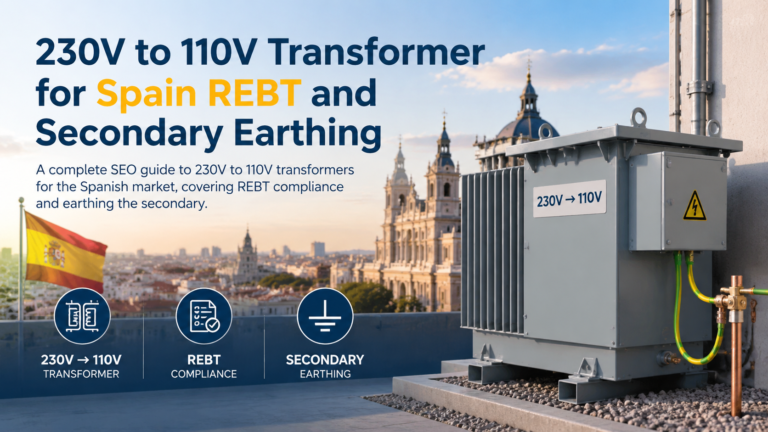
Трансформатор 230 В на 110 В для Испании: соответствие требованиям REBT, стандартам ITC-BT-18 и ITC-BT-24, заземление вторичной обмотки и документация по стандарту UNE-EN IEC 61558.
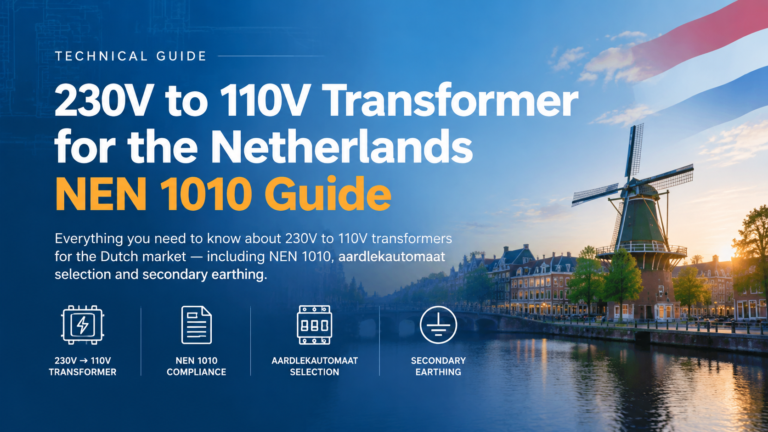
Трансформатор 230 В – 110 В для Нидерландов: стандарт NEN 1010, требования к устройствам защитного отключения (30 мА), различия между «aardlekschakelaar» и «aardlekautomaat», а также вторичное заземление.
Трансформатор 230 В — 110 В для Франции: NF C 15-100, заземление по схеме TT, дифференциальная защита на 30 мА и когда следует заземлять вторичную обмотку.
Мы используем файлы cookie для улучшения вашего пользовательского опыта, предоставления персонализированного контента и анализа посещаемости нашего сайта.