Every week a buyer asks the same question in a slightly different form: “I have 60Hz equipment and 50Hz power — will your transformer fix it?” The honest answer is no, and the useful answer is more specific. A transformer fixes voltage. Frequency is a separate variable, and whether a mismatch matters depends on what is inside the machine, not on the nameplate wattage.
This guide separates the two problems, quantifies what actually changes when you run a 60Hz load on a 50Hz supply (and the reverse), and gives a decision table by load type. Where a transformer is the right purchase, it is the whole purchase; where it is not, buying one wastes money and delays the real fix.
Voltage and frequency are independent
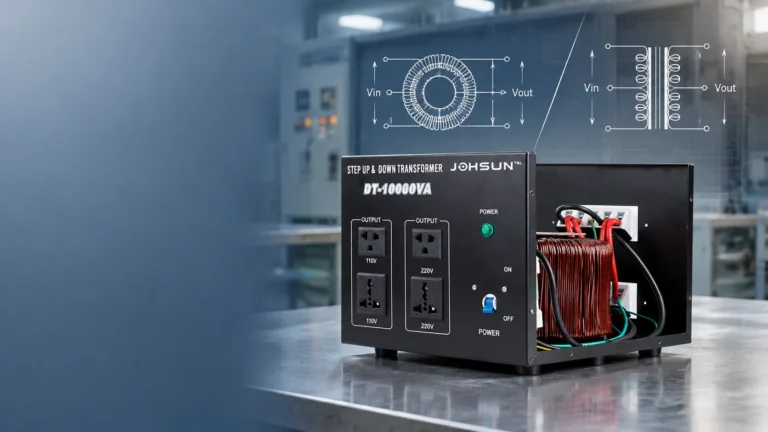
A transformer is copper and laminated steel. It transfers energy by magnetic induction at whatever frequency arrives at its primary. Feed it 50Hz and 50Hz comes out, at the voltage you selected. There is no mechanism inside it to synthesise cycles that the supply does not have.
So a “110V 60Hz” appliance on a 240V 50Hz supply, connected through a step-down transformer, will run at 110V 50Hz. That is a correct voltage and the wrong frequency. What follows from that depends on the load.
What changes inside a 60Hz machine on 50Hz power
Induction motors: slower, and hotter at the same load
Synchronous speed is set by frequency and pole count: n = 120f ÷ p. A four-pole motor turns at 1,800 rpm on 60Hz and 1,500 rpm on 50Hz — 17% slower. Slip adds a little, so the real figure is around 16-17%.
The second effect matters more. A motor’s magnetic circuit is designed for a specific voltage-to-frequency ratio. At 110V and 60Hz the ratio is 1.83 V/Hz; at 110V and 50Hz it is 2.2 V/Hz, about 20% higher. Higher flux means the core runs closer to saturation, magnetising current rises, and the motor heats up for the same mechanical output. The standard remedy is to reduce the voltage to about 83% (5/6) of rated when running a 60Hz motor on 50Hz, or to derate the mechanical output to about 83% at full voltage.
In practice: a motor that was comfortably loaded at 60Hz will run hot at 50Hz. A motor that was already near its service factor will fail. If the application depends on shaft speed — a pump delivering a specified flow, a machine cycle time — a transformer does not solve it at all.
Transformers and magnetic components: more flux, more heat
Core flux is proportional to voltage divided by frequency. A transformer rated at 60Hz and fed the same voltage at 50Hz carries 20% more flux, sits closer to saturation, draws more magnetising current and runs hotter and louder. Well-built units tolerate this with a modest derating — around 10-15% — but a marginal design will hum audibly and cook.
This is why a transformer bought for a 60Hz market should be specified as 50/60Hz rated when it is going into a 50Hz country. The DT/ST range is rated 50/60Hz for exactly this reason.
Clocks, timers and anything that counts cycles
Equipment that derives time from the mains — older microwave timers, some chargers, certain industrial controllers — will run 17% slow on 50Hz if it was calibrated for 60Hz. Nothing in the transformer changes that. Modern devices with a crystal oscillator are unaffected.
Switch-mode power supplies: usually unaffected
A supply marked 100-240V, 50/60Hz rectifies the incoming AC to DC before it does anything else, so frequency is irrelevant to it. This covers laptops, phone chargers, LED drivers, most telecom equipment, most modern appliances and most PLC power supplies. Many of these need no transformer at all in a 220V country — read the label before buying one.
Resistive and heating loads: completely unaffected
Heaters, ovens, kettles, incandescent and halogen lamps, soldering irons. Frequency has no effect on resistive heating. A 110V heater on a step-down transformer performs exactly as specified.
Decision table by load type
| Yük |
Does frequency mismatch matter? |
Doğru yaklaşım |
| Laptop, phone charger, LED driver marked 100-240V |
Hayır |
Plug adapter only — no transformer |
| Resistive heater, oven, incandescent lighting |
Hayır |
Step up/down transformer for voltage only |
| Switch-mode power supply, PLC supply, telecom rectifier |
Hayır |
Transformer for voltage only |
| Audio amplifier, studio equipment |
Mostly no |
Transformer for voltage; check for mains-referenced timing circuits |
| Fridge, air conditioner, compressor |
Yes — slower, hotter, shorter life |
Derate to 83% voltage or replace the motor; transformer alone is a compromise |
| Pump or fan (centrifugal load) |
Yes — 17% slower means 40% less flow, and the duty point moves |
VFD or a 50Hz-rated motor |
| Machine tool with a fixed cycle time |
Yes — cycle time changes |
VFD, or re-gear the drive |
| Microwave or device with mains-derived timer |
Yes — runs slow |
Accept the error, or replace the timer board |
| Medical or laboratory instrument rated 60Hz only |
Yes — usually a specification limit |
Rotary frequency converter, not a transformer |
The three ways to change frequency, and what each costs you
- Variable frequency drive (VFD). Rectifies to DC and synthesises a new AC waveform. Cheap per kW and widely available. Limits: the output is a switched waveform, not a clean sine, so motor insulation and bearing currents become a consideration; a VFD is built to drive one motor, not to feed a panel of mixed loads; and most VFDs must be derated when the input voltage sags.
- Rotary frequency converter. A motor-generator set: a 50Hz motor drives a 60Hz alternator. Produces a genuine sine wave at the right frequency and can feed a distribution board. Costs more, is heavier, has bearings and brushes to service, and is less efficient — typically 80-85% end to end.
- Solid-state frequency converter. A double-conversion unit that rectifies and re-inverts at the target frequency. Cleaner and quieter than a rotary set, and the right answer for a laboratory or a small panel, but priced accordingly.
None of these is a transformer, and no transformer substitutes for one. Where the load is a mix of a 60Hz motor and 110V electronics on a 240V 50Hz site, the practical answer is usually a düşürücü transformatör for the electronics and a separate VFD for the motor, rather than one oversized frequency converter feeding everything.
What to specify when ordering
Three lines on the enquiry prevent most of these problems: the appliance’s full rating plate (voltage, frequency, current, and whether it is single or three phase), the destination country and its nominal supply, and what the load actually is — motor, heater, electronics or mixed. Our engineers will tell you when a transformer is sufficient and when it is not, which is more useful than quoting you one anyway.
Bu DT/ST datasheet (PDF) lists the full 100VA-10kVA range at 50/60Hz. If the load is a control panel rather than a single appliance, the STU series is the passive converter built for panel mounting, and for adjustable test voltages the variable transformer range runs from 0.5kVA to 5kVA.
Frequently asked questions
Will a transformer convert 50Hz to 60Hz?
No. A transformer changes voltage only, and the output frequency always equals the input frequency. Converting frequency needs a VFD, a rotary motor-generator set or a solid-state frequency converter.
Can I run a 60Hz motor on 50Hz at the rated voltage?
It will run, about 17% slower, and it will run hotter because the flux in the core is roughly 20% higher. Reduce the voltage to about 83% where the drive allows it, or limit the mechanical load to about 83% of rated output. Continuous full-load operation at rated voltage is not recommended.
Can I run a 50Hz motor on 60Hz?
Yes, more easily. The motor runs 20% faster and the flux drops, so it runs cooler. The risk moves to the load: a centrifugal pump or fan absorbs power with the cube of speed, so 20% more speed means roughly 70% more shaft power. Check the driven equipment, not just the motor.
Does a 50/60Hz rated transformer work in both directions?
Yes. A unit rated 50/60Hz is designed so that the core does not saturate at the lower frequency at its rated voltage, so it works on either supply. A 60Hz-only transformer used at 50Hz should be derated by roughly 10-15%.
Why does my imported appliance hum louder than it should?
Usually core saturation from running a 60Hz-rated transformer or motor on 50Hz at full voltage. The 20% extra flux pushes the laminations towards saturation, which is audible as a deeper, louder hum and shows up as extra heat. Reducing the primary voltage by about 17% normally settles it.
Is it cheaper to buy a 50Hz version of the machine?
Often, yes, once you count the cost of a frequency converter, the derating, the spare parts and the efficiency loss. A transformer is cheap because the problem it solves is simple; a frequency mismatch is not that problem.
Have a rating plate you are not sure about? Send a photo of it to our engineering team with the destination country, and we will tell you whether a transformer is enough.