






How Does a Current to Voltage Converter Work?
Learn how a current to voltage converter uses an op-amp, feedback resistor, and negative feedback to turn sensor current into voltage.
Read More
 English
A DC voltage converter changes one direct-current voltage into another, while an AC voltage converter changes the voltage of an alternating-current source. In practical terms, a DC converter may turn a 24V battery supply into regulated 12V DC. An AC converter may turn 220–240V AC into 110–120V AC for an appliance.
The most important difference is not simply the voltage number: it is the current type and waveform expected by the load. DC has fixed polarity, while AC reverses polarity periodically. That difference determines the converter topology, components, ratings, protection, and applications.
| Feature | DC voltage converter | AC voltage converter |
|---|---|---|
| Typical conversion | DC to lower, higher, or regulated DC | AC to lower or higher AC |
| Common topology | Buck, boost, or buck-boost switching circuit | Transformer, autotransformer, or electronic AC converter |
| Output characteristic | Fixed-polarity voltage with specified ripple | Alternating waveform with specified RMS voltage and frequency |
| Typical source | Battery, solar DC bus, vehicle, DC power supply | Utility mains, generator, AC distribution system |
| Typical load | Electronics, controls, sensors, communication equipment | Household appliances, tools, motors, industrial equipment |
| Key ratings | Input range, output voltage/current, ripple, efficiency | Input/output voltage, VA, frequency, isolation, surge capacity |
| Polarity | Must normally be observed | Waveform reverses each cycle |
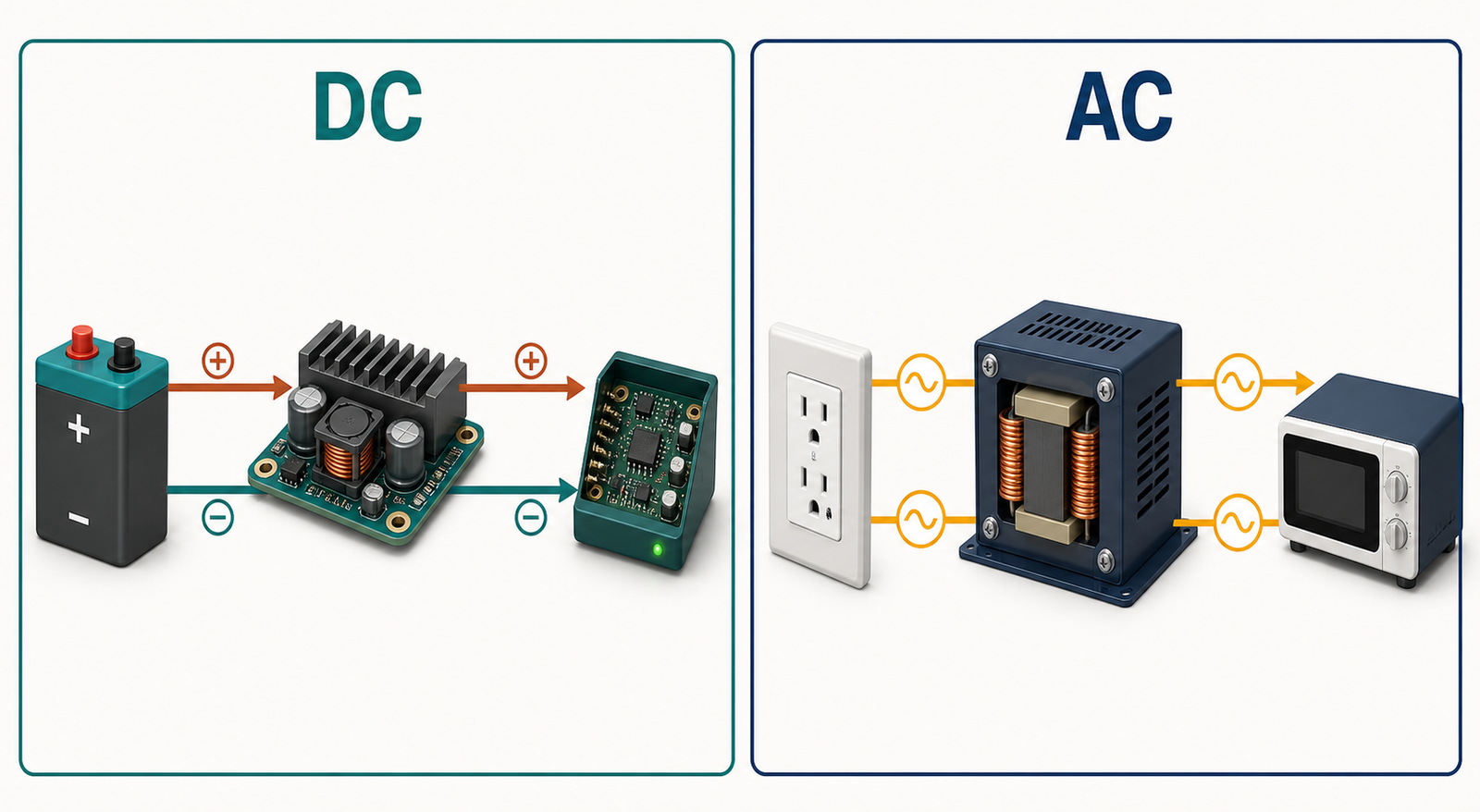
A DC-to-DC voltage converter accepts DC input and produces DC output at a different or regulated level. Switching converters store and release energy through inductors, capacitors, and controlled semiconductor switches. A feedback loop compares the output with a reference and adjusts switching operation to keep the voltage stable.
Common examples include converting a truck’s 24V system to 12V, providing 5V from a battery pack, creating several processor supply rails, or stabilizing voltage from a solar source. The converter must accept the full source-voltage range and deliver the continuous and transient current required by the load.
Check minimum and maximum input voltage, output voltage accuracy, maximum current, efficiency, switching frequency, output ripple, transient response, thermal derating, and isolation. Also confirm polarity and grounding. Reversing a nonprotected DC input can damage both the converter and the load.
An AC-to-AC voltage converter changes the RMS voltage delivered to an AC load while keeping the output alternating. A traditional step-up or step-down transformer uses electromagnetic induction and a winding turns ratio. An autotransformer uses part of one winding in common and is generally smaller for a given rating, but it normally does not isolate the output from the input.
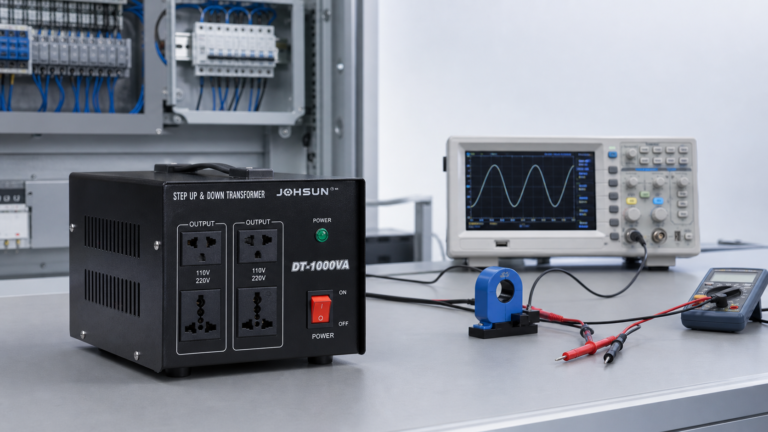
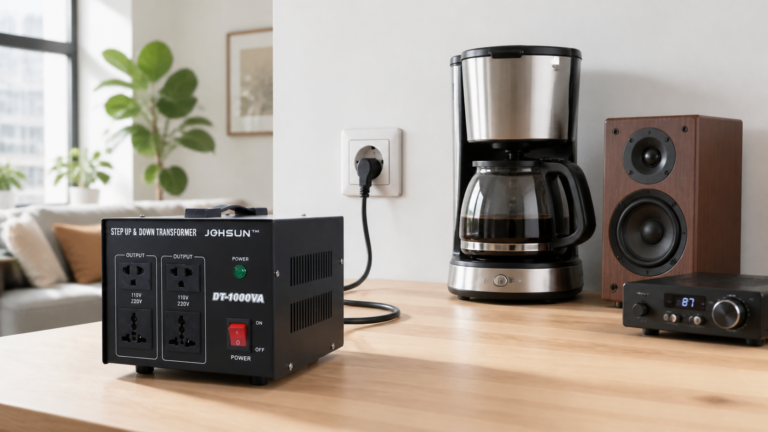
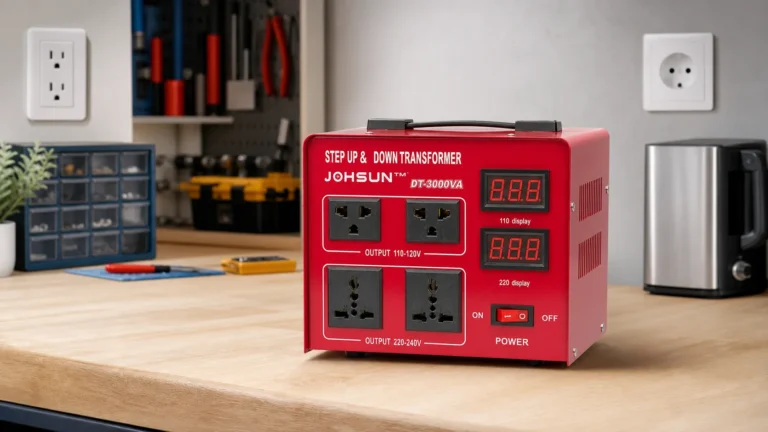
For appliances used across countries, the familiar application is 220–240V to 110–120V step-down conversion or the reverse. Johsun Tec’s step-up and step-down transformer category shows AC converter options across multiple capacity ranges.
A standard transformer changes voltage but normally leaves frequency unchanged. Converting 230V 50Hz to 115V does not make the output 60Hz. Many heaters and universal-input electronic appliances tolerate either frequency, but induction motors, clocks, turntables, and frequency-sensitive equipment may not.
AC equipment nameplates commonly state RMS voltage, frequency, watts, current, or volt-amperes. VA and watts can differ when power factor is below one. Motors, compressors, pumps, and transformer-fed equipment may also draw high startup current, so an AC converter should not be selected only from steady-state watts.
| Input | Output | Common name | Example |
|---|---|---|---|
| DC | DC | DC-DC converter | 24V battery to regulated 12V |
| AC | AC | AC voltage converter or transformer | 230V AC to 115V AC |
| AC | DC | AC-DC power supply or rectifier supply | Mains input to 24V DC control power |
| DC | AC | Inverter | Battery or solar DC to mains-style AC |
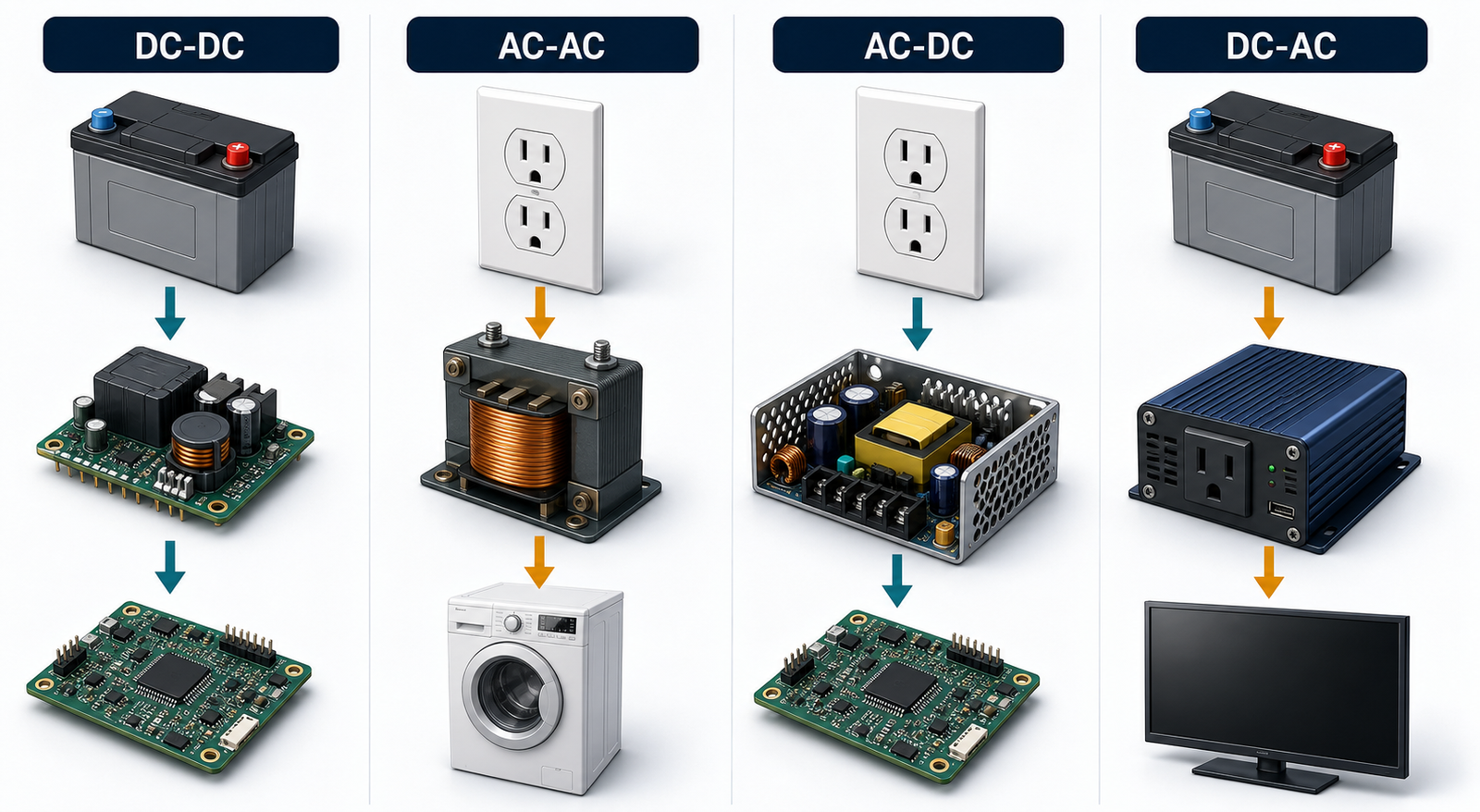
Modern products may contain several stages. A switch-mode AC-DC supply can rectify mains AC to high-voltage DC, switch it into high-frequency AC, transform it, then rectify and filter it again. The product is named by its external input and output even though internal waveforms change several times.
DC cannot be stepped through an ordinary transformer without first being switched. A DC converter therefore uses power semiconductors to create a changing current. Inductors or transformers store and transfer energy, capacitors smooth the output, and feedback adjusts duty cycle or switching frequency.
AC already creates changing magnetic flux, so a transformer can transfer energy directly between windings. The turns ratio sets the approximate voltage ratio. Transformer performance is influenced by frequency, core material, winding resistance, load, temperature rise, insulation, and VA rating.
Isolation is a design feature, not an automatic result of conversion. A non-isolated buck converter shares an electrical reference between input and output. An isolated DC-DC topology can separate them. A two-winding AC transformer can provide isolation, while an autotransformer generally cannot. Always verify the product specification instead of assuming.
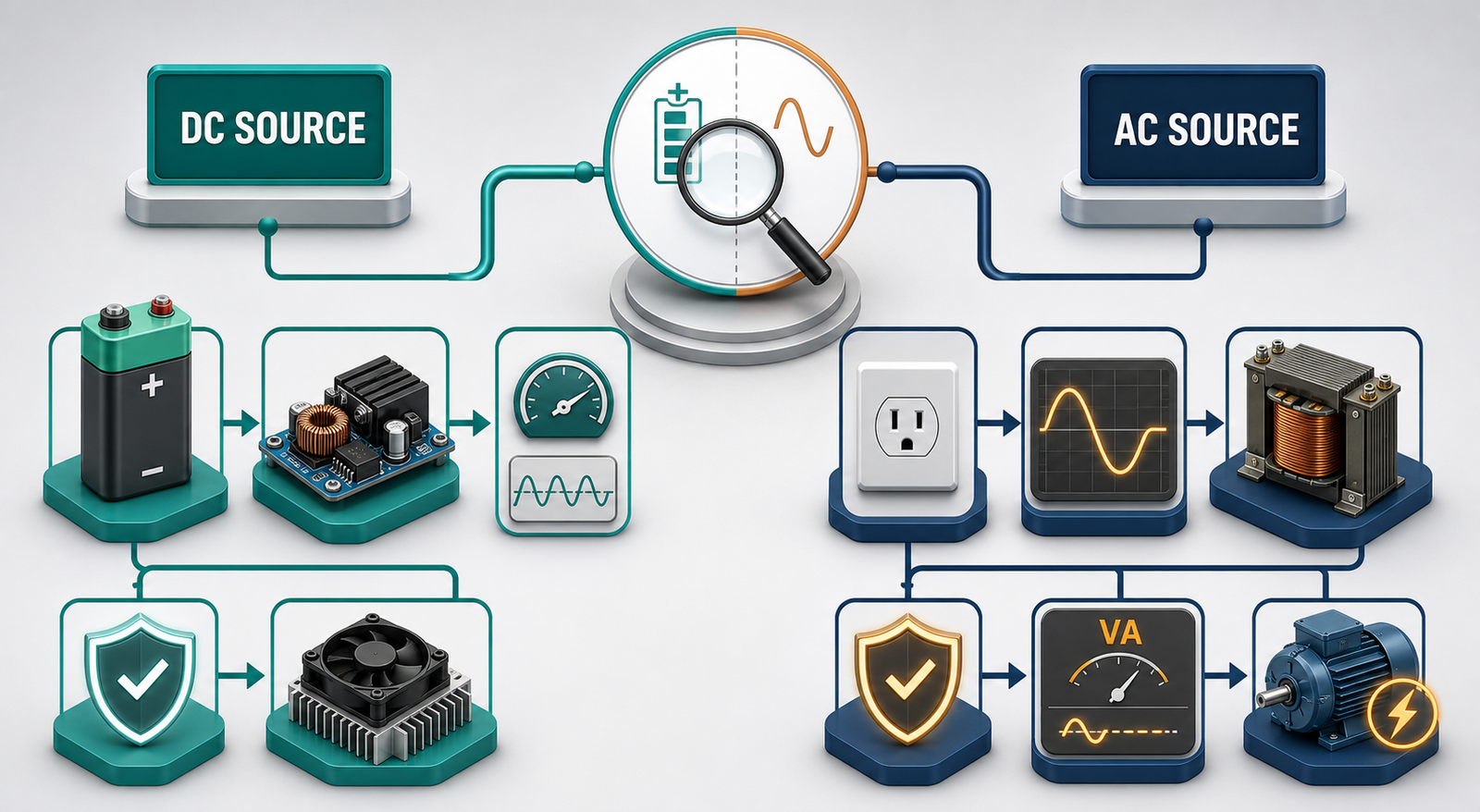
Identify whether the source is AC or DC, its nominal voltage and possible range, and whether polarity applies. Then read the load’s required voltage, current or VA, frequency, and allowed tolerance. The converter’s input must match the source and its output must match the load.
For DC loads, multiply voltage by current to estimate watts, then account for efficiency and transient current. For AC loads, use nameplate VA when available and consider power factor and startup surge. A refrigerator compressor or motor can need much more current during starting than during normal operation.
Sensitive DC electronics may require low ripple and fast transient response. AC loads may require a sine-wave output, correct RMS voltage, and compatible frequency. A transformer does not regulate against every input-voltage fluctuation; an automatic voltage regulator is a different function.
Confirm grounding, connectors, enclosure rating, cooling, duty cycle, operating temperature, overload protection, short-circuit protection, fuse or breaker arrangement, and required certifications. Mains-voltage installation should follow applicable electrical rules and product instructions.
For international appliances or commercial equipment requiring AC voltage conversion, capacity and construction should match the real load. A compact DT/ST Series 100VA–1500VA travel converter covers lower-rated applications. The DT/ST Series 100VA–10KVA converter range extends to larger capacities.
For another enclosure and magnetic construction option, review the ZX Series 500VA–2000VA toroidal converter. A specific higher-capacity comparison point is the DT-5000VA 110V/220V converter transformer. These are AC voltage converter examples, not substitutes for a DC-to-DC regulator.
Commercial projects may also need regional sockets, panel markings, enclosure changes, brand labeling, or custom voltage specifications. The ODM and OEM service outlines the customization route for qualified projects.
Not unless the product is specifically designed with an AC input stage. A DC-DC converter expects DC within its stated range. An AC source first needs suitable rectification, filtering, protection, and often isolation.
No, not from steady DC in normal operation. A transformer requires changing current and magnetic flux. DC must first be switched into a changing waveform by an electronic converter.
Its external function is AC-to-DC conversion, although it may contain an internal DC-DC stage. A DC voltage converter normally refers to a device with DC input and DC output.
There is no universal answer. Efficiency depends on topology, voltage ratio, load, power rating, switching or magnetic losses, and operating conditions. Compare efficiency curves or rated losses at the intended load.
Yes. Neither is lossless. Semiconductor conduction and switching losses heat DC converters, while winding and core losses heat AC transformers. Ventilation and thermal derating must follow the manufacturer’s requirements.
Choose a DC voltage converter when both source and load use DC but require different or regulated voltage levels. Choose an AC voltage converter when an AC load needs a different AC voltage. If the conversion crosses between AC and DC, specify an AC-DC power supply or a DC-AC inverter instead.
Learn more about the manufacturer on the Johsun Tec home page and About Us. For help matching an AC converter to voltage, frequency, capacity, startup demand, and installation conditions, contact Johsun Tec.