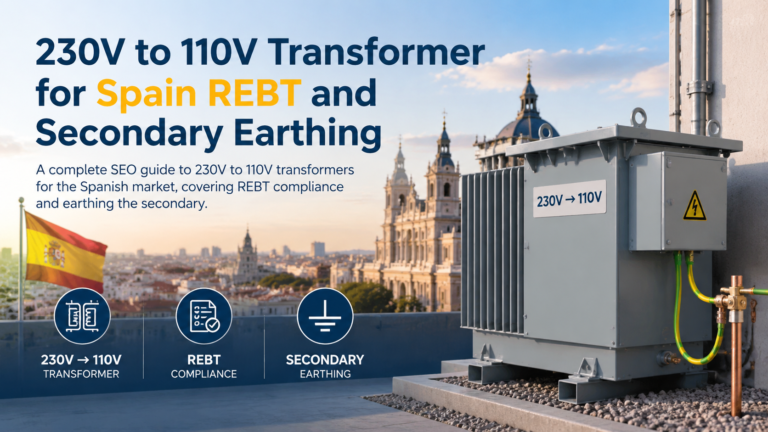







230V to 110V Transformer for Spain: REBT and Secondary Earthing
230V to 110V transformer for Spain: REBT compliance, ITC-BT-18 and ITC-BT-24, earthing the secondary and UNE-EN IEC 61558 documentation.
Read More
 English
Power socket voltages vary from place to place, and if you have ever traveled abroad or imported equipment from another country, you already know the frustration: the plug does not fit, or worse, the voltage does not match. A device rated for 120V can be destroyed instantly when plugged into a 230V outlet. Understanding why these differences exist and what solutions are available helps travelers, businesses, and equipment buyers avoid costly mistakes.
The story begins in the late 1800s, when countries electrified their grids independently. In the United States, Thomas Edison championed a 110V direct current (DC) system, while Europe—adopting alternating current (AC) later—opted for 220V to transmit power more efficiently over longer distances with thinner copper wiring. Each country standardized its own voltage, plug shape, and frequency before international travel and global trade made the differences a widespread problem.
National infrastructure lock-in makes convergence nearly impossible today. Replacing every wall socket, circuit breaker, transformer, and appliance in a country would cost billions. The European Union did harmonize its nominal supply voltage to 230V (±6%) at 50Hz during a 1995–2008 transition period, but the plug shapes across Europe still differ—France uses Type E, Germany uses Type F, and the United Kingdom uses Type G. Similarly, Japan remains the only country operating at 100V with two different frequencies: 50Hz in the east and 60Hz in the west.
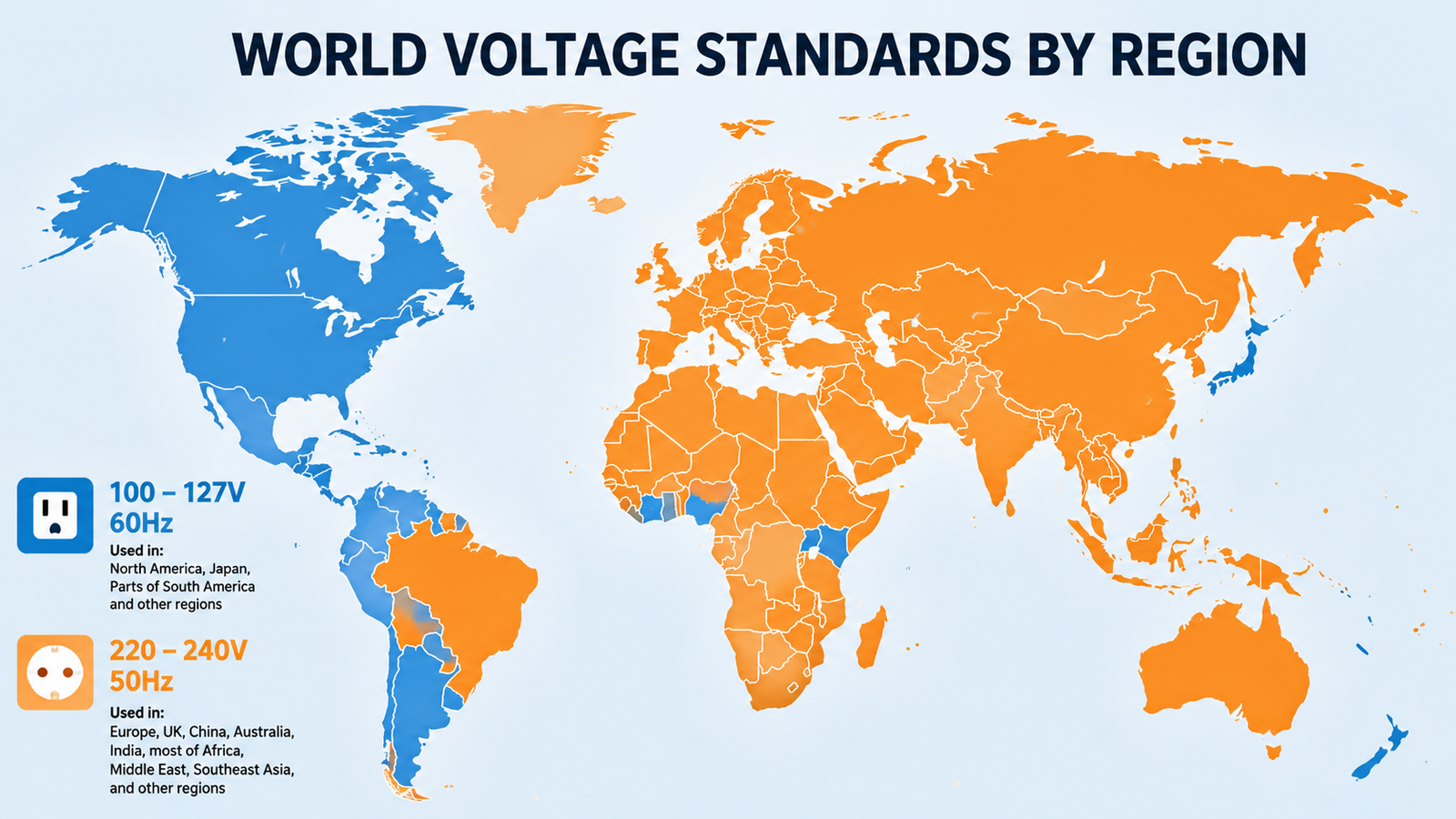
The world operates on two broad voltage ranges. Understanding which range your destination or equipment falls into is the first step toward selecting the right solution.
| Voltage Range | Frequency | Typical Regions |
|---|---|---|
| 100–127V | 60 Hz | United States, Canada, Mexico, Japan, parts of South America and the Caribbean |
| 220–240V | 50 Hz | Europe, United Kingdom, China, Australia, India, most of Africa, the Middle East, and Southeast Asia |
Within each range, small variations exist. The United States supplies 120V, Taiwan supplies 110V, and Japan supplies 100V—but all fall within the low-voltage band and are generally compatible with each other. Similarly, the UK at 230V and Australia at 230V are both within the high-voltage band. Devices rated for one voltage within a band usually tolerate minor differences in the same band for short-term use.
Beyond voltage, the physical shape of the plug and socket varies widely. The International Electrotechnical Commission (IEC) classifies plugs into 15 types, labeled A through O. Even when voltages match, a mismatched plug shape means you cannot connect your device without an adapter.
| Plug Type | Pin Description | Key Countries | Voltage |
|---|---|---|---|
| Type A | Two flat parallel pins | USA, Canada, Mexico, Japan | 100–127V |
| Type B | Two flat pins + round ground pin | USA, Canada, Mexico | 120V |
| Type C | Two round pins (Europlug) | Most of Europe, Asia, South America | 220–240V |
| Type E/F | Two round pins + grounding | France, Germany, Spain, Poland | 220–240V |
| Type G | Three rectangular pins | UK, Ireland, Singapore, Hong Kong, UAE | 220–240V |
| Type I | Two angled flat pins + ground | Australia, New Zealand, China, Argentina | 220–240V |
| Type N | Three round pins | Brazil, South Africa | 127V or 220V |
Note that some countries use multiple plug types simultaneously. China accepts Types A, C, and I. Thailand uses a mix of Types A, B, C, and F. India uses Types C, D, and M depending on building age. Always confirm the specific plug type at your destination rather than assuming a single national standard.
Frequency is the second dimension of electrical incompatibility. The low-voltage band (100–127V) typically runs at 60Hz, while the high-voltage band (220–240V) typically runs at 50Hz. For resistive loads like heaters and incandescent lamps, frequency differences have little effect. But for devices with motors—fans, washing machines, compressors, power tools—the frequency directly affects rotational speed and performance.
A 60Hz motor running on 50Hz supply spins roughly 17% slower and may overheat over time. Conversely, a 50Hz motor on 60Hz runs faster but draws less current. Timing devices and older electric clocks can drift significantly when operated at the wrong frequency. For industrial equipment, frequency mismatch can cause more damage than voltage mismatch, because a standard step-up and step-down transformer changes voltage but does not change frequency. When frequency-sensitive equipment must operate on a mismatched grid, a dedicated frequency converter is required.
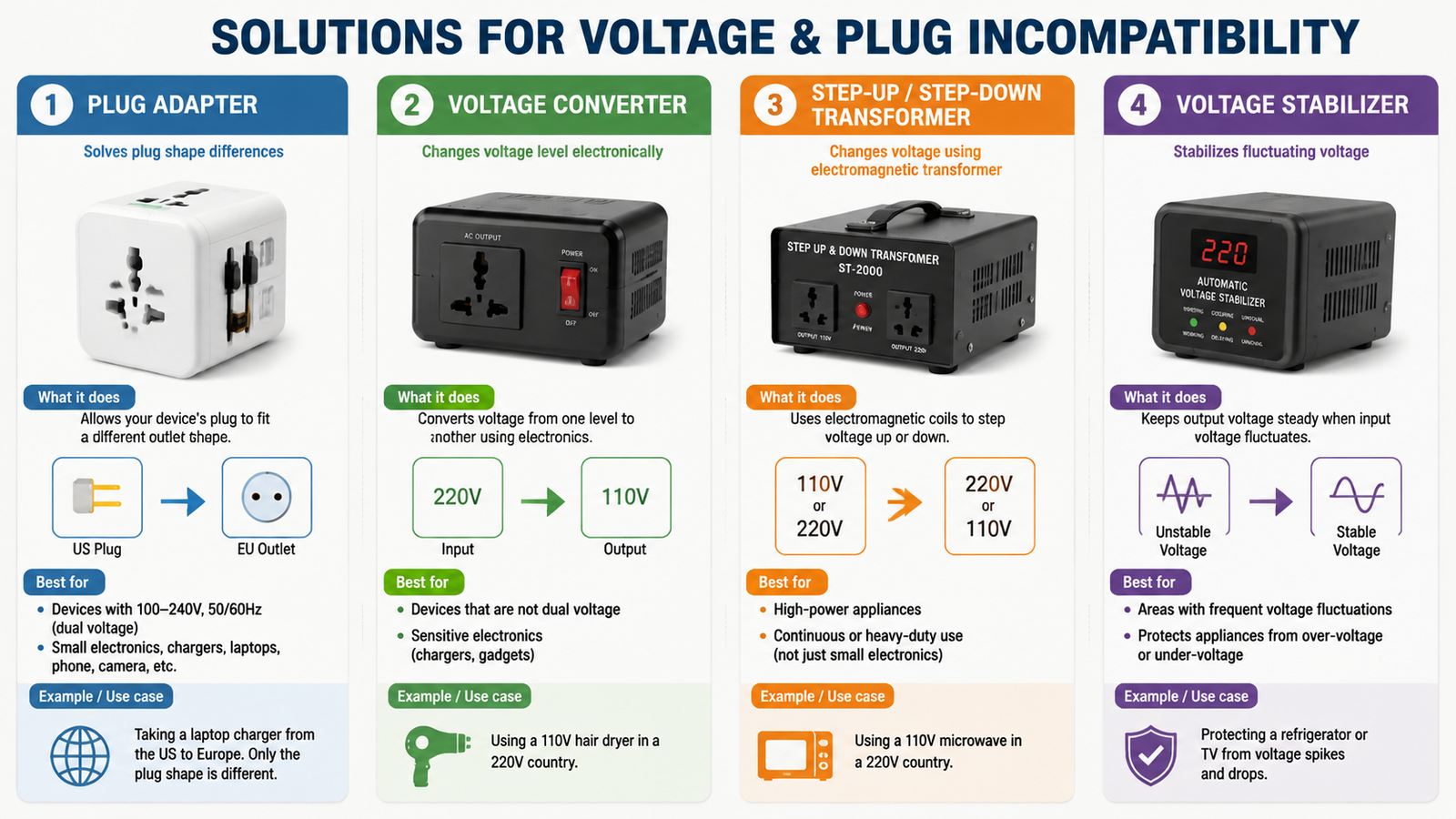
Once you understand the problem—wrong plug shape, wrong voltage, wrong frequency, or unstable supply—the next step is choosing the correct solution. Each tool addresses a different layer of the mismatch.
A plug adapter changes the physical pin configuration so your plug fits the wall socket. It does not alter voltage or frequency. If your device is dual-voltage (rated 100–240V), a simple adapter is all you need. Most modern phone chargers, laptop power supplies, and camera battery chargers fall into this category. Look for the label “Input: 100–240V ~ 50/60Hz” on your device’s power brick.
A voltage converter changes the output voltage level so a single-voltage device can operate on a different grid. A step-down converter reduces 220–240V to 110–120V, while a step-up converter does the reverse. These are typically compact, portable units designed for travel-sized electronics. They are suitable for low-wattage devices but are not ideal for high-power appliances like hair dryers or industrial equipment, which require transformers rated for continuous heavy loads.
For equipment that needs to run continuously on a mismatched voltage grid, a step-up or step-down transformer is the correct long-term solution. Unlike travel converters, transformers are built for sustained operation and can handle much higher wattages—typically from 100VA to 10KVA or more. A bidirectional unit can perform both functions, but the input voltage must be set correctly before connecting equipment. This is the standard choice for imported machinery, industrial control panels, and commercial installations where the equipment voltage differs from the local mains supply. For guidance on sizing and selecting the right unit, refer to our step up down transformer pricing guide to understand capacity-to-cost relationships.
Sometimes the voltage mismatch is not about a fixed difference but about fluctuation. In many regions, the grid supply swings significantly—dropping to 180V or spiking to 260V on a nominal 230V line. A voltage stabilizer continuously monitors and corrects the output to keep it within a safe band, protecting motors, medical imaging systems, data center loads, and production lines. If your equipment voltage matches the local nominal voltage but the supply is unstable, a stabilizer from a reliable voltage stabilizer supplier is the appropriate solution rather than a transformer.
Before buying any adapter or converter, inspect the label on your device’s power supply. The information is usually printed in small text on the power brick, the plug body, or the device’s nameplate.
When a device is single-voltage and the local grid voltage differs, using only a plug adapter is dangerous—the device will receive the wrong voltage and may be permanently damaged or catch fire.
| Mistake | Risk | Correct Approach |
|---|---|---|
| Using only a plug adapter for a single-voltage device | Device receives double or half the intended voltage, causing permanent damage or fire | Check the device label first. Use a converter or transformer if not dual-voltage. |
| Undersizing a transformer | Overheating, blown fuses, or unstable operation under load | Add a 50–100% safety margin above the device’s rated wattage, especially for motor loads. |
| Ignoring frequency differences | Motors run at wrong speed, overheat, or fail prematurely | Confirm frequency compatibility. Use a frequency converter if the device requires a specific 50Hz or 60Hz supply. |
| Assuming a country uses one plug type | Arriving with the wrong adapter and being unable to charge devices | Research all plug types used at your destination, especially in countries with mixed standards. |
| Using a travel converter for high-wattage appliances | Converter overheats and fails; appliance may be damaged | Use a properly rated step-up/step-down transformer for high-wattage or continuous-use equipment. |
| Scenario | Recommended Solution | Key Consideration |
|---|---|---|
| Traveling abroad with a dual-voltage phone or laptop | Plug adapter only | Confirm “100–240V” on the charger label before departure. |
| Traveling with a single-voltage hair dryer | Voltage converter (or use hotel appliance) | Match converter wattage to device wattage with a safety margin. |
| Operating imported 220V equipment on a 120V grid | Step-up transformer | Size for continuous load; verify frequency compatibility. |
| Running US-rated 120V machinery on a 230V grid | Step-down transformer | Account for motor startup surge; add 50–100% capacity margin. |
| Equipment voltage matches grid but supply is unstable | Voltage stabilizer | Choose servo or static type based on response-time needs. |
| Frequency-sensitive equipment on wrong-frequency grid | Frequency converter | Confirm whether the device also needs voltage conversion simultaneously. |
Countries developed their electrical grids independently during the late 19th and early 20th centuries. The US chose 110V for safety in wooden buildings, while Europe selected 220V for transmission efficiency. Once infrastructure was built and millions of appliances were installed, changing the national standard became economically impractical, so the differences persist.
Only if your device is rated for dual-voltage operation (100–240V). A plug adapter changes the pin shape only; it does not alter voltage. If your device is single-voltage (e.g., 120V only) and you plug it into a 230V socket using just an adapter, the device will be damaged or destroyed.
Voltage converters are typically compact, portable units designed for low-wattage travel electronics. Step-up and step-down transformers are built for continuous, higher-wattage operation—suitable for appliances, machinery, and permanent installations. Transformers are rated in VA and must be sized with a safety margin above the equipment’s running load.
No. A standard step-up or step-down transformer changes voltage levels but does not convert 50Hz to 60Hz or vice versa. If your equipment is frequency-sensitive (motors, compressors, timing devices), you may need a dedicated frequency converter in addition to or instead of a transformer.
Check the wattage or VA rating on your device’s nameplate, then add a 50–100% safety margin. For resistive loads like heaters, a smaller margin is acceptable. For inductive loads like motors and compressors, the margin accounts for startup surge current, which can be several times the running current.
Power socket voltages vary from place to place because of historical grid development, and the differences extend beyond voltage to plug shapes and frequency. The key to solving these mismatches is identifying which layer of incompatibility you face—plug shape, voltage level, frequency, or supply stability—and choosing the right tool for that specific problem. Dual-voltage devices need only a plug adapter. Single-voltage devices require a converter or transformer. Unstable grids call for a stabilizer. Frequency-sensitive equipment may need a dedicated frequency converter.
For permanent installations and B2B equipment compatibility, properly sized step-up and step-down transformers provide a reliable, long-term solution. If you have questions about selecting the right voltage conversion equipment for your application, visit our FAQ page or explore the full range of power supply products from Johsun Tec.