اختيار المناسب Step Up and Step Down Autotransformer comes down to knowing your input voltage, your required output voltage, and the total load you need to power. An autotransformer uses a single continuous winding with taps to step voltage up or down — making it smaller, lighter, and less expensive than an equivalent isolation transformer. But without isolation between windings, selecting the wrong unit can damage equipment or create safety hazards. This guide walks you through every factor that matters, from voltage ratio and kVA sizing to phase configuration and application fit.
ما هو المحول الذاتي؟
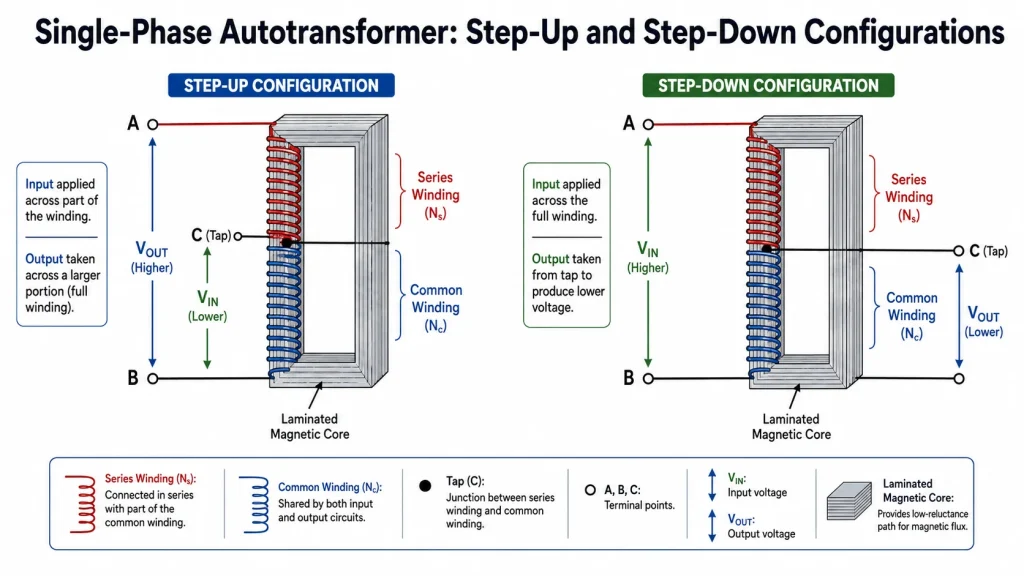
An autotransformer is a transformer with one continuous winding that serves as both the primary and secondary side. A portion of the winding — called the common section — is shared between input and output. The remaining portion, the series section, handles the voltage difference. Because part of the winding does double duty, autotransformers transfer power both inductively and conductively, which is why they achieve higher efficiency in a more compact frame than dual-winding isolation transformers.
The trade-off is that an autotransformer does not provide electrical isolation. A fault on the primary side can pass directly to the secondary, which limits where these devices can be safely used. However, for voltage conversion in industrial machinery, HVAC systems, motor starting, laboratory testing, and international equipment adaptation, the autotransformer is often the most practical and economical choice.
كيفية اختيار المحولات الذاتية ذات الترقي والتخفيض
The direction of voltage change determines the autotransformer type. The decision is simple: compare your available supply voltage to the voltage your equipment requires.
Step-up autotransformer: Output voltage is higher than input voltage. Use this when your supply is lower than what your load needs — for example, running 230 V equipment on a 120 V supply.
Step-down autotransformer: Output voltage is lower than input voltage. Use this when your supply is higher than what your load needs — for example, powering 120 V equipment from a 240 V line.
A step-up configuration places the load across the full winding while the source connects to a tap on a portion of the winding. In step-down, the source connects across the full winding and the load taps a portion. The turns ratio works the same as a conventional transformer: output voltage equals input voltage multiplied by the ratio of secondary turns to primary turns.
Supply Voltage
Required Load Voltage
Autotransformer Type Needed
Common Example
120 V
230 V
التدرج
Using European equipment in North America
230 V
120 V
مخفض الجهد
Using North American equipment in Europe
208 V
480 V
التدرج
Industrial machine requiring higher voltage
480 V
208 V
مخفض الجهد
Distribution panel feeding lower-voltage equipment
Once you know the voltage direction, evaluate the following specifications. Each affects compatibility, performance, and long-term reliability.
المواصفات
ماذا يعني ذلك
How to Choose
kVA Rating
Maximum apparent power the unit can deliver continuously
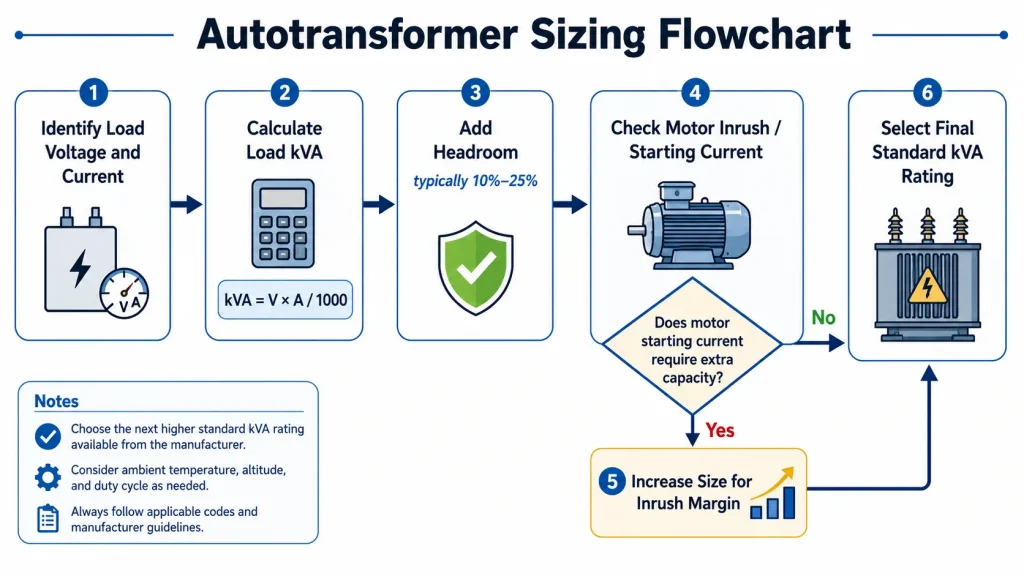
Sum your total load in watts, add 20-30% headroom. For motor loads, size at least 1.6× the running kVA to handle inrush.
جهد الإدخال
The supply voltage available at your facility
Match exactly. Common values: 120 V, 208 V, 240 V, 380 V, 480 V, 600 V. Check the wiring diagram for tap options.
جهد الخرج
The voltage your load equipment requires
Must match the equipment nameplate. Many units offer multiple output taps for flexibility.
التردد
Operating frequency of the supply (50 Hz or 60 Hz)
Most modern units are rated 50/60 Hz. Verify if your application is frequency-sensitive.
Number of Phases
Single-phase or three-phase
Match your supply and load. Three-phase loads need three-phase autotransformers or a bank of single-phase units.
Insulation Class
Maximum operating temperature of the winding insulation
Class 220 (200°C) is common for industrial units. Higher ambient temperatures may require a higher class.
Impedance
Opposition to current flow, affects voltage regulation and fault current
Typically 2-6% for autotransformers. Lower impedance means better regulation but higher fault current.
Enclosure Rating
Protection against dust, moisture, and contact
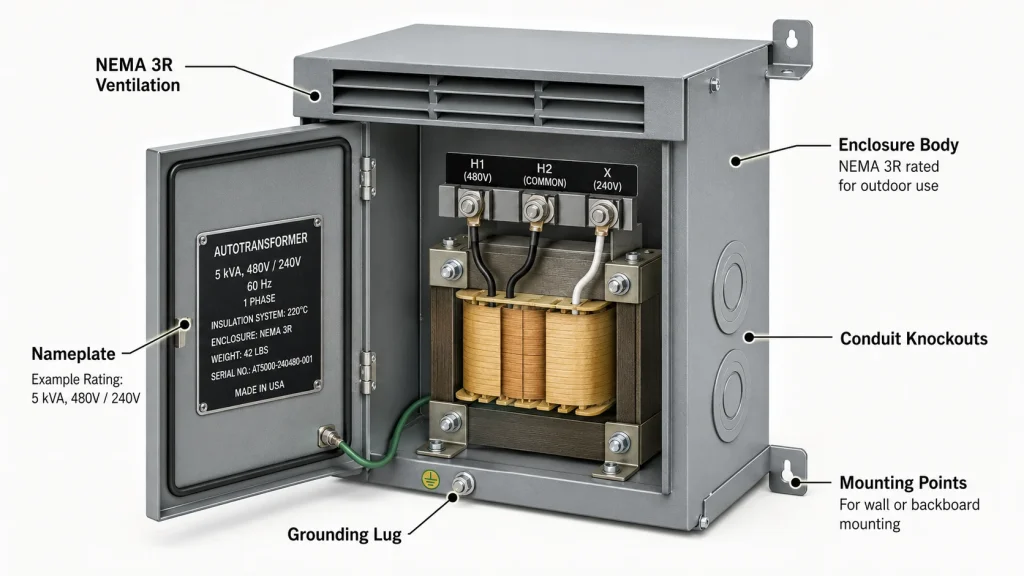
NEMA 1 for indoor dry locations; NEMA 3R for outdoor; NEMA 4/4X for washdown or corrosive areas.
If your application requires custom voltage ratios or application engineering support, reach out to جوهصن تيك. CONTACT US.
How to Size an Autotransformer Correctly
Undersizing is the single most common mistake in autotransformer selection. An undersized unit overheats, trips protection, and fails prematurely. Oversizing is safe but costs more and takes more space.
Step 1: Calculate Your Total Load
Add up the wattage or kVA of every device that will be powered simultaneously. For resistive loads like heaters, kVA equals kW. For inductive loads like motors, account for power factor: kVA = kW / power factor.
Step 2: Add Safety Headroom
For continuous loads, add at least 20% above your calculated total. For example, if your load totals 8 kVA, select a 10 kVA unit.
Step 3: Account for Motor Inrush
Electric motors draw 4 to 8 times their running current during startup. Size the autotransformer so motor loads do not exceed 60% of its rated capacity. A 5 kVA motor should use at least an 8.5 kVA autotransformer.
Step 4: Check for Future Expansion
If you plan to add equipment within the unit’s service life, size up now. The marginal cost of a larger kVA rating is small compared to the cost of replacement.
Single-Phase vs. Three-Phase Autotransformers
The phase configuration of your facility and equipment determines this choice. Matching phases incorrectly will prevent the equipment from operating.
Single-phase autotransformers serve residential, light commercial, and small industrial loads. Typical ratings range from 0.05 kVA to 100 kVA. They are used for voltage conversion of individual appliances, tools, HVAC units, and bench testing.
Three-phase autotransformers serve industrial machinery, motor control centers, and distribution panels. They handle higher power levels, typically 3 kVA to 1000+ kVA, and maintain balanced voltage across all three phases.
You can also configure three single-phase autotransformers in a bank to serve a three-phase load. This approach offers redundancy: if one unit fails, the other two can sometimes sustain reduced operation. Common three-phase connection methods include wye (star) and delta configurations. For step-up/step-down within a three-phase system, open-delta connections using two units can work when cost is a primary concern, though at reduced capacity.
Application-Specific Selection Guide
Different applications impose different demands. Use this table to match your use case to the right autotransformer profile.
التطبيق
Typical kVA Range
Voltage Pairs
الاعتبارات الرئيسية
Industrial machinery
5 – 500 kVA
208↔480, 240↔480, 380↔480
Motor inrush, continuous duty, NEMA 3R enclosure, Class 220 insulation
HVAC and air conditioning
3 – 150 kVA
208↔230, 208↔460, 230↔460
Compressor starting current, outdoor rating, buck-boost for minor correction
Motor starting (reduced-voltage)
10 – 500 kVA
50%, 65%, 80% tap settings
Short duty cycle, tap selection for starting torque, bypass contactor integration
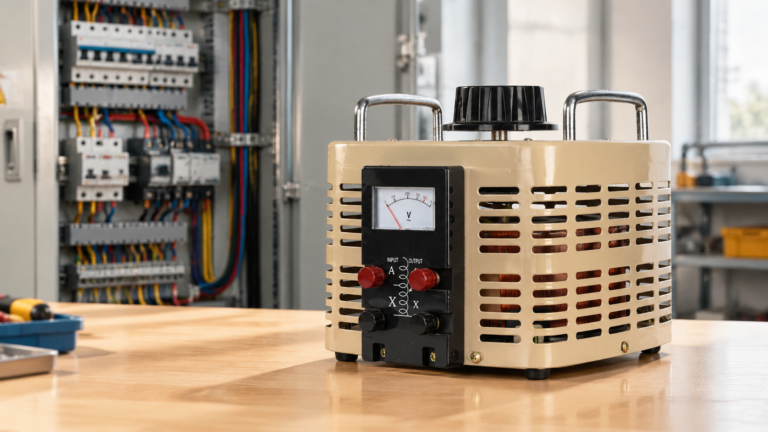
Variable output (Variac), smooth voltage control, metering, short-circuit protection
Renewable energy systems
50 – 5000 kVA
600↔34,500, 690↔33,000
Harmonic tolerance, high BIL rating, ester-based cooling for environmental safety
Safety, Isolation, and Code Compliance
Autotransformers do not provide galvanic isolation between primary and secondary. This is the most important safety distinction from isolation transformers. In the event of a winding failure, full primary voltage can appear at the output. For this reason, autotransformers should not be used where electrical isolation is required for personnel safety or sensitive electronics protection.
Grounding and Protection
Proper grounding is essential. The common terminal of the autotransformer is typically connected to the system neutral or ground. Overcurrent protection — fuses or circuit breakers — should be installed on both the input and output sides. For three-phase systems, a buried delta tertiary winding can absorb harmonic currents and limit ground-fault propagation.
Applicable Standards
IEC 60076 series: International standard for power transformers covering general requirements, temperature rise, dielectric tests, and loading guides.
IEEE C57 series: North American standard for distribution, power, and regulating transformers.
UL 5085 / CSA C22.2 No. 66: Safety standards for low-voltage transformers in the U.S. and Canada.
NEMA ST 20: Enclosure type designations for environmental protection (NEMA 1, 3R, 4, 4X, 12).
Common Mistakes When Choosing an Autotransformer
خطأ
Why It Happens
How to Avoid It
Undersizing kVA
Calculating only running load, ignoring inrush and future expansion
Add 20% minimum headroom; for motor loads, size to 60% of rated kVA
Expecting electrical isolation
Assuming all transformers work the same way
Choose an isolation transformer if galvanic separation is required for safety
Wrong voltage taps
Matching “close enough” instead of exact voltage
Verify nameplate voltage of load equipment; select taps that match exactly
Ignoring frequency differences
Assuming 50 Hz and 60 Hz are interchangeable in all cases
Confirm the autotransformer is rated for the supply frequency; some motors are frequency-sensitive
Mismatching phase count
Ordering single-phase for a three-phase load or vice versa
Check equipment nameplate and supply panel; three-phase loads need three-phase units or a bank of three single-phase units
Skipping enclosure rating
Prioritizing cost over environmental suitability
Match enclosure NEMA rating to installation environment: indoor vs. outdoor, dusty vs. clean, wet vs. dry
Reversing step-up/step-down beyond design
Using a step-down unit backwards to get step-up
While autotransformers are sometimes reversible, doing so can cause slightly incorrect output voltage and may violate the nameplate rating
Step-by-Step Selection Checklist
Work through this checklist in order. Each step narrows your options and brings you closer to the right unit.
Determine voltage direction: Is your supply voltage higher or lower than your load requirement? This tells you step-up vs. step-down.
Record exact voltages: Note the supply voltage at your facility and the required voltage on your equipment nameplate.
Calculate total load kVA: Sum the power of all devices, account for power factor on inductive loads, and add 20% headroom.
Check for motor loads: If motors are present, verify the autotransformer is rated for at least 1.6× the motor running kVA.
Confirm phase count: Single-phase or three-phase. Match the load. For three-phase loads, decide between one three-phase unit or a bank of single-phase units.
Verify frequency: Confirm the unit is rated for your supply frequency (50 Hz, 60 Hz, or dual-rated).
Select enclosure type: Choose NEMA rating based on installation environment (indoor, outdoor, washdown, hazardous).
Check applicable standards: Ensure the unit carries certifications required in your region (UL, CSA, CE, IEC).
Confirm tap configuration: Verify the unit provides the specific input and output taps you need. Multiple output taps add flexibility.
Review safety requirements: If isolation is required, an isolation transformer — not an autotransformer — is the correct choice.
If your application requires custom voltage ratios, specific enclosure modifications, or advice on integrating an autotransformer into an existing system, reach out to اتصل بنا for application engineering support.
This comparison is one of many technical resources we publish to support smarter component selection. Whether you’re specifying transformers for a control panel, troubleshooting voltage conversion in a retrofit project, or sourcing custom magnetics for a new product line — you’ll find detailed product guides, application notes, and datasheets to keep your project moving. Visit our Johsun Tech home to explore our complete transformer catalog and the latest engineering content.
الأسئلة الشائعة
Can I use an autotransformer in reverse — step-down as step-up?
In many cases, yes. Autotransformers are electrically symmetrical and can often be reversed. However, a unit designed and nameplate-rated as step-down may deliver slightly less output voltage when used in reverse due to internal losses. Always check the manufacturer’s specifications. For critical applications, use a unit nameplate-rated for the direction you intend.
What happens if I choose an autotransformer with too low a kVA rating?
An undersized autotransformer will overheat. The winding insulation degrades rapidly above its rated temperature, leading to shorted turns, reduced output voltage, and eventually complete failure. It may also trip upstream overcurrent protection or cause voltage sag that damages connected equipment.
How is an autotransformer different from a buck-boost transformer?
A buck-boost transformer is a type of autotransformer specifically designed for small voltage corrections, typically 5% to 20% adjustment. Standard autotransformers handle larger voltage ratios — commonly 2:1 or 3:1 — and are built for continuous power conversion rather than minor trimming. Buck-boost units are typically smaller and less expensive but limited to narrow correction ranges.
Do autotransformers work with DC voltage?
No. Like all transformers, autotransformers rely on a time-varying magnetic field to transfer power inductively. DC produces a constant field that cannot induce voltage in the secondary. Applying DC will cause the winding to act as a short circuit, drawing excessive current and burning out the unit.
Can I connect multiple devices to one autotransformer?
Yes, as long as the total combined load does not exceed the kVA rating. Connect all devices in parallel on the output side. Use a distribution panel or terminal block with individual overcurrent protection for each branch circuit. Ensure the combined inrush current from devices that start simultaneously does not exceed the autotransformer’s short-term overload capacity.
When should I choose an isolation transformer instead of an autotransformer?
Choose an isolation transformer when you need galvanic separation between input and output for safety, noise rejection, or protection of sensitive electronics. Medical equipment, data center servers, audio systems, and any application where a primary-side fault could endanger personnel or equipment typically require isolation. Autotransformers are the better choice when size, weight, cost, and efficiency are priorities and isolation is not required.
How a buck-boost transformer works: series-winding polarity, differential kVA sizing with single-phase and three-phase examples, and the five limits that decide when it is the wrong tool.
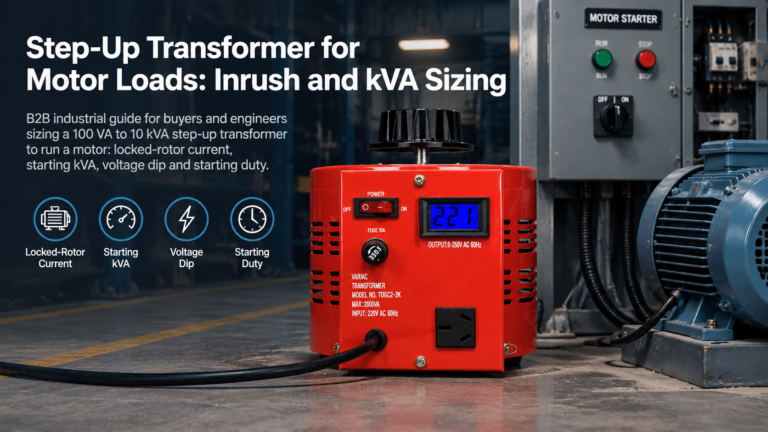
How to size a step-up transformer for a motor: locked-rotor current, kVA code letters, starting kVA by method, voltage-dip and thermal-duty checks, plus the traps most guides miss.
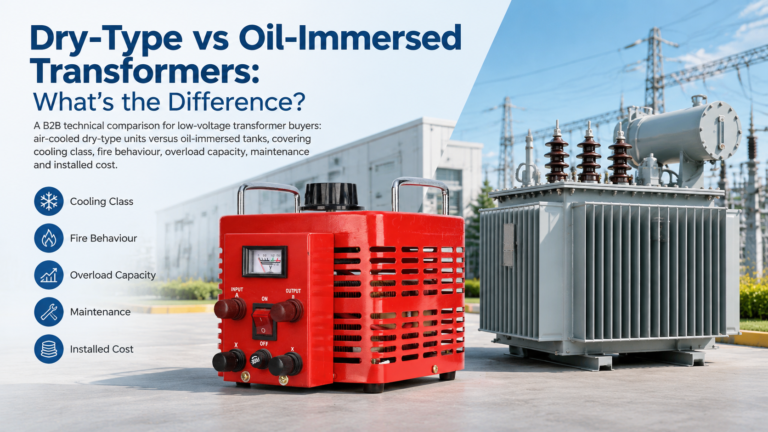
A practical dry-type vs oil-immersed transformer comparison for low-voltage buyers: cooling class, fire safety, overload, maintenance and installed cost, plus a ten-minute selection sequence.