When you select a single phaseStep Up and Step Down Transformers for imported machines or electronics, you are really choosing how safely and efficiently your line voltage will match foreign equipment from Europe, the Middle East, or Southeast Asia. This guide focuses on how to connect, how to select, and which model makes sense for B2B buyers and engineers.
What is a step up and step down transformers?
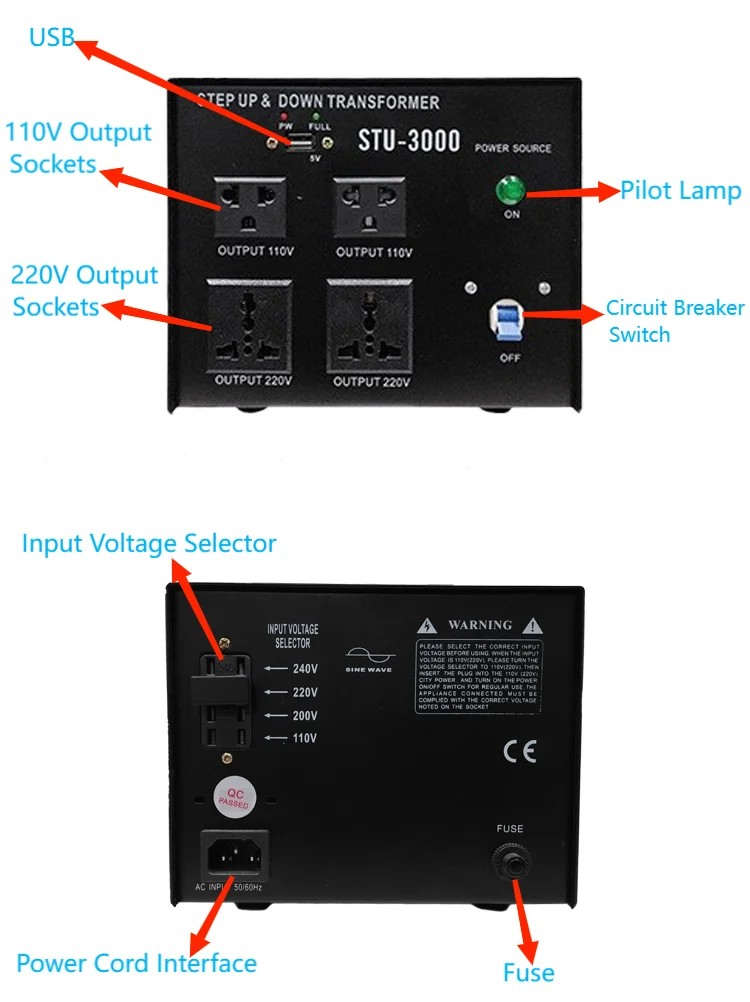
A سلسلة STU من STU-100VA إلى STU-5000VA المحولات الكهربائية لأعلى ولأسفل is a single‑phase voltage converter that can either raise (step up) or reduce (step down) AC voltage between common standards such as 110/120 V and 220/230/240 V. The same transformer core and windings can usually be used in both directions; whether it acts as step‑up or step‑down depends on which winding you connect to the mains and which you use as the output.
For imported single‑phase equipment, this type of step up and step down transformers is widely used to:
Run 120 V North American equipment from 220–240 V supplies in Europe, the Middle East, or Southeast Asia.
Run 220–240 V equipment from 110–120 V supplies in the USA, Japan, or some parts of the Middle East.
Provide isolation and over‑voltage protection for sensitive lab instruments, audio equipment, and control cabinets.
Typical use cases: Europe, Southeast Asia, Middle East
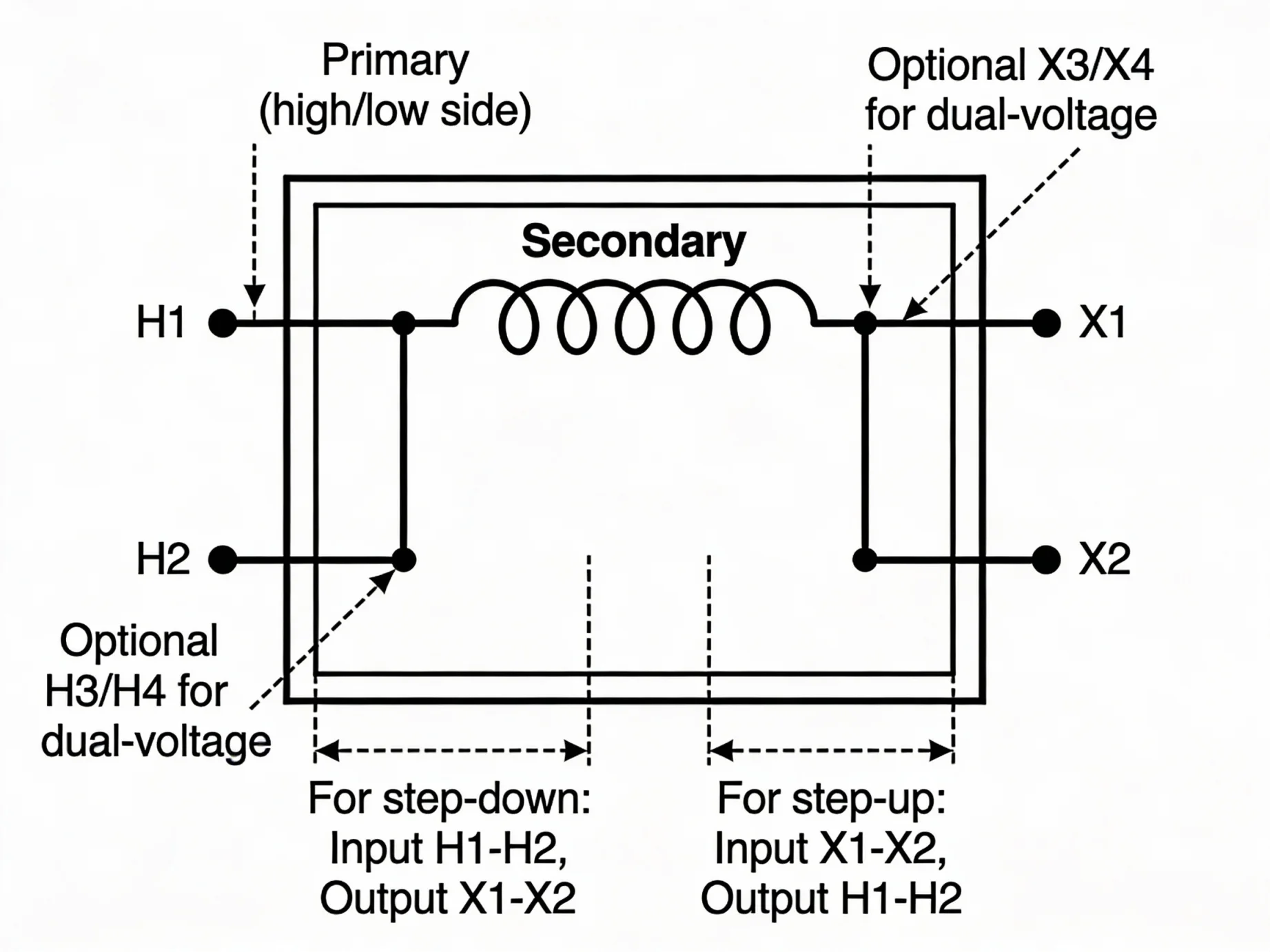
Connect 220–240 V live to H1, neutral to H2 (or as per diagram).
Connect protective earth to the transformer’s earth terminal or enclosure.
الاتصال الثانوي
X1 and X2 provide 110–120 V output.
Connect X1 as “hot” and X2 as “neutral” to the equipment input.
Bond one side to earth only if the design and standards require it; in many isolation setups the secondary may be floating or referenced via a single point.
Polarity and protection
Make sure input and output fusing/breakers are sized to the transformer VA and line voltage.
Use thermal or overcurrent protection recommended by the manufacturer.
Example B: 110/120 V supply → 220–240 V equipment (step‑up)
In most reversible units, you simply swap which winding is used as input:
Connect your 110/120 V mains to the low‑voltage winding terminals (e.g., X1–X2).
Take 220–240 V from the high‑voltage winding (e.g., H1–H2).
If the المحول has a voltage selector switch (110/220 V input selector), set the switch to match the supply and then use the corresponding output socket (110 or 220 V) for your equipment.
Quick wiring checklist for engineers
الخطوة
Check item
ما أهمية ذلك
1
Match primary voltage
Prevent over‑voltage or under‑voltage
2
Match secondary voltage
Ensure equipment receives rated voltage
3
Confirm VA rating + margin
Avoid overheating, nuisance tripping
4
Correct primary and secondary use
Decide step‑up vs step‑down function
5
Earthing and protection devices
Personnel safety, compliance, equipment life
How to select the right step up and step down transformers for your project
For B2B projects, selection is not just “110 to 220 V or 220 to 110 V”; you must also consider power, duty cycle, isolation, environment, and standards.
Key selection parameters
نطاق جهد الإدخال
Common: 220–240 V (EU, SEA, Middle East), 110/120 V (US, some ME bases), 100 V (Japan).
For multi‑country cabinets, consider wide‑range or dual primary designs.
Output voltage(s)
110/120 V or 220–240 V for imported tools, medical ancillaries, and lab equipment.
100 V secondary if you frequently handle Japanese machines.
Power rating (VA or kVA)
Sum all connected loads, consider inrush current (motors, compressors, SMPS).
Add at least 25–30% margin for continuous duty; more for high‑inrush devices.
Type: isolation vs autotransformer
Isolation transformer: galvanic isolation between input and output, better protection, often preferred for medical, lab, and control cabinets.
Autotransformer: smaller, cheaper, but no isolation; used when space and cost are critical and isolation is not required.
توافق التردد
Check 50/60 Hz rating and derating rules when using 60 Hz‑designed equipment on 50 Hz systems or vice versa.
Standards and certifications
For exports to Europe, Southeast Asia, and Middle East, look for CE marking, ISO 9001 manufacturing, and any industry‑specific approvals required in your sector.
Quick selection table (single‑phase)
Project scenario
Recommended type
الملاحظات
240 V site supply → 120 V US equipment (continuous duty)
Single‑phase isolation transformer
25–30% VA margin, CE / ISO preferred
230 V supply → 100 V Japanese lab instruments
Step‑down isolation transformer
Consider multi‑tap secondary for 100/110/120 V
120 V supply → 230 V EU equipment in Middle East or US plants
Step‑up autotransformer or isolation
Choose isolation for higher safety
Mixed US + EU devices in one test bench
Multi‑output step up and step down transformer
Independent 110/120 V and 220–240 V outlets
OEM exported machine with integrated foreign sub‑assemblies
Custom single‑phase transformer
Match cabinet space, terminals, and wiring scheme
A good rule of thumb: if the transformer will be built into a control cabinet or used in sensitive environments, isolation and robust certification are usually worth the small extra cost for B2B buyers.
Because you target Europe, Southeast Asia, and Middle East markets, you will see slightly different mains voltages and plug systems, but most fall between 220 and 240 V at 50 Hz.
Europe and UK
Typical supply: 230 V, 50 Hz.
Common requirement: 230 → 120 V (US tools), 230 → 100 V (Japan), 120 → 230 V (US sites with EU equipment).
Recommended: CE‑marked, single‑phase isolation or autotransformers with 230 V primary and 100/110/120 V secondary options.
Southeast Asia (e.g., Singapore, Malaysia, Vietnam)
Typical supply: 220–240 V, 50 Hz.
Use cases: industrial cabinets with imported North American PLCs, lab instruments from Japan, EU medical auxiliaries.
Recommended: compact, panel‑mount transformers designed for continuous duty, high ambient temperature, and cabinet installation.
Middle East
Typical supply: often 220–240 V, 50 Hz, but some industrial sites also have 120 V and 60 Hz systems.
Use cases: oil & gas skids, building automation panels, water treatment equipment combining US and EU components.
Recommended: wide‑range input step up and step down transformers able to operate on both 50 and 60 Hz, with robust insulation and derating information for hot climates.
Practical notes for engineers and buyers
When you specify or purchase step up and step down transformers at B2B level, a few practical details will save a lot of trouble during commissioning.
Oversizing and inrush
For resistive or electronic loads (IT, small instruments), 25–30% VA margin is usually enough.
For motors, compressors, or large SMPS, consider higher rating or soft‑start solutions; check inrush current and let the manufacturer help with sizing.
بيئة التثبيت
Inside electrical cabinets: pick compact designs with low temperature rise and clear terminal markings for fast wiring.
Stand‑alone floor or wall units: look for robust enclosures, lifting points, and front‑panel indicators for voltage and load.
Safety and maintenance
Ensure correct earthing of core and enclosure, and follow local wiring rules for neutral and protective earth on the secondary side.
Plan periodic checks for temperature, noise, and insulation condition in preventive maintenance schedules.
If you share your input voltage, output voltage, load type, and target countries, a professional step up and step down المحولات manufacturer can quickly recommend a short‑listed model and provide drawings for your cabinet design.
الأسئلة الشائعة
u003cstrongu003eCan the same transformer be used as both step‑up and step‑down?u003c/strongu003e
Yes, most single‑phase transformers are reversible; if you feed the low‑voltage winding and take power from the high‑voltage winding, it works as a step‑up unit, and vice versa for step‑down, as long as voltage and VA ratings are respected.
u003cstrongu003eHow much bigger should the VA rating be than my load?u003c/strongu003e
For continuous operation, it is common to select at least 25–30% above the total connected load to handle heating, inrush, and small expansions.
u003cstrongu003eDo I need an isolation transformer or is an autotransformer enough?u003c/strongu003e
If you need galvanic isolation, additional safety, or noise reduction (lab, medical, control panels), choose isolation; if cost and size are critical and isolation is not required, an autotransformer can be acceptable.
u003cstrongu003eCan I use one transformer in multiple countries?u003c/strongu003e
Yes, if it supports the relevant input voltages and frequencies (e.g., 220–240 V, 50/60 Hz) and provides the required outputs (100/110/120/230 V); always verify the nameplate and derating notes.
u003cstrongu003eWhat information should I send to a manufacturer for quotation?u003c/strongu003e
Provide input voltage and frequency, output voltage(s), total VA or kW, load type (resistive, motor, electronic), duty cycle, installation location (cabinet or standalone), and target markets/standards, so they can propose a suitable, compliant transformer solution.
How a buck-boost transformer works: series-winding polarity, differential kVA sizing with single-phase and three-phase examples, and the five limits that decide when it is the wrong tool.
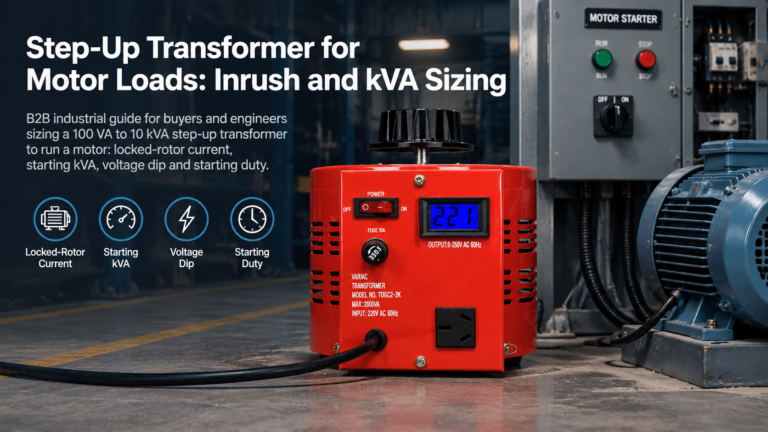
How to size a step-up transformer for a motor: locked-rotor current, kVA code letters, starting kVA by method, voltage-dip and thermal-duty checks, plus the traps most guides miss.
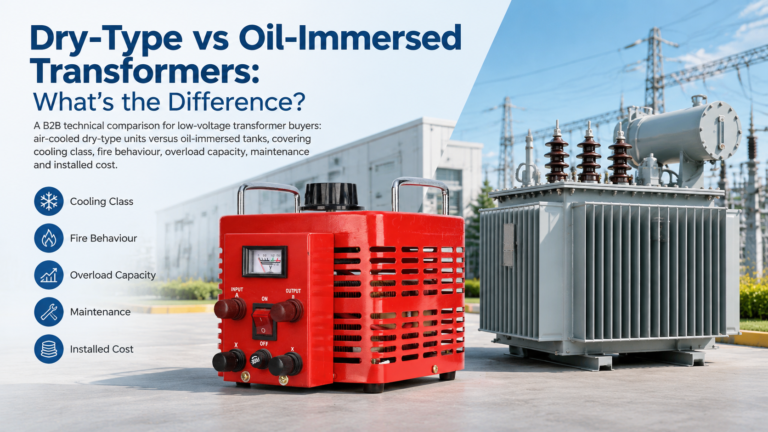
A practical dry-type vs oil-immersed transformer comparison for low-voltage buyers: cooling class, fire safety, overload, maintenance and installed cost, plus a ten-minute selection sequence.