Transformer Applications by Industry: A 100 VA–10 kVA Guide
Veröffentlicht: Autor: Lisa
Most articles about transformer applications jump straight to 33 kV switchyards and 50 MVA units. That is not the world most buyers live in. In power distribution rooms, machine shops, clinics and small solar installations, the transformer on the purchase order is a 100 VA to 10 kVA dry-type unit, and the questions are different: which ratio, how much inrush, what enclosure, how hot will it run. This guide walks through the four verticals that account for most of that demand — power, industrial, medical and renewable — and shows what each one actually requires from the part number you specify.
The Four Jobs a Small Transformer Actually Does
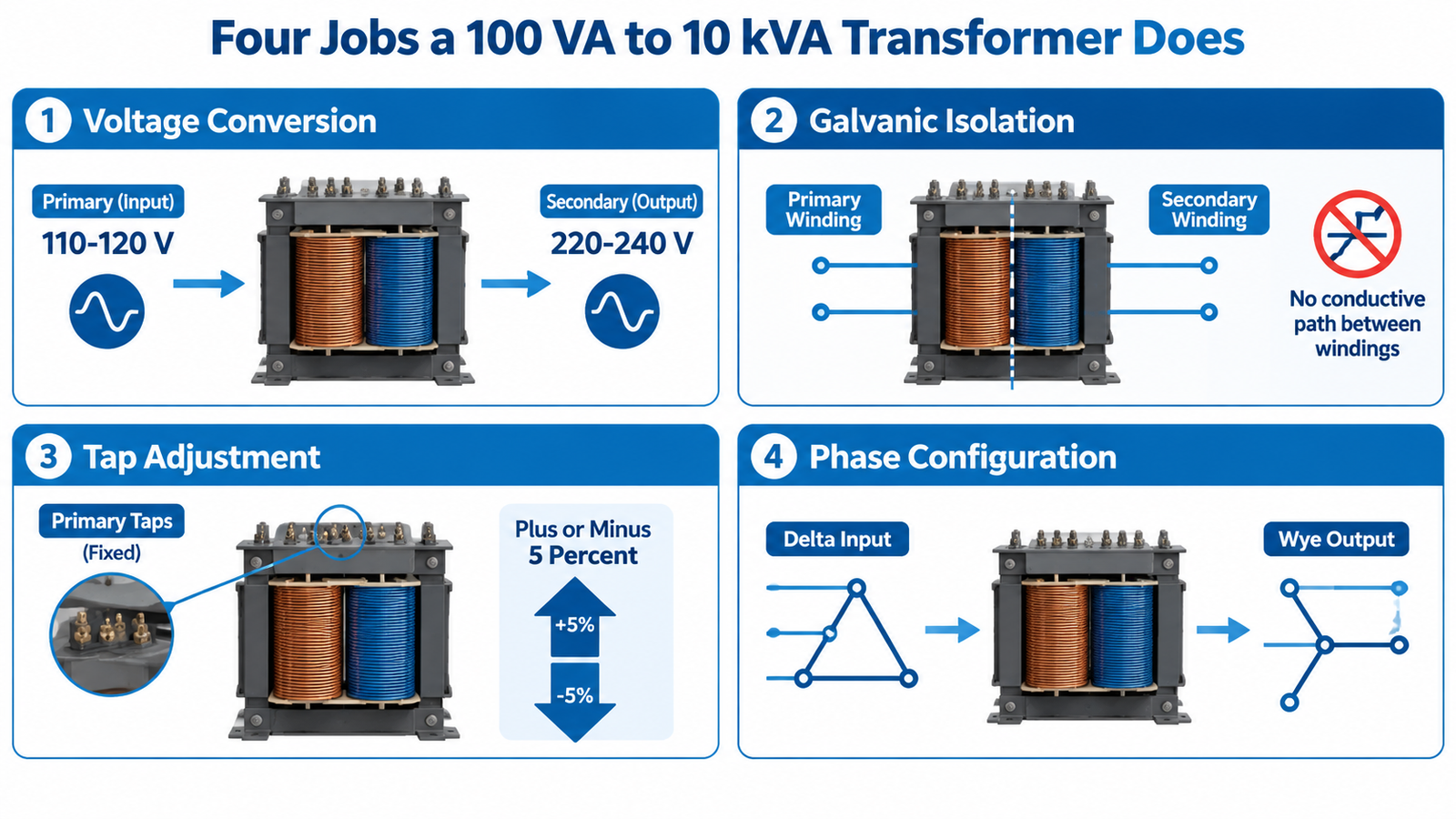
Before the industry specifics, separate function from market. Almost every transformer application in this range asks for one of four things, and mixing them up is where specifications go wrong.
Voltage conversion. Matching equipment designed for 110–120 V to a 220–240 V grid, or the reverse — the classic step-up / step-down job.
Galvanic isolation. No conductive path between windings, which breaks ground loops, limits secondary fault current and keeps noise from crossing circuits.
Ratio adjustment. Fixed primary taps (commonly ±5%) that correct a supply running persistently high or low, without an active regulator.
Phase or configuration change. Three-phase input with single-phase output, or a centre-tapped secondary that creates a neutral point where none existed.
An autotransformer does the first and third well, never the second. That distinction decides whether a unit is acceptable in a medical room or laboratory — confirm it on the datasheet first.
Power Distribution and Utility Auxiliary Applications
Inside distribution substations and ring main units, small transformers rarely carry load current. They carry the systems that keep switchgear alive: protection relays, RTU and SCADA supplies, trip and close circuits, anti-condensation heaters, and battery charger inputs.
These loads are modest — often 200 VA to 2 kVA — but the duty is harsh: 24 hours a day in an enclosure that may sit at 40 °C. Two specifications matter more than nameplate kVA. No-load loss is billed continuously whether or not anything is switching. Inrush capability decides whether the secondary sags when contactor coils, heaters and charger capacitors draw five to eight times steady current for a few cycles, which is enough to drop a relay. Most utility-side transformer applications at this scale live or die on those two numbers.
Practical defaults for this segment: continuous duty, Class F insulation with a 60 K rise or better, ±5% primary taps, IP23 enclosure indoors, and a 50/60 Hz rating if the panel may be exported. Sizing guidance for the kVA basis itself is covered in why transformers are rated in kVA.
Industrial and Manufacturing Applications
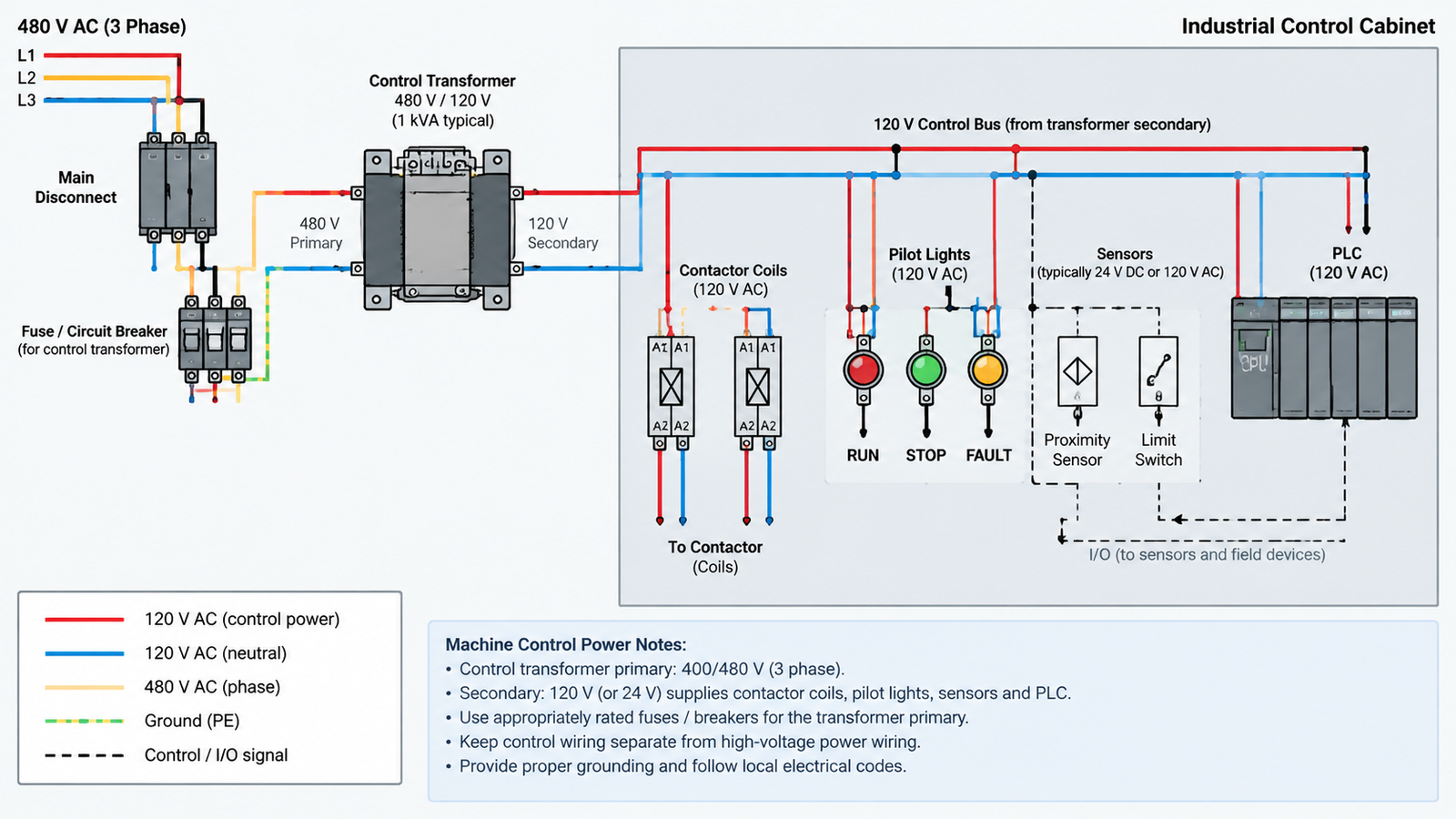
Machine control power
Every control cabinet needs a low-voltage rail for contactor coils, pilot lights, sensors and a PLC. A Steuertransformator with a 400/480 V primary and a 120 V or 24 V secondary is the standard answer, and the sizing rule is counter-intuitive: size on inrush VA, not on the sum of holding currents. A coil that holds at 10 VA can pull 80 VA while closing. Add the simultaneous pick-up of several contactors and a 150 VA steady load can legitimately need a 500 VA unit.
Imported production equipment
Machines bought from another region arrive with a fixed voltage expectation. A 60 Hz motor on a 50 Hz supply runs about 17% slower; a 50 Hz motor on 60 Hz speeds up and can overload its driven load. The transformer fixes voltage, not frequency, so check the motor nameplate before assuming a converter solves the problem.
Motor and drive loads
Induction motors draw six to eight times full-load current at start. A transformer feeding a motor should generally be rated at 1.5 to 2 times motor FLA, or replaced by a K-rated drive-isolation design when a VFD is involved. Non-linear current from drives heats windings faster than sinusoidal current at the same RMS value, so a 10 kVA unit serving a 7.5 kVA drive load is not automatically comfortable.
Medical and Healthcare Applications
Clinical environments ask for isolation, quiet operation and predictable leakage current. Typical duties include analysers and laboratory instruments, dental and ophthalmic chairs, imaging support equipment, and isolated supplies in patient-care areas.
The requirements that separate medical transformer applications from general industrial ones are measurable rather than decorative: low inter-winding capacitance so common-mode noise does not cross the barrier, shielded windings where sensitive electronics are nearby, fan-free convection cooling because acoustic noise and dust ingress both matter, and documented leakage current test results rather than a marketing claim.
One caution: a general-purpose dry-type transformer is not medical-grade simply because it isolates. IEC 60601-1 governs the device and IEC 60364-7-710 covers group 2 medical locations; neither is satisfied by an unverified off-the-shelf unit. Ask for the hipot record, insulation class and measured leakage current. The engineering case is set out in this article on isolation transformers and power quality.
Renewable Energy Applications
Utility-scale solar uses medium-voltage step-up transformers, which is a different product category entirely. Below 10 kVA, renewables appear in smaller but real places: inverter isolation in off-grid and hybrid systems, pump controllers, monitoring power in remote cabinets, and small wind or hydro installations where generator voltage does not match the load.
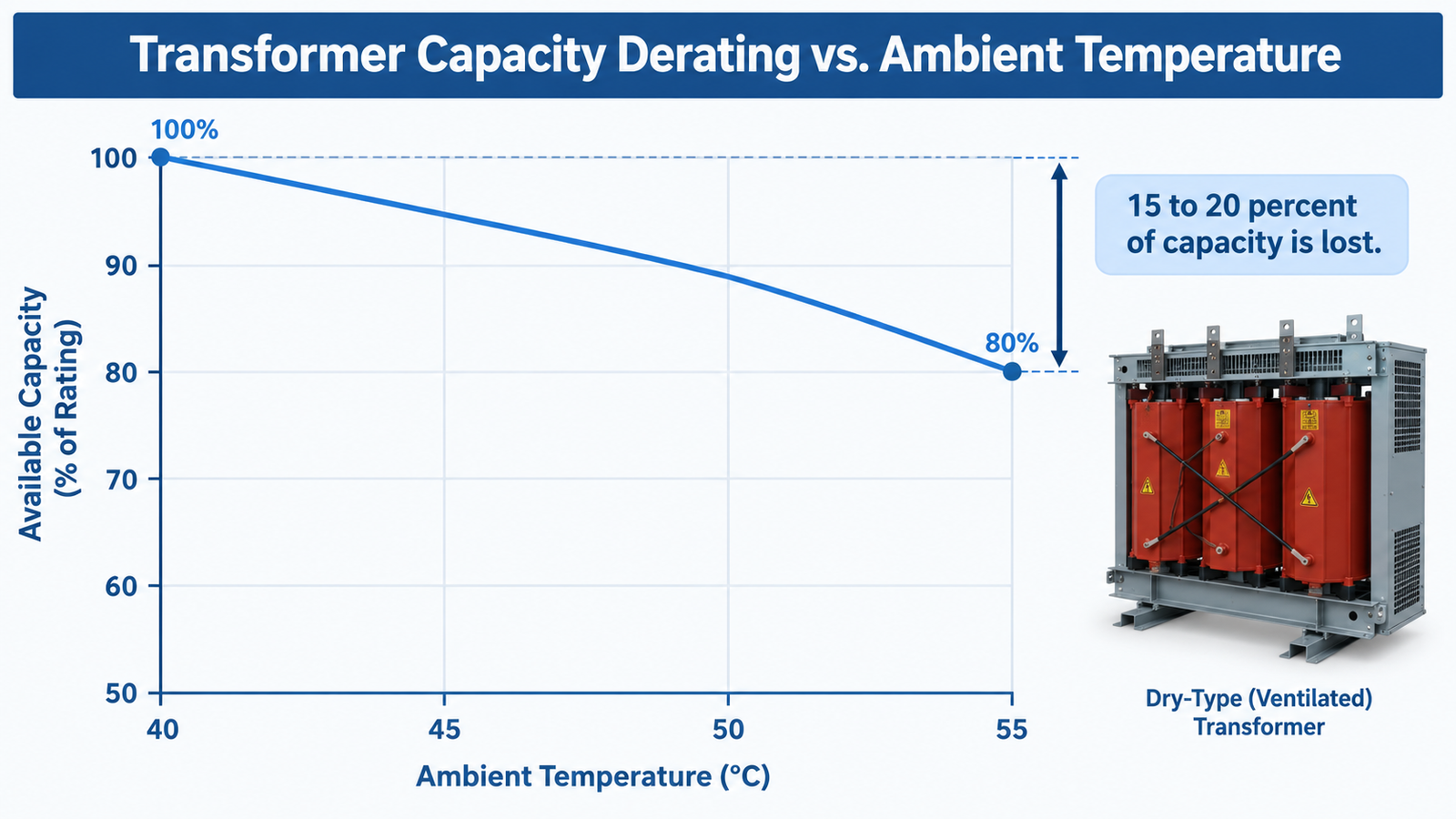
Three conditions dominate. Ambient temperature comes first — a rooftop or desert cabinet can sit at 50–55 °C, and a unit rated at 40 °C loses roughly 1.5% of capacity per degree above that, so 15–20% is gone before any load is connected. Ingress protection comes second: IP54 or IP65 for outdoor mounting, positioned so convection still works. Third, inverter output is harmonic-rich, so 20–30% oversizing is normal practice rather than conservative engineering. These are the renewable transformer applications where a standard catalogue unit most often gets derated.
Commercial, HVAC and Test-Bench Applications
Light commercial work is steady. Rooftop HVAC units need 24 V control power; hotels need 230 V to 110 V conversion for guest appliances; workshops and laboratories need a variable source for burn-in and fault-finding. In each case the transformer is selected for duty cycle and enclosure rather than precision, and a unit left running must be rated for continuous operation.
Industry Selection Matrix
Use this matrix to compare transformer applications, then confirm against the actual load profile. The kVA figures are typical ranges for small dry-type units, not limits.
Industrie
Primary function
Typical rating
Common ratio
Watch-out
Power distribution / utility auxiliary
Control and protection power, heater supply
0.2–2 kVA
400/230 V, 480/120 V
Continuous duty and no-load loss
Industrial machine control
Control rail for coils, PLC, sensors
0.1–1 kVA
480/120 V, 400/24 V
Inrush VA, not holding VA
Imported equipment
Voltage matching
0,5–10 kVA
230/115 V, 220/110 V
Frequency, not just voltage
Medical and laboratory
Isolation, low leakage
0.5–5 kVA
230/230 V, 230/115 V
Verified leakage current data
Renewable / off-grid
Inverter isolation, remote power
0.3–5 kVA
230/230 V, 230/115 V
Ambient derating and harmonics
Commercial and HVAC
Control power, appliance conversion
0.1–3 kVA
230/24 V, 230/115 V
Continuous rating in enclosed spaces
Five Specification Mistakes That Cross Every Industry
Sizing in kW instead of VA. A 3 kW load at 0.8 power factor needs 3.75 kVA. Nameplate kW is an output figure, not a transformer rating.
Ignoring inrush. Motors, contactor coils, capacitor-input chargers and toroidal cores all draw a start-up surge. Size for the surge, then confirm the steady state fits.
Assuming 40 °C ambient. Most small units are rated at 40 °C. Rooftops, plant rooms and sealed cabinets run hotter, and capacity falls with every degree.
Treating isolation as a given. An autotransformer has a shared winding and no isolation barrier. If the application needs a separately derived source, this is the wrong product regardless of ratio.
Forgetting the enclosure. A unit that fits the electrical requirement but not the IP rating will fail on dust or condensation before it fails electrically.
Matching a Series to the Application
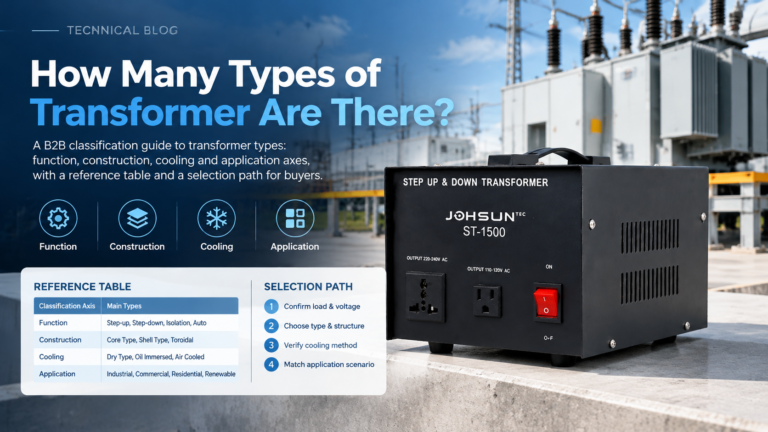
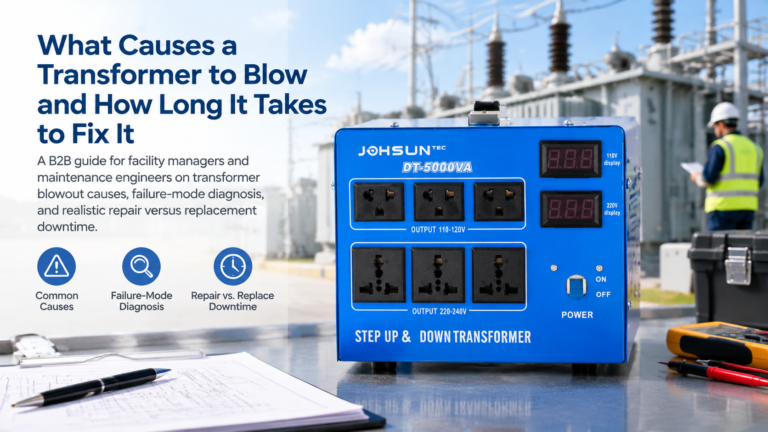
For imported equipment, test benches and light industrial panels in the 100 VA to 3 kVA range, a multi-tap step-up / step-down design covers most of the four verticals above without a custom build. The STU series 100 VA–3000 VA converter is the usual starting point for 110/220 V work, with larger DT and ST units covering up to 10 kVA where the load is fixed and the duty is continuous. For applications needing a defined ratio rather than a switched one, the step-up and step-down transformer range lists the available ratings and terminal arrangements.
Fazit
Industry labels are useful shorthand for transformer applications, but the specification behind them repeats. Decide whether you need conversion, isolation, tap adjustment or a phase change; size for inrush and ambient rather than steady-state nameplate; then confirm the enclosure and duty cycle match the room the unit will live in. Get those right and the vertical matters far less than the datasheet. If you are unsure which function your application needs, describe the load and the supply and we will point you to the closest standard unit.
FAQ
What is the most common transformer application?
Voltage conversion for equipment built for a different grid, followed by control power inside industrial panels. Between them they account for the majority of units sold in the 100 VA to 10 kVA range.
Can one transformer serve several industries?
Often yes. A 1 kVA 230/115 V isolation unit works in a workshop, a clinic and a laboratory. What changes is documentation: medical and utility buyers usually require test records that industrial buyers do not.
Do I need an isolation transformer for medical equipment?
Not automatically; it depends on the equipment standard and location classification. What is not optional is verified leakage current data — a supplier who cannot provide it has not demonstrated a medical-grade product.
How much should I oversize a transformer for a motor?
Plan on 1.5 to 2 times motor full-load amps, more if it starts frequently or drives a high-inertia load. With a VFD, specify a K-rated or drive-isolation design instead of simply adding kVA.
Is a 50 Hz transformer usable on 60 Hz?
Usually yes, with margin, because a higher frequency reduces flux for the same voltage. The reverse — a 60 Hz unit on 50 Hz — increases flux and can saturate the core, so it needs derating or a different design.
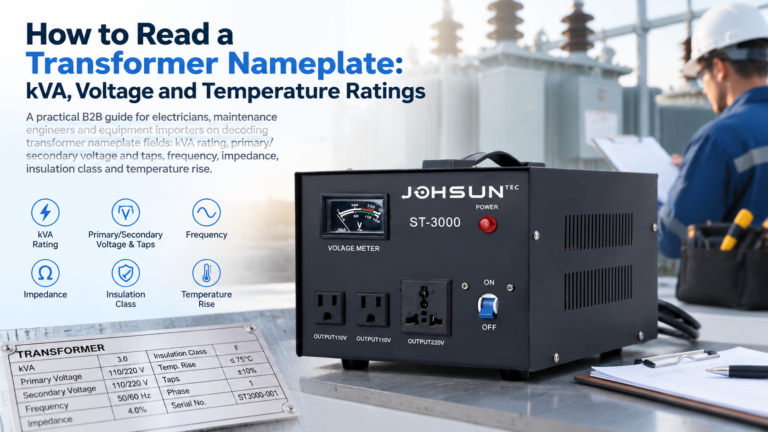
Learn how to read a transformer nameplate: decode the kVA rating, voltage and taps, frequency, impedance, insulation class and temperature rise before you install or replace a unit.