Transformer Core Types: Laminated, Toroidal and Amorphous Compared
Veröffentlicht: Autor: Lisa
Die meisten Ratgeber zu transformer core types present laminated, toroidal and amorphous cores as three equal options. At 100 VA to 10 kVA they are not equal: laminated silicon steel covers the overwhelming majority of units available off the shelf, toroidal cores exist but change the cost structure, and amorphous cores rarely appear below roughly 15–25 kVA.
The core decides a small transformer’s no-load loss, inrush current, noise and size before a single turn of wire is wound. This article compares them on the properties that reach a purchase order.
What the Core Does and Which Properties It Sets
A core is a low-reluctance path coupling flux from primary to secondary; air works, but takes roughly a thousand times more magnetizing current. Fix the geometry and three properties follow: no-load loss, set by material, lamination thickness and design flux density; usable flux density, set by the saturation limit, which decides how much iron you need per kVA; and leakage flux path, which decides stray field and noise. For the anatomy rather than a selection decision, see Transformatorenkonstruktion und Eisenkernstruktur.
Laminated Core: Stacked Steel and Why It Dominates This Range
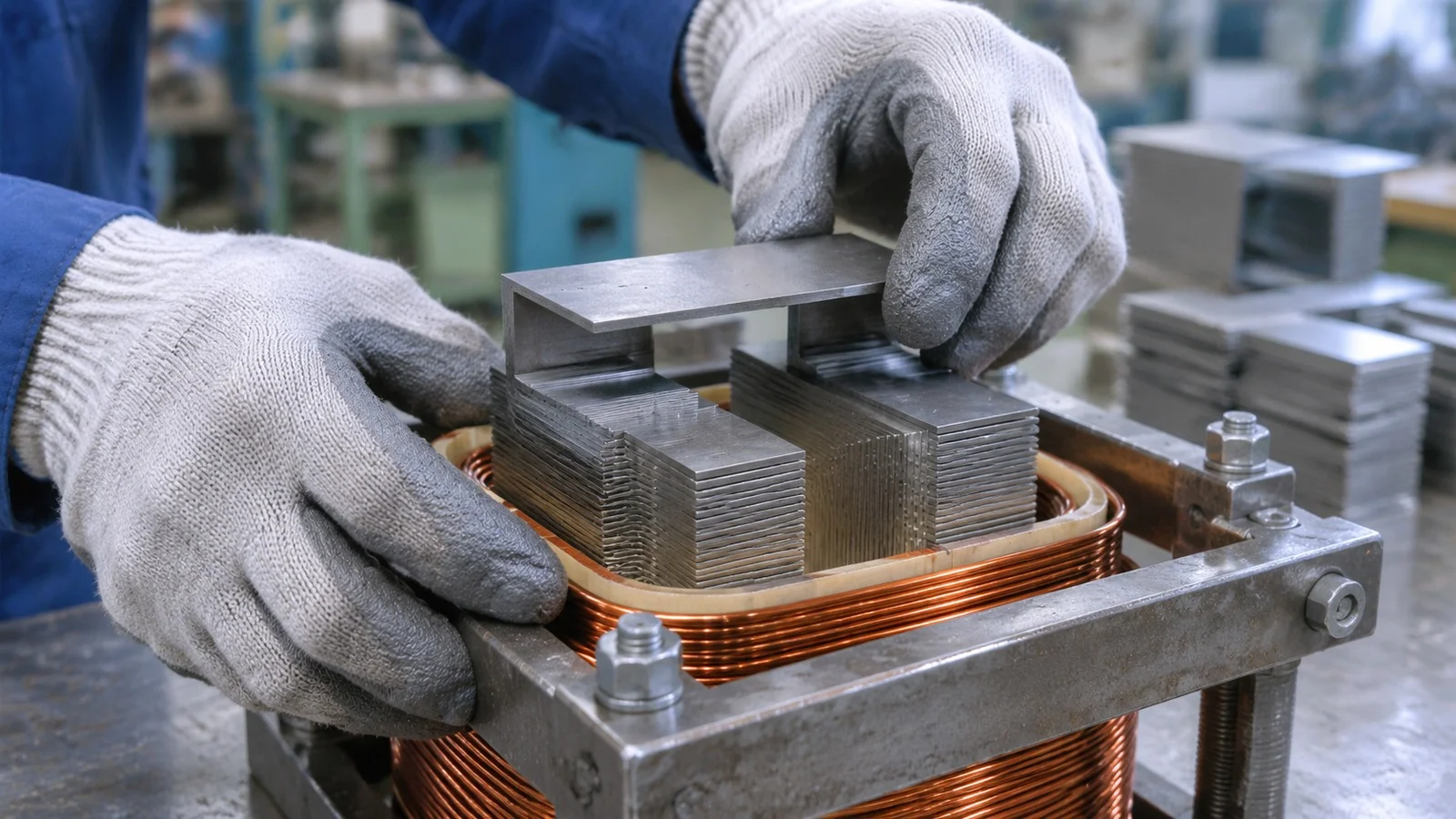
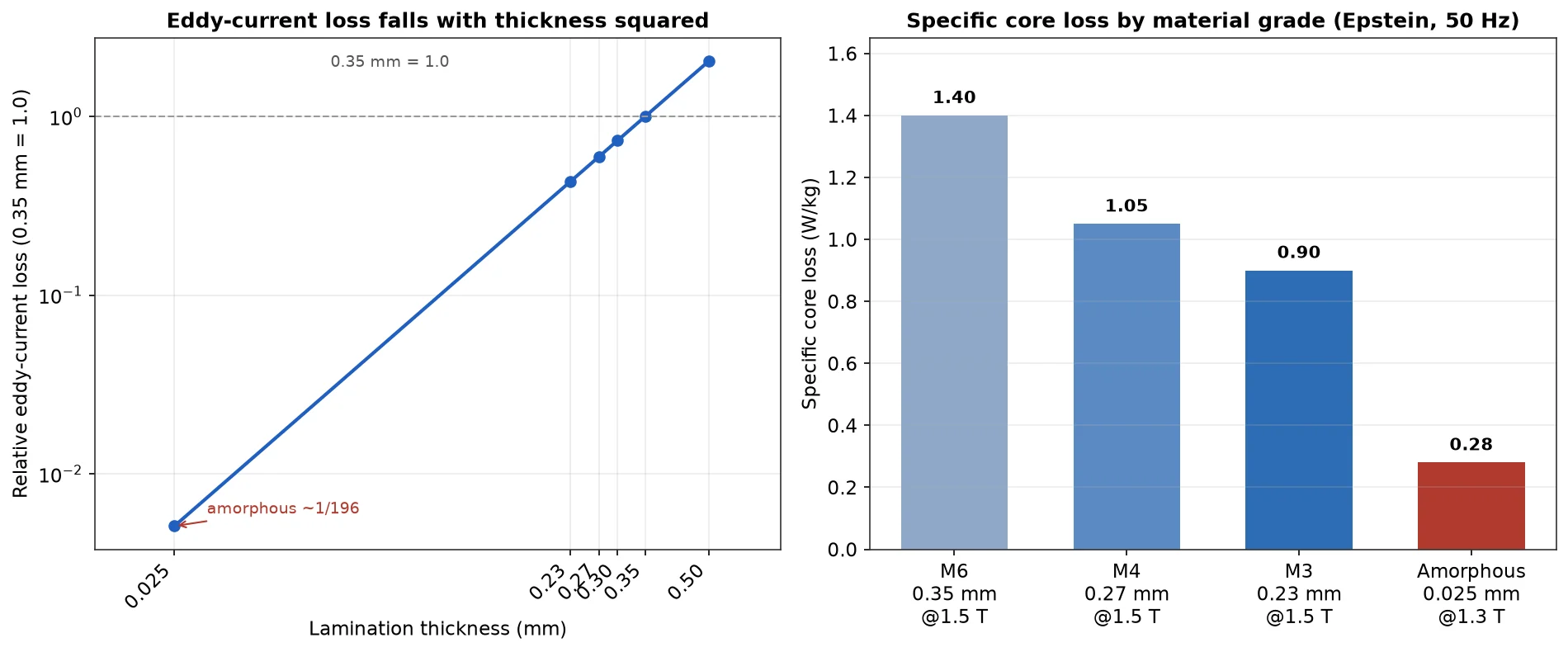
A laminated core is stacked from thin grain-oriented electrical steel (GOES) sheets, clamped into an E-I, U-I or C-core shape, each sheet coated so eddy currents cannot circulate through the whole stack. Standard thicknesses run 0.50, 0.35, 0.30, 0.27 and 0.23 mm; eddy loss falls with the square of thickness, so a 0.35 mm sheet has about 2.4 times the loss of a 0.23 mm sheet of the same grade.
Laminated construction wins this band for unglamorous reasons. Standard bobbins fit standard window sizes, so a 1 kVA unit needs no new tooling. Butt joints between E and I sheets add a small air gap that softens inrush — often a benefit. Heat escapes through the core, which contacts the coil on three sides, and a damaged stack can be re-stacked where a toroid is scrap. The trade-offs are more leakage flux, more joint hum, and a boxier package.
A toroidal core is wound from continuous GOES strip into a doughnut, flux following the rolling direction the whole way with no joints in the magnetic circuit. Wire is applied by passing it through the hole with a shuttle — slow, hard to automate, and why a toroid costs more than an equivalent laminated unit.
The payoff: no air gap and a closed path mean low magnetizing current and stray field often quoted an order of magnitude below a comparable E-I design, plus lower noise because there are no joints to rattle.
Three things surprise first-time buyers. The closed path cuts both ways, so inrush can be higher than a laminated design. Inner windings are buried under outer ones and cool poorly, so the same temperature rise needs a larger core. And a metal fastener through the centre creates a shorted turn, fixed with an insulating washer and a single-point clamp. For winding geometry, see transformer winding types.
Amorphous Core: The Lowest Loss and the Highest Entry Threshold
Amorphous metal is cast as ribbon about 0.025 mm thick — fourteen times thinner than a 0.35 mm lamination. Since eddy loss scales with thickness squared, the eddy component drops by close to two orders of magnitude, and published specific losses land around 0.25–0.30 W/kg against 1.3–1.5 W/kg for common 0.35 mm GOES.
Two penalties follow. Amorphous saturates near 1.56 T where GOES reaches 1.8–2.0 T, so designs run at 1.3–1.35 T and need a larger core; the ribbon is brittle, must be annealed in a magnetic field and rebuilt as a cut core, and stacking factor drops to 0.80–0.86.
So the premium is driven by assembly labour, not material — why amorphous is routine at distribution scale, where hundreds of kilograms of core amortize the tooling, and almost unheard of at 1 kVA. A lower saturation limit also thins the flux margin, covered in Sättigung des Transformatorenkerns.
Laminated, Toroidal and Amorphous Core Comparison
Typical values for 50/60 Hz dry-type units in the 100 VA–10 kVA band, not guaranteed limits. Narrow transformer core types to one candidate, then verify against test data.
Property
Laminated (E-I / U-I)
Toroidal
Amorphous
Core material
GOES sheet, 0.23–0.50 mm
GOES strip, 0.23–0.35 mm, continuous
Amorphous ribbon, ~0.025 mm
Typical design flux density
1.5–1.7 T
1.5–1.6 T
1.3–1.35 T
Specific core loss
0.9–1.5 W/kg
0.9–1.3 W/kg
0.25–0.30 W/kg
Stacking factor
0.95–0.97
0.90–0.95
0.80–0.86
Stray field at 300 mm
Highest
Lowest
Niedrig
Audible noise
Highest (joint hum)
Lowest
Moderate, needs firm clamping
Inrush current
Moderated by joint gaps
Highest for same design flux
High, tighter saturation margin
Relative cost at 1 kVA
Baseline
1.5–2.5×
Rarely quoted below ~15 kVA
Availability, 100 VA–10 kVA
Standard catalogue
Custom or audio/medical stock
Not normally offered
Core Loss Numbers: Lamination Thickness and Flux Density
Specific loss in W/kg is the only fair comparison because it normalizes out transformer size. Published figures for common grades, at 50 Hz:
Material
Thickness
Reference flux density
Specific loss
Conventional GOES (M6-class)
0.35 mm
1.5 T
1.3–1.5 W/kg
High-permeability GOES (M4-class)
0.27 mm
1.5 T
1.0–1.1 W/kg
Laser-scribed GOES (M3-class)
0.23 mm
1.5 T
0.85–0.95 W/kg
Amorphous ribbon
~0.025 mm
1.3 T
0.25–0.30 W/kg
Apply two corrections. The building factor: a finished core with joints, clamping pressure and handling damage loses 1.15–1.30 times what an Epstein strip sample does. The reference flux density: amorphous figures are quoted at 1.3 T, not 1.5 T, so the roughly 5× advantage above is already like-for-like.
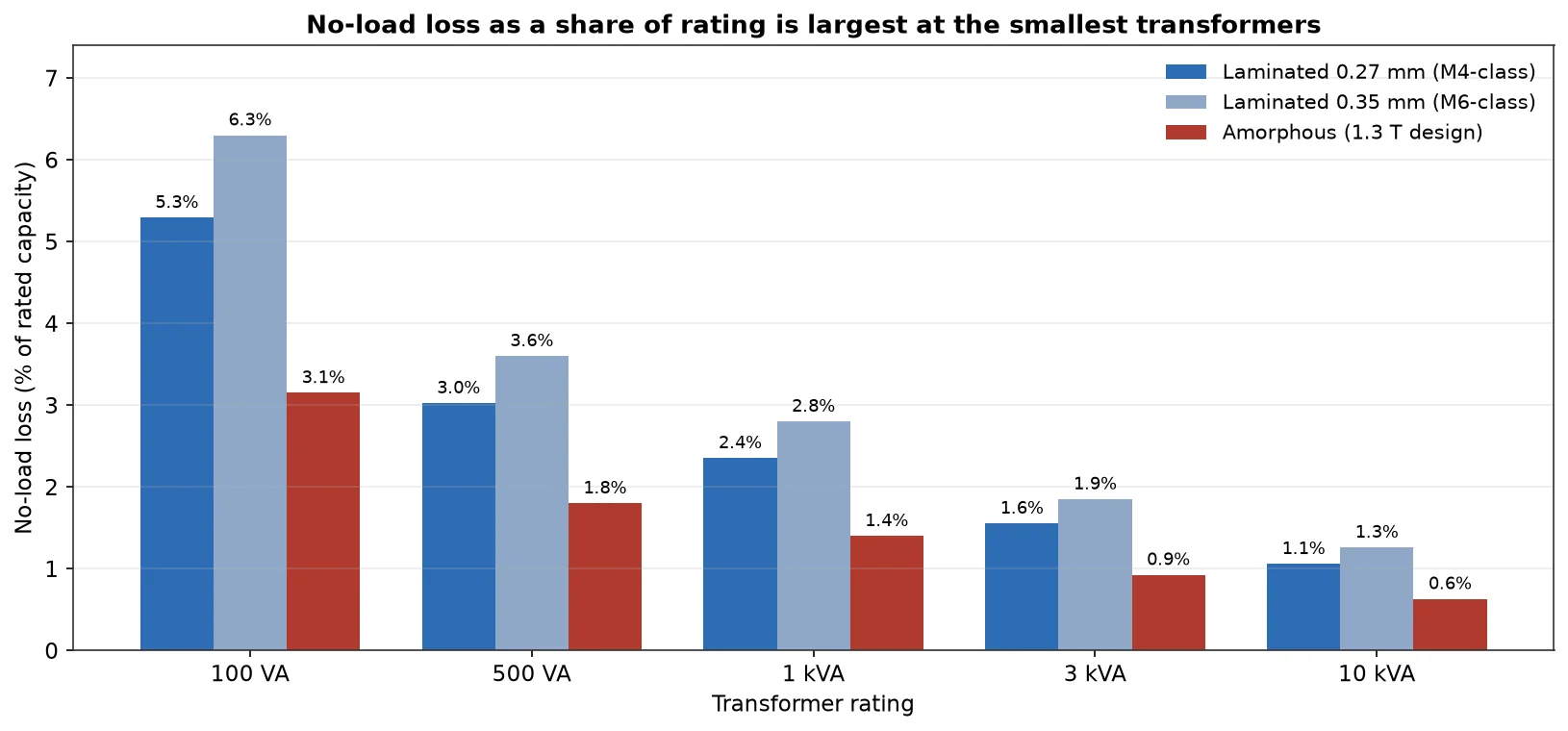
Now apply it. A 1 kVA, 50/60 Hz EI unit typically shows 20–40 W of no-load loss, about 2–4% of rating. Switching to 0.27 mm M4-class steel cuts specific loss 25%, but the core is only ~65% of total no-load loss, so the total falls ~16%. Amorphous cuts core loss by three quarters but needs 15% more iron, landing total loss near half.
The conclusion is uncomfortable but useful: at 100 VA–10 kVA the material family matters less than the grade within it and the flux density the designer picked. Dropping design flux density from 1.5 T to 1.3 T cuts core loss by roughly a fifth for about 15% more core — far cheaper than asking for amorphous.
What Core Type Changes Beyond Loss: Inrush, Noise and Size
Inrush. At switch-on the core can saturate for the first few cycles and draw many times rated current. Laminated butt joints add an effective gap that limits the excursion; a continuous toroidal path does not, so a toroid can trip a breaker a laminated unit would not.
Noise. Magnetostriction changes the core’s shape twice per cycle, and joints and loose clamps amplify it. A toroid is quietest, a laminated stack loudest, amorphous sits between the two. Between 45 and 55 dB(A) at one metre is background versus complaint.
Size and weight. Usable flux density sets core cross-section, so amorphous needs more iron and stacks less densely — an amorphous core is larger than a GOES core of equal rating.
No-load loss as a share of rating is largest at the bottom of the range: a 100 VA unit can lose 6% standing idle, a 10 kVA unit closer to 1.3%. To convert those percentages into annual kWh, see transformer no-load loss.
Matching Core Type to the Application
Anmeldung
Recommended core
Grund
General 110/220 V conversion, machine supply
Laminated E-I, 0.35 mm
Lowest cost, standard stock, adequate loss
Continuously energised control or instrument supply
Core claims are easy to write and hard to check after delivery. Ask for these seven items in writing:
Material grade and thickness as a standard designation plus millimetres — 0.35 mm M6-class, 0.27 mm M4-class. “High-quality silicon steel” is not a specification.
Guaranteed no-load loss in watts, with the flux density and frequency at which it applies.
No-load current in amperes or as a percentage of rated current — the number that exposes a core built from too little iron.
Core weight and stacking factor, so a low loss claim can be checked against the iron specified.
Sound level in dB(A) at one metre, at rated voltage and no load.
Temperature rise and insulation class; short-margin symptoms appear in transformer overheating.
Core construction — E-I or U-I, clamped or bolted, varnish impregnated or not. Impregnation is what stops a stack getting louder over its service life.
You can check the first two without a laboratory: an open-circuit test, rated voltage on the low-voltage winding with the high side open, measures both directly.
Fazit
Laminated, toroidal and amorphous are not three interchangeable answers. In the 100 VA–10 kVA range, laminated E-I is the default because it is cheap, available and repairable; toroidal is right when stray field, noise or volume bind; and amorphous is a large-transformer technology whose loss advantage cannot cover its assembly cost at small ratings. What actually moves your no-load loss is lamination grade and design flux density. Sizing a unit for a specific duty cycle? Send the load profile and the core can be matched before the order is placed.
FAQ
Which transformer core type is most efficient?
Amorphous metal, at 0.25–0.30 W/kg against 1.3–1.5 W/kg for conventional 0.35 mm grain-oriented steel. Among laminated types, toroidal is most efficient because the flux path is continuous.
Is a toroidal transformer better than a laminated one?
Better on stray field, noise and volume; worse on cost, inrush current, cooling and repairability. For audio and medical equipment the trade is usually worth it.
Why is amorphous core not used in small transformers?
Because cost is driven by assembly, not material. At 1 kVA the annealing and cut-core assembly can exceed the price of the transformer, while the energy saved is only tens of kWh a year.
Does a thinner lamination always mean lower loss?
Yes for the eddy-current component, which falls with the square of thickness, so 0.27 mm sheet loses roughly 40% less to eddy currents than 0.35 mm. Hysteresis loss does not improve with thickness alone.
How can I tell what core is inside a transformer?
Run an open-circuit test: apply rated voltage to the low-voltage winding with the high side open and measure input power and current. Compare the watts against the guaranteed no-load loss.
Prove the tap changer is guilty before you open it: a symptom-first fault table for rotary selectors and OLTCs, acceptance test values, and the twenty-minute annual check.
An on-load tap changer regulates under load; an off-load tap changer needs a de-energized visit. Why an OLTC never fits 100 VA to 10 kVA units, plus real tap-selection math on a 1000 VA transformer.
A buyer-focused comparison of transformer winding types for 100VA-10kVA dry-type units: where layer, disc and foil windings each make sense, and what to specify on your next RFQ.