Transformer Overheating: 5 Warning Signs Before Failure
Veröffentlicht: Autor: Lisa
A Transformator rarely fails without telling you first. The earliest messages are quiet: a case that is warmer than it was last quarter, a hum that sits slightly lower in pitch, a terminal screw that needs another quarter turn this year. By the time smoke appears, the insulation has usually been degrading for months.
This guide ranks five transformer overheating symptoms in the order they appear, gives the thresholds that separate normal from alarming on units from 100 VA to 10 kVA, and sets out what to do at each stage. For the underlying physics and root causes, read our guide to the causes and hazards of transformer overheating.
Why Overheating Always Leaves a Trail
Insulation does not fail at a threshold. It ages, and the rate is brutally sensitive to temperature: every 8 to 10°C of sustained rise above the rated hottest-spot temperature halves the remaining insulation life. A unit running 10°C hotter than it should loses roughly half its life, not ten percent.
That changes what you measure. The useful question is not “is this transformer hot?” but “is it hotter than it used to be at the same load?” Two units can both show 70°C. One has run there since commissioning; the other climbed from 55°C in three months, and that climb is the warning.
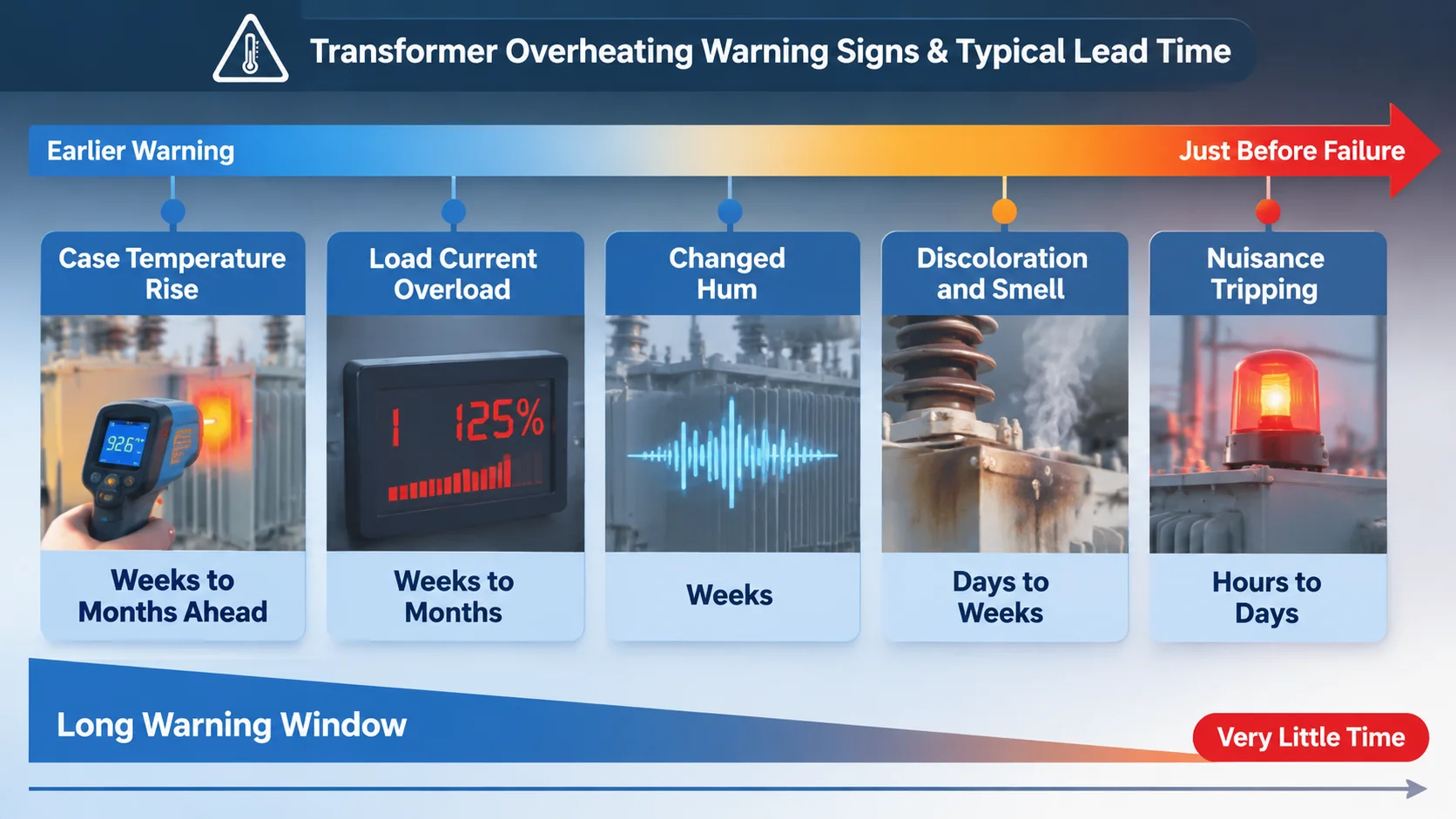
The five signs arrive in a predictable order, each reflecting a different depth into the failure chain. Temperature rises first, since it responds to extra loss anywhere. Load current identifies the cause. A change in sound points to something magnetic or mechanical. Discoloration means insulation has already been altered. Nuisance tripping means the fault has become electrical.
Warning Sign 1: A Case That Runs Hotter Than Its Own Baseline
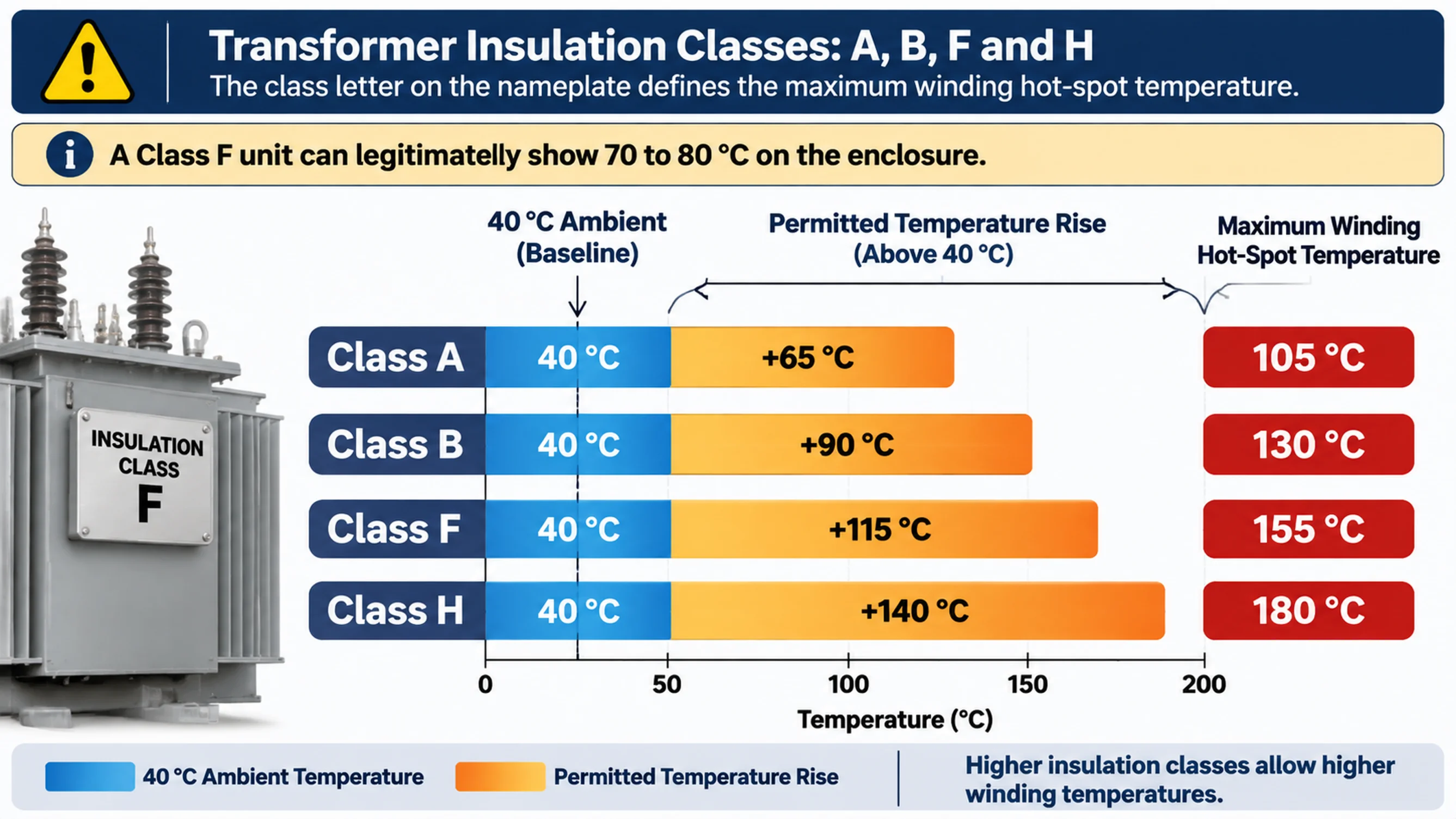
Absolute temperature is only half the story. The class letter on the nameplate defines the limit for the hottest point inside the winding.
Isolierstoffklasse
Maximum winding hot-spot
Typical use in small units
Class A
105°C
Older impregnated and paper-insulated designs
Class B
130°C
Encapsulated and general-purpose dry-type
Class F
155°C
Industrial control and step up / step down units
Class H
180°C
High-ambient and high-temperature applications
Those are winding temperatures, not case temperatures. A Class F unit under full load in a 40°C panel can legitimately show 70 to 80°C on the enclosure, because the case is shedding heat from a much hotter interior. Condemning it because it is uncomfortable to touch is the most common false alarm in the field.
What you want is a baseline and a trend: case temperature at a known load and ambient, repeated at the same load. A rise of 10°C or more with the load unchanged is a genuine early warning. If the temperature rise figure on the nameplate confuses you, our guide to reading a transformer nameplate walks through the rating fields.
Measure with an infrared thermometer, not your hand. Shiny bare metal reads 20 to 30°C low on a cheap IR gun, so tape the surface and aim at that. Never touch terminals, and never touch a case whose history you do not know.
Warning Sign 2: Load Current Creeping Toward the Nameplate
Temperature tells you something is wrong; current usually tells you why. Clamp every supply conductor and compare the reading with nameplate kVA divided by supply voltage. Because copper loss rises with the square of current, a sustained 20 percent overload produces roughly 44 percent more winding heat.
Two patterns are easy to miss. The first is the slow creep: a unit commissioned at 60 percent of rating that now sits at 95 percent because equipment was added over several years. Nothing failed, nothing alarmed, and the transformer has been cooking at its limit. The second is imbalance on a three-phase unit, where total current looks fine but one phase carries far more and that limb overheats. If you find either, work the numbers with our guide on how to calculate transformer overload before deciding whether to redistribute load or replace the unit.
Warning Sign 3: A Hum That Changed Character
All transformers hum. The sound comes from magnetostriction, the expansion and contraction of core laminations as flux reverses every half cycle. It is normal, steady, and proportional to flux density. What matters is a change.
Listen at two conditions: secondary disconnected, then at normal load. A loud hum at no load points to overvoltage, core saturation, or a DC component on the supply. A hum that turns rough or develops a beat under load points to loose laminations, harmonic distortion, or mechanical resonance. Any of these raises losses and temperature without the current exceeding rating. Our article on why low voltage transformers make noise separates the harmless cases from the ones that need attention.
Warning Sign 4: Discoloration, Smell and Stiff Insulation
This sign moves the situation from monitoring to intervention. Winding varnish darkens from honey to near-black as it oxidizes. Enclosure paint browns or blisters above a hot spot. Lead insulation goes stiff and brittle.
Smell is more decisive. A sharp, ozone-like odor suggests arcing or corona discharge; scorched paper or hot varnish means insulation is already carbonizing. Neither is reversible, and neither should be investigated with the unit energized. Isolate it, let it cool, and take an insulation resistance reading before returning it to service.
Warning Sign 5: Nuisance Trips and Terminals That Keep Loosening
When a breaker or thermal relay trips at a load you know is within rating, the protection is not the problem. Repeated trips mean the current path has developed a fault, most often a turn-to-turn short that reduces the effective winding and draws more current for the same output. The same logic applies to terminal screws needing re-torquing every few months: thermal cycling from a poor contact loosens them, the looser contact runs hotter, and the cycle tightens until the terminal fails. At this stage the unit comes out of service; re-energizing to “see if it does it again” is how a repairable transformer becomes a fire.
The Lead-Time Table: Which Sign Comes First
Warning sign
What it tells you
Typical lead time
First action
Case temperature 10°C above its own baseline
Extra loss somewhere in the unit
Weeks to months
Log it, clamp the current
Load current at or above 90% of nameplate
Cause identified: sustained overload
Weeks to months
Redistribute load or plan an upgrade
Hum changed pitch or became rough
Core, harmonic or mounting change
Weeks
Check supply quality and mounting
Discoloration, brittle leads, hot smell
Insulation already degraded
Days to weeks
Isolate and test insulation resistance
Nuisance trips, terminals that keep loosening
Internal fault developing
Hours to days
Remove from service, do not re-energize
What Looks Like Overheating but Is Not
A Class H unit at 80°C case temperature. That is the design working, not failing. Check the class first.
A hot afternoon. A 40°C workshop adds 15 to 20°C to every surface in it. Compare readings taken at the same time of day.
The first minutes after a motor starts. Inrush is many times running current, and a brief warm-up afterwards is expected.
An IR gun aimed at shiny metal. Emissivity error, not a fault. Tape the surface and re-measure.
A blocked filter or closed cabinet door. The unit is fine; the enclosure is not. Fix airflow first.
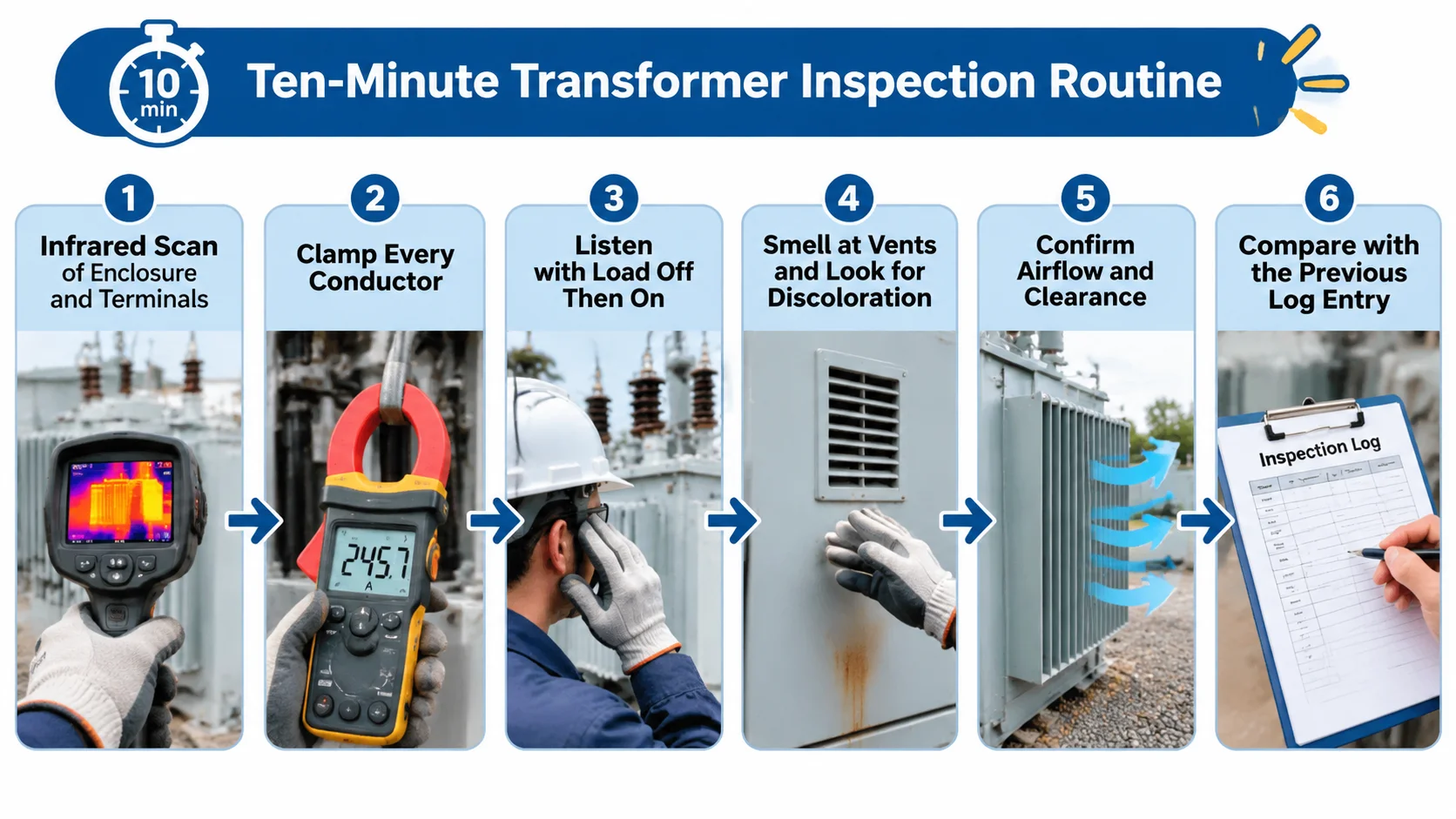
A Ten-Minute Walk-Up Inspection
Scan the enclosure top, terminals, and windings visible through the vents with an infrared thermometer. Record the highest reading and where it was.
Clamp every supply conductor and write down each value, not just the highest.
Listen with the load off, then on. Note any change in pitch or roughness.
Smell at the vents and look for discoloration at terminals and lead exits.
Confirm airflow through the vents and clearance around the case.
Compare all of it with the previous log entry. The comparison is the finding.
If you need to verify thermal behaviour under controlled conditions, feed the unit from an adjustable supply and raise the input in steps while watching temperature and current together. A TDGC2J variable transformer with a pointer meter is the usual bench tool, because the dial gives a repeatable voltage point instead of a guess.
When to Replace Instead of Keep Monitoring
Monitoring has a limit. Replace rather than keep watching if insulation resistance has fallen and does not recover; if there has been a hot smell or smoke; if nuisance trips recur; if the unit runs above 90 percent of rating most of the time; or if it is over ten years old with a rising baseline. A planned replacement costs less than an unplanned outage.
Final Thoughts
Transformer overheating symptoms are rarely dramatic until the last few hours. A baseline temperature, a clamp reading, and the habit of listening are enough to catch the problem early. If your measurements point to a unit that is simply too small for the job, browse our Aufwärts- und Abwärtstransformator range, or send us the load, ambient temperature and duty cycle and we will size a replacement with real thermal margin.
FAQ
What are the first signs of a transformer overheating?
A case temperature that has risen against its own baseline at the same load, usually by 10°C or more. A change in the hum often appears at the same stage. Discoloration and smell come later, once insulation has already been affected.
What temperature is too hot for a transformer?
It depends on the insulation class: 105°C maximum winding hot-spot for Class A, 130°C for Class B, 155°C for Class F, and 180°C for Class H. Case temperature is always lower, so a hot enclosure alone does not prove a fault.
Can a transformer overheat below its rated load?
Yes. Harmonic currents from drives and rectifiers raise eddy-current and stray losses without lifting the fundamental current, and high ambient temperature reduces the heat a unit can shed. Either can push winding temperature past the limit at what looks like a safe load.
How long does a transformer last once it starts overheating?
It depends on how far above the limit it runs. Because each sustained 8 to 10°C above the rated hot-spot roughly halves insulation life, a unit running 10°C hot may have months rather than years left.
Should I keep running a transformer that smells hot?
No. A smell of scorched varnish or paper means insulation is already carbonizing, and continued operation risks a short circuit or fire. Isolate the unit, let it cool, and test insulation resistance before deciding whether it can be repaired.
How to read a transformer quotation: the cost blocks behind the unit price, the seven costs that appear after it, how Incoterms change the landed number, and a sheet for comparing three quotes fairly.
Transformer voltage regulation is the percentage drop in secondary voltage from no load to full load. Learn the formula, a 2 kVA worked example, a bench procedure, and six ways to improve it.
XFMR on electrical drawings simply means transformer — but the tag alone carries no ratings. Learn where it appears, which tags get confused with it, and the twelve fields that make it orderable.