Wie viele Leuchten kann ich an einen Niederspannungstransformator anschließen?
Veröffentlicht: Autor: Lisa
A Niederspannungstransformator is the quiet workhorse behind every safe landscape lighting system. It steps standard 120V household power down to 12V or 24V so you can bury cable, mount fixtures near soil and water, and handle connections without the risks that come with line voltage. But before you start connecting path lights, spotlights, and deck fixtures, one question always comes up: how many lights can I put on a low voltage transformer?
The short answer is that there is no fixed fixture limit. The real limit is wattage. You can add as many lights as you like as long as their combined wattage stays within the transformer’s rated capacity and leaves a safety margin for reliable operation. In this guide, you will learn how to calculate that number for your own outdoor lighting project, why the 80% rule matters, and how voltage drop and bulb type can change the math.
What Determines How Many Lights a Transformer Can Handle?
Three variables control how many fixtures a single low voltage transformer can support: the transformer’s wattage rating, the wattage of each light, and the safety margin you leave for long-term performance.
Transformer wattage rating
Every low voltage transformer is rated for a maximum load, usually shown in watts (W) or volt-amps (VA). Common residential sizes range from 100W to 1200W. That number is the ceiling, not the target. Running at the ceiling leaves no room for inrush current, temperature swings, or future expansion.
Wattage per fixture
Modern LED path lights typically draw 2W to 5W each, while LED spotlights and floodlights may use 7W to 15W each. Older halogen fixtures use 20W to 50W each. Always use the actual wattage printed on the fixture or bulb, not the incandescent-equivalent brightness rating sometimes shown on packaging.
The 80% safety margin
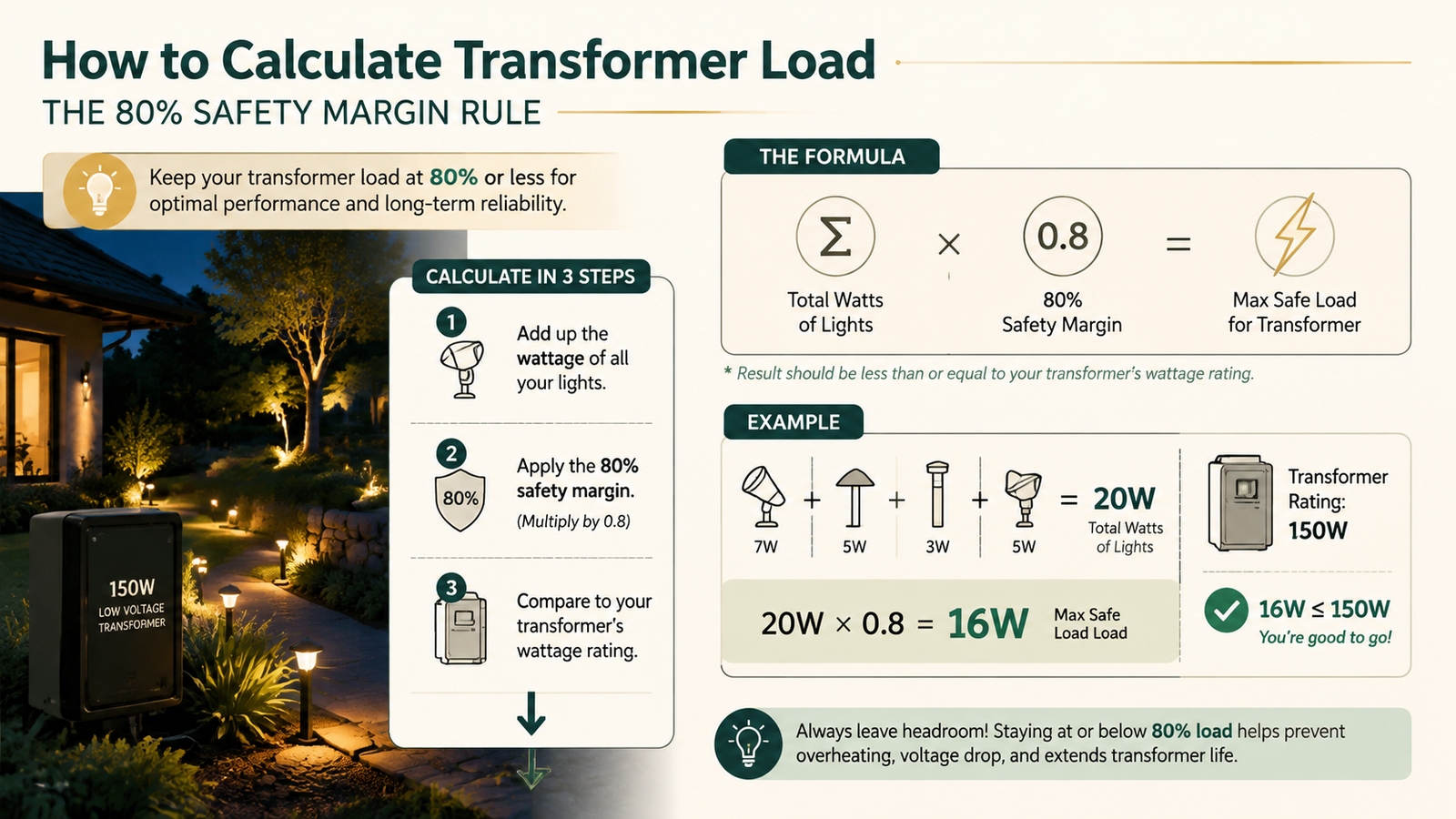
Industry best practice is to load a transformer to no more than 80% of its rated capacity. This buffer protects against overload, reduces heat, extends transformer life, and leaves headroom for a few extra lights later. Mathematically, loading to 80% is the same as multiplying your total fixture wattage by 1.25 to find the minimum transformer size you need.
Quick Formula for Calculating Light Count
Use this simple formula once you know your transformer’s rating and the wattage of each light:
Maximum safe fixture count = (Transformer wattage × 0.8) ÷ Wattage per fixture
For example, if you have a 150W transformer and plan to use 5W LED path lights, the calculation is:
If you prefer to size the transformer to match an existing fixture list, reverse the math:
Minimum transformer size = Total fixture wattage × 1.25
For example, twenty 4W path lights give you 80W total. Multiplying by 1.25 gives 100W, so a 150W unit would be a comfortable choice with room to grow.
Light Count Reference Table
The table below shows approximate fixture counts for common transformer sizes and fixture wattages. Use it as a quick reference, then confirm against your actual fixture ratings and wire layout.
Transformer rating
Safe load (80%)
4W LED lights
7W LED lights
10W LED lights
35W halogen spots
100W
80W
20
11
8
2
150W
120W
30
17
12
3
300W
240W
60
34
24
6
500W
400W
100
57
40
11
600W
480W
120
68
48
13
LED vs. Halogen: How Bulb Type Changes the Count
The type of bulb you choose has a bigger impact on fixture count than many people realize. LED landscape lights use 75% to 90% less power than halogen equivalents. That means a 150W transformer that can run three 35W halogen spotlights can run roughly seventeen 7W LED spotlights or thirty 4W LED path lights.
LEDs also run cooler, last longer, and maintain consistent color temperature when voltage is stable. For most residential and commercial outdoor lighting projects today, LED fixtures are the practical choice because they let you do more with a smaller transformer.
Voltage Drop: Why Distance Also Matters
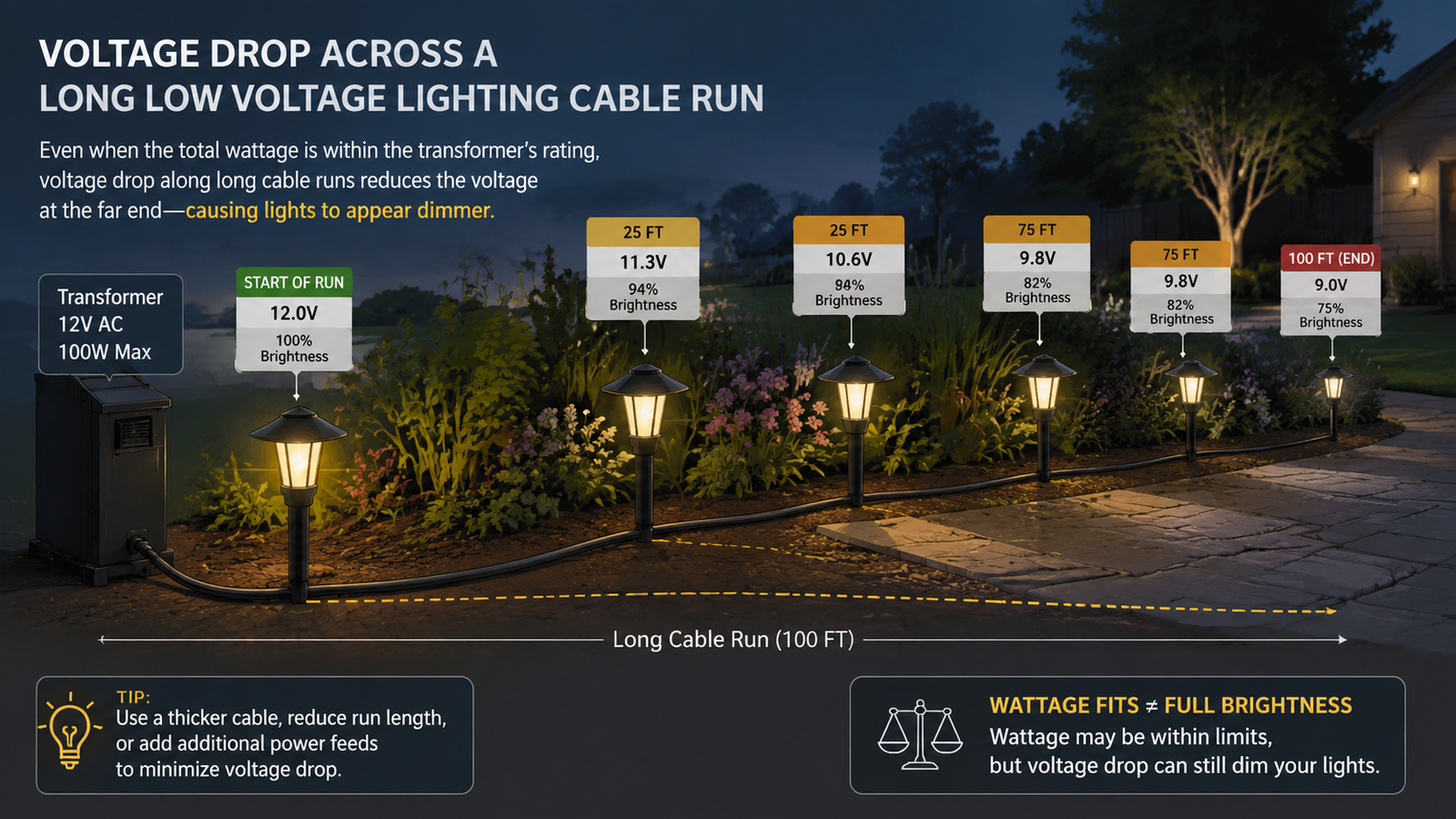
Even if your total wattage fits within the 80% rule, long cable runs can still leave the far end of your circuit looking dim. This happens because wire resistance causes voltage drop: the farther electricity travels, the more voltage is lost along the way.
Voltage drop becomes more noticeable at 12V than at 120V. A 1V loss on a 12V circuit is more than 8%, while the same 1V loss on a 120V circuit is less than 1%. To keep landscape lighting bright and even, aim for a voltage drop below 10% and ideally under 5%.
You can reduce voltage drop by:
Using thicker wire: 12/2 is common for moderate runs, while 10/2 helps on long runs.
Keeping the transformer centrally located so no single run is unnecessarily long.
Splitting fixtures across multiple circuits or transformer zones instead of daisy-chaining everything on one line.
Choosing a multi-tap transformer with 12V, 13V, 14V, or 15V outputs to compensate for drop on long runs.
Practical Example: Sizing for a Garden Path
Imagine you want to light a 40-meter front walkway with fourteen 4W LED path lights and four 7W LED spotlights for two trees. The math looks like this:
Path lights: 14 × 4W = 56W
Spotlights: 4 × 7W = 28W
Total load: 84W
Minimum transformer size: 84W × 1.25 = 105W
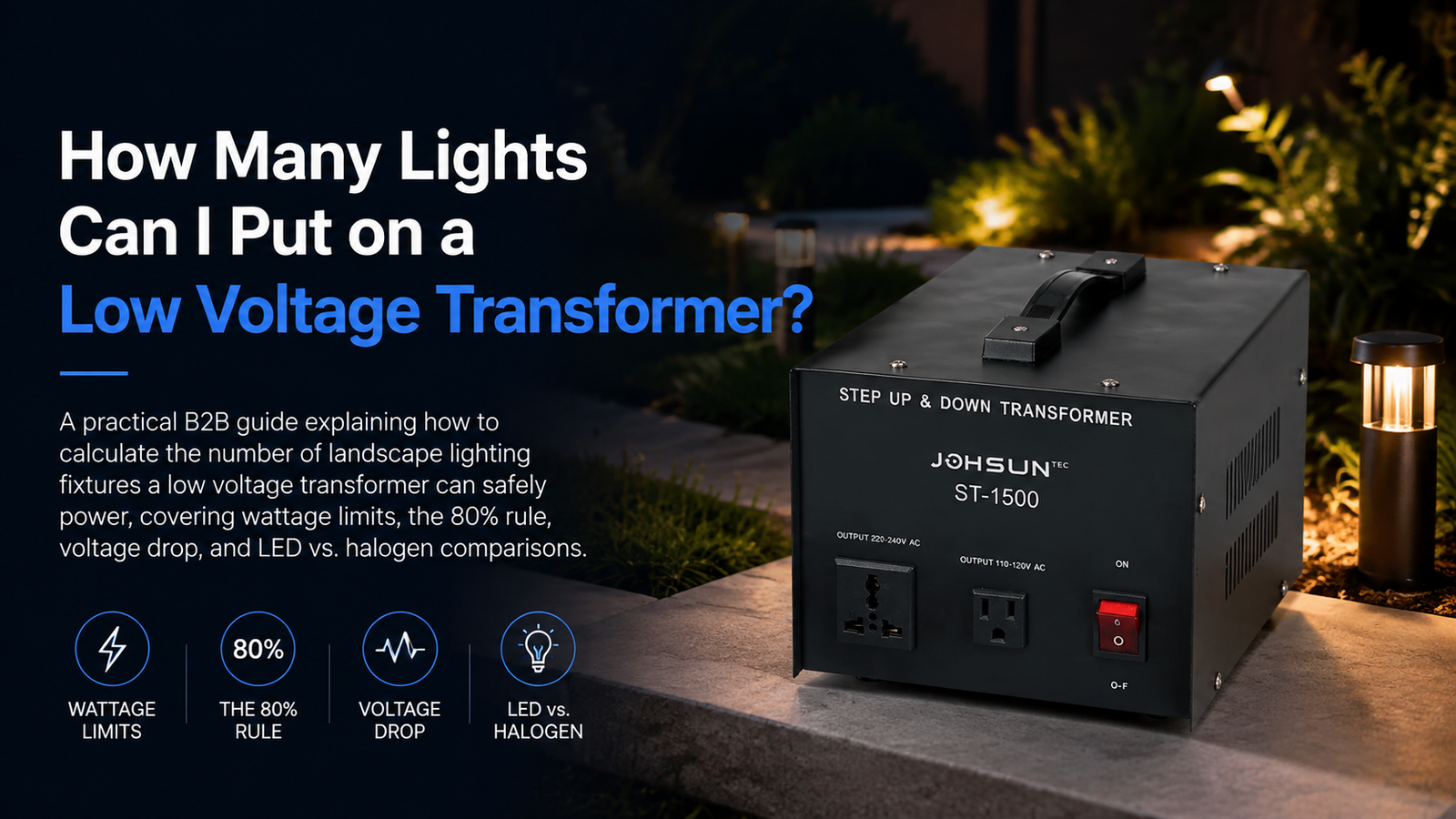
A 150W transformer would be a smart choice. It gives you 120W of safe capacity, covers the 84W load comfortably, and leaves room for a few future fixtures. For a project like this, the ST-1500VA step-up and step-down transformer offers a flexible capacity point for small-to-medium outdoor lighting loads.
When to Split Your Lights Across Multiple Circuits
Once you move beyond a simple path or patio, consider splitting the system into zones. Multi-zone transformers or separate transformers let you control front-yard, backyard, and accent lighting independently. They also reduce voltage drop because each circuit carries less current over shorter distances.
Signs that you should split your layout include:
Total wattage approaching 80% of a single transformer’s rating.
Runs longer than 30 meters to the farthest fixture.
Mixed fixture types with very different wattages on the same circuit.
Desire for independent on/off or dimming control for different areas.
Häufig zu vermeidende Fehler
Ignoring the 80% rule. Running a transformer at 95% or 100% of capacity may work briefly, but it shortens lifespan and leaves no margin for inrush current.
Using equivalent wattage instead of actual wattage. A “40W equivalent” LED may only draw 5W. Use the real number.
Oversizing dramatically. An unregulated magnetic transformer running far below capacity can push secondary voltage above 12V and shorten LED life.
Forgetting voltage drop. A transformer sized correctly for wattage can still produce dim lights at the end of a long, thin cable run.
Mixing AC and DC fixtures. Most low voltage landscape transformers output 12V AC. LED drivers designed for 12V DC may not work correctly on AC output.
Fazit
How many lights you can put on a low voltage transformer depends on simple arithmetic: add up fixture wattage, apply an 80% safety margin, and divide by the wattage of each light. A 150W transformer can comfortably run twenty to thirty small LED fixtures, while the same unit may only support a handful of halogen spotlights.
Remember to also account for voltage drop, bulb type, and whether you need multiple zones. If you are sizing a transformer for a new landscape or garden lighting project and want a unit with proven build quality, explore our Aufwärts- und Abwärtstransformator range or read our deeper guide on how low voltage transformers work.
Häufig gestellte Fragen
Can I exceed the 80% load rule for a short time?
No. Sustained loading above 80% increases heat, reduces transformer life, and can trip internal breakers. The 80% guideline is a design target, not a temporary ceiling.
How many 5W LED lights can I run on a 300W transformer?
A 300W transformer has 240W of safe capacity at 80%. Divided by 5W per fixture, you can run approximately 48 lights under ideal conditions. Long cable runs may reduce the practical count due to voltage drop.
Does the number of fixtures matter more than total wattage?
Total wattage matters far more than fixture count. Ten 3W LEDs draw the same power as one 30W halogen. Always size by watts, not by the number of fixtures.
What wire gauge should I use for low voltage landscape lighting?
14/2 works for short, lightly loaded runs. 12/2 is the most common choice for residential installations. Use 10/2 for long runs or heavily loaded circuits to keep voltage drop within acceptable limits.
Can I mix LED and halogen lights on the same transformer?
Yes, as long as the combined wattage stays under 80% of the transformer’s rating and all fixtures are compatible with the transformer’s AC or DC output. Keep in mind that halogen fixtures draw much more power and generate more heat.
Should I buy a larger transformer than I need today?
Buy one size larger than your current load if you plan to expand within a few years, but avoid dramatically oversizing. A unit loaded between 50% and 80% of capacity usually delivers the best balance of efficiency, voltage stability, and longevity.
Recommended Models for Low-Voltage Lighting Loads
If you are specifying a unit rather than reading theory, start here. These models cover the capacity bands most often requested for low-voltage lighting loads, and each links straight to its specification and price range.
Tell us the input voltage, output voltage, phase and continuous kVA you need, and we will confirm the matching model, price and lead time within one business day. Non-standard ratings are handled through OEM/ODM custom transformer manufacturing.
230-V-auf-110-V-Transformator für die Niederlande: NEN 1010, 30-mA-Fehlerstromschutzvorschriften, „Aardlekschakelaar“ versus „Aardlekautomaat“ und Sekundärerdung.