A 3-Phasen-Autotransformator ändert die Spannung einer dreiphasigen Wechselstromversorgung über Wicklungen, die einen gemeinsamen elektrischen Abschnitt aufweisen. Im Gegensatz zu einem herkömmlichen Trenntransformator sind dessen Ein- und Ausgang leitend miteinander verbunden. Diese Konstruktion mit gemeinsamer Wicklung kann die Größe, den Kupferverbrauch, die Kosten und die elektrischen Verluste reduzieren, wenn die erforderlichen Ein- und Ausgangsspannungen relativ nahe beieinander liegen.
Ein JOHSUN-Dreiphasen-Autotransformator ist eine anwendungsspezifische Lösung zur Spannungsumwandlung für Industrieanlagen, Fertigungslinien, Motoren, Prüfsysteme und importierte Maschinen. Er kann so konfiguriert werden, dass er die Spannung erhöht oder senkt, wandelt jedoch keinen Einphasenstrom in Dreiphasenstrom um. Sowohl die Quelle als auch die Last müssen kompatible Dreiphasensysteme sein.
Wie funktioniert ein dreiphasiger Autotransformator?
Ein Dreiphasen-Autotransformator wendet dasselbe Prinzip der elektromagnetischen Induktion auf drei Wechselstromphasen an, die im Abstand von 120 elektrischen Grad zueinander liegen. Jede Phase nutzt eine Abgriffwicklung. Ein Teil dieser Wicklung ist sowohl für die Versorgung als auch für die Last gemeinsam, während der verbleibende Teil die Serienwicklung bildet. Die Energie gelangt teilweise durch magnetische Induktion und teilweise über die direkte elektrische Verbindung zum Ausgang.
Bei einem idealen Transformator entspricht das Spannungsverhältnis dem Windungsverhältnis:
Vraus / Vin = Nraus / Nin
Der tatsächliche Netzstrom und die Nennleistung in kVA hängen vom Anschluss, der Stufenschaltung, der Last, dem Einschaltdauerverhältnis, dem Temperaturanstieg und der geltenden Norm ab. Ein Hersteller sollte daher den Leiterquerschnitt, den Kern, die Isolierung, das Gehäuse, die Kühlmethode, die Anschlüsse und die Schutzmaßnahmen anhand der vollständigen elektrischen Spezifikation auswählen – und nicht nur anhand des Spannungsverhältnisses.
Aufbau eines 3-Phasen-Autotransformators
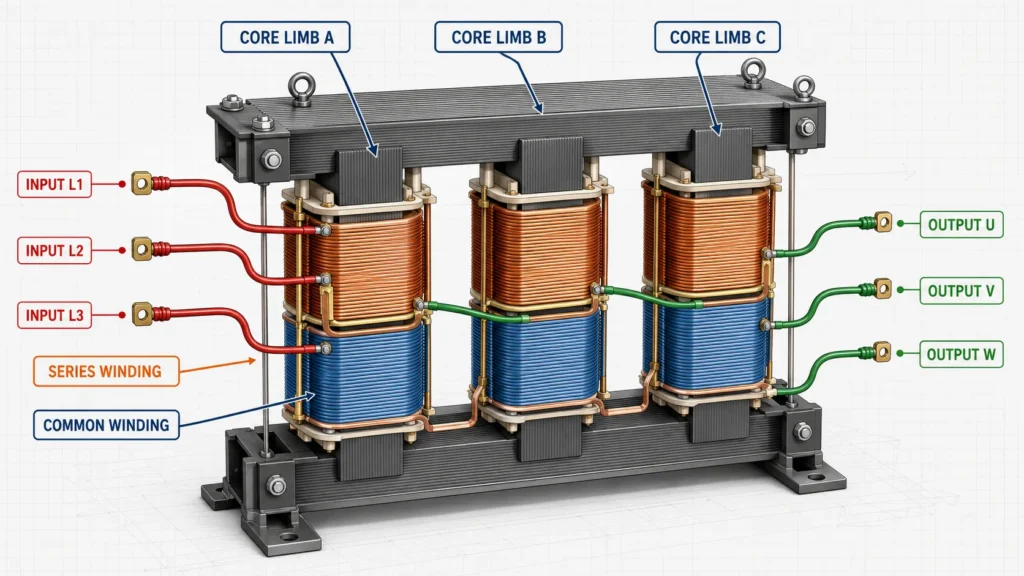
Der Aufbau eines dreiphasigen Autotransformators erfolgt in der Regel entweder mit einem integrierten dreiteiligen Magnetkern oder mit einer Anordnung aus drei einphasigen Einheiten. Bei einer kompakten Dreiflügel-Konstruktion bieten die aus laminiertem Elektro-Stahl gefertigten Kernabschnitte einen Weg mit geringem Reluktanzwiderstand für den Magnetfluss. Isolierte Kupfer- oder Aluminiumleiter sind um die Flügel gewickelt, wobei die Abgriffe an berechneten Windungspositionen herausgeführt werden.
Zu den wichtigsten Teilen gehören in der Regel:
Laminierter Magnetkern: Leitet Wechselstrom und begrenzt dabei die Wirbelstromverluste.
Gemeinsame Wicklung: Wird von den Eingangs- und Ausgangsschaltungen gemeinsam genutzt.
Reihenschaltung: Erhöht oder verringert die Spannung der gemeinsamen Wicklung.
Spannungsabgriffe: Legen Sie das erforderliche feste oder wählbare Umrechnungsverhältnis fest.
Dämmsystem: Trennt Windungen, Phasen, den Kern und zugängliche Metallteile.
Anschlüsse und Gehäuse: Sicherstellung einer sicheren Verbindung, Kühlung, Inspektion und mechanischen Absicherung.
Optionales Zubehör: Dazu können Temperatursensoren, Lüfter, Messgeräte, Schutzschalter, Überspannungsschutz, Räder oder kundenspezifische Klemmenanordnungen gehören.
JOHSUN kann Anforderungen hinsichtlich nicht standardmäßiger Spannungen, kVA, Frequenzen, Gehäuse, Kennzeichnung, Stecker, Anschlüsse und Markenzeichen anhand seiner ODM- und OEM-Dienstleistungen. Die endgültige Ausführung sollte stets unter Berücksichtigung der Installationsumgebung des Projekts und der geltenden elektrischen Vorschriften überprüft werden.
Betrieb von Aufwärts- und Abwärts-Autotransformatoren
Das gleiche Wicklungskonzept kann beide Funktionen erfüllen. In einem Aufwärts- und Abwärts-Autotransformator, die für die Einspeisung und die Last verwendeten Anschlüsse bestimmen, ob die aktiven Ausgangswindungen größer oder kleiner sind als die Eingangswindungen.
Betriebsmodus
Eingangsanschluss
Ausgangsanschluss
Ergebnis
Abwärtswandler
Durch weitere kurvenreiche Abschnitte
Über weniger kurvenreiche Abschnitte
Die Ausgangsspannung ist niedriger als die Eingangsspannung
Step-up
Über weniger kurvenreiche Abschnitte
Durch weitere kurvenreiche Abschnitte
Die Ausgangsspannung ist höher als die Eingangsspannung
Einige Geräte sind für den reversiblen Betrieb ausgelegt, jedoch darf die Reversibilität niemals als selbstverständlich vorausgesetzt werden. Die Nennwerte der Anschlüsse, der Überstromschutz, die Stufenschalterpositionen, die Erdungsanweisungen und das Schema auf dem Typenschild des Herstellers müssen die beabsichtigte Drehrichtung bestätigen.
So lesen Sie einen Schaltplan für einen 3-Phasen-Autotransformator
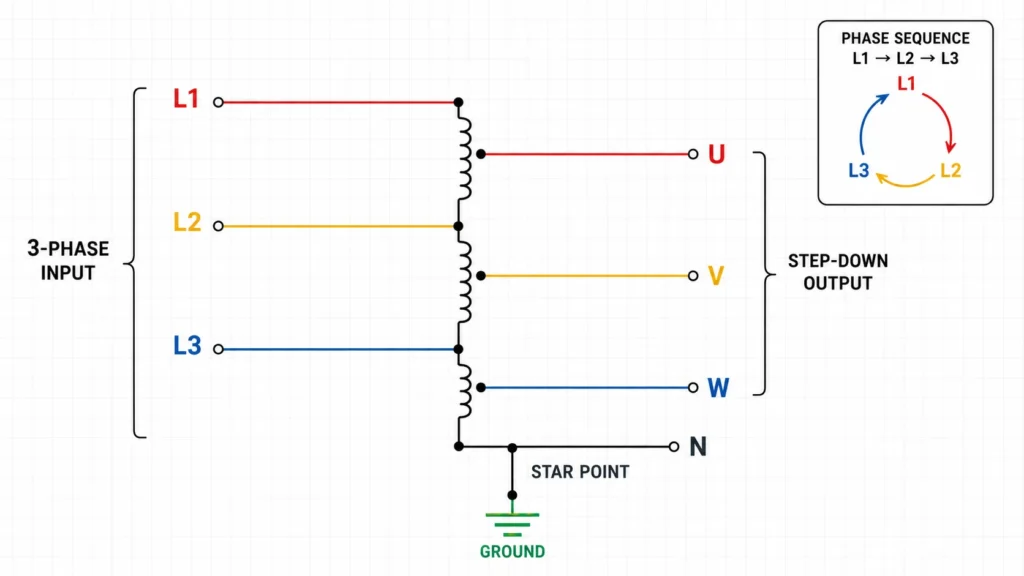
Ein Schaltplan für einen dreiphasigen Autotransformator zeigt in der Regel drei Abzweigwicklungen, die in Sternschaltung (Y-Schaltung) angeordnet sind. Ein Ende jeder Phasenwicklung ist am Sternpunkt angeschlossen, während die drei äußeren Enden an L1, L2 und L3 angeschlossen sind. Die Ausgangsleiter werden von den entsprechenden Abzweigen derselben Wicklungen abgezweigt. Da es auch andere Schaltungsvarianten gibt, ist das mit dem Gerät mitgelieferte Typenschild-Schaltbild maßgebend.
Bevor Sie einen Schaltplan auslegen oder verdrahten, überprüfen Sie bitte folgende Punkte:
Ermitteln Sie die Nennwerte für Ein- und Ausgang Zeile für Zeile Spannungen.
Überprüfen Sie, ob ein Neutralleiter vorhanden ist, erforderlich ist, geerdet ist oder absichtlich weggelassen wurde.
Stellen Sie die Phasenfolge so ein, dass die angeschlossenen Motoren sich in die gewünschte Richtung drehen.
Vergleichen Sie jede Anschlussbezeichnung mit der Zeichnung und dem Typenschild des Geräts.
Überprüfen Sie die Position des Absperrhahns, bevor Sie die Stromzufuhr einschalten.
Sorgen Sie für eine Schutzvorrichtung mit korrekter Nennleistung sowohl auf der Eingangs- als auch auf der Ausgangsseite.
Messen Sie Isolationswiderstand, Durchgang, Phasenfolge und Leerlaufleistung gemäß einem genehmigten Inbetriebnahmeverfahren.
Sicherheitshinweis: Ein Dreiphasen-Autotransformator verfügt über keine galvanische Trennung zwischen Eingang und Ausgang. Die Installation und Prüfung dürfen ausschließlich von qualifiziertem Elektrofachpersonal unter Verwendung der mitgelieferten Zeichnungen, unter Beachtung der örtlichen Vorschriften, unter Anwendung geeigneter Verriegelungsverfahren und unter Verwendung von Prüfgeräten mit korrekter Nennleistung durchgeführt werden.
Was bedeutet das Symbol für einen 3-Phasen-Autotransformator?
Ein Symbol für einen Dreiphasen-Autotransformator wird in der Regel als drei Spulen mit Abgriffen oder als vereinfachtes einphasiges Dreiphasen-Transformatorsymbol mit der Bezeichnung „Autotransformator“ dargestellt. Das charakteristische Merkmal besteht darin, dass die Eingangs- und Ausgangsanschlüsse dieselbe Wicklung nutzen und nicht als vollständig getrennte Primär- und Sekundärspulen dargestellt werden.
Achten Sie in den Detailzeichnungen auf die Dreiphasen-Kennzeichnungen, die Abzweigpunkte, den gemeinsamen oder Neutralleiter-Anschluss, den Schutzleiter und die Klemmennummern. Die Sternschaltung kann gekennzeichnet sein Y und Delta als D. Leiten Sie keine tatsächlichen Anschlüsse allein aus einem generischen Symbol ab; Symbole erläutern die Funktion der Schaltung, während das Anschlussschema des Herstellers die physikalische Verdrahtung definiert.
Vorteile und Einschränkungen
Möglicher Vorteil
Wichtige Einschränkung
Weniger Wicklungsmaterial bei einem geeigneten Spannungsverhältnis
Keine galvanische Trennung zwischen Eingang und Ausgang
Geringere Abmessungen und geringeres Gewicht als bei einer vergleichbaren isolierten Bauweise
Eine niedrige Impedanz kann einen hohen Fehlerstrom verursachen.
Hoher Wirkungsgrad und gute Spannungsregelung
Störungen auf der Eingangsseite können sich auf den Ausgang auswirken
Kostengünstig bei relativ geringen Spannungsunterschieden
Nicht geeignet, wenn Sicherheit oder funktionale Isolierung erforderlich sind
Diese Vor- und Nachteile erklären, warum ein Autotransformator oft eine attraktive Lösung für die Anpassung an industrielle Spannungspegel ist, während ein Trenntransformator nach wie vor die bessere Wahl für Anwendungen bleibt, die eine galvanische Trennung, ein separat gespeistes System oder ein bestimmtes Stör- und Erdungsverhalten erfordern.
Typische Anwendungen
Dreiphasen-Autotransformatoren kommen üblicherweise bei Industriemaschinen zum Einsatz, die aus einem Markt mit einer anderen Versorgungsspannung importiert werden, sowie beim Anlaufen von Motoren, bei der Spannungsanpassung in Laboren, bei Anlagen in Fertigungslinien, bei HLK-Anlagen, bei Prüfständen und bei der Verbindung von Systemen mit kompatiblen Erdungsanordnungen. Sie sind besonders nützlich, wenn das Spannungsverhältnis moderat ist und kompakte Abmessungen oder ein hoher Wirkungsgrad eine Rolle spielen.
Die Eignung für den jeweiligen Einsatz hängt von der Art der Last ab. Bei Motoren sind unter Umständen Berechnungen des Anlaufstroms und des Einschaltverhältnisses erforderlich; nichtlineare Lasten können Oberschwingungen verursachen; und unsymmetrische Lasten können die Phasenleistung beeinträchtigen. Bitte teilen Sie uns die Lastleistung, den Anlaufstrom, den Eingangsbereich, die Ausgangstoleranz, die Betriebsstunden, die Umgebungstemperatur, die Höhe über dem Meeresspiegel, die Schutzart und die Montageart mit, bevor Sie ein Gerät auswählen.
So legen Sie einen dreiphasigen Autotransformator von JOHSUN fest
Beginnen Sie mit der Eingangsspannung, der Ausgangsspannung, der Frequenz, der Phasenkonfiguration und der erforderlichen kVA-Leistung. Legen Sie anschließend die Lastart, den Dauerbetrieb oder den intermittierenden Betrieb, die Umgebungsbedingungen, die Kühlung, die Schutzart des Gehäuses, die Art der Kabeleinführung, die bevorzugte Anschlussart, die geltende Zertifizierung und das Schutzkonzept fest. Falls die Last Motoren oder einen hohen Einschaltstrom aufweist, geben Sie die Anfahrmethode und das Lastprofil an.
Sie können sich das ansehen JOHSUN-Energieversorgungslösungen und erfahren Sie mehr über den Hersteller auf der Über JOHSUN Seite. Bei individuellen Anforderungen an Dreiphasensysteme geben Sie bitte die vollständigen Spezifikationen über Kontakt damit ein Ingenieur die Auslegung beurteilen kann, anstatt sich ausschließlich auf die Nennleistung in kVA zu stützen.
Verwandte JOHSUN-Produkte zur Spannungserhöhung und -senkung
JOHSUN bietet außerdem entsprechende einphasige 110/220-V-Spannungswandler für den Einsatz im privaten Bereich, im Büro, im gewerblichen Bereich sowie in der Leichtindustrie an. Diese sind zwar kein Ersatz für ein dreiphasiges Gerät, veranschaulichen jedoch die verfügbaren Leistungsbereiche und Gehäuseausführungen:
Ein Dreiphasen-Autotransformator ist eine effiziente und kompakte Lösung zur Anpassung von Dreiphasenspannungen, wenn keine galvanische Trennung erforderlich ist. Die Wahl des richtigen Geräts hängt von weit mehr als nur den Eingangs- und Ausgangswerten ab: Anschlussart, Erdung, Fehlersicherung, Lastverhalten, Umgebungsbedingungen und Betriebsdauer spielen ebenfalls eine Rolle. Erstellen Sie für ein JOHSUN-Projekt eine vollständige elektrische und mechanische Spezifikation, damit Wicklung, Kern, Gehäuse, Anschlüsse, Kühlung und Schutzvorrichtungen auf die konkrete Anwendung abgestimmt werden können.
Häufig gestellte Fragen
Bietet ein dreiphasiger Autotransformator eine Isolierung?
Nein. Eingang und Ausgang nutzen einen Teil der Wicklung gemeinsam und sind elektrisch miteinander verbunden. Wählen Sie einen Trenntransformator, wenn eine galvanische Trennung erforderlich ist.
Kann das Gerät Einphasenstrom in Drehstrom umwandeln?
Nein. Ein Transformator verändert das Verhältnis zwischen Spannung und Strom; er erzeugt jedoch keine fehlenden Phasen. Für diese Funktion ist ein geeigneter Phasenwandler oder ein Antrieb erforderlich.
Kann dasselbe Gerät die Spannung sowohl erhöhen als auch verringern?
Manche Ausführungen können in beide Richtungen betrieben werden, jedoch nur, wenn die Wicklung, die Anschlüsse, die Schutzvorrichtungen und die Herstellerangaben dies ausdrücklich zulassen. Betreiben Sie ein Gerät niemals einfach aus der Annahme heraus in umgekehrter Richtung.
Welche Angaben sind für die Auswahl der kVA-Nennleistung erforderlich?
Geben Sie die Eingangs- und Ausgangsspannungen, die Last in kW oder kVA, den Leistungsfaktor, den Wirkungsgrad, den Anlauf- oder Einschaltstrom, den Einschaltzeitanteil, die Umgebungsbedingungen und die gewünschte Reservekapazität an. Motoren und nichtlineare Lasten erfordern besondere Beachtung.
Ist immer ein Neutralleiter erforderlich?
Nein. Die Verfügbarkeit des Neutralleiters hängt vom System und der Wicklungsanschlussart ab. Die Erdung und die Behandlung des Neutralleiters müssen der technischen Auslegung, dem Typenschildschema und den örtlichen elektrischen Vorschriften entsprechen.
Warum kommt eine Sternverbindung häufig vor?
Eine Sternschaltung bietet einen praktischen gemeinsamen Bezugspunkt und kann die Spannungsbelastung pro Phase im Verhältnis zur Netzspannung verringern. Ihre Eignung hängt jedoch weiterhin von der Erdung, den Oberschwingungen, der Lastverteilung und der Gesamtauslegung des Systems ab.
230-V-auf-110-V-Transformator für die Niederlande: NEN 1010, 30-mA-Fehlerstromschutzvorschriften, „Aardlekschakelaar“ versus „Aardlekautomaat“ und Sekundärerdung.