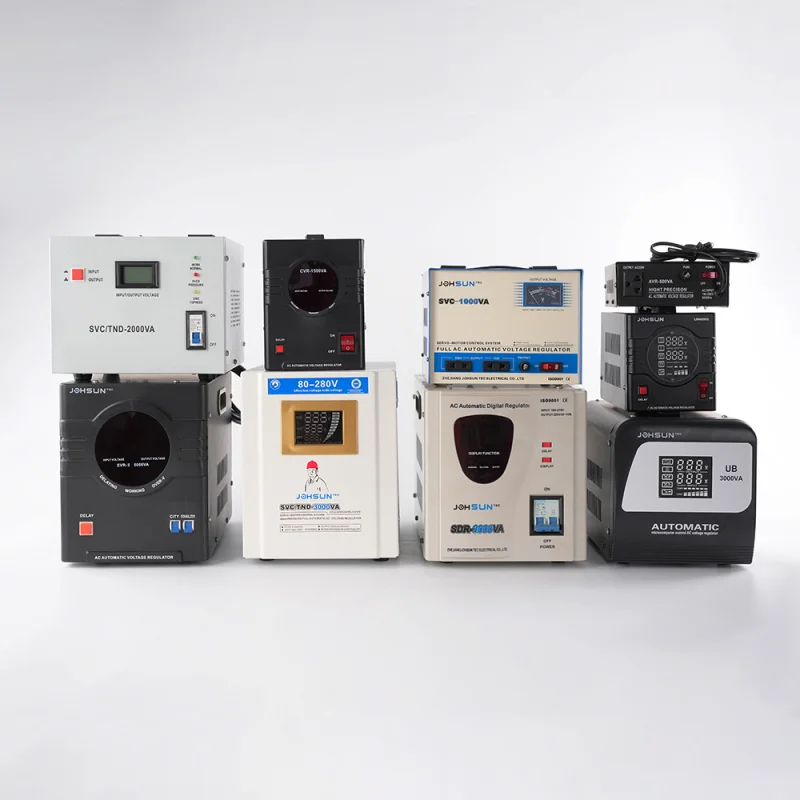
Como escolher o modelo certo de estabilizador de tensão CA
Publicado: Autor: Johsuntech
If you are a procurement manager or B2B buyer, “AC voltage stabilizer” is not just a product category. It’s a risk‑reduction tool for your machinery, production lines, and IT infrastructure.
In markets with unstable grids, a wrong choice can mean burnt circuit boards, melted motors, or unplanned shutdowns. The good news? You don’t need to be an electrical engineer to pick the right model. You do need to know how to link your real‑world load, voltage data, and environment to one specific AC voltage stabilizer model and spec.
In this guide, I’ll walk you through how to choose the right AC voltage stabilizer model, capacity, type, e interface for your project, using real‑world‑style questions and practical tables. By the end, you’ll know exactly “how to choose the right model and specs for your voltage stabilizer project” without getting lost in textbook definitions.
Before you even open a product page, answer three questions:
What exact equipment will be protected (e.g., CNC machines, chillers, servers, production line PLCs)?
What is the total power in kW or kVA, including startup peaks?
Is this a single‑phase ou three‑phase project?
Procurement teams often skip the second and third questions and select by “guess‑plus‑safety‑margin.” That leads to either an oversized, overpriced unit or a critically undersized one that trips every time a motor starts.
Matching stabilizer power to your real load
For industrial and commercial projects, the rule is simple:
Sum the rated power of all connected equipment.
Add at least 20–30% margin for startup inrush and future additions.
Round up to the next standard AC voltage stabilizer capacity.
For example, if your total connected load is 18 kW, you should look at 20–25 kVA static or servo stabilizers, not 15 kVA.
Below is a practical reference table you can use as a quick filter while you evaluate different AC voltage stabilizer models.
Total connected load (kW)
Recommended stabilizer rating (kVA)
Caso de uso típico
Up to 3 kW
3–5 kVA
Small office server rack, lab equipment, small AV systems
3–10 kW
6–10 kVA
Workshops, small production lines, retail HVAC systems
10–20 kW
15–20 kVA
Medium‑size production lines, data cabinets, multiple AC units
20–50 kW
30–50 kVA
Industrial workshops, small factories, telecom base stations
50–100 kW
75–125 kVA
Large production lines, server rooms, commercial buildings
100–200 kW
150–200 kVA
Heavy industrial plants, data centers, multi‑floor HVAC
This table helps you quickly narrow down which AC voltage stabilizer series to focus on and avoid “lowest‑price” units that cannot handle your real load.
If you are still unsure, feel free to share your load list and one‑line electrical diagram. A quick power‑level check can prevent costly mistakes later.
Se a sua empresa busca soluções de estabilizador de tensão para montagem em parede, entre em contato hoje mesmo para solicitar um catálogo de produtos ou uma cotação adaptada às suas necessidades.
Step 2: Choose the right stabilizer type (relay, servo, static)
Not all AC voltage stabilizers work the same way. The three main types your engineering team will encounter are:
Relay‑type AC voltage stabilizer
Servo‑motor‑type AC voltage stabilizer
Static (digital/IGBT) voltage stabilizer
Which one you choose depends on equipment sensitivity, response speed, e maintenance appetite, not just cost.
When to pick a relay‑type AC voltage stabilizer
Relay‑type stabilizers are step‑change devices. They use electronic sensing plus relays to switch transformer taps.
Best for:
Equipment with low sensitivity to voltage steps (e.g., basic pumps, older motors, simple heaters).
Applications where budget is tight and precision is not critical.
Typical specs to watch:
Voltage correction accuracy ±5–10%.
3–6 voltage steps instead of continuous adjustment.
What to watch out for:
Faster relay wear in areas with frequent voltage swings, which means more frequent service.
Possible tiny drop‑outs during tap switching, which can be bad for sensitive electronics.
You can use relay‑type AC voltage stabilizers for light industrial ou small‑scale commercial projects where you mainly want “something between the grid and the motor.”
When to pick a servo‑motor AC voltage stabilizer
Servo‑motor stabilizers use a motor to continuously move the transformer wiper, giving you smooth, step‑free correction.
Best for:
Production lines with CNC machines, injection‑molding machines, printing equipment, and precision motors.
Medical equipment, testing rigs, and any load that cannot tolerate ±5% swings.
Typical specs to look at:
Voltage accuracy ±1–2%.
Wider correction range (for example, 160–270 V → 220–240 V).
Stronger overload tolerance and better overload protection.
Procurement teams often skip this spec until they see a damaged PLC or servo drive. If your project has numerical control systems, PLCs, or frequency inverters, a servo‑motor AC voltage stabilizer is usually the safer choice.
When to pick a static (digital/IGBT) AC voltage stabilizer
Static stabilizers use power electronics (IGBTs, thyristors) instead of moving parts. They are the fastest and most precise type.
Best for:
Data centers, server racks, and telecom equipment.
High‑precision industrial automation, robotics, and sensitive electronics.
Key advantages:
Adjustments in milliseconds, not seconds.
No mechanical wear, so maintenance is mainly about cooling and cleaning.
Often include digital displays, remote monitoring, and communication interfaces (Modbus, SNMP, etc.).
If your project has high‑value equipment, long‑term uptime targets, or needs diagnostics for energy audits, a static AC voltage stabilizer should be on your shortlist.
Quick type comparison table
Recurso
Relay‑type AC voltage stabilizer
Servo‑motor AC voltage stabilizer
Static (IGBT) AC voltage stabilizer
Correction accuracy
±5–10%
±1–2%
±0.5–1%
Response speed
Medium (step‑wise)
Smooth, continuous
Very fast (milliseconds)
Manutenção
Higher (relay wear)
Medium (mechanical parts)
Low (no moving parts)
Cost level
Baixa
Medium
Alto
Uso típico
Basic motors, pumps
Production lines, PLCs
Data centers, precision electronics
Use this table as a filter when you compare AC voltage stabilizer models. If you tell me whether your project is more “heavy‑duty industrial” or “high‑precision electronics,” you can eliminate at least one type.
Step 3: Match input‑output specs to your project
Once you know the type e rough power rating, you still need to match the input‑output specs to your real‑world conditions.
Too many buyers just check the nominal voltage (e.g., 230 V) and ignore the rest. That’s how you end up with a stabilizer that can’t cope with your brutal voltage swings.
Key specs to verify
When you ask for a quotation or compare models, always confirm:
Faixa de tensão de entrada (what your grid actually gives, not what the label says).
Output voltage range and accuracy (±1%? ±3%?).
Phase configuration (single‑phase or three‑phase).
Compatibilidade de frequência (50 Hz, 60 Hz, or both).
Overload and short‑circuit protection rating.
For example, if your measured voltage swings from 180 V to 260 V, a stabilizer with a correction range of 170–270 V is safer than one rated 200–240 V.
How to translate your voltage data into specs
Many B2B buyers still rely on “voltage is bad” instead of real numbers. If you can, ask your site engineer or installer to:
Measure minimum and maximum voltage over at least 1–2 weeks.
Note whether swings are slow (voltage “creeps” down) or fast (spikes and dips).
Then you can use a simple rule:
Select an AC voltage stabilizer whose correction range is at least ±15–20% wider than your measured fluctuations.
In practice, this means you can ignore cheap “±10%” models in regions with wild swings.
Sample spec‑matching table
Below is a table you can copy‑paste into your internal RFQ template.
Project feature
What to ask for in AC voltage stabilizer specs
Por que isso é importante
Voltage swings: 180–260 V
Input range 160–280 V or wider
Covers rare dips and spikes
Output target: 220 V ±3%
Output accuracy ±3% @ 220 V
Protects sensitive equipment
Three‑phase 400 V system
Three‑phase, 400 V input/output
Avoids single‑phase overload
Load includes motors
>= 30% overload tolerance for 10–15 minutes
Handles startup inrush
Operating location: hot, dusty
IP rating >= IP20, temp rating 40–50 °C
Reduces failures in harsh spots
When you send an RFQ, you can literally say:
“Please quote AC voltage stabilizer models matching Table X (input range, accuracy, phase, overload, IP rating).”
This turns a vague “I need a stabilizer” into a technical‑spec‑driven discussion.
Step 4: Decide on installation and integration details
Even the best AC voltage stabilizer can underperform if you don’t think about where and how it will be installed.
Mounting and environment
Freestanding floor‑mounted units are common in industrial panels and server rooms.
Wall‑mount AC voltage stabilizer units save floor space in small offices or counter‑top environments.
Cabinet‑integrated units can be installed directly inside your main electrical panel.
Ask yourself:
Is there enough ventilation around the unit?
Is the environment dusty, humid, or corrosive?
Will maintenance engineers need to access the unit regularly?
If yes to any of these, you should pay close attention to Classificação IP, cooling method (fan‑assisted vs natural), and access clearance.
Integration with your existing electrical system
Some buyers treat stabilizers like a “plug‑and‑play” box. In reality, AC voltage stabilizers need to be integrated into your electrical architecture.
Common questions to clarify:
Will the stabilizer be installed upstream (before the main distribution board) or downstream (for one specific machine or line)?
Você precisa de bypass so the load can run directly on the grid during maintenance?
Você precisa de remote monitoring, alarms, or communication (Modbus, dry‑contact outputs)?
If you share your one‑line diagram, you can ask the supplier to indicate exact connection points for the stabilizer and bypass.
Quick integration checklist table
Integration aspect
What to specify
Typical option
Installation position
Main line vs machine‑specific
Main line or per‑machine
Bypass requirement
Manual or automatic bypass
Manual bypass most common
Monitoring
Digital display, meters, or remote
Digital display + alarms
Proteção
Overload, short‑circuit, overvoltage
Standard in industrial models
Communication
None, Modbus, or integration tag
Optional, request in RFQ
Using this small table in your RFQ forces suppliers to give you clear answers, not “standard” boilerplate text.
Step 5: Avoid common procurement pitfalls
Even with good technical specs, B2B buyers often fall into a few traps.
1. Selecting only by price
AC voltage stabilizers are not “commodity‑like” as they look. A 10–20% price difference can mean:
Lower quality transformers.
Fewer protection features.
Shorter warranty or no field support.
Always compare price per kVA e warranty conditions, not just total price.
2. Ignoring long‑term support and spare parts
If you select a stabilizer from a supplier with no local service network, you may wait weeks for a repair. Ask:
What is the warranty period (1 year, 2 years, 3 years)?
Are spare parts available locally or regionally?
Do they provide technical documentation in your language?
3. Forgetting customization and project‑specific needs
Some projects need:
Custom voltage ranges (e.g., 110 V ±5% for Japanese equipment).
Special enclosures ou collaboration with your panel builder.
If your project has a mixed‑voltage system ou special frequency, mention that clearly in your RFQ.
Choosing the right AC voltage stabilizer model and specs is not about memorizing catalog tables. It’s about linking your real‑world load, voltage data, e environment to one specific configuration.
If you follow these steps—map your load, pick the right type (relay, servo, or static), match input‑output specs, think about installation, and avoid pure price‑driven selection—you already have a much stronger foundation than most buyers.
And if you tell me your project type (CNC workshop, small factory, data room, telecom base station, etc.), your phase, and your rough power need, you can quickly narrow down to a short list of AC voltage stabilizer models that actually fit your project.
If you feel ready to move from “learning” to “ordering,” you can send a brief load list and installation environment description, and outline your voltage range challenges. That’s usually enough to recommend a concrete model range and next‑step verification.
Se a sua empresa busca soluções de estabilizador de tensão para montagem em parede, entre em contato hoje mesmo para solicitar um catálogo de produtos ou uma cotação adaptada às suas necessidades.
u003cstrongu003eHow do I know whether I need a relay‑type, servo‑type, or static AC voltage stabilizer?u003c/strongu003e
Choose a u003cstrongu003erelay‑typeu003c/strongu003e for simple motors and pumps where ±5–10% accuracy is acceptable. Go for a u003cstrongu003eservo‑motor stabilizeru003c/strongu003e if you run CNC machines, PLCs, or production lines that need ±1–2% accuracy. Pick a u003cstrongu003estatic (IGBT) stabilizeru003c/strongu003e when you protect data centers, telecom equipment, or high‑precision electronics that demand millisecond‑level response and ±0.5–1% accuracy.
u003cstrongu003eWhat is the correct AC voltage stabilizer capacity for my factory or workshop?u003c/strongu003e
Add up the rated power (kW) of all connected equipment, then add 20–30% for startup inrush and future expansion. Round up to the next standard rating (for example, 18 kW load → 20–25 kVA stabilizer). If your team is still unsure, sharing a simple load list lets an expert confirm the right model range.
u003cstrongu003eCan I install an AC voltage stabilizer myself, or do I need an engineer?u003c/strongu003e
For u003cstrongu003eindustrial and commercial projectsu003c/strongu003e, you should always involve a qualified electrician or engineer. They will check the one‑line diagram, confirm the correct position in the panel, connect ground and protection, and verify the bypass and protection settings. Trying to “plug and play” on a three‑phase system can create safety and warranty risks.
u003cstrongu003eWhat input voltage range should I choose for an unstable grid?u003c/strongu003e
If your measured voltage swings from 180 V to 260 V, select an AC voltage stabilizer with an input range at least ±15–20% wider than that (for example, 160–280 V). Avoid models whose range is only ±10% around nominal voltage; they may not handle extreme dips or spikes and can drop out under real‑world conditions.
u003cstrongu003eWhy should I care about overload and short‑circuit protection on an AC voltage stabilizer?u003c/strongu003e
Motors and production‑line equipment create high startup inrush currents. If the stabilizer cannot tolerate, for example, 130–150% overload for short periods, it may trip frequently or damage internal components. Strong overload and short‑circuit protection protect the stabilizer itself and reduce unplanned downtime in industrial environments.
u003cstrongu003eWhat is the difference between single‑phase and three‑phase AC voltage stabilizers?u003c/strongu003e
Use a u003cstrongu003esingle‑phase stabilizeru003c/strongu003e for offices, small workshops, and loads up to roughly 10 kW on a 230 V system. Use a u003cstrongu003ethree‑phase stabilizeru003c/strongu003e for factories, larger HVAC systems, and production lines where the main supply is 400 V three‑phase. Mixing them (e.g., three‑phase load on a single‑phase stabilizer) can cause imbalanced loading and early failure.
u003cstrongu003eHow can I verify that a supplier’s AC voltage stabilizer really fits my project?u003c/strongu003e
Request a short spec table that matches your project needs: input range, output accuracy, phase, rated kVA, overload capability, and IP/temperature rating. Then share your load list and one‑line diagram; a good supplier can confirm if their model fits and suggest any adjustments. If they only send generic catalog text, ask for project‑specific confirmation before placing an order.
Uma das maneiras mais rápidas de estourar um orçamento não é comprar um estabilizador de tensão mais caro, mas comprar o estabilizador de tensão errado. Como um especialista em produtos que já observou centenas de empresas superestimarem, subestimarem ou instalarem mal seus estabilizadores, posso lhe dizer: a mágica não está na placa de identificação da marca. Ela está na carga, [...]
O que é um estabilizador de tensão para montagem em parede? Um estabilizador de tensão para montagem em parede é um dispositivo automático de regulagem de tensão que mantém a tensão CA em uma faixa segura e estável. Ele foi projetado para residências, escritórios e pequenos espaços comerciais e pode ser montado em uma parede para economizar espaço no chão e, ao mesmo tempo, proteger TVs, condicionadores de ar, refrigeradores, computadores, [...]