Transformador elevador abaixador para correspondência de potência industrial
Publicado: Autor: Johsuntech
If you ask me what an up step down transformer really does in a factory, I will give you the non-textbook answer first: it keeps good equipment from having a very bad day. A step-up transformer raises voltage, and a step-down transformer lowers it, which is why they sit quietly behind power transmission, factory machinery, data centers, medical equipment, and imported industrial systems that need the “wrong” voltage turned into the right one.
That sounds simple, of course. Buying the right one is not. In real projects, the transformer has to match voltage, current, phase, frequency, installation conditions, and load behavior, or the wrong specification can blow your budget and timeline faster than a procurement meeting that starts with “let’s just buy the cheapest one.”
I look at how the unit will be wired, what kind of equipment it will feed, whether the load is resistive or motor-driven, and whether the buyer needs a standard unit or a custom step up and step down transformer manufacturer for an OEM project. That is the difference between a STU Series STU-100VA to STU-2000VA transformer that merely exists and one that actually earns its place in the panel.
Where the Buying Value of Up Step Down Transformer?
When industrial buyers search for an “up step down transformer,” they are usually not shopping for a physics lesson. They are trying to solve one of four business problems: power mismatch between site and machine, export equipment voltage adaptation, control power isolation, or stable voltage conversion for sensitive loads such as hospital devices, automation lines, and data-center equipment.
That is also why a serious Step Up and Step Down Transformer supplier talks about stability, efficiency, premium materials, and customization instead of only repeating the words “step-up” and “step-down.” Johsun Tec category description positions these products around reliable voltage conversion, industrial applications, and customizable solutions for client-specific requirements, which is exactly what B-end buyers usually care about first.
In practice, I treat “which transformer should I buy?” as a configuration question, not a catalog question. A single phase step up transformer can be perfect for small export equipment, while a three phase step down transformer is usually the right direction for factory machinery, production lines, and heavier industrial loads.
Procurement scenario
Voltage need
Better-fit transformer
Why buyers choose it
Export equipment for mixed overseas markets
Site voltage does not match machine nameplate
Single phase step up or step down transformer for equipment adaptation
Supports imported or exported devices that must adapt to local grids
Factory machinery and production lines
Stable three-phase conversion
Three phase step down transformer or step-up unit depending on plant supply
Better fit for heavy machinery and industrial equipment
Data centers and medical devices
Stable voltage with low loss and protection
Low-loss, low-temperature-rise transformer with compliance focus
Sensitive equipment needs stability over bargain pricing
OEM machinery projects
Custom voltage combinations or multi-output needs
OEM transformer for industrial equipment, customized by application
Reduces compromise when standard ratios do not fit the project
So yes, the phrase “industrial control transformer supplier” matters, but only when the supplier understands application context. If the conversation starts with your input voltage, output voltage, phase, frequency, ambient temperature, and load type, you are already speaking the language of a real B2B project instead.
How the Wiring Should Work in Real Projects
Let me say the practical part out loud: a transformer wiring diagram is not decoration. It is the difference between correct voltage conversion and a very expensive lesson in smoke. A common industry convention marks the higher-voltage winding with H terminals and the lower-voltage winding with X terminals, so names like H1, H2, X1, and X2 are not random letters; they help installers identify which side is intended for the higher-voltage and lower-voltage winding.
The basic rule is simple even if the job is not: connect the source to the rated input winding, and connect the load to the rated output winding. One source notes this plainly as primary-to-power-source and secondary-to-load, and that is still the cleanest way to think about step up transformer wiring and step down transformer wiring on site.
Frequency matters too. Buyers often focus on voltage and forget that 50Hz and 60Hz compatibility must match the application, because a frequency mismatch can damage equipment or shorten service life.
For a step-down unit, the secondary side carries higher current than the primary side, which is why conductor sizing, terminal rating, and downstream protection cannot be treated casually. In other words, if you reduce voltage, current goes the other way, and copper suddenly becomes everyone’s favorite topic.
Wiring checkpoint
What to confirm
Por que isso é importante
Terminal identification
Verify H-side and X-side markings from the nameplate or transformer wiring diagram
Prevents connecting the supply to the wrong winding
Input side
Connect the power source to the rated primary/input winding
Wrong input connection can cause incorrect output or damage
Output side
Connect the load to the rated secondary/output winding
Ensures the equipment sees the intended voltage
Frequência
Confirm 50Hz or 60Hz before energizing
Mismatch can damage equipment
Current capacity
Check secondary current, cable size, and protection devices
Step-down designs raise current on the lower-voltage side
Now for a question buyers ask more often than they admit: can one unit work both ways? Technically, yes. One source explains that a transformer can be operated “backward” to perform the opposite function, but only within the original design voltage and current parameters, otherwise efficiency suffers or the unit may be damaged.
That means a buyer searching for a “220V to 380V Up Step Down Transformer” should not assume every “380V to 220V step down transformer” can be casually reversed in production. It may work in theory, but in procurement I prefer the boring answer: specify the real application, get the correct winding arrangement, and keep commissioning day pleasantly free of surprises.
How I Select the Right Unit
When I evaluate a project, I start with five things: input voltage, output voltage, load current or kVA, frequency, and phase type. Those points appear again and again in Up Step Down Transformer selection references because they directly determine whether the unit will be safe, stable, and properly sized for the actual load.
Then I look at the load itself. A transformer feeding electronics is not the same as a transformer feeding motors, heaters, compressors, or tools with high inrush current. Johsun’s own procurement advice recommends at least 100% margin above rated wattage for most electronics and 3–4 times margin for loads with high inrush currents, which is one of the most commercially useful details a buyer can apply right away.
Efficiency and temperature rise are next because the cheapest Up Step Down Transformer is often the most expensive one to live with. A higher-efficiency unit lowers long-term energy cost, and lower temperature rise generally supports longer life, especially in warm or enclosed installations.
Environment matters too. Indoor or outdoor use, humidity, dust, installation space, wall-mount versus floor-standing layout, and enclosure protection all belong in the RFQ. This is not “extra detail”; this is how you avoid buying a perfect transformer for the wrong room.
Fator de seleção
What I ask the buyer
What usually fits best
Relação de tensão
What is the exact input and required output voltage?
A dedicated 220V to 380V step up transformer or 480V to 240V step down transformer when ratios are fixed
Load size
What is the running load and starting load?
Capacity above actual demand, with extra margin for inrush loads
Phase type
Single-phase or three-phase system?
Single phase step up transformer for lighter equipment; three phase step down transformer for factory machinery
Frequência
Is the site 50Hz or 60Hz?
A 50Hz 60Hz transformer only when the design explicitly supports both
Ambiente de instalação
Indoor, outdoor, dusty, humid, or high-heat area?
IP-rated or specially enclosed custom solutions where conditions are harsh
Compliance and support
Which certifications and after-sales documents are required?
IEC, UL, or ISO-oriented sourcing with supplier technical support
One useful commercial detail is often overlooked: some equipment accepts a universal input, such as 120–277V. In those cases, selecting a Up Step Down Transformer that only reduces voltage to 240V instead of 120V can mean a smaller unit and lower cost, provided the equipment really supports that range.
That is why I never recommend a model based on voltage alone. I recommend it based on the whole application. For buyers comparing a standard stock product with a custom step up and step down Transformer supplier, the custom option usually wins when the project involves multi-output needs, space constraints, unusual site power, or OEM branding requirements.
Which Configuration Usually Wins the Order
There is no universal best model, and frankly, that is a good thing. The Up Step Down Transformer product category itself emphasizes customizable solutions, which tells me the smarter sales conversation is not “Which SKU is best?” but “Which configuration best protects your equipment and project margin?”
Here is how I would match common B2B requests in the real world. This is the part buyers usually want first anyway, because nobody wakes up excited to discuss turns ratio before coffee. The application decides the configuration, and the configuration decides the inquiry.
Buyer request
Typical power situation
Best-fit configuration
Commercial note
“I need a Up Step Down Transformer for 220V to 380V machinery.”
Site supply is lower than machine requirement
Three-phase step-up transformer sized to machine load and startup demand
Good for industrial equipment that must run above local supply voltage
“I need a step down transformer for 480V to 240V equipment.”
Plant supply is higher than machine input
Three phase step down transformer with proper secondary current rating
Common for machinery, controls, and retrofits
“I am exporting a machine and need voltage adaptation.”
Destination grid differs from build-country grid
Single phase or three-phase export transformer based on equipment design
Ideal long-tail fit for export equipment voltage converter projects
“I need stable power for sensitive systems.”
Sensitive load, low tolerance for fluctuation
Low-loss, low-temperature-rise transformer with compliance focus
Better fit for medical, test, or data-center environments
“I need one supplier for OEM production.”
Repeated orders with custom specs
OEM transformer for industrial equipment with customized winding and enclosure
Best fit for private-label and machinery manufacturers
If your buyer persona is a plant engineer, system integrator, panel builder, or OEM sourcing manager, the best conversion language is not hype. It is specificity. Phrases like “three phase step down transformer for factory machinery,” “single phase step up transformer for export equipment,” and “custom transformer manufacturer for OEM machinery” convert better because they describe a real use case, not just a search term.
And yes, a gentle sales push belongs here. If the project still has open questions on voltage, kVA, phase, or enclosure, the fastest path is to send the equipment nameplate, site power details, and target output requirement to the Up Step Down Transformer supplier so the quotation matches the application instead of guessing at it. That is how serious inquiries become orders instead of email chains.
A good up step down transformer does not just convert voltage. It protects uptime, controls operating cost, and keeps imported or custom-built equipment working the way the design team promised it would. For B2B buyers, the smartest choice is usually the one that is correctly wired, correctly sized, and correctly specified for the real load rather than the cheapest unit on the page. Please click to Entre em contato conosco e send an inquiry for more product information or product recommendations for your project!
And if I may end with one gentle nudge from one industry person to another: when the application is clear, ordering becomes easy. Send the nameplate data, the site voltage, and the target output requirement, and you move from “maybe this fits” to a transformer that is actually ready to work.
PERGUNTAS FREQUENTES
Can a transformer work in reverse?
Yes, but only within original design limits
How do I read the wiring diagram?
Identify H terminals, X terminals, input, and output
Do I need single-phase or three-phase?
It depends on the supply and load type
How much margin should I keep?
At least 100% for many electronics, 3–4x for high inrush loads
Can an up step down transformer be used both as step-up and step-down?
Yes, it can be operated backward in principle, and one source states this directly, but only within the original voltage and current design parameters. If you push it outside those limits, you may lose efficiency or damage the unit, so for a production order I recommend specifying the intended direction of use in the quotation.
How do I read a transformer wiring diagram without making mistakes?
Start by identifying the higher-voltage winding and the lower-voltage winding. The H markings generally identify the higher-voltage side and the X markings identify the lower-voltage side, after which the source goes to the rated input winding and the load goes to the rated output winding.
Should I buy a single-phase or three-phase model?
If the equipment is small, commercial, or light-duty, single-phase may be enough. If the project involves factory machinery, production lines, or heavier industrial applications, three-phase is typically the better choice because industrial references consistently place heavy machinery in that category.
What size transformer should I order for motors or high inrush loads?
Do not size it only to the running watts. Johsun’s procurement note recommends keeping at least 100% margin for many electronics and 3–4 times margin for power tools, heating devices, or other high inrush loads, which is a very practical rule for avoiding overload at startup.
Does 50Hz or 60Hz really matter?
Absolutely. Selection references list frequency as a core specification, and they warn that mismatch can damage equipment, so a 50Hz 60Hz transformer should only be selected when the design truly supports both frequencies.
When is a custom transformer the better choice?
A custom unit makes more sense when the project has unusual voltage combinations, strict installation space, special enclosure needs, multi-output requirements, or OEM branding goals. Johsun’s product category and selection content both emphasize customization for client-specific needs, which aligns well with machinery builders and repeat B2B buyers.
What should I include in my inquiry to get an accurate quote?
Send the input voltage, output voltage, phase, frequency, load type, required kVA or current, installation environment, and any compliance requirement. Those are the same core variables repeatedly highlighted in transformer selection references, and they let the supplier quote the right unit instead of a polite but risky guess.
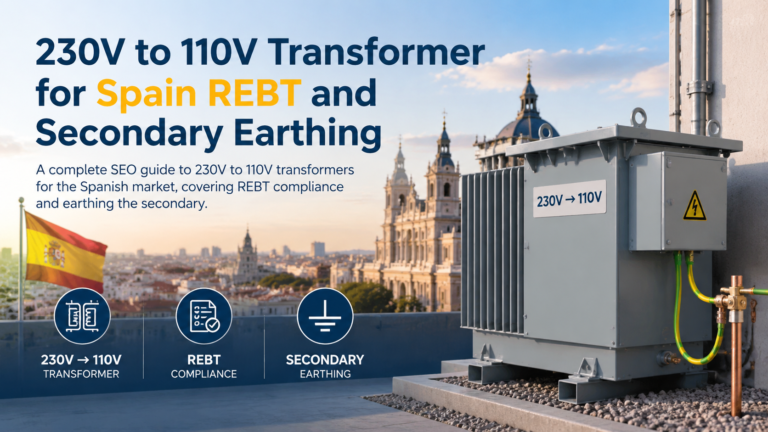
Transformador de 230 V para 110 V para a Espanha: em conformidade com a norma REBT, ITC-BT-18 e ITC-BT-24, aterramento do lado secundário e documentação conforme a norma UNE-EN IEC 61558.
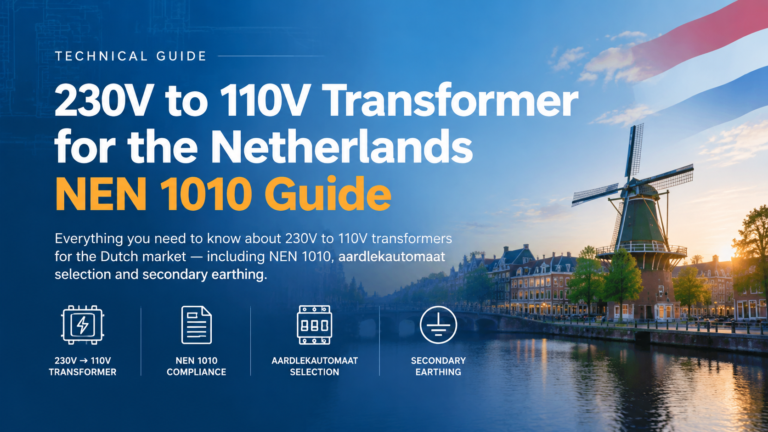
Transformador de 230 V para 110 V para a Holanda: norma NEN 1010, regras de 30 mA para disjuntores de fuga à terra, disjuntor de fuga à terra versus disjuntor automático de fuga à terra e aterramento secundário.