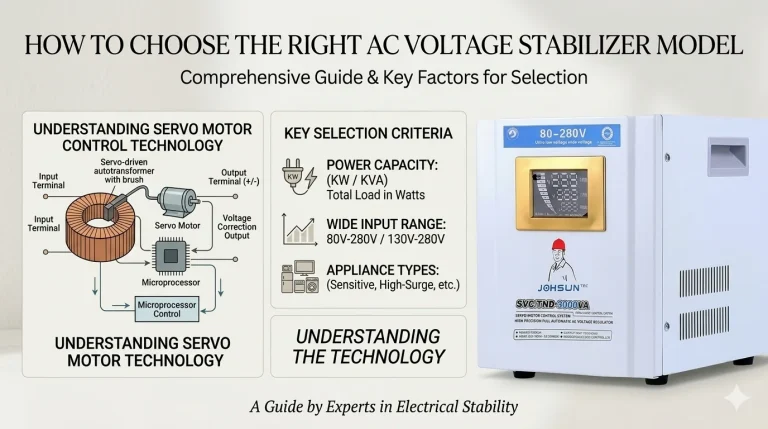
Look up voltage regulator vs stabilizer and you will find comparison pages that flatly contradict each other. One says a regulator is a manual variac; the next says it is a servo machine; a third treats the two words as synonyms. The contradiction is not laziness — the word “regulator” really is used for several different devices, while “voltage stabilizer” names one specific category of equipment. This guide untangles the vocabulary first, then gives you a decision framework, a comparison table and an RFQ checklist so you order the machine your load actually needs. For the product range behind this article, see our voltage stabilizers categoria.
The Quick Answer: What Each Device Does
A estabilizador de tensão is a standalone device installed between the mains supply and your equipment. It continuously measures the incoming voltage and automatically corrects sags and swells — typically an input window of ±15% to ±30% and an output held within a few percent of nominal. Its job is protection against a supply that moves.
A “voltage regulator”, however, is whatever the speaker means it to be: an IC on a circuit board, a board inside a generator, a manual variac on a bench, or — in most export markets — the very same automatic mains corrector that stabilizer sellers ship. So the honest answer to voltage regulator vs stabilizer is: first find out which regulator the other person means, then decide by function, not by label.
“Voltage Regulator” Is Four Different Devices
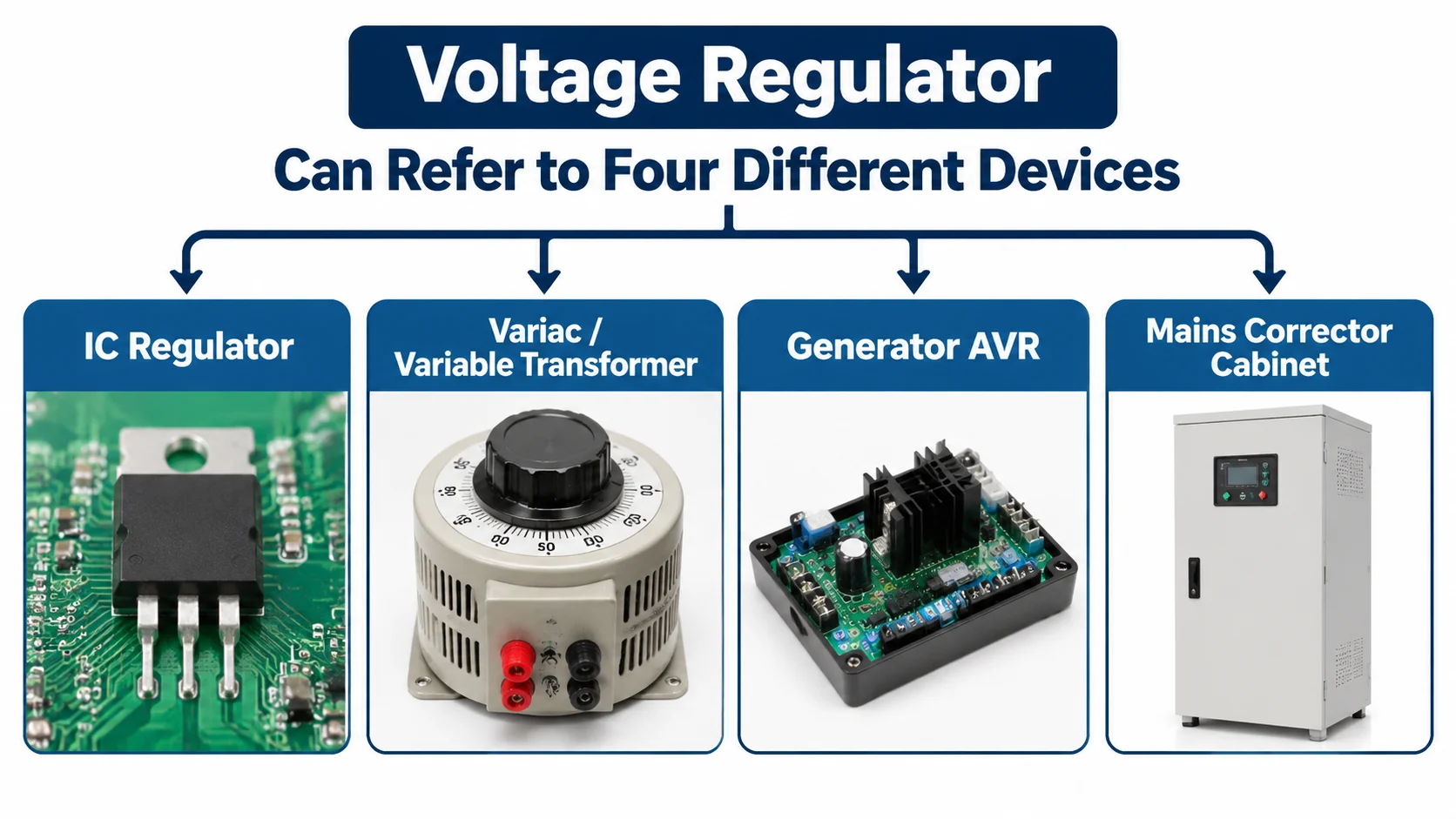
When a datasheet, a marketplace listing or a supplier email says “voltage regulator”, it can refer to any of the four devices below. Each solves a different problem, and only one of them protects factory equipment from an unstable grid.
| What “regulator” refers to |
What it is |
What problem it solves |
Can it protect factory equipment? |
| IC regulator |
Linear or switching regulator chip inside a PCB power supply (the 78xx/LM317 family, or buck/boost converter stages) |
Stable low-voltage DC for electronics |
No — it lives downstream, inside your device |
| Generator AVR |
The control board that regulates a generator alternator’s field current |
Holds generator output near nominal as load changes |
Partly — only while the genset runs well |
| Variac (variable transformer) |
Manual, continuously adjustable transformer driven by a dial or motor |
Sets a chosen output voltage for testing and burn-in |
No — it does not react to grid changes on its own |
| Automatic mains corrector |
Relay, servo or static unit sold as “AVR” or “automatic voltage regulator” in many markets |
Automatically corrects a fluctuating AC supply |
Yes — this is what the market usually calls a voltage stabilizer |
The fourth row explains most of the confusion. In South Asia, Southeast Asia and the Middle East, buyers say stabilizer; generator and electronics vendors say AVR; European catalogs often say mains voltage regulator. The hardware overlaps heavily. In practice, the voltage regulator vs stabilizer question ends with both words pointing at the same cabinet. What matters when you buy is the correction technology and the numbers behind it.
What a Voltage Stabilizer Actually Does
Inside a stabilizer, a control circuit compares the output against a reference and corrects deviations in one of three ways: switching transformer taps with relays, driving a carbon brush along a variable autotransformer with a servo motor, or correcting electronically with power semiconductors. The technology sets the accuracy, the response speed and the price.
| Tecnologia |
Typical output accuracy |
Correction behaviour |
Best suited to |
Relative cost |
| Relay type |
±5–10% |
Stepped, audibly clicks between taps |
Fridges, ACs, pumps, lighting, non-critical loads |
Lowest |
| Servo type |
±1–3% |
Smooth, continuous; a few hundred ms per correction |
CNC, injection moulding, printing, medical, workshops |
Medium |
| Static / electronic |
±0.5–1% |
Fast, no moving parts |
IT racks, instruments, lab and control electronics |
Mais alto |
For small and mid-sized loads, the practical choice is usually relay versus servo. A relay unit such as our AVR series (0.5–10 kVA) is the economical pick for basic appliances and light machinery. A servo unit such as the SVR series (0.5–10 kVA) holds a much tighter output band and tolerates motor inrush better, which is why it is the default for industrial loads. We compare the correction technologies in depth in our guide to types of voltage stabilizers.
The Manual “Regulator”: Variable Transformers
The second meaning of “regulator” is the variac — a transformer whose output you set by hand. A unit like the TDGC2J series (0.5–5 kVA) lets an operator dial anywhere from 0 to about 110% of the input, which is exactly what you want for bench testing, equipment burn-in, lamp-dimming trials or speed control. It is not a protection device: if the grid sags overnight, a variac set to 220 V simply follows it down. Buy a variac when you need adjustment; buy a stabilizer when you need correction.
When Neither Device Is What You Need
There is a third situation buyers often misdiagnose: the voltage is stable but the wrong value. A 230 V European machine fed from a 110 V American outlet, or a 100 V Japanese appliance running on 220 V, does not have a stability problem — it has a ratio problem. No stabilizer or variac is the right answer; a fixed-ratio step-up/step-down transformer is. A unit such as the DT-3000VA step-up/step-down transformer converts 110 V to 220 V (or back) continuously and unattended, with no control circuit to fail. If the wrong-value supply is also unstable, you pair a transformer with a stabilizer downstream.
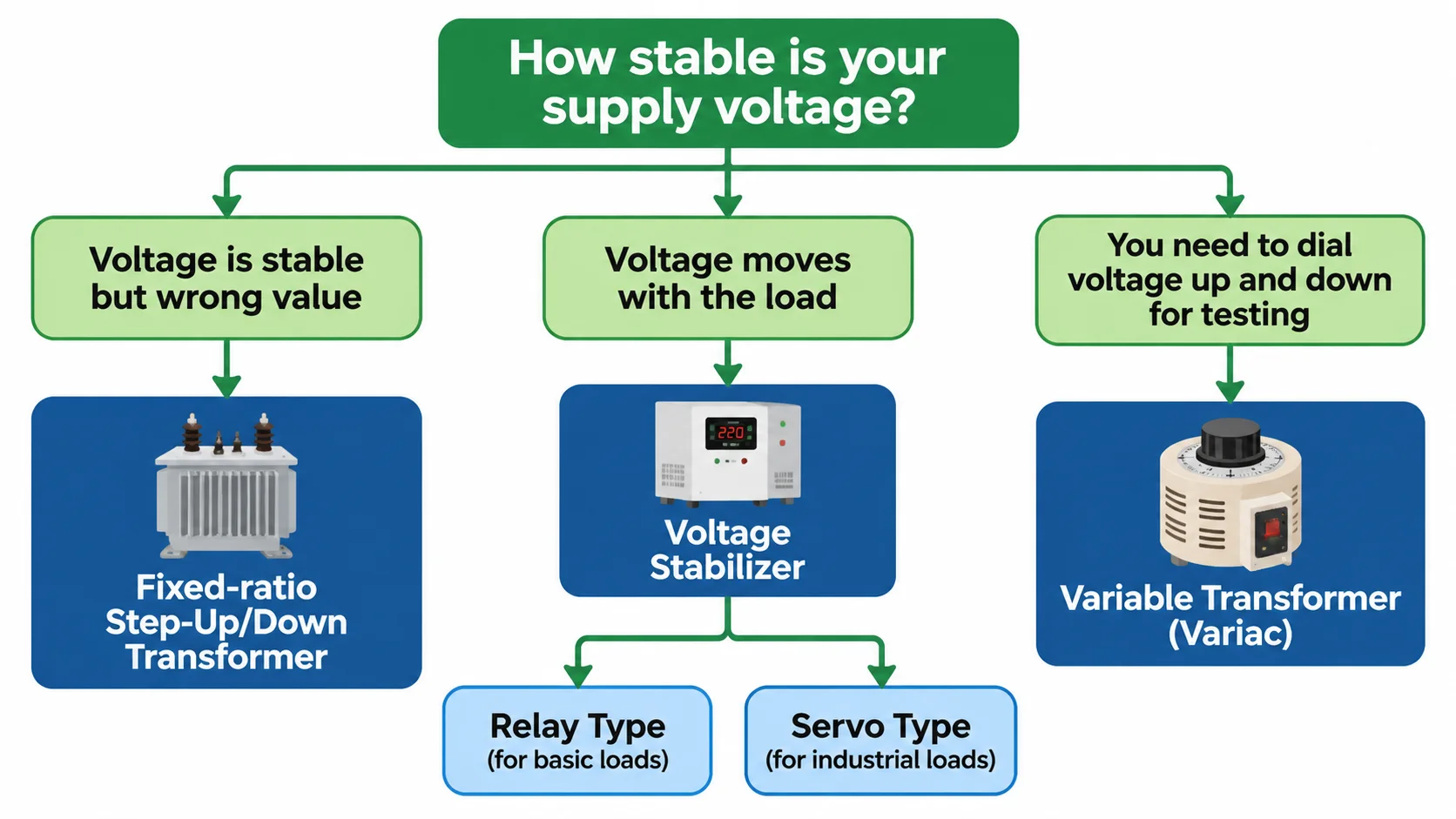
Four Questions That Settle the Choice
Instead of arguing vocabulary, walk the load through four questions. They end at one of the four devices above, every time.
- Is the voltage wrong, or is it moving? Wrong-but-stable → fixed-ratio transformer. Moving → continue.
- How far does it move, really? Log the site for a week: note the lowest and highest readings at peak hours. A supply that stays within 190–250 V needs a far smaller correction window than one that drops to 150 V, and the input window drives both the product choice and the price.
- What accuracy does the load tolerate? Heaters and motors shrug off ±8%. Mixed office and retail loads are comfortable at ±3–5%. CNC drives, PLCs and medical equipment want ±1–3% or better — which pushes you to servo or static technology.
- Do you need adjustment or protection? If someone on your team needs to sweep the voltage on purpose — testing, burn-in, R&D — that is a variac’s job, and it can sit alongside a stabilizer rather than replace it.

Once the technology is settled, sizing decides whether the unit survives. Convert watts to VA by dividing by the power factor, add 20–30% headroom for motor starting current, and verify the largest inrush on the line. Our voltage stabilizer buying guide walks through the kVA calculation step by step.
What to Put in the RFQ So You Get the Right Machine
A one-line request — “5 kVA AVR, best price” — invites a mismatched quote, because the seller has to guess every parameter that matters. Put these eight items in the enquiry and the quotations you receive become directly comparable:
- Connected load in kVA, power factor, and the starting current of the largest motor
- Measured input voltage range (minimum and maximum, not the nominal grid figure)
- Nominal output voltage and frequency (230 V/50 Hz, 110 V/60 Hz, three-phase or single-phase)
- Required output accuracy (±8%, ±3%, ±1%)
- Preferred correction technology, or let the supplier propose one with justification
- Protections: over/under-voltage cut-off, overload, time-delay, bypass switch
- Duty cycle: continuous industrial duty or intermittent domestic use
- Environment: ambient temperature, dust, altitude, indoor or outdoor mounting
Send the same sheet to three suppliers and the differences in price will finally map to differences in hardware — copper weight, brush quality, control board grade — instead of to whoever interpreted “regulator” most loosely.
The Practical Takeaway
Voltage stabilizer and voltage regulator are not rival products; one is a category and the other is a word that four categories borrow. Match the device to the problem — a moving supply needs automatic correction, a wrong-but-stable supply needs a ratio change, a test bench needs a dial — then pin the choice with measured input data and a written accuracy target. Do that, and the label on the box stops mattering.
PERGUNTAS FREQUENTES
Is an automatic voltage regulator (AVR) the same as a voltage stabilizer?
In the mains-protection context, usually yes — most products sold as “AVR” are relay or servo stabilizers. But AVR also names the control board inside a generator and the regulator chips inside electronics, so confirm which device the seller means before comparing prices.
Can I use a variac instead of a voltage stabilizer?
Not for unattended protection. A variac holds whatever output you set it to and does not compensate when the input moves, so equipment left connected overnight is unprotected. Use a variac for testing and adjustment, a stabilizer for protection.
Which is better for a workshop: relay or servo stabilizer?
If the workshop runs machine tools, compressors or any load with starting surges, a servo unit’s ±1–3% accuracy and smoother correction justify the higher price. A relay unit is fine for lighting, heaters and basic appliances where ±8% is acceptable.
Do I still need a stabilizer if my generator already has an AVR?
The genset’s AVR only regulates the generator itself. If the genset is oversized and the governor is sluggish, an external stabilizer with an adjustable time delay helps; sized poorly, the two control loops can hunt against each other, so state the generator make and rating in the RFQ.
How do I size a stabilizer for a motor load?
Divide running watts by the power factor to get VA, then allow for starting current — typically 3–5 times the running current for compressors and pumps. A 3 kVA compressor load usually calls for a 6–10 kVA stabilizer; confirm the actual inrush with the motor nameplate or a clamp meter.