Transformer Overheating: 5 Warning Signs Before Failure
The five transformer overheating symptoms in the order they appear, with temperature baselines, lead times and field actions for small units.
Leia mais

Two suppliers quote the same 1.5 kVA step up and step down unit. One returns USD 168, the other USD 214. Neither document is false, yet the numbers describe different conductors, packing, paperwork and risk. Power transformer pricing only becomes comparable once you stop reading the total and start reading the layers underneath it. This guide opens a transformer quotation line by line and gives you a comparison sheet for your shortlist. It covers the 100 VA to 10 kVA bracket — browse the Transformadores elevadores e redutores range for context — where fixed costs and freight minimums distort price far more than the per-kVA logic used for MVA equipment.
A quotation is not a price. It is three documents stapled together, and most buyers compare only the first while assuming the other two are identical.
| Layer | What it contains | How it is usually hidden |
|---|---|---|
| Cost stack | Conductor, core steel, insulation, labour, enclosure, testing, margin | Collapsed into one unit price |
| Scope | Material grade, temperature rise, IP rating, terminals, test reports | Left to “standard” without definition |
| Terms | Incoterm, packing, validity, payment, warranty, lead time | Fine print on page two |
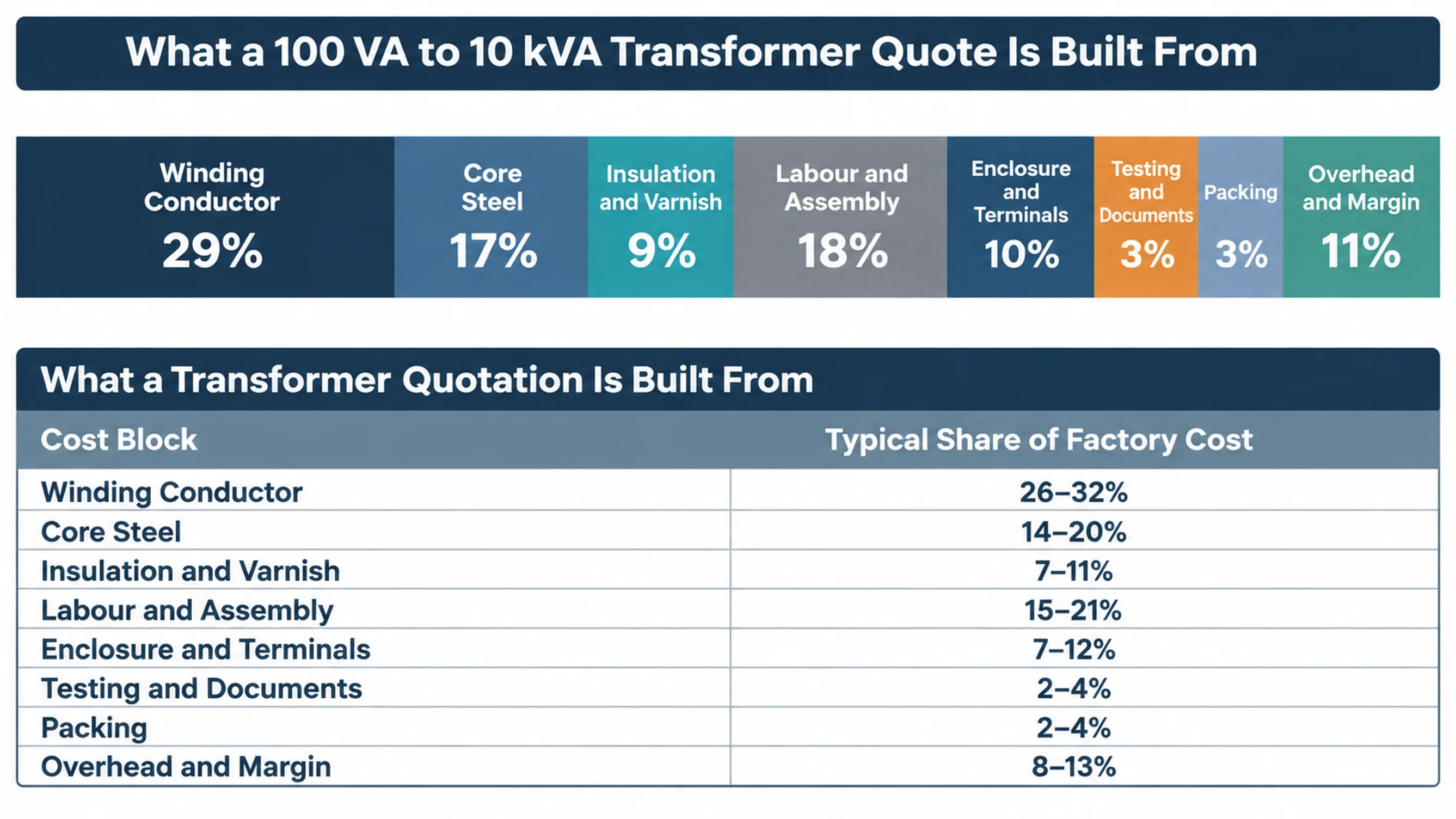
At 100 VA to 10 kVA two blocks dominate: winding conductor and core steel, together 40% to 50% of factory cost. Both are traded commodities, which is why small-transformer quotes carry short validity. Labour is the block buyers underestimate — winding a 500 VA coil takes nearly as many operations as a 5 kVA coil, so its share climbs as the rating falls. Packing and testing behave the same way.
| Cost block | Typical share | Negotiable? |
|---|---|---|
| Winding conductor (copper or aluminium) | 26–32% | Only via material choice |
| Core steel (CRGO grade) | 14–20% | Via loss class and grade |
| Insulation, varnish, tape, bobbins | 7–11% | Limitada |
| Labour, winding and assembly | 15–21% | Volume dependent |
| Enclosure, terminals, hardware | 7–12% | Specification dependent |
| Testing, documents, nameplate | 2–4% | Scope dependent |
| Embalagem | 2–4% | Order size dependent |
| Overhead and margin | 8–13% | Volume dependent |
Before arguing about any block, confirm the rating. A quote built on an undersized kVA figure is not a bargain at any price; our walkthrough on transformer capacity calculation covers the load-factor and expansion allowances that belong behind the number you send out.
None of these is dishonest. Each is a legitimate specification decision — decided silently when the quote is written, discovered when the invoice arrives.
Copper and aluminium both meet the same rated output, so “1.5 kVA, 220 V to 110 V” fits either. Aluminium costs less, needs a larger cross-section and runs with higher load losses. Our comparison of copper vs aluminium transformer windings quantifies the trade-off. Ask for conductor material and conductor weight in writing — the weight cannot be fudged.
A unit quoted to a 60 K rise and one to 45 K look identical on paper and behave very differently in a hot plant room. If the offer is silent, assume the cheapest permissible combination.
Open frame and IP54 enclosed are two products at two prices. When the enclosure sits under “optional accessories”, the headline is for the open frame. Fix the IP rating from site conditions, then insist it sits inside the base price.
Terminal blocks versus flying leads, lead length, plug type and nameplate language are all costed. A buyer who needs 1.5 m leads and a bilingual nameplate is not buying the catalogue item.
“Factory tested” can mean a continuity check or a full routine test with recorded turns ratio, losses, insulation resistance and applied voltage. On export shipments that decides whether goods clear or sit in a warehouse.
Small transformers are heavy for their volume. Cartons, wooden cases, ISPM-15 treatment and LCL minimums all land after the unit price. Ask for packed weight and dimensions per unit, not unit weight.
A seven-day validity on a copper-wound unit is a warning, not a courtesy: the price is exposed to the metal market and will be re-struck at order. Thirty days, or a copper index clause, is more useful than a lower number that expires before your approval cycle ends.
| Hidden item | Where it hides | Question to ask | Typical impact |
|---|---|---|---|
| Conductor material | Omitted from the line description | Copper or aluminium? State conductor weight. | 8–15% of unit price |
| Temperature rise and insulation class | Footnote or absent | Insulation class and rated rise? | 3–8% |
| Enclosure and IP rating | Listed under options | Is IP20 or IP54 inside this price? | 5–12% |
| Terminals, leads, nameplate | Not mentioned | Terminal type, lead length, nameplate language? | 2–6% |
| Test scope | “Tested” without definition | Routine report included? Which tests? | 2–5% |
| Packing and freight minimum | Excluded from unit price | Export case? ISPM-15? LCL minimum? | 4–10% of order |
| Validity and metal index | Fine print | Validity period? Copper index clause? | 0–8% at re-quote |
The same unit quoted EXW and DDP can differ by 25% or more once freight and duty are included — they are not competing prices but different products. Confirm every supplier quotes the same Incoterm to the same named place.
| Termo | What the price includes | What stays with you |
|---|---|---|
| EXW | Goods at the factory door | Inland haul, export clearance, freight, insurance, duty |
| FOB | Loaded on board at the named port, export cleared | Ocean freight, insurance, import clearance, duty, inland delivery |
| CIF | Goods, ocean freight and insurance to the named port | Import clearance, duty, port charges, inland delivery |
| DDP | Delivered to your address with duty paid | Unloading and internal distribution only |
Normalization converts every offer to the same scope, quantity, delivery point and currency, then ranks on the total. It takes twenty minutes and usually changes the winner.
One cross-check catches most silent downgrades: compare packed weight for the same rating. A quote materially lighter on an identical specification is usually carrying less copper or thinner core steel. Check the figures against what our guide to how to read a transformer nameplate says the document should contain.
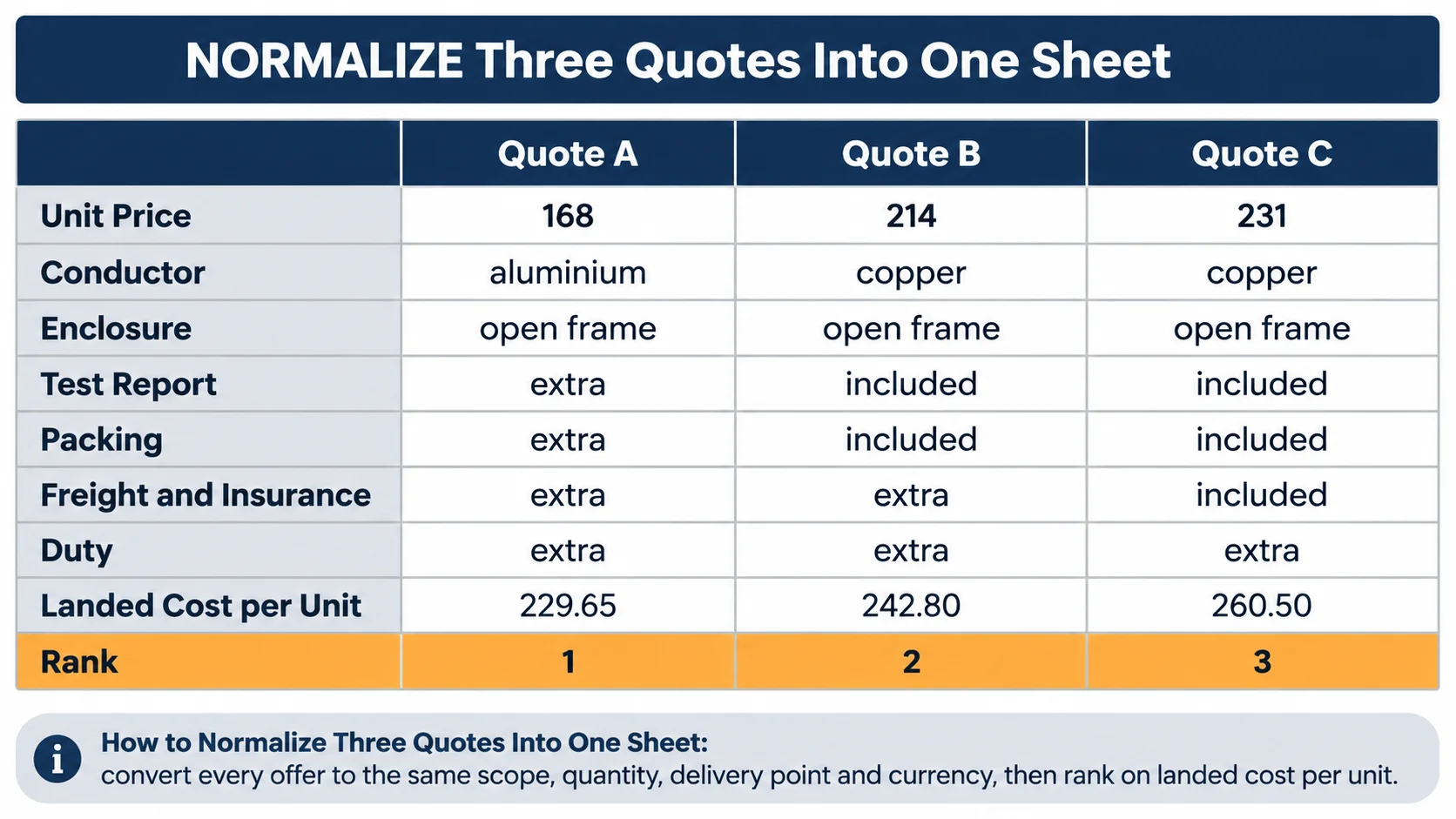
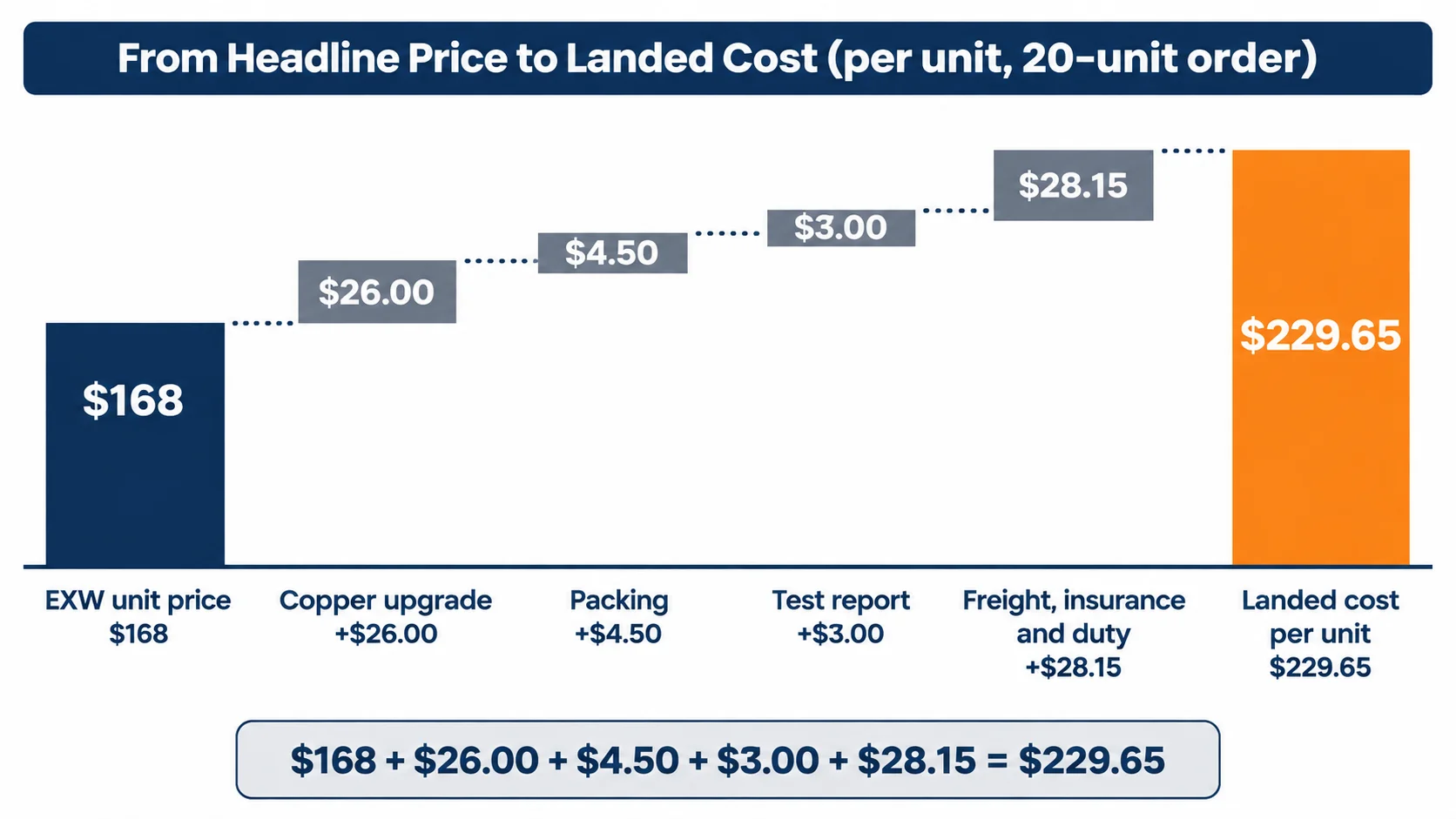
An illustrative order of twenty units, 220 V to 110 V, single phase, to a European port. Three quotes come back at USD 168, USD 214 and USD 231 — a headline gap of 21.5% between the first two.
The USD 168 offer is aluminium-wound, open frame, no carton, no test report, seven-day validity. Bringing it to the copper specification the others carry adds USD 26 per unit, USD 90 packing for the order and USD 60 for a test report. The USD 214 offer is copper with carton and report included, valid thirty days. The USD 231 offer is FOB rather than EXW, which explains most of its premium.
| Line | Quote A | Quote B | Quote C |
|---|---|---|---|
| Headline unit price | 168 (EXW, aluminium) | 214 (EXW, copper) | 231 (FOB, copper) |
| Copper upgrade to match | +26 | — | — |
| Test report to match | +60 per order | included | included |
| Packing to match | +90 per order | included | included |
| Freight and insurance | +380 | +380 | in FOB uplift |
| Duty at 4.2% on CIF value | +183 | +196 | +210 |
| Landed total, 20 units | 4,593 | 4,856 | 5,210 |
| Landed cost per unit | 229.65 | 242.80 | 260.50 |
Normalized, the gap between A and B falls from 21.5% to about 5%. What remains is a judgement about a seven-day validity against thirty, and what a re-quote mid-approval costs you. Quote C is not expensive; it is priced at a different point in the chain.
The unit in this example sits in the range covered by our DT-1500VA step up and down voltage converter transformer, quoted on exactly this basis: conductor material, enclosure, terminals, test scope and Incoterm stated separately, so comparison is arithmetic rather than guesswork.
Most of the price spread in a tender is created by the buyer’s own enquiry. A request for “a 3 kVA transformer” invites three suppliers to answer three different questions. Send one table instead: kVA with load profile, voltage ratio, phase, frequency, insulation class and rise, IP rating, terminals and lead length, nameplate language, test scope, packing dimensions, quantity, delivery point, Incoterm, HS code, validity and payment terms.
Two decisions sit above these. Whether the site needs a dry-type or oil-immersed design is set out in our dry-type vs oil-immersed comparison. Whether you buy from a factory or a trader changes both price and responsibility chain — see our notes on choosing power transformer manufacturers before you shortlist.
Read every quotation on four axes: cost stack, scope, commercial terms and delivery point. Convert all offers to one specification and Incoterm before ranking, price the gaps, and treat validity as a cost line. A quote you cannot normalize is not cheap — it is incomplete.
For an enquiry in the 100 VA to 10 kVA range, send the list above and we will return a quote broken down the same way — conductor material, test scope and packing stated line by line.
No single figure, and at small ratings the ratio misleads. Price per kVA falls steeply as capacity rises because labour, testing, packing and overhead are largely fixed per unit. A 100 VA unit can carry several times the per-kVA rate of a 10 kVA unit of the same construction — compare only within one capacity band.
Almost always because the offers describe different products: aluminium instead of copper, a lower insulation class, an open frame instead of an enclosure, a narrower test scope, packing and freight excluded, or a shorter validity. Normalize the scope and most of the gap goes.
Compare where you take delivery. With your own forwarder, normalize to FOB and compare freight separately; for one budget number, use DDP. Never rank EXW against DDP without adding freight, insurance and duty in between.
A datasheet with rated values, conductor material and weight, insulation class and temperature rise, IP rating, a test list, packing weights and dimensions, the Incoterm with a named place, validity and payment terms. Anything missing becomes a question after the order.
Often, yes. At 100 VA to 10 kVA the purchase price is small enough that ten years of losses can exceed the price gap between two offers. Ask for guaranteed no-load and load loss in watts and compare them beside the landed price, not after it.