How to Audit a Transformer Supplier: A Factory Checklist for B2B Buyers
Yayın tarihi: Yazar: Lisa
A transformer supplier audit is not a tour of a showroom. For a unit in the 100 VA to 10 kVA class it is a one-day verification of four things: that the windings are the material you paid for, that the core is the grade claimed, that every unit receives a routine test rather than a sample, and that the numbers on the nameplate can be reproduced on a bench in front of you. This checklist is built to do exactly that, including the acceptance values to write into the audit form and the questions that separate a manufacturer from an assembler who buys wound coils and drops them into a sheet-metal box.
What a Small Dry-Type Supplier Audit Covers
Most published audit templates are written for oil-immersed power transformers of 5 MVA and above. They ask about crane capacity, vapour-phase drying, impulse voltage levels, short-circuit withstand type tests witnessed by an independent laboratory, and a dissolved gas analysis baseline. Take that list to a factory building 3 kVA conversion units and you will collect a folder of “not applicable” answers while still not knowing whether the copper is copper.
The two scopes overlap in only three places: conductor material, core material and routine testing. Everything else has to be rewritten for the small-power class, and the rewrite is where most buyers lose control of the audit.
Audit item
Power-class check (5 MVA and above)
Check at 100 VA to 10 kVA
Sargı
Vapour-phase drying, moisture ≤0.5%
Conductor grade, layer insulation, varnish dip and bake cycle
Çekirdek
Automated shearing line, step-lap joints
Steel grade and thickness (0.35 mm vs 0.50 mm), stacking factor
Dielectric
Impulse test, partial discharge ≤5 pC
Hipot on 100% of units, insulation resistance at 500 V DC
Test
Type tests plus witnessed factory acceptance test
Routine test on every unit, type test once per design
Traceability
Serial number, oil test history
Winding data sheet per batch, turns count record
Sertifikasyon
Third-party type reports
CE declaration of conformity, EN 61558 report, ISO 9001 scope
Documents to Request Before Booking the Visit
Ask for five items by email and give the supplier 48 hours to respond. The quality of that response is itself part of the audit: a manufacturer sends PDFs whose certificate numbers you can look up, an assembler sends photographs of a brochure.
ISO 9001 certificate with the scope wording visible. Check the certificate number on the issuing body’s public register and read the scope line. “Manufacture of transformers” is a different claim from “trade of electrical products”, and the second one is common.
CE declaration of conformity. For a low-voltage transformer, CE is a self-declaration under the Low Voltage Directive, not a certificate issued by anyone. The document must name the harmonised standard applied, the model list covered, and the responsible person established in the European Union.
A routine test record for a unit already shipped, with a serial number that matches a photograph of that unit’s nameplate.
Material certificates for the magnet wire and the core steel, showing the supplier name, the grade and the coil number.
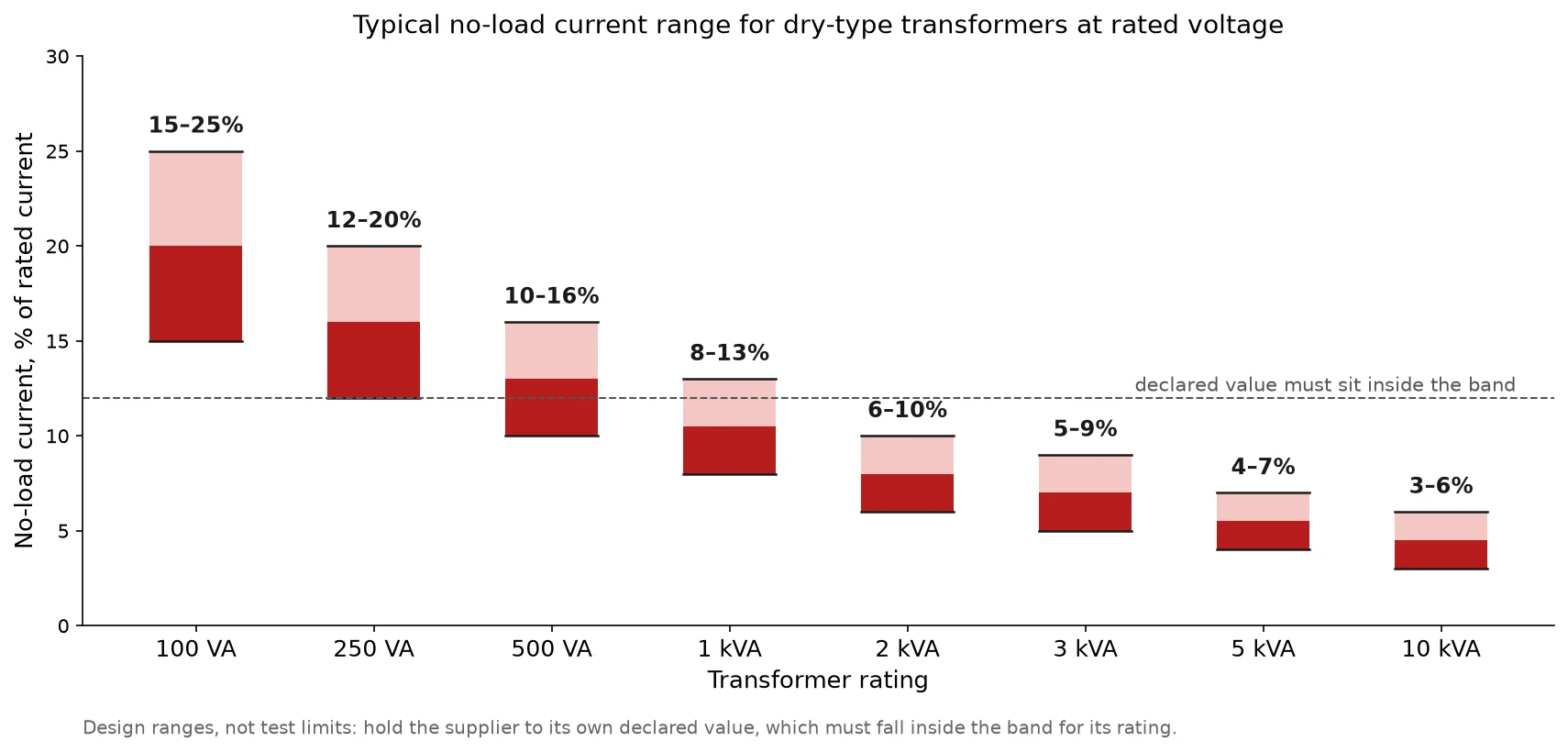
A winding data sheet for the model you are buying: turns per winding, wire diameter, core stack dimensions and the declared no-load current.
None of these documents proves that the unit you receive will be built the same way. That is what the visit is for, and the documents exist mainly to make the visit shorter.
Seven Factory Stations That Reveal the Real Capability
Walk the line in process order and stop at each station long enough to touch something. The right-hand column is what you are looking for; the last column is how the same station looks in a factory that only assembles.
Station
What to inspect
Assembler tell
1. Incoming material store
Magnet wire spools with grade labels for Class B, F or H enamel; core steel bundles with the steel maker’s tag
Unlabelled spools, no steel tag, wire drawn from a generic drum and sold by weight
2. Core cutting and stacking
Shear or punching die, lamination thickness checked with a micrometer
Pre-stacked cores bought in, no thickness gauge anywhere on site
3. Winding
Winder with a turns counter and a tensioner, layer insulation on the roll
Hand winding without a counter for anything above 500 VA
4. Insulation and lead-out
Interleaving between layers, sleeving on lead wires, a stated torque for terminal screws
Leads soldered straight to terminals with no sleeving
5. Varnish dip and bake
Dip tank plus oven with a temperature chart recorder, two dips and two bakes for Class F
Air-dry lacquer, or no impregnation at all
6. Routine test bench
Hipot set, ratio meter, insulation tester and a variac, all with calibration labels inside 12 months
One multimeter and a wall socket
7. Packing
Drop-tested carton, foam corner blocks, nameplate and manual in every box
Bubble wrap and reused cartons
Three of these stations decide the outcome. If the winding room has no turns counter, the ratio printed on the nameplate is a design intention rather than a measured property. If the oven has no chart recorder, the varnish cure is whatever the operator remembers from the last shift. If the hipot set carries a calibration label older than twelve months, the routine test has become a ritual.
Witnessed Routine Tests and Their Acceptance Numbers
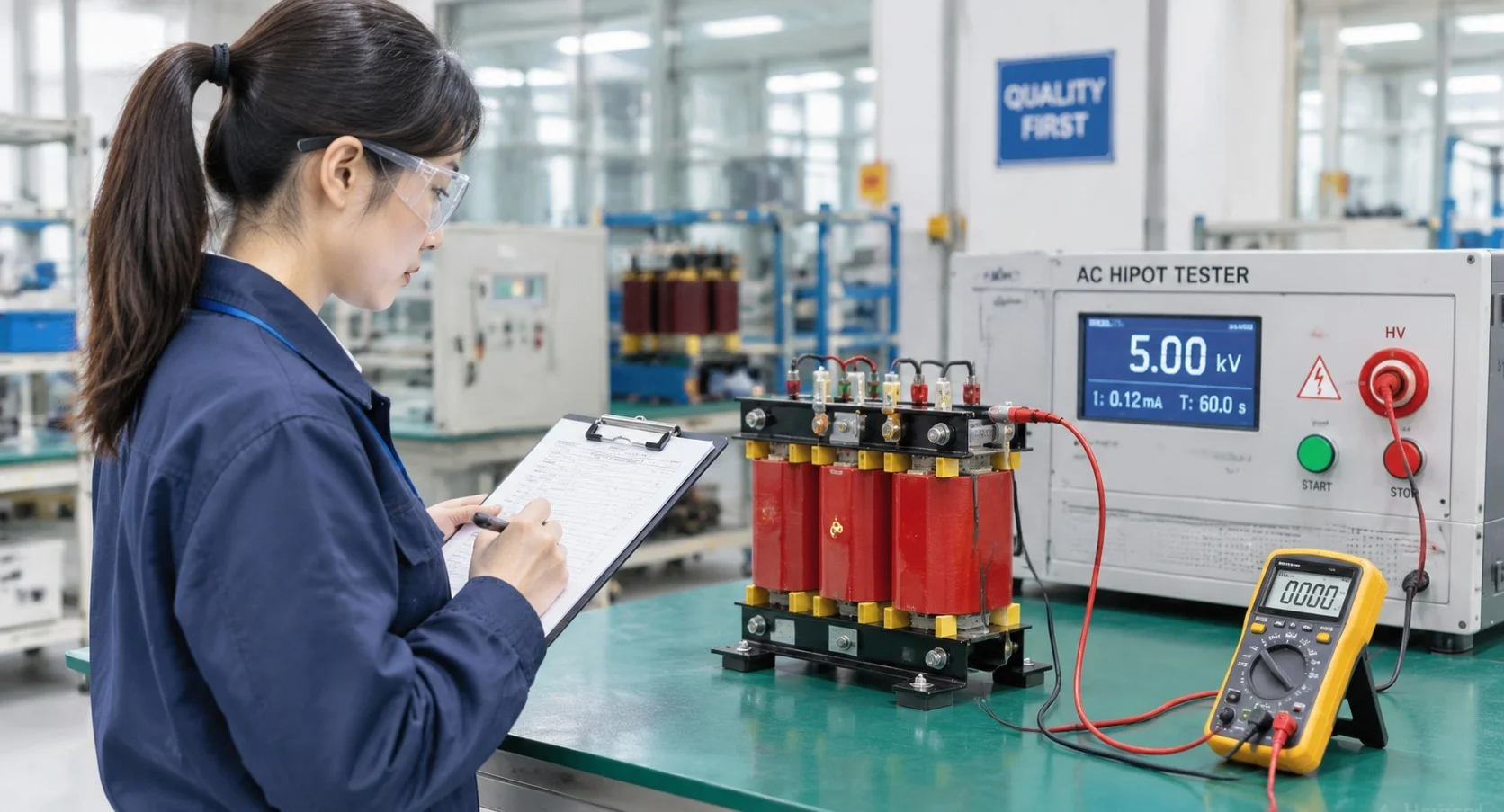
Bring your own instruments: a four-and-a-half digit multimeter, a 500 V insulation tester, a milliohm meter and a clamp meter. Then ask the line to run one unit of your model in front of you and record the values on your form, not on theirs.
Test
Instrument
Acceptance
What a failure points to
Dönüş oranı
Ratio meter, or two meters across a variac
Within ±1% of the nameplate ratio at every tap
Wrong turns count or wrong tap wiring
DC resistance, each winding
Four-wire milliohm meter
Balance within 2% between sections or phases
Loose joint, wrong wire gauge, broken strand
No-load current
Clamp meter at rated voltage, secondary open
At or below the supplier’s declared value, typically 3% to 12% of rated current
Shorted turn, wrong stack height, low-grade steel
İzolasyon direnci
500 V DC, 60 seconds
100 MΩ or more winding-to-winding and winding-to-core when new
Moisture, damaged sleeving, contaminated varnish
Dielectric withstand
Hipot at the routine test level
No breakdown and no flashover for the routine duration
Insufficient creepage, damaged enamel
Output voltage, no load
Multimeter on the secondary
Within the commercial tolerance, commonly ±3% to ±5%
Ratio error or tap selection error
Two of these numbers confuse buyers more than the rest. Turns ratio tolerance and output voltage tolerance are not the same specification: the first is a manufacturing check, the second is a commercial promise that also absorbs regulation from no load to full load. A supplier who quotes one number for both has not thought about it, and the purchase order should carry them as separate clauses. The turns ratio procedure ve DC resistance measurement method are both reproducible on site with a variac and two meters, so there is no reason to accept a bench result you did not see.
Material Verification: Copper, Core Steel and Insulation
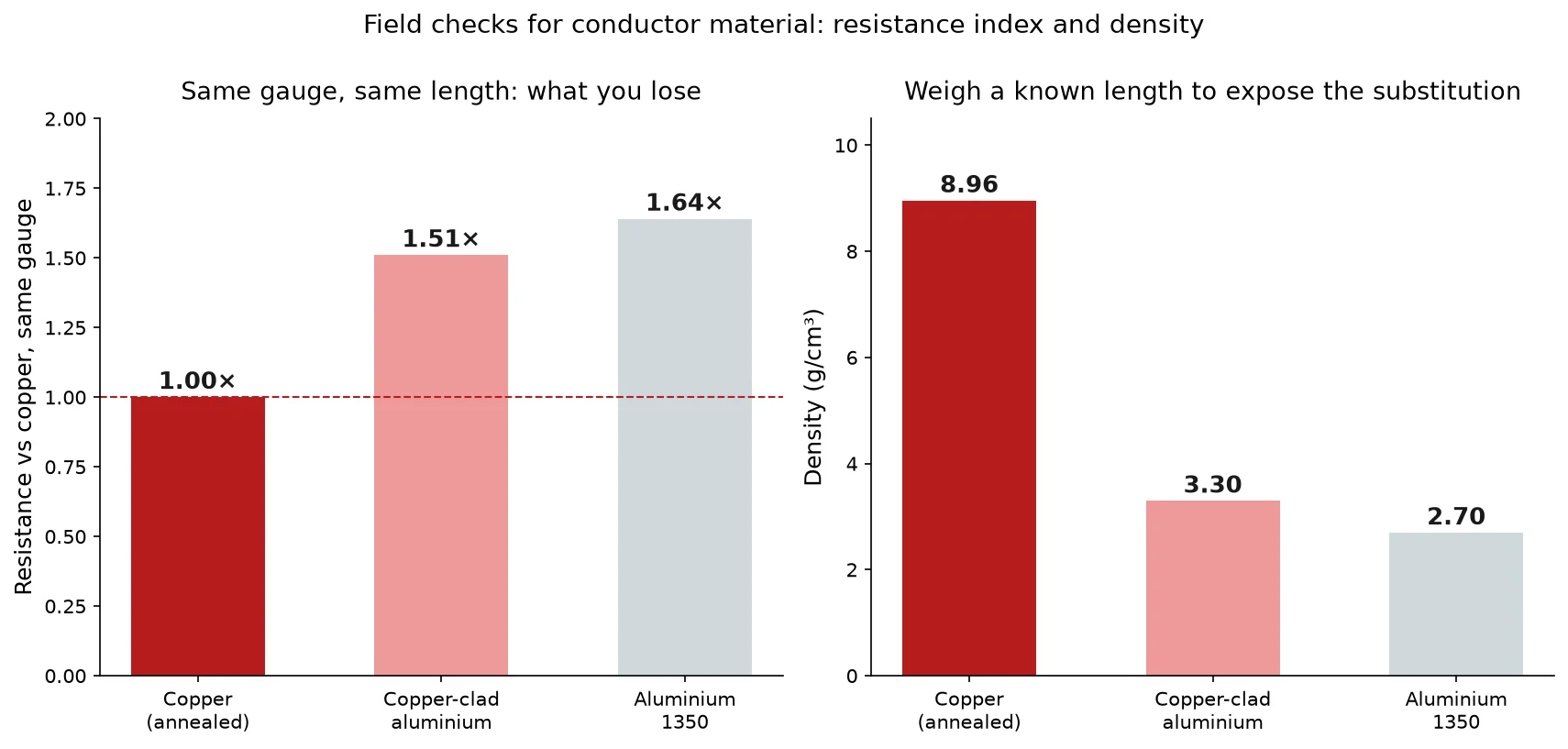
Conductor substitution is the most common cost reduction in this product class, because copper-clad aluminium looks like copper at the terminal and costs roughly a third as much. Density and resistivity settle the question faster than any document.
Conductor
Density (g/cm³)
Resistivity at 20 °C (µΩ·cm)
Resistance vs copper, same gauge
Annealed copper
8.96
1.72
1.00
Copper-clad aluminium, 10% copper by volume
about 3.3
about 2.6
about 1.5
Aluminium 1350
2.70
2.83
1.64
Three field checks take ten minutes. Scrape the enamel from a 20 mm length of wire: copper-clad aluminium shows a silver core under a thin copper skin. Weigh a measured length and compare it against the density table. Then measure one metre with a milliohm meter and compare the result with 1.72 µΩ·cm for the cross-section you specified. The conductor comparison guide covers the weight, loss and thermal consequences of each choice in more depth.
For the core, measure the lamination with a micrometer. Cold-rolled grain-oriented steel at 0.35 mm is the normal grade for this class; 0.50 mm is cheaper and roughly doubles eddy-current loss for the same flux density; anything above that is not transformer steel. Look at the cut edge as well: a bright, burr-free edge with a grey insulating coating indicates properly stored grain-oriented material, while a rusty or blue-oxide edge indicates stock that has been sitting in a humid warehouse. The core construction comparison explains why thickness matters more than the marketing name of the steel.
Insulation class has to match in three places at once: the enamel on the wire, the varnish and the lead wire. A unit sold as Class F with Class B lead wire is a Class B unit, and its temperature rise limit drops with it.
Weighted Audit Scorecard
Score each area from 0 to 5, multiply by the weight and add. Below 70 out of 100 the supplier is one to develop rather than qualify, and any single score of 0 or 1 in the material or test rows overrides the total.
Alan
Ağırlık
What earns a 5
Design documentation
15
Winding data sheet and declared no-load current supplied without being chased
Incoming material control
20
Labelled spools, steel tags retained, a scrap segregation area
Winding and impregnation
25
Turns counter in use, two-dip-two-bake with oven records
Routine test coverage
20
100% hipot and ratio test, records filed by serial number
Calibration and traceability
10
All instruments within calibration, records retrievable by batch
Packing and export experience
10
Drop-tested carton, prior shipments to your region, correct documents
Red Flags That Should End the Visit
Refusal to run a hipot test on a finished unit while you are standing there.
The claim that “every unit is tested” but no record exists for the serial number you were shown.
A quotation that is only valid without a material specification attached.
No turns counter on the winder and no explanation of how ratio is controlled.
No cured-resin smell in the store; a properly baked unit smells of resin, not solvent.
A capacity rating stated at 25 °C ambient with no derating note for 40 °C.
A CE mark on the label with no declaration of conformity behind it.
Contract Terms That Give the Audit Teeth
An audit without contractual consequences is a site visit. Convert each finding into a written commitment in the purchase order, and make the commitment measurable so that a future dispute is about a number rather than an impression.
Declared no-load current and no-load loss per model, with the routine test record attached to each shipment.
Conductor stated by grade, for example Class F enamel over annealed copper of 99.9% purity at a stated diameter.
Core steel grade and thickness in millimetres, not a trade name.
Rated capacity at 40 °C ambient, and the derating curve for higher ambient temperatures.
Ratio tolerance and output voltage tolerance as two separate clauses.
A pre-shipment sample: a photograph of the nameplate and the test record for the first unit of every batch.
A deviation clause stating that substitution of conductor or core material voids the warranty.
Once the numbers are contractual, the commercial comparison gets easier as well, because a quote built on aluminium can no longer be compared line by line with one built on copper. The guide to reading a transformer quotation picks up at that point and covers the cost blocks that sit behind the unit price.
Sonuç
Auditing a supplier in the 100 VA to 10 kVA range takes one day and costs less than a single failed shipment. Bring your own meters, insist on a witnessed routine test, verify the conductor with a milliohm meter and the core with a micrometer, and then write every number you saw into the purchase order. That is the difference between qualifying a manufacturer and hoping you found one.
If you are benchmarking suppliers for a low-voltage conversion or isolation unit, the DT-3000VA yükseltici ve düşürücü transformatör is a useful reference point for what the documentation package should contain: winding data, declared no-load current and a routine test record per serial number. Send us the model and the destination market and we will return the test data before you book a flight.
SSS
How long does a transformer supplier audit take?
One day for a factory in the 100 VA to 10 kVA class, of which two to three hours are spent on the floor. The document review takes 48 hours before the visit and the scorecard takes an hour afterwards. Anything longer usually means the factory is large enough to need a separate quality department to answer questions.
Do I need a third-party inspection for a small transformer order?
Rarely. For a 3 kVA unit, a witnessed routine test with your own meters covers the failure modes that matter. Third-party inspection earns its fee above roughly 100 kVA, or where the order is repeat volume and you need an independent record for a warranty claim.
What is the difference between a routine test and a type test?
A routine test is performed on every unit produced and checks that the individual transformer meets its rating. A type test is performed once on a representative unit of a design and proves the design itself, including temperature rise and dielectric strength at the full test level. A supplier who offers type test reports but no routine records has proven the design and not the shipment.
Is a CE mark enough to qualify a transformer supplier?
No. For a low-voltage transformer the CE mark is a self-declaration, so the mark alone says only that the supplier claims conformity. Ask for the declaration of conformity, the harmonised standard cited, and a test report from a laboratory whose accreditation you can verify.
Can a supplier be audited remotely?
Partly. Documents, a live video walk-through and a witnessed test on a video call will confirm process and test capability. Conductor material and core thickness cannot be verified without physical access to the material, which is precisely the substitution most likely to occur.
Laminated, toroidal and amorphous transformer cores compared for 100 VA to 10 kVA dry-type units: where each construction wins, what the loss numbers mean, and the seven quotation checks.
Prove the tap changer is guilty before you open it: a symptom-first fault table for rotary selectors and OLTCs, acceptance test values, and the twenty-minute annual check.
An on-load tap changer regulates under load; an off-load tap changer needs a de-energized visit. Why an OLTC never fits 100 VA to 10 kVA units, plus real tap-selection math on a 1000 VA transformer.