أن محول ذاتي is a specialized electrical device that uses a single continuous winding to step voltage up or down. Unlike conventional two-winding transformers, it shares part of the same coil between input and output, making it smaller, more efficient, and less expensive for applications where electrical isolation is not required. In this guide, you will learn how an auto transformer works, the main types available, their advantages and limitations, and where they are used in real-world power systems.
What Is an Auto Transformer?
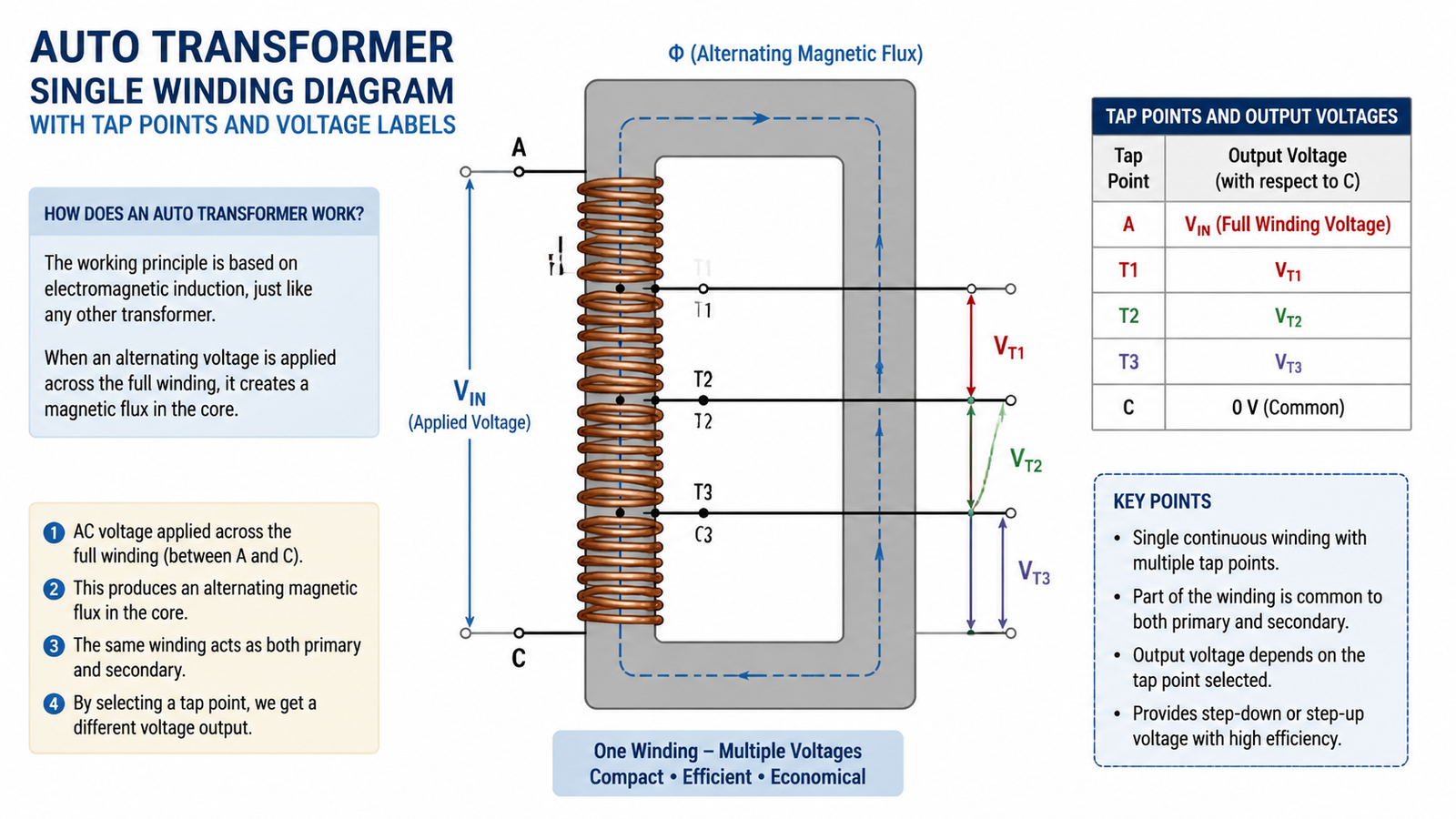
An auto transformer—sometimes written as autotransformer—is a transformer with only one winding that serves as both the primary and secondary coil. Taps along the winding allow engineers to extract different voltage levels from the same coil. The word “auto” comes from the Greek for “self,” referring to the self-acting single-coil design rather than any automatic mechanism.
In a conventional isolation transformer, energy transfers entirely through magnetic induction between two separate windings. In this design, energy transfers partly by magnetic induction and partly by direct electrical conduction through the shared portion of the winding. This dual transfer path is what gives the unit its higher efficiency and compact footprint.
For a deeper look at how autotransformers differ from standard step-up and step-down designs, see our comparison of step-up and step-down transformer vs autotransformer.
How Does an Auto Transformer Work?
The working principle is based on electromagnetic induction, just like any other transformer. When an alternating voltage is applied across the full winding, it creates a magnetic flux in the core. This flux induces a voltage in every turn of the coil. By connecting the load to a tap point partway along the winding, the output voltage becomes a fraction of the input voltage.
The voltage ratio follows the same turn-ratio law as conventional transformers:
V₂ / V₁ = N₂ / N₁ = k
Where V₁ is the primary voltage across the full winding of N₁ turns, and V₂ is the secondary voltage across the tapped section of N₂ turns. The transformation ratio k determines whether the device steps voltage up (k > 1) or down (k < 1).
Because the common section of the winding carries only the difference between primary and secondary currents, copper losses are reduced. The copper saving is approximately k × 100 percent, which means these units are most economical when the voltage ratio is close to 1:1.
Types of Auto Transformers
These devices are classified by function, phase configuration, and adjustability. Choosing the right type depends on your voltage range, load size, and whether you need fixed or variable output. For a broader overview of classifications, read our article on autotransformer definition, types and use.
Step-Up Auto Transformer
A step-up unit increases the output voltage above the input level. The secondary connection uses more turns than the primary section. These designs are common in power transmission networks where two systems with slightly different voltages must be interconnected.
Step-Down Auto Transformer
A step-down design reduces voltage. The load connects to a tap with fewer turns than the full winding. This configuration is widely used for motor starting, where reduced voltage limits inrush current and mechanical stress on the driven equipment.
Variable Auto Transformer (Variac)
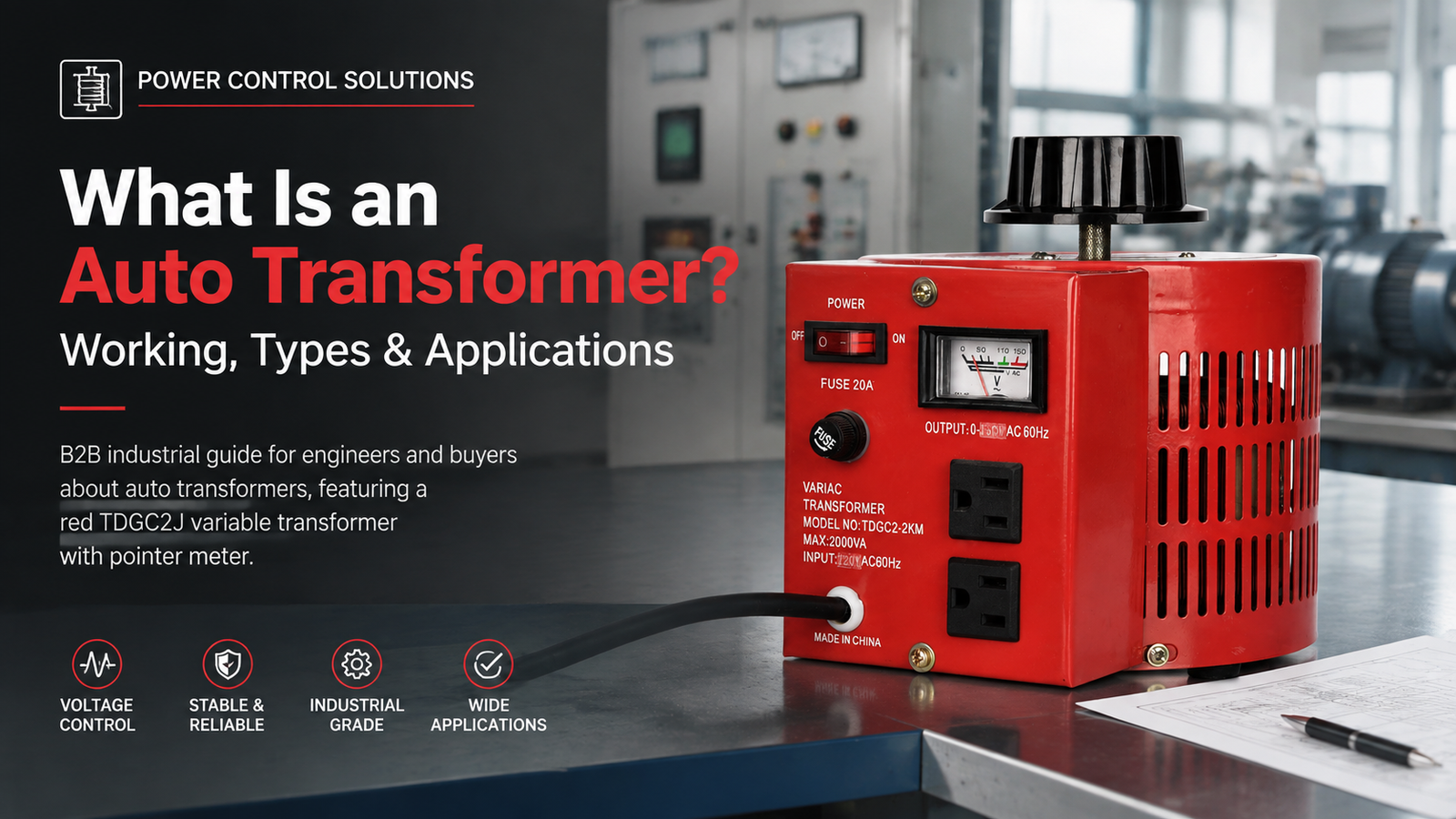
A variable unit, commonly called a Variac, provides a smoothly adjustable output voltage. A sliding brush or rotary contact moves along an exposed winding, allowing continuous adjustment from near zero to slightly above line voltage. Variacs are essential in laboratories, repair shops, and product testing environments where precise voltage control is needed.
Johsun offers a practical line of variable transformers for bench and light industrial use. The TDGC2J Variable Transformer With Meter provides 0.5 kVA to 5 kVA capacity with a built-in pointer voltmeter for real-time output monitoring. For applications requiring a 0–130 V output range, the TDGC2J 0-130V Variable Transformer is a compact single-phase option. If you need a regulator without a meter, the TDGC2J Single Phase Voltage Regulator covers the same power range in a simple, reliable housing.
Tapped and Compensating Auto Transformers
Tapped units provide fixed voltage levels at predetermined tap points. They are popular in distribution panels and OEM equipment where the required output is known in advance. Compensating designs fine-tune voltage to counteract sags and swells on long feeder runs, helping sensitive industrial loads stay within tolerance.
Single-Phase and Three-Phase Auto Transformers
Single-phase models serve residential, commercial, and small laboratory loads typically up to a few tens of kVA. Three-phase units handle industrial motor banks, utility substations, and large production lines. Three-phase designs may use star (wye) or delta configurations depending on grounding and phase-shifting requirements.
| النوع |
Voltage Behavior |
Typical Use Case |
| التدرج |
المخرجات > المدخلات |
Transmission interconnection |
| مخفض الجهد |
المخرجات < المدخلات |
Motor starting, reduced-voltage supply |
| المتغير (فارياك) |
Smoothly adjustable |
Laboratory testing, equipment burn-in |
| Tapped |
Fixed preset levels |
Panel boards, machinery OEM |
| Compensating |
Buck-boost correction |
Voltage stabilization on long lines |
المزايا والعيوب
These devices offer clear benefits when the application does not require galvanic isolation. However, their shared-winding design introduces safety and performance limits that engineers must understand before specifying one.
| المزايا |
العيوب |
| Higher efficiency (often ≥ 98 %) |
No electrical isolation between primary and secondary |
| Smaller size and lighter weight |
Full primary voltage can appear at output if common winding opens |
| Lower cost due to less copper and core material |
Higher short-circuit current because of low impedance |
| Better voltage regulation |
Grounding and neutral cannot be isolated |
| Reduced copper losses |
Not suitable for high voltage ratios (best near 1:1) |
The most important safety consideration is the lack of isolation. Because input and output share a direct electrical path, a fault on the primary side can propagate to the load. For this reason, they should not be used in medical equipment, sensitive instrumentation, or any installation where codes mandate galvanic separation.
Applications of Auto Transformers
These transformers are found across domestic, commercial, and heavy industrial sectors. Their efficiency and compact size make them attractive wherever a small voltage adjustment is needed and isolation is not a constraint.
Voltage Regulation and Stabilization
They form the core of many voltage stabilizers. Compensating windings buck or boost the line voltage to keep output within a tight tolerance band. This is especially valuable in regions with unstable grid supply.
Motor Starting
Large induction motors draw five to seven times their full-load current during direct-on-line starting. A starter of this type applies a reduced voltage—typically 50 %, 65 %, or 80 % of line voltage—then bypasses the transformer once the motor reaches speed. The Korndörfer starter is a well-known three-contactor scheme that uses this approach.
Laboratory and Testing
Variable units (Variacs) are standard equipment on electronics benches. Technicians use them to power up repaired equipment gradually, test products at over- and under-voltage conditions, and simulate real-world supply fluctuations. To learn more about wiring and practical setups, see our guide on Variac transformer working, wiring and applications.
Power Transmission
Utilities use large three-phase units to tie together transmission networks with close but not identical voltage levels— for example, 115 kV to 138 kV. The reduced material requirements translate to significant cost savings at high MVA ratings.
Audio and Impedance Matching
Toroidal designs provide low-loss impedance matching in professional audio systems. Their ring-shaped core minimizes electromagnetic interference and hum, preserving signal quality in broadcast and recording environments.
How to Choose the Right Auto Transformer
Selecting the right unit requires matching electrical ratings to the application while respecting safety boundaries. Consider these factors before ordering:
- Voltage ratio: These units are most efficient when the ratio is close to 1:1. For large differences, a conventional two-winding transformer is usually the better choice.
- القدرة المقننة بالكيلو فولت أمبير: Size the unit for the maximum continuous load current, including any motor-starting overload.
- Isolation requirement: If codes or safety standards require galvanic isolation, use an isolation transformer instead.
- Adjustability: Choose a fixed-tap unit for known voltages, or a Variac-style unit if you need smooth, continuous adjustment.
- Phase and frequency: Match the transformer to your supply—single-phase or three-phase, 50 Hz or 60 Hz.
- Environment: Check ambient temperature, altitude, and humidity limits against the manufacturer’s datasheet.
الخلاصة
This design is an efficient, compact solution for voltage transformation when electrical isolation is not required. Its single-winding construction reduces material costs, copper losses, and physical size, making it attractive for motor starting, voltage regulation, laboratory testing, and utility interconnection. The trade-off is the absence of galvanic isolation, which limits use in safety-critical and sensitive electronic applications. By understanding the working principle, types, and selection criteria outlined in this guide, you can specify the right unit for your project with confidence.
If you need a reliable variable transformer for bench or light industrial use, explore Johsun’s variable transformer range to find a model that matches your voltage and capacity requirements.
الأسئلة الشائعة
What is the main difference between an auto transformer and an isolation transformer?
This design uses a single shared winding, so there is no electrical isolation between input and output. An isolation transformer has two separate windings and provides full galvanic isolation, making it safer for sensitive or medical equipment.
Can an auto transformer step up and step down voltage?
Yes. By reversing the connection, the same unit can function as either a step-up or step-down device. The direction depends on which portion of the winding is treated as the primary.
Why are auto transformers more efficient than conventional transformers?
They transfer part of the power directly through the shared winding by electrical conduction, not just by magnetic induction. This reduces I²R losses in the copper and requires less core material than a two-winding design.
When should I not use an auto transformer?
Avoid them when galvanic isolation is required by code, when grounding flexibility is important, or when the voltage ratio is very large. In these cases, a conventional isolation transformer is the safer choice.
ما هو «فارياك»؟
A Variac is a brand name that has become a generic term for a variable auto transformer. It uses a sliding brush contact to provide a continuously adjustable AC output voltage, typically from near zero to slightly above the input line voltage.
Are auto transformers suitable for three-phase systems?
Yes. Three-phase models are widely used in industrial and utility applications. They can be configured in star or delta arrangements depending on voltage, grounding, and phase-shifting requirements.
Recommended Models for Autotransformer Applications
If you are specifying a unit rather than reading theory, start here. These models cover the capacity bands most often requested for autotransformer applications, and each links straight to its specification and price range.
أخبرنا بجهد الدخل وجهد الخرج والطور والقدرة المستمرة بالكيلو فولت أمبير (kVA) التي تحتاجها، وسنقوم بتأكيد الطراز المطابق والسعر ومدة التسليم في غضون يوم عمل واحد. أما القيم غير القياسية، فيتم التعامل معها من خلال تصنيع المحولات المخصصة وفقًا لمعايير OEM/ODM.