Aufwärts- und Abwärtstransformator - Was ist der Unterschied, wie wird verdrahtet und wie wird ausgewählt?

If you’re new to Transformatoren, the names can feel intimidating. In reality, most B2B projects come down to three practical questions:

  1. Will the transformer make my voltage match the equipment?
  2. How do I connect it (without guessing)?
  3. Which type should I buy—autotransformer or isolation—and what size (kVA) do I need?

This guide is written for buyers, procurement teams, and engineers who want a clear, “do this → then this” approach—especially for Auf- und Abspanntransformatoren used in industrial systems, control panels, machinery imports, and site voltage mismatches.


What is the difference between step up and step down transformer?

Step-up transformer (voltage goes UP)

A Aufwärtstransformator converts a lower input voltage to a higher output voltage.

Beispiel: 208V → 480V (common for machinery or motor systems)

Step-down transformer (voltage goes DOWN)

A Abspanntransformator converts a higher input voltage to a lower output voltage.

Beispiel: 480V → 208Y/120V (common for facility distribution and panel power)

The “hidden” difference that matters in real projects

Beginners often think the only difference is the direction of voltage. In practice, the big impacts are:

  • Current is higher on the lower-voltage side (thicker cables, bigger breakers)
  • Neutral/ground requirements can change depending on output wiring (especially for 208Y/120V)
  • Isolation vs non-isolation (this decides which product you should buy)

Before you buy: write your requirement in one sentence

Use this format (it makes quoting faster and reduces wrong shipments):

Input: ___V, ___phase, ___Hz
Output: ___V, ___phase (Need neutral? Yes/No), ___Hz
Load: ___kW or ___A (continuous + max), load type (motor / VFD / rectifier / heaters / PLC)
Installation: indoor/outdoor, enclosure/IP, ambient temp, mounting type

If you only do one thing from this article—do this.


How to connect a transformer (simple wiring rules)

Safety note: final wiring must be done by qualified electricians per local code. This section is to remove confusion, not replace safety procedures.

Terminal labels you will see (most common)

  • H1, H2 (and H3) = Primary (input from the power source)
  • X1, X2 (and X3) = Secondary (output to your load)
  • PE / Ground = earth ground to the enclosure

If you remember only this: Power goes to H, load goes to X.

H1H2 X1 X2

Single-phase step-down or step-up wiring (beginner version)

Goal: convert 230V to 115V (step-down) or 115V to 230V (step-up)

Connection logic

  1. Connect your supply to H1/H2 (input side)
  2. Connect your load to X1/X2 (output side)
  3. Connect protective earth (PE) to the transformer enclosure
  4. If the transformer has multiple taps, choose the tap that matches your actual input voltage

Common beginner mistake: mixing H and X terminals.
If you connect supply to X and load to H, your output won’t match expectations and protection may be wrong.

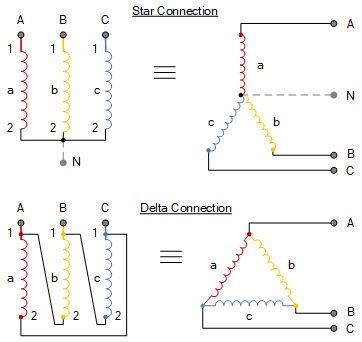
Three-phase step-down wiring (example: 480V → 208Y/120V)

This is very common in North American industrial sites and data rooms.

What you must clarify before wiring

  • Is the secondary Y (wye/star) with a neutral?
  • Benötigen Sie 120V single-phase loads (lighting, outlets, PLC power supplies)?
    • If yes, you likely need 208Y/120V (wye) output.
step up or step down transformer

Connection logic

  1. Supply 3-phase input to H1/H2/H3
  2. Load 3-phase output from X1/X2/X3
  3. If the secondary is 208Y/120V, you will also have X0 (neutral)
  4. Grounding and neutral bonding must follow your site design/code requirements (don’t “guess bond”)

Common beginner mistake: buying a 208V delta output when you actually need 120V loads.
No neutral = no 120V.

3.4 Three-phase step-up wiring (example: 208V → 480V)

Connection logic

  1. Supply to H terminals
  2. Load from X terminals
  3. Watch your low-voltage side current (it will be higher)

Common beginner mistake: undersizing cables/breakers on the low-voltage side.
In a step-up, the 208V side often carries the highest current.


How to size the transformer (kVA) without overthinking

Transformers are sized in kVA, not kW.

Quick sizing formulas

  • Single-phase:
    kVA ≈ (V × A) / 1000
  • Three-phase:
    kVA ≈ (1.732 × V × A) / 1000

Add practical margin (this prevents overheating and nuisance trips)

Use these as procurement-friendly rules of thumb:

  • Heaters / stable linear loads: 10–20% margin
  • Motors (DOL start) / high inrush: 50–100% margin (depends on start method)
  • VFD / rectifier / UPS (non-linear loads): 25–50% margin + ask about harmonics/derating

Why margin matters:
Even when the kVA math looks correct, real loads often have inrush, harmonic current, or poor power factor that increases heating.

step up and step down transformers

Wenn Ihr Unternehmen Lösungen für Aufwärts- und Abwärtstransformatoren sucht, kontaktieren Sie uns noch heute, um einen Produktkatalog oder ein auf Ihre Bedürfnisse zugeschnittenes Angebot anzufordern.


Which type should you choose? (This is where most wrong orders happen)

When buyers search “step up and step down transformers,” they often find two different product families:

Option A: Autotransformer (step up and step down autotransformer)

Best when you just need voltage conversion and don’t need isolation.

  • Pros: smaller, cheaper, higher efficiency
  • Cons: no electrical isolation between input and output

Typical B2B uses

  • Site voltage mismatch: 3 phase autotransformer 400V to 415V, 380V ↔ 400V ↔ 415V
  • Equipment import conversion where isolation is not required
  • industrial voltage conversion transformer “Small ratio” changes (ex: 208 ↔ 240)

Option B: Isolation transformer (two-winding transformer)

Best when you need electrical separation, noise reduction, or a cleaner system boundary.

  • Pros: isolation, better for noise/common-mode issues, flexibility for grounding schemes
  • Cons: larger, heavier, higher cost

Typical B2B uses

  • Sensitive control systems, PLC panels, instrumentation
  • Sites that need a defined neutral strategy (depending on design)
  • Situations where safety or electrical separation is required

Option C: Buck-boost transformer (small correction)

Best when the voltage difference is small (often 10–20%).

  • Pros: very cost-effective for minor adjustments
  • Cons: not for large voltage jumps

Typische Verwendung

  • 240V → 208V or 208V → 240V buck boost transformer corrections for HVAC, motors, control panels

“Which one should I buy?” Decision checklist

Use this fast decision path:

Step 1 — What’s the voltage conversion?

  • Big change (ex: 110 ↔ 220, 208 ↔ 480, 380 ↔ 220): go to Step 2
  • Small correction (ex: 208 ↔ 240): consider buck-boost first

Step 2 — Do you need isolation?

  • Yes / not sure → choose isolation transformer
  • No → choose Autotransformator

Step 3 — Single-phase or three-phase?

  • Equipment nameplate usually states: 1PH oder 3PH
  • If it says 3~, that’s three-phase.

Step 4 — Do you need a neutral output?

  • Need 120V single-phase loads from a three-phase system?
    → choose a wye (Y) secondary with neutral (ex: 208Y/120)

Step 5 — What is your load type?

  • Motors/VFD/UPS/rectifier?
    → add margin and confirm suitability (harmonics, inrush)

Practical buying specs

Transformer type: Autotransformer / Isolation / Buck-boost
Rated capacity: ___ kVA (continuous)
Input: ___V, ___phase, ___Hz
Output: ___V, ___phase (neutral required: Yes/No), Hz
Taps required: Yes/No (range: ±
%)
Load: ___A max, A continuous, load type: motor / VFD / UPS / heaters
Enclosure: indoor/outdoor, IP
, mounting: wall/panel/floor
Ambient: ___°C, altitude ___m
Compliance needed: CE/UL (if required by project)
Extras: terminal blocks/lugs, breaker, thermal protection, noise limit

This is the fastest way to get accurate quotes from suppliers.


Common mistakes

  1. Buying the right voltage but wrong phase
    • Fix: always list input/output phase (1PH vs 3PH)
  2. Forgetting frequency (50Hz vs 60Hz)
    • Fix: include Hz; some designs require derating at 50Hz
  3. Needing 120V loads but buying a delta output
    • Fix: if you need 120V, specify 208Y/120V with neutral
  4. Undersizing due to motor inrush or VFD harmonics
    • Fix: add margin and disclose load type in RFQ
  5. Assuming “step-down can be used as step-up” without confirming
    • Fix: if you plan reverse connection, require supplier written confirmation + tap behavior clarification

FAQ

Can one transformer do both step up and step down?

Yes—many products are designed as “step up and step down transformers” with selectable taps/terminals so you can use them in either direction.

Is an autotransformer safe?

It can be safe when properly applied, but it does u003cstrongu003enotu003c/strongu003e provide isolation. If isolation is required by your safety design or application, choose a two-winding isolation transformer.

How do I know my transformer size (kVA)?

Use kVA formulas (single-phase or three-phase) based on voltage and current, then add margin depending on load type (motor/VFD/UPS usually need more margin).

What’s the fastest way to avoid ordering the wrong unit?

Send a one-line requirement: input V/phase/Hz, output V/phase/Hz (neutral yes/no), load type, max current, install environment.

Vorheriger Beitrag

Wie funktionieren Aufwärts- und Abwärtstransformatoren?

Nächster Beitrag

Wandmontage Spannungsstabilisator Hersteller Johsun Tec

Verwandte Beiträge

+86-15658763197 Telefon sales@johsuntech.com E-Mail Chatten auf WhatsApp WhatsApp