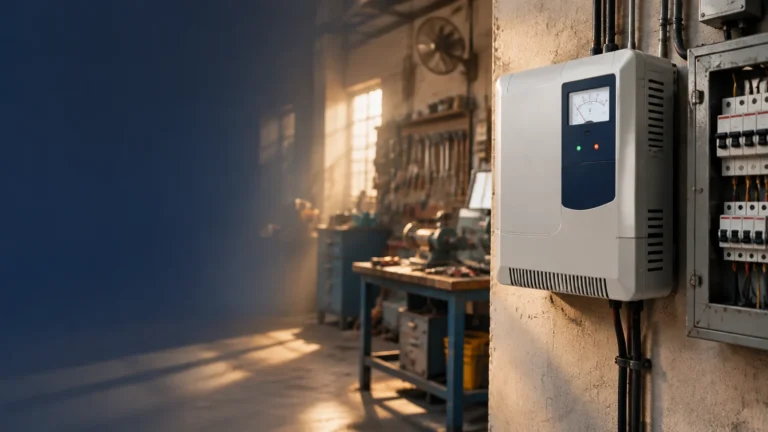
A Wall Mount Voltage Stabilizer is an automatic voltage regulating device that keeps AC voltage within a safe, stable range. It is designed for homes, offices, and small commercial spaces and can be mounted on a wall to save floor space while protecting TVs, air conditioners, refrigerators, computers, and other critical appliances.
Most wall‑mounted stabilizers use servo‑motor‑with‑carbon‑brush oder relay‑with‑multi‑tap‑transformer technology to provide automatic “boost” and “buck” functions, ensuring the output voltage remains within a narrow band (typically 220V±3%∼8%).
Key Technical Parameters
Parameter
Typical Value / Range
Anmerkungen
Eingangsspannungsbereich
130–260V or 140–260V (single‑phase)
Some wide‑range models support 85–275V for unstable grids.
Ausgangsspannung
220V or 110V (optional)
Standard household voltage in many regions.
Output Accuracy
220V ± 3% ∼ 8%
Ensures connected appliances operate within a safe voltage window.
Kapazität Bereich
500VA – 5kVA (residential)
Suitable for home loads such as air conditioners, refrigerators, TVs.
Capacity Range (Commercial)
Up to 8–12kVA
For small commercial or multi‑appliance setups.
Effizienz
>95% (up to >97% in premium models)
Low self‑consumption, minimal impact on electricity cost.
Response Time (Relay‑type)
<0.5 s (for 10% voltage change)
Fast regulation for frequently fluctuating grids.
Response Time (Servo‑motor‑type)
~1–2 s
Smooth, continuous adjustment for sensitive loads.
Overvoltage Protection
Automatic cut‑off when voltage exceeds threshold
Typically above 246V or user‑adjustable limit.
Undervoltage Protection
Automatic cut‑off when voltage falls below threshold
Typically below 150V or user‑adjustable limit.
Overload / Short‑Circuit Protection
Built‑in protection circuit
Limits current or disconnects power under overload/short circuit.
Overtemperature Protection
Automatic shutdown when overheated
Prevents damage due to poor ventilation or long high‑load operation.
Time Delay
3–7 seconds (sometimes 3–7 minutes)
Avoids inrush current when multiple devices restart after power recovery.
Display Type
LED or LCD
Shows input voltage, output voltage, load, and fault codes.
Noise Level (Servo‑motor‑type)
Typically <40 dB
Suitable for bedrooms and offices.
Expected Lifespan
8–15 years
Depends on transformer quality, cooling design, and operating environment.
Wall Mount Voltage Stabilizer Working Principle
Wall Mount Voltage Stabilizers operate according to a “sample‑judge‑adjust” closed‑loop control process.
Voltage Sampling: Internal circuits continuously monitor input and output voltage. When the grid voltage fluctuates (for example, from 180V up to 250V), the control unit detects the deviation immediately.
Control Logic: A microcontroller or IC determines whether to “boost” or “buck” based on the set target (such as 220V) and triggers the actuator (servo motor or relay bank).
Regulation Methods:
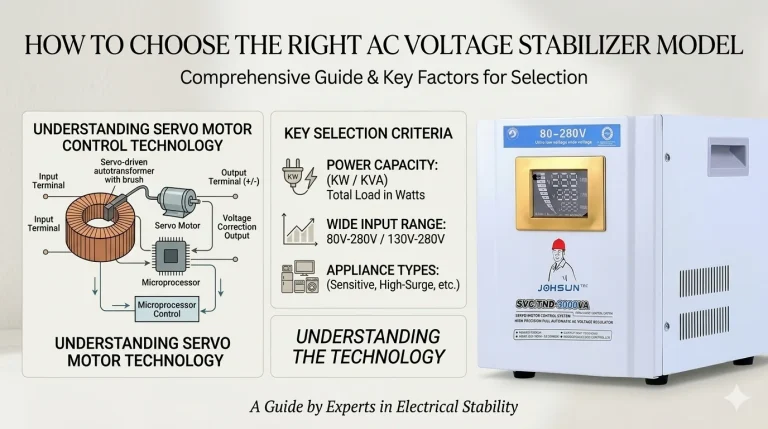
Servo‑Motor‑with‑Carbon‑Brush Type: A stepper motor moves the carbon brush on an autotransformer, enabling smooth, continuous voltage adjustment, ideal for wave‑sensitive loads.
Relay‑with‑Multi‑Tap Type: Multiple relays switch between different transformer windings to provide fast, discrete adjustment, with faster response and no mechanical wear, suitable for frequently fluctuating grids.
Protection and Output: If voltage exceeds thresholds (for example, above 246V or below 150V), the device automatically disconnects the output to protect downstream equipment. At the same time, an LED/LCD display shows real‑time input/output voltage and load status.
Wenn Ihr Unternehmen Lösungen für die Wandmontage von Spannungsstabilisatoren sucht, nehmen Sie noch heute Kontakt auf und fordern Sie einen Produktkatalog oder ein auf Ihre Bedürfnisse zugeschnittenes Angebot an.
1. Automatic Voltage Regulation and Appliance Protection
Automatically boosts or bucks voltage, stabilizing wide input ranges (e.g., 130–260V) into a stable output of 220V±3%∼8%, protecting sensitive components such as compressors, motors, and power boards from damage.
Reduces problems caused by voltage fluctuations, such as equipment overheating, failed startups, or flickering lights, and helps extend the service life of appliances.
2. Multi‑Level Intelligent Protection
Overvoltage / Undervoltage Protection: Automatically cuts off output when voltage exceeds safe limits, preventing component breakdown or motor burnout.
Overload / Short‑Circuit Protection: Limits current or disconnects power during overloads or short circuits to protect circuits and connected devices.
Delay Start: Following a power recovery, the device delays output activation to avoid large inrush currents from multiple appliances starting simultaneously.
Optional Lightning/Surge Protection: Some models integrate MOV modules to absorb lightning‑induced or switching surges, providing extra protection for downstream equipment.
3. Wall‑Mount Design for Space Saving and Aesthetics
Slim housings can be mounted directly on walls near distribution boxes, in living rooms, bedrooms, or near air conditioners, saving valuable floor space and hiding cables for a cleaner look.
Housings are typically made of flame‑retardant ABS or metal, combined with optimized heat‑dissipation structures to ensure safety, reliability, and quiet operation.
4. High Efficiency, Low Noise, Long‑Term Reliability
Typical efficiency is >95%, with minimal self‑consumption, so long‑term continuous operation does not noticeably increase electricity bills.
Servo‑motor‑type models often operate below 40dB (similar to a quiet library), making them suitable for bedrooms and offices.
High‑grade transformers (e.g., CRGO silicon steel core, copper windings) and independent SMT manufacturing ensure stable, long‑term operation under continuous load.
Wall Mount Stabilizer vs. Other Types – Key Advantages
Dimension
Wall Mount Voltage Stabilizer
Floor‑Standing / Cabinet Stabilizer
Plug‑In / Small Power Stabilizer
Installation
Mounts directly on the wall, saves floor space, ideal for homes and small offices.
Usually placed on the floor, requires reserved space, suitable for large server rooms or industrial areas.
Typically plug‑in style, fits only single devices.
Space & Appearance
Wall‑mounted layout is neat and integrates better with interior design.
Larger footprint, visually more intrusive.
Compact but can appear cluttered when placed on the floor.
Typical Load
Ideal for 1 air conditioner or 1–3 household appliances connected together.
Suitable for multiple high‑power devices or three‑phase industrial loads.
Limited to single low‑power devices such as TVs or routers.
Sicherheit
Mounted away from ground water and out of children’s reach, reducing risk of contact.
Floor installation may be exposed to water or accidental contact.
Often placed near sockets, which can pose contact risks if not positioned carefully.
Intelligence & Protection
Typically includes wide input range, overvoltage/undervoltage/overload/short‑circuit protection and time‑delay start.
Three‑phase or large industrial models may offer more complex protection, at higher cost.
Basic protection features, mainly for simple voltage stabilization.
Summary: Wall Mount Voltage Stabilizer are ideally suited to residential and small‑commercial environments, offering an optimal balance of compact design, efficient protection, safety, aesthetics, and cost while safeguarding critical appliances such as air conditioners, refrigerators, and televisions.
Why Choose Our Wall Mount Voltage Stabilizer?
Among the many Wall Mount Voltage Stabilizer options on the market, our products distinguish themselves through several key advantages that deliver higher value to customers:
1. High‑Precision Regulation and Wide Input Range
We maintain output voltage at 220V±3%∼8% using microcontroller‑based control with servo‑motor or high‑speed relay regulation, ensuring air conditioners, refrigerators, and other loads operate smoothly under voltage fluctuations.
Wide input ranges (such as 130–260V or wider) make our stabilizers suitable for areas with unstable grids, so you can avoid constant “voltage anxiety.”
2. Comprehensive Intelligent Protection for Peace of Mind
Our units integrate overvoltage, undervoltage, overload, short‑circuit, overtemperature, time‑delay start, and optional surge/lightning protection modules, creating multiple layers of safety.
Smart detection and automatic shutdown effectively prevent motor burnout, power‑supply failure, and premature equipment aging.
3. Elegant Wall‑Mount Design and Quiet Operation
Ultra‑thin housings can be mounted directly on walls near distribution boxes, in living rooms, bedrooms, or next to air conditioners, saving floor space and improving interior neatness.
Low‑noise design (often below 40dB) and smooth servo‑motor operation make them ideal for quiet environments such as bedrooms and offices.
4. High Efficiency, Low Power Loss, and Long Lifespan
Typical efficiency above 95%, with high‑quality copper windings and CRGO silicon‑steel cores, ensures high performance even under heavy continuous loads.
Independent SMT manufacturing and optimized circuit layouts extend product life and reduce the need for replacements or maintenance.
5. Localized Service and Reliable Support
We provide professional sizing guidance (single‑unit air conditioner vs. multi‑appliance setups), installation recommendations, and after‑sales support, offering a seamless experience from selection → installation → long‑term use.
Our Wall Mount Voltage Stabilizer range covers multiple capacities (e.g., 500VA to 10kVA), suitable for homes, small shops, and offices, satisfying diverse application needs.
If you share your brand name and positioning (for example, “high‑end home use” or “industrial‑grade commercial”), the content above can be further refined into a ready‑to‑use English product category page layout with H1/H2 headings, meta descriptions, comparison tables, and a polished “Why choose us” section.
FAQ
Which appliances are suitable for Wall Mount Voltage Stabilizers?
They are designed for single‑phase residential power systems and are commonly used for:u003cbru003eAir conditioners (1–2.5 HP), refrigerators, TVs, computers, routers, NAS units, and surveillance systems.u003cbru003eWhen selecting a model, match or slightly exceed the total load power (kVA/VA) of the connected appliances to ensure enough capacity.
Can a Wall Mount Voltage Stabilizer fully replace a UPS?
No. A voltage stabilizer mainly stabilizes voltage but does u003cstrongu003enot provide backup power during outagesu003c/strongu003e; a UPS provides battery backup when the grid fails. The two can be used together:u003cbru003e1. The stabilizer protects equipment from voltage fluctuations,u003cbru003e2. The UPS keeps critical devices (such as PCs or servers) running during blackouts.
Does wall‑mount installation require a professional electrician?
It is recommended to have a qualified electrician perform the installation, especially when:u003cbru003e1. Connecting the unit to the distribution board or air switches,u003cbru003e2. Ensuring proper grounding,u003cbru003e3. Choosing a suitable location with good ventilation, low humidity, and easy access to the display.
How often should I maintain it, and what is its expected lifespan?
1. The service life is typically in the range of 8–15 years, depending on transformer quality, 2. cooling design, and operating environment.u003cbru003ePeriodically check that ventilation openings are not blocked by dust to avoid overheating.
What information does the display show?
Most models feature LED or LCD displays that show real‑time information such as: Input voltage, output voltage, load percentage (or current), and fault codes (e.g., overvoltage, undervoltage, overheat).
A 5kVA stabilizer rated at 230V cannot deliver 5kVA at 170V. How to size against the real input range, choose between relay, servo and static, and wire a single-phase unit so it lasts.
Wenn Sie ein Beschaffungsmanager oder B2B-Einkäufer sind, ist “Wechselspannungsstabilisator” nicht nur eine Produktkategorie. Es ist ein Instrument zur Risikominderung für Ihre Maschinen, Produktionslinien und IT-Infrastruktur. In Märkten mit instabilen Netzen kann eine falsche Wahl verbrannte Leiterplatten, geschmolzene Motoren oder ungeplante Abschaltungen bedeuten. Die gute Nachricht? Sie müssen kein [...]
Einer der schnellsten Wege, ein Budget zu sprengen, ist nicht der Kauf eines teureren Spannungsstabilisators, sondern der Kauf des falschen Spannungsstabilisators. Als Produktexperte, der Hunderte von Unternehmen beobachtet hat, die ihre Stabilisatoren über- oder unterspezifiziert oder falsch verdrahtet haben, kann ich Ihnen sagen: Die Magie liegt nicht im Markenschild. Sie liegt in der Last, [...]