Spannungskonstanthalter Einkaufsführer für B2B-Einkäufer
Veröffentlicht: Autor: Johsuntech
Eine der schnellsten Möglichkeiten, ein Budget zu sprengen, ist nicht der Kauf eines teureren Spannungsstabilisator, sondern durch den Kauf des falschSpannungsstabilisator. As a product expert who has watched hundreds of businesses over‑spec, under‑spec, or miswire their stabilizers, I can tell you: the magic is not in the brand nameplate. It is in the die Last, die Schwankung und die Art und Weise, wie Sie es anschließen.
In dieser Anleitung werden wir Schritt für Schritt durch folgende Punkte gehen: So wählen Sie den richtigen Spannungsstabilisator aus, wie man es anschließt, worauf B2B-Einkäufer tatsächlich achten (kVA, IP-Schutzart, Reaktionszeit und mehr) und wie man zwischen Servo- und statischen Ausführungen für Fabriken, Rechenzentren, Krankenhäuser und Produktionslinien wählt. Und ja, wir werden endlich auch die klassische Frage des Einkaufsausschusses beantworten: “Welches Modell soll ich der Beschaffung zur Bestellung empfehlen?”
Was ein Spannungsstabilisator wirklich für Ihr Unternehmen leistet
Ein Spannungsstabilisator ist mehr als nur ein schickes Gerät zwischen Ihrem Stromnetz und Ihren Geräten. Er ist ein Finanzrisikomanager für Ihre Anlagegüter. In einer Fabrik kann eine Unterspannung von 10% die Motorströme um 15–20% ansteigen lassen, die Wicklungen überhitzen und die Lebensdauer des Motors verkürzen. In einem Raum für medizinische Bildgebung kann eine einzige, nicht korrigierte Spannungsspitze das Netzteil eines mehrere Millionen Dollar teuren MRT-Geräts dauerhaft außer Betrieb setzen.
Für B2B-Einkäufer lautet die entscheidende Frage nicht: “Brauche ich einen Spannungsstabilisator?”, sondern: “Bei welcher Spannungsbereich, Ansprechzeit und kVA ”Muss mein Stabilisator in Betrieb sein?“ Zu den typischen Anwendungsfällen gehören:
Industrieanlagen mit dreiphasigen Leitungen mit 380 V–415 V und Netzschwankungen von ±15–25%.
Rechenzentren und Telekommunikationsstandorte, an denen Lasten mit 400 V ±2% betrieben werden.
Medizinische Geräte und Laborgeräte, die eine Regelung im Bereich von ±0,5–11 TP3T erfordern.
Workshops für KMU und Etagen der Führungsetage, in denen CNC-Maschinen, HLK-Anlagen und Bürogeräte auf einem einzigen Stabilisator vereint sind.
So finden Sie heraus, welchen Spannungsstabilisator Sie benötigen
Bevor Sie eine Modellnummer oder eine kVA-Angabe erhalten, benötigen Sie drei Dinge:
Lastprofil: Welche Geräte Sie schützen und wie viel Strom diese tatsächlich verbrauchen.
Schwankungsprofil: Wie niedrig und wie hoch Ihre Eingangsspannung im Tagesverlauf schwankt.
Kritikalitätsstufe: Wie lange darf der Ausfall des Stabilisators dauern?.
Betrachten Sie dies als Ihre Checkliste für die B2B-Beschaffung. Wenn Ihr Projektdokument nicht mindestens diese drei Angaben enthält, wird der Anbieter entweder eine Schätzung vornehmen oder das Gerät überdimensionieren, um sein eigenes Risiko abzusichern – ein sehr häufiger Grund dafür, dass Stabilisatoren 20–30% größer (und teurer) sind, als sie eigentlich sein müssten.
Schritt 1: Last und kVA korrekt berechnen
Die meisten Nutzer denken: “Man addiert die auf dem Typenschild angegebenen kW und kauft die gleiche kVA.” Das führt unweigerlich zu Enttäuschungen. Sie müssen außerdem Folgendes berücksichtigen:
Leistungsfaktor (insbesondere bei Motoren und industriellen Verbrauchern).
Spitzen-Einschaltstrom bei Motoren und Transformatoren.
Zukünftige Erweiterung (Hinzufügen von 10–201 TP3T-Puffer).
Eine einfache Faustregel lautet:
Bei ohmschen Lasten (Heizgeräte, Öfen), kVA ≈ kW.
Bei induktiven Lasten (CNC-Maschinen, Kompressoren, HLK-Anlagen) multiplizieren Sie die kW-Leistung mit 1,2–1,5, um die kVA-Leistung zu erhalten.
Wenn Sie beispielsweise eine Werkstatt mit einer Gesamtanschlussleistung von 40 kW haben, diese jedoch größtenteils aus Motoren und CNC-Maschinen besteht, müssen Sie realistisch gesehen mit 48–60 kVA. Anschließend rundet man auf die nächste Standardleistung auf: 50 kVA oder 60 kVA.
Schritt 2: Messen Sie Ihren Spannungsbereich und Ihre Ansprechgeschwindigkeit
Nicht alle Stabilisatoren korrigieren auf dieselbe Weise. Wenn an Ihrem Standort auf einer 230-V-Leitung 180–260 V anliegen, entspricht dies einer Schwankungsbreite von ±20–25%. Ein Stabilisator mit einer Nennspannung von 190–260 V mag für ein Büro im Einzelhandel ausreichend sein, nicht jedoch für eine Produktionslinie mit häufigen Spannungseinbrüchen.
Faustregel:
Wenn die gemessene Schwankung ±15% beträgt, wählen Sie einen Stabilisator mit einem Bereich von mindestens ±20–25%.
Wenn die Schwankung regelmäßig über ±20% hinausgeht, sollten Sie einen größeren Eingangsbereich oder ein Modell mit höherer Kapazität in Betracht ziehen.
Gleichzeitig ist die Reaktionszeit ist wichtig. Für ein kleines Büro reicht in der Regel ein Servostabilisator mit einer Reaktionszeit von 20–50 ms aus. Für ein Rechenzentrum oder ein Labor fragen viele Käufer ausdrücklich nach Statische Spannungsstabilisatoren mit einer Korrektur im Mikrosekundenbereich.
Schritt 3: Wählen Sie je nach Anwendungsfall zwischen „Servo“ und „Statisch“
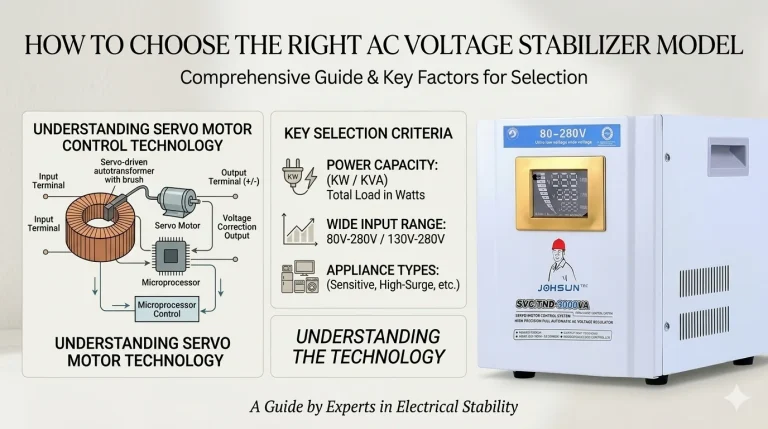
An dieser Stelle kommen viele B2B-Einkäufer ins Stocken. Soll man sich für eine Servo-Spannungsregler (elektromechanisch) oder ein statischer Spannungsstabilisator (IGBT-basiert)? Stellen Sie sich das einmal so vor:
Servostabilisator ist wie ein erfahrener Mechaniker mit einem manuellen Drehregler. Er kann große Eingangsbereiche und hohe industrielle Belastungen bewältigen, ist jedoch langsamer und erfordert regelmäßige Wartung (Bürsten, Motoren, Lager).
Statischer Stabilisator ist wie ein elektronischer Hochgeschwindigkeits-Stabilisator. Er ist schneller, leiser und hat keine beweglichen Teile, ist jedoch pro kVA in der Regel teurer und eignet sich besser für empfindliche Geräte.
In Ihrer Ausschreibung ist es hilfreich, sich klar auszudrücken: “Wir benötigen einen dreiphasigen Servo-Spannungsstabilisator mit 50 kVA, 400 V ±2%, Eingang 380–440 V, mit manuellem Bypass und Überlastschutz.” Dieser Satz allein deckt bereits den Großteil dessen ab, was ein Anbieter benötigt, um Ihnen ein Angebot zu unterbreiten.
Wenn Ihr Unternehmen Lösungen für die Wandmontage von Spannungsstabilisatoren sucht, nehmen Sie noch heute Kontakt auf und fordern Sie einen Produktkatalog oder ein auf Ihre Bedürfnisse zugeschnittenes Angebot an.
So schließen Sie einen Spannungsstabilisator in einer realen Umgebung an
Die Wahl des richtigen Modells ist nur die halbe Miete. Die andere Hälfte ist wie man es an das System anschließt. Falsche Verkabelung ist nach wie vor eine der Hauptursachen für Ausfälle von Stabilisatoren – und für Garantieansprüche, die Anbieter gerne ablehnen.
Grundlegende Anschlussprinzipien
Bei einer standardmäßigen dreiphasigen Industrieanlage ist der Verdrahtungsablauf einfach:
Nützlichkeit in → Eingabe CB → Stabilisator-Eingang.
Die externen Ein- und Ausschalter werden übersprungen.
Verlegung langer Kabel vom Ausgang des Stabilisators zur Last ohne ausreichenden Querschnitt.
Mehrere Spannungsstabilisatoren ohne ordnungsgemäße Synchronisierung parallel schalten.
Wenn Ihr Projekt über eine 200-kVA-Werksstromleitung verfügt, könnte die Konfiguration etwa wie folgt aussehen:
Ein dreiphasiger Servo-Spannungsstabilisator mit 200 kVA für die Hauptproduktionslinie.
Ein kleinerer statischer Stabilisator mit 15 kVA für die Büro- und Laborgeräte am selben Standort.
Dies ist ein typisches regionales Phänomen in Südostasien und in Schwellenländern, wo Fabriken ein großer Stabilisator für die Anlage und eine Präzisionsvorrichtung für empfindliche Lasten.
Anschluss der Steuerung und Überwachung
Für B2B-Einkäufer, denen die Integration wichtig ist, bieten moderne Stabilisatoren häufig folgende Funktionen:
RS485- oder Modbus-Schnittstellen für die Fernüberwachung.
Alarme mit potentialfreiem Kontakt für Überspannung, Unterspannung, Überlast und Bypass.
Optionale Digitalanzeigen zur Anzeige von V, A, kW und kVA in Echtzeit.
Diese Funktionen wirken sich direkt darauf aus, wie Käufer suchen und ihre Suchanfragen formulieren. Anstelle von bloß “Spannungsstabilisator 50 kVA” sieht man nun beispielsweise:
“50-kVA-Spannungsstabilisator mit Modbus-Kommunikation”
“Industrieller Spannungsstabilisator mit Digitalanzeige und Alarmkontakten”
Wenn Sie vorhaben, den Stabilisator in Ihr SCADA- oder Gebäudemanagementsystem zu integrieren, ist dies kein Luxus, sondern eine zwingende Voraussetzung.
So wählen Sie das richtige Modell und die passenden Spezifikationen für Ihr Projekt aus
Nun kommt der Teil, auf den sich Ihr Beschaffungsteam wirklich freut: “Welches Modell?” Um diese Frage zu beantworten, müssen Sie Ihre Standortdaten in Spezifikationssprache.
Typische technische Daten von Spannungsstabilisatoren für den industriellen Einsatz (B2B-orientiert)
Hier ist ein praktischer Überblick darüber, worauf echte B2B-Einkäufer bei den technischen Daten von Stabilisatoren tatsächlich achten:
Parameter
Warum dies für B2B-Einkäufer von Bedeutung ist
Häufige suchmaschinenfreundliche Werte
Nennleistung (kVA)
Bestimmt die Kapazität und die Projektkosten
15 kVA, 30 kVA, 50 kVA, 100 kVA, 200 kVA, 300 kVA
Phase
Einphasige vs. dreiphasige Verkabelung vor Ort
Einphasig, dreiphasig
Eingangsspannungsbereich
Wie viel Netzschwankung kann es bewältigen?
180–260 V (Einphasen), 380–440 V (Dreiphasen)
Genauigkeit der Ausgangsspannung
Wie stabil ist Ihre Lastspannung?
220 V ±21 TP3T, 400 V ±21 TP3T
Technologieart
Zuverlässigkeit von Servosystemen im Vergleich zu statischen Systemen
Wenn Sie eine Angebotsanfrage verfassen, können Sie eine Struktur wie diese buchstäblich per Kopieren und Einfügen als Technischer Anhang. Es sorgt für eine Abstimmung zwischen Ihren internen Ingenieuren und externen Anbietern und verhindert das klassische Missverständnis: “Wir dachten, es wären 200 kVA, aber sie haben 150 kVA angeboten.”.
Welches Modell sollten Sie für Ihren Anwendungsfall bestellen?
Es gibt kein allgemeingültiges “bestes” Modell. Was zählt, ist anwendungsgerecht. Davon abgesehen, hier sind einige Kaufverhalten von B2B-Kunden in der Praxis Sie können sich ausleihen:
Eine kleine Fertigungsanlage mit CNC-Maschinen und Schweißanlagen im Leistungsbereich von 30–40 kW kostet oft 40–50 kVA dreiphasiger Servo-Spannungsstabilisator mit einer Eingangsspannung von 380–440 V und einer Ausgangsspannung von 400 V ±2%.
Ein Rechenzentrum oder ein Telekommunikationsstandort, an dem Racks und Server geschützt werden sollen, entscheidet sich in der Regel für eine Statischer Spannungsstabilisator mit 100–200 kVA mit RS485/Modbus, digitaler Anzeige und einer Genauigkeit von ±0,5–1%.
Eine Bildgebungsabteilung eines Krankenhauses kann eine 50 kVA statischer Spannungsstabilisator für MRT/CT mit einem 15-kVA-Aggregat für Laborgeräte auf derselben Etage.
Wenn Sie mir Ihre genaue Last in kW, den Spannungsbereich und die Kritikalität (Fabrik vs. Rechenzentrum vs. Krankenhaus) mitteilen, können Sie buchstäblich Ihren eigenen Text für eine “Angebotsanfrage” verfassen und einen Anbieter dazu bringen, Ihnen ein Angebot zu unterbreiten, das Ihren tatsächlichen Bedingungen entspricht – und nicht nur einem Katalogfoto.
Wenn Ihr Unternehmen Lösungen für die Wandmontage von Spannungsstabilisatoren sucht, nehmen Sie noch heute Kontakt auf und fordern Sie einen Produktkatalog oder ein auf Ihre Bedürfnisse zugeschnittenes Angebot an.
u003cstrongu003eWas ist der beste Spannungsstabilisator für eine Fabrik?u003c/strongu003e
Die beste Lösung für eine Fabrik ist in der Regel ein dreiphasiger Servo-Spannungsstabilisator im Bereich von 30–200 kVA, je nach Gesamtlast. Er sollte die an Ihrem Standort gemessenen Spannungsschwankungen bewältigen können (zum Beispiel 340–440 V Eingangsspannung) bewältigen und eine Ausgangsspannung von 400 V ±21 TP3T mit manuellem Bypass und Überlastschutz liefern. Käufer suchen häufig nach “Fabrik-Spannungsstabilisator 50 kVA dreiphasig” oder “Industrie-Spannungsstabilisator 100 kVA für Produktionsanlagen”.”
u003cstrongu003eIst ein statischer Spannungsregler besser als ein Servoregler?u003c/strongu003e
Statische Stabilisatoren eignen sich besser für u003cstrongu003eempfindliche Hochgeschwindigkeitslastenu003c/strongu003e wie Rechenzentren, Labore und medizinische Geräte. Sie sind schneller, leiser und wartungsärmer. Servostabilisatoren eignen sich besser für u003cstrongu003eindustrielle Hochlastanwendungenu003c/strongu003e mit starken Spannungsschwankungen. Man kann sich statische Stabilisatoren als “Präzisionschirurgen” und Servostabilisatoren als “Schwerlastmechaniker” vorstellen.”
u003cstrongu003eWoher weiß ich, wie viel kVA ich benötige?u003c/strongu003e
Addieren Sie die kW-Leistung aller angeschlossenen Geräte, wenden Sie einen Multiplikator von 1,2–1,5 für Motoren und induktive Lasten an und fügen Sie eine Sicherheitsmarge von 10–20% hinzu. Runden Sie anschließend auf die nächste Standard-kVA-Nennleistung auf. Beispiel: 40 kW induktive Last → 48–60 kVA → wählen Sie 50 kVA oder 60 kVA. Beschaffungsteams suchen häufig nach “Spannungsstabilisator 50 kVA Rechner” oder “Wie wählt man die Leistung eines Spannungsstabilisators von kW in kVA um?”.”
Which model fits this job?
Relay type stabilizers General-purpose +/-8% correction for lighting, refrigeration and IT loads.
Not sure of the capacity? Send the input and output voltage, the country standard and the load list to sales@johsuntech.com and we will confirm the model within one working day.
A 5kVA stabilizer rated at 230V cannot deliver 5kVA at 170V. How to size against the real input range, choose between relay, servo and static, and wire a single-phase unit so it lasts.
Wenn Sie ein Beschaffungsmanager oder B2B-Einkäufer sind, ist “Wechselspannungsstabilisator” nicht nur eine Produktkategorie. Es ist ein Instrument zur Risikominderung für Ihre Maschinen, Produktionslinien und IT-Infrastruktur. In Märkten mit instabilen Netzen kann eine falsche Wahl verbrannte Leiterplatten, geschmolzene Motoren oder ungeplante Abschaltungen bedeuten. Die gute Nachricht? Sie müssen kein [...]
Was ist ein Spannungsstabilisator für die Wandmontage? Ein Spannungsstabilisator für die Wandmontage ist ein automatisches Spannungsregelungsgerät, das die Wechselspannung in einem sicheren, stabilen Bereich hält. Er ist für Privathaushalte, Büros und kleine gewerbliche Räume konzipiert und kann an der Wand montiert werden, um Platz zu sparen und gleichzeitig Fernsehgeräte, Klimaanlagen, Kühlschränke, Computer, [...]