Transformador de 230 V a 110 V para Francia: NF C 15-100 y puesta a tierra TT
Publicado: Autor: Lisa
France is where the standard 230 V to 110 V transformer selection question gets interesting. Because French low-voltage installations are predominantly TT earthed, the question “should the secondary be earthed?” has a different answer than in a British or German TN installation. This guide explains what a 230V to 110V transformer has to satisfy on a French site, and why the RCD conversation is not the same as elsewhere in Europe.
It is written for electrical designers, maintenance engineers and buyers integrating imported US equipment or building a permanent 110 V supply in France. For the French-language version, see Transformateur 230V 110V.
What the transformer does, in plain terms
A step-down transformer reduces 230 V AC to 110 V AC. It is a passive magnetic device: two windings on a shared core, with the turns ratio fixing the voltage ratio. Nothing in the device regulates the output.
Three points drive the engineering:
Frequency is not converted. A 60 Hz motor on the French 50 Hz grid runs slower and hotter. This is a load problem, not a transformer problem.
Output sags under load. A unit specified at 110 V no-load delivers roughly 105–110 V at full load. For a load with tight tolerances, specify a 115 V or 120 V secondary.
Protection is not built in. The transformer holds its ratio whatever the load does. Overload protection is upstream or in the load.
The French TT system, and why it changes the answer
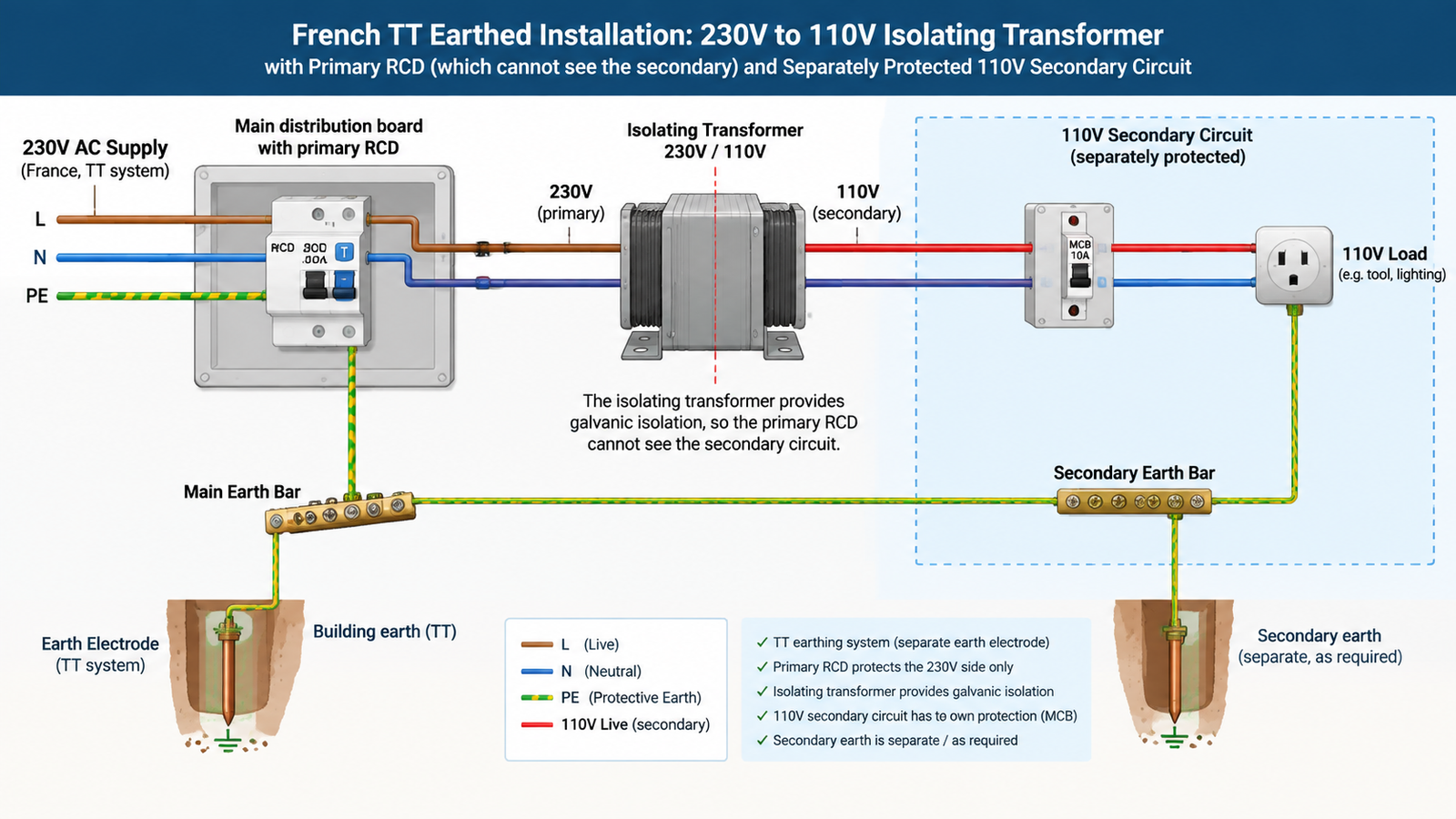
France operates a 230 V / 50 Hz supply at 50 Hz, but the dominant earthing arrangement for low-voltage installations is TT: the supply neutral is earthed at the source, and the installation’s exposed conductive parts are connected to a local earth electrode that is electrically independent of the supply neutral.
The consequence is straightforward: in a TT system, fault current returns through the earth itself, so earth fault protection depends entirely on a residual current device. That is why NF C 15-100 requires residual current protection of at most 30 mA on accessible socket circuits.
Now apply that to a transformer with isolated windings. The secondary becomes a separate, floating system. A fault from the 110 V secondary to earth does not return through the primary conductors — it returns through the earth electrode system. The primary RCD cannot see it. This is the point that catches out French installations again and again.
What NF C 15-100 means for your transformer installation
NF C 15-100 is the French installation standard and the reference that a French inspector or insurer will actually work from. The points most relevant to a step-down transformer installation:
Requirement area
What NF C 15-100 expects
Impact on the transformer
Residual current protection
30 mA maximum on socket circuits accessible to ordinary persons
Primary feed protected as any other circuit; secondary needs its own scheme if required
Earthing
Earth electrode with defined resistance, bonded exposed conductive parts
Enclosure and terminal box bonded to the earth bar — always
Overcurrent protection
Device rated for the conductor and the load
Size the primary protection for the transformer’s full-load current × 1.25
Sockets and plugs
Type E (2P+T) with earth pin
Match primary plugging; do not rely on adapters for permanent installations
Voltage drop
Limited across the installation
Account for the transformer’s own regulation plus cable drop
When to earth the secondary — and when not to
Three legitimate configurations exist on French sites. Pick by purpose, not by habit.
Configuración
Secondary treatment
When it is right
Earthed secondary (TT-compatible)
Secondary neutral bonded to the installation earth at one point
Permanent 110 V distribution feeding ordinary equipment; allows secondary RCD protection to function
Protective separation
Secondary left isolated (floating)
Test benches, laboratories, diagnostic work where a first fault should not trip anything
Auto-transformer
No separate secondary earth exists
Non-critical loads where separation is not required by the application
If the secondary is left floating in continuous production use, a single insulation fault will go undetected until a second fault appears — at which point the protective device may not operate as intended. That is an acceptable trade-off on a bench; it is not acceptable for a permanent 110 V supply feeding a machine.
The detailed method, including how to verify earth continuity and how to test the fault path at commissioning, is set out in how to ground a transformer secondary. Final connection must be made by a qualified electrician working to NF C 15-100.
The transformer standard behind the CE mark
Aplicación
French designation
What it covers
General requirements
IEC 61558-1 and NF EN IEC 61558-1
Base standard: construction, tests, marking
Isolating transformers
NF EN IEC 61558-2-4
Separate windings for general applications
Safety isolating transformers
NF EN IEC 61558-2-6
Additional output voltage and current limits
Auto-transformers
NF EN IEC 61558-2-13
Step-up and step-down auto configurations
CE marking
Directives 2014/35/EU (LVD) and 2014/30/EU (EMC)
EU declaration of conformity
Ask for the declaration of conformity for the specific model on the order. A generic certificate covering a product family is common in export trade and does not satisfy a French technical review, particularly when the ErP regulation requires published no-load loss figures for small transformers.
Choosing the construction
Construcción
Separation
La mejor opción
Auto-transformer
None — shared winding
Heating, lighting, simple motor loads
Isolating transformer
Full galvanic separation
Machine control, test benches, noise-sensitive loads
Safety isolating transformer
Full, with limited output
Portable tools, wet or confined environments
Toroidal
Model dependent
Audio, medical, low stray-field requirements
For continuous duty in an enclosure, the DT/ST range from 100 VA to 10 kVA provides the standard building blocks: transformer DT/ST series 100VA–10KVA. Mixing an auto-transformer into a job that later needs separation is one of the more expensive mistakes in this field, because it forces a re-design of the protection scheme rather than a component swap.
Sizing in VA for French loads
Transformer ratings are in VA. On resistive loads, watts and VA are close; on motors, pumps and switched-mode supplies the power factor is below 1 and the required VA is higher. Add inrush on top:
Resistive load: +20 %
Motor load: +100 % (factor 2)
Switched-mode supplies and inverter inputs: +30 to +50 %
Continuous-duty operation: keep at 70–80 % of rated VA
In TT with isolated windings, secondary faults return through earth and are invisible to the primary RCD
Design secondary protection explicitly
Leaving the secondary floating in permanent use
First fault goes undetected; no automatic disconnection
Reference the secondary at one point, or install permanent insulation monitoring
Confusing watts with VA
Undersized transformer, thermal trips
Use the VA figure with a real margin
Relying on a plug adapter for a permanent installation
No earth continuity guarantee
Wire the primary properly to a Type E socket or permanently
60 Hz equipment on the 50 Hz grid
Speed loss and overheating
Check frequency dependence before specifying
Next step
On a French site, the transformer itself is rarely the hard part. The protection concept is. Confirm the earthing arrangement, decide deliberately whether the secondary is earthed or floating, size in VA with margin for inrush, and require conformity documentation for the exact model.
Send the voltage, frequency, load profile and earthing arrangement and we will come back with the appropriate type: Contacto.
PREGUNTAS FRECUENTES
Does a 230V to 110V transformer need to be earthed on the secondary in France?
Not always, but in permanent installations it usually should be. In a TT system, referencing the secondary at a single point to the installation earth is what allows a residual current device to detect a secondary earth fault. In bench and laboratory use, a floating secondary is a legitimate and deliberate choice.
Why does my 30 mA differential not trip when the 110 V side faults?
Because the transformer has isolated windings. The secondary fault current returns through the earth electrode system, not through the primary current transformer, so the differential sees no imbalance. This is a fundamental property of isolated secondaries, not a device fault.
Which standard does a 230V to 110V transformer have to meet in France?
The IEC 61558 series in its French implementation, NF EN IEC 61558 — part 2-4 for isolating transformers, 2-6 for safety isolating transformers, 2-13 for auto-transformers — plus CE marking under the Low Voltage and EMC Directives. NF C 15-100 governs installation.
Can the same unit be used as a step-up transformer?
Often yes, by feeding the secondary winding and taking the output from the primary. Confirm in the datasheet that the manufacturer explicitly permits reverse operation before relying on it.
What margin does a continuous-duty transformer need?
Size at 70–80 % of rated VA. Add 20 % on resistive loads, a factor of 2 on motor loads, and 30–50 % on switched-mode supply loads to cover inrush current.
Is an auto-transformer acceptable in France?
For non-critical loads where separation is not required — heating, lighting, simple motor loads — yes, and it is more efficient. Where separation is required by the application or by risk assessment, it is not an option.
How a buck-boost transformer works: series-winding polarity, differential kVA sizing with single-phase and three-phase examples, and the five limits that decide when it is the wrong tool.
How to size a step-up transformer for a motor: locked-rotor current, kVA code letters, starting kVA by method, voltage-dip and thermal-duty checks, plus the traps most guides miss.
A practical dry-type vs oil-immersed transformer comparison for low-voltage buyers: cooling class, fire safety, overload, maintenance and installed cost, plus a ten-minute selection sequence.