Transformador de 230 V a 110 V para los Países Bajos: Guía NEN 1010
Publicado: Autor: Lisa
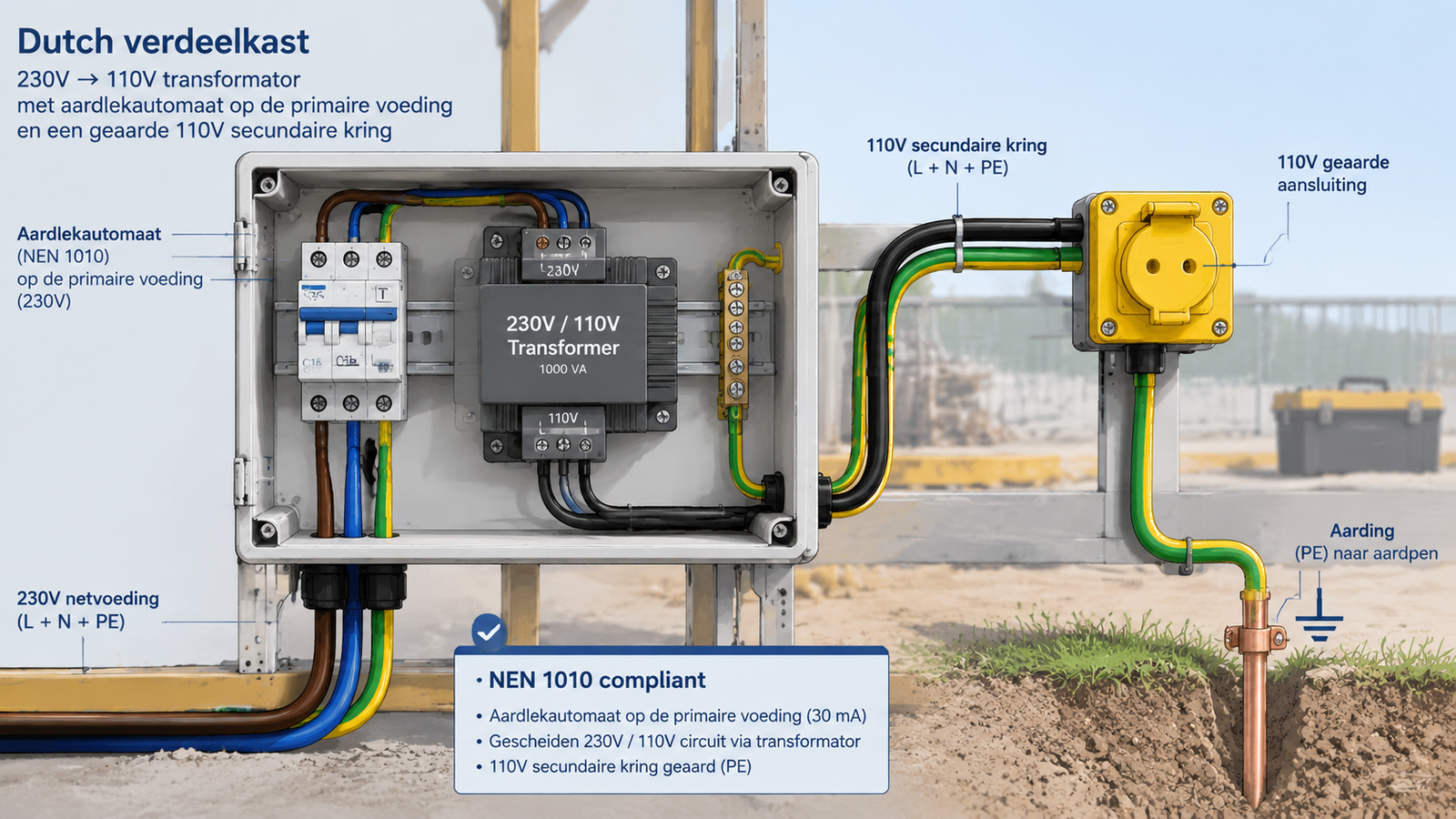
In the Netherlands, the 230 V to 110 V transformer question is settled by two documents: NEN 1010 for the installation and the IEC 61558 series for the product. Get those right and the rest is arithmetic. Get them wrong and you end up with a correctly sized transformer that fails inspection because the protective device cannot see a fault on the 110 V side. This guide covers what a 230V to 110V transformer needs to satisfy on a Dutch site.
It is written for electrical designers, machine builders and buyers in the Netherlands. For the Dutch-language version, see Spanningsomvormer 230V 110V.
The Dutch starting point: NEN 1010
NEN 1010 is the Dutch safety standard for low-voltage installations and the national implementation of IEC 60364. Where the UK works from BS 7671 and the US from the NEC, the Netherlands works from NEN 1010 — with local amendments that are stricter than the base standard in a few places, notably around earth leakage protection.
The clauses that matter for a step-down transformer installation:
Area
What NEN 1010 expects
Effect on the transformer installation
Earth leakage protection
Socket circuits for general use protected by an RCD with a maximum trip current of 30 mA
Primary feed protected as any other circuit; the secondary needs its own scheme
Earthing
Continuous protective conductor, defined earth electrode resistance
Enclosure and terminal box bonded to the earth rail without exception
Overcurrent protection
Device matched to conductor and load
Primary protection rated at full-load current × 1.25
Isolation and switching
Each circuit isolatable from every active conductor, with defined exceptions for TN-C and TN-S
Affects the upstream switch-disconnector, not the transformer itself
Circuit grouping
Limits on the number of final circuits per 30 mA RCD
Relevant when the transformer adds a new group to an existing meterkast
The grouping limit is easy to miss. A single 30 mA RCD covering many final circuits accumulates capacitive leakage from switch-mode power supplies, and adding a transformer-fed group can push it over the trip threshold. Modern practice in the Netherlands favours an aardlekautomaat per circuit rather than one shared aardlekschakelaar, precisely to avoid nuisance tripping.
Aardlekschakelaar or aardlekautomaat — which matters here?
Dispositivo
Función
When it is the right choice
Aardlekschakelaar (RCD)
Earth leakage only
Retrofit into an existing meterkast with separate MCBs; subject to the four-circuit grouping limit
Aardlekautomaat (RCBO)
Earth leakage plus overcurrent in one module
New circuits; keeps a fault on the transformer feed from taking down the whole installation
For a new 110 V supply, specify an aardlekautomaat. It combines the overcurrent protection the transformer needs with the 30 mA leakage protection NEN 1010 requires, in one module width, and it isolates the consequences of a fault to a single group.
The key technical point: a primary RCD cannot see the secondary
This is the single most important thing to get right, and the most commonly missed item in Dutch installations.
A step-down transformer with separate windings creates an electrically isolated secondary circuit. A residual current device monitors the balance between line and neutral current in the conductors passing through it. A fault on the secondary side does not return through those primary conductors — it returns through the earthing system to the earth electrode. The RCD sees no imbalance and does not operate.
The consequence: a 30 mA aardlekschakelaar on the 230 V feed of an isolated transformer provides no earth fault protection for the 110 V circuit. Options to resolve it:
Reference the secondary to earth at one point — then the fault current can return through the protective conductor system and an RCD on the secondary will operate.
Use an auto-transformer instead — with a shared winding, primary and secondary share a conductor, so the primary RCD covers the secondary circuit. This is only legitimate where the application does not require separation.
Leave the secondary isolated and monitor it — an insulation monitoring device gives an alarm on the first fault. Appropriate for test benches and laboratories, not for ordinary production circuits.
The counter-intuitive result deserves repeating: for a purely isolated secondary in permanent use, a single insulation fault goes completely unnoticed. It stays invisible until a second fault appears, at which point the protective device may not operate in time. The verification method is documented in how to ground a transformer secondary. Wiring in the verdeelkast must be carried out by a vakbekwaam persoon working to NEN 1010.
Earthing the secondary in a Dutch TT stelsel
Configuración
Secondary treatment
Fault disconnection
Fit
Auto-transformer
No discrete secondary earth
Via primary RCBO
Non-critical loads where separation is not needed
Earthed isolated secondary
Neutral bonded to earth at a single point
Via secondary RCD
Permanent 110 V distribution
Isolated and monitored
Floating, with insulation monitoring
Alarm on first fault
Laboratory, test bench, diagnostic work
Dutch low-voltage installations are predominantly TT, so the earth electrode and the protective conductor system carry the return path for fault current. That reinforces the same conclusion: without a secondary reference, there is no return path for a 110 V fault and therefore no automatic disconnection.
NEN-EN-IEC 61558 and KEMA certification
Aplicación
Dutch designation
What it covers
General requirements and tests
NEN-EN-IEC 61558-1
Base safety standard for the series
Scheidingstransformatoren (isolating)
NEN-EN-IEC 61558-2-4
Separate windings, general applications
Veiligheidstransformatoren (safety isolating)
NEN-EN-IEC 61558-2-6
Additional limits on output voltage and current
Spaartransformatoren (auto)
NEN-EN-IEC 61558-2-13
Step-up and step-down auto configurations
Medical isolating transformers
NEN-EN-IEC 61558-2-15
Medical examination and treatment rooms
CE marking
LVD 2014/35/EU and EMC 2014/30/EU
EU declaration of conformity
Dutch buyers frequently ask about KEMA. Strictly, KEMA is a certification body rather than a standard, and KEMA marking is not a legal requirement for a transformer placed on the EU market — a valid CE declaration is. That said, an independent test report from a recognised body is a useful risk-reduction signal on imported product, particularly for medical-adjacent applications where NEN-EN-IEC 61558-2-15 may apply.
Construction choice
Construcción
Separation
Typical Dutch application
Spaartransformator
Ninguno
Verwarming, verlichting, simple motor loads
Scheidingstransformator
Full galvanic
Machine control, measurements, noise filtering
Veiligheidstransformator
Full, limited output
Portable tools, damp or confined locations
Ringkerntransformator
Model dependent
Audio, laboratory, low stray field
For continuous duty in a machine or verdeelkast, the DT/ST range covers 100 VA to 10 kVA with a consistent terminal scheme: transformer DT/ST series 100VA–10KVA. Keeping one series across the power range is what makes spare parts and terminal labelling predictable in a machinebouw programme.
Sizing in VA for Dutch machinebouw and installatietechniek
Transformer ratings are in VA, not watts. Dutch machine builders deal frequently with servo drives, switched-mode supplies and refrigeration compressors, all of which have poor power factor or high inrush.
Resistive load (verwarming, verlichting): +20 %
Motor load: +100 % (factor 2) — higher for compressor hard starts
Switched-mode supplies and drive inputs: +30 to +50 %
Continuous duty: keep at 70–80 % of rated VA
Multiple simultaneous loads: sum the ratings, do not use the largest load as the reference
Assuming the primary aardlek covers the 110 V side
Secondary earth faults never cleared
Reference the secondary or use an auto-transformer where separation is not required
Secondary left floating in permanent use
First fault undetected
Bond the secondary at one point, or install insulation monitoring
One shared 30 mA RCD across too many groups
Nuisance tripping once the transformer group is added
Use an aardlekautomaat per circuit
Reading appliance watts as VA
Undersized transformer, thermal trips
Use the VA figure with real margin
No protective conductor continuity check
Protection ineffective despite correct design
Verify enclosure-to-earth-rail continuity before energising
Next step
On Dutch projects, compliance comes from two decisions made in the right order: choose the construction that matches the separation requirement, then define how the secondary is earthed, before sizing in VA with margin for inrush. NEN 1010 governs the wiring; IEC 61558 governs the product; the documentation proves both.
Send the supply voltage, frequency, load profile and earthing arrangement and we will come back with the matching type: Contacto.
PREGUNTAS FRECUENTES
Does a 230V to 110V transformer need earth leakage protection?
The 230 V primary feed needs protection as any other circuit under NEN 1010 — 30 mA maximum for socket circuits for general use. The 110 V secondary needs its own arrangement, because a residual current device on the primary cannot detect a fault on an isolated secondary.
What is the difference between an aardlekschakelaar and an aardlekautomaat?
An aardlekschakelaar provides earth leakage protection only. An aardlekautomaat combines earth leakage and overcurrent protection in one module. For a new transformer-fed circuit, an aardlekautomaat is the practical choice.
Can an auto-transformer be used for a 230 V to 110 V conversion in the Netherlands?
Yes, where the application does not require galvanic separation. Because primary and secondary share a winding, the primary protective device also covers the secondary circuit, which simplifies compliance considerably. Where separation is required — medical, laboratory, certain machine safety functions — a scheidingstransformator is mandatory.
Is KEMA certification required?
No. KEMA is a certification body, not a legal requirement. What is required is a valid CE declaration of conformity under the Low Voltage and EMC Directives. An independent test report is nevertheless a useful signal of product quality on imported equipment.
Which standard applies to the transformer itself?
IEC 61558 in its Dutch implementation, NEN-EN-IEC 61558 — 2-4 for scheidingstransformatoren, 2-6 for veiligheidstransformatoren, 2-13 for spaartransformatoren, and 2-15 where medical isolating transformers apply.
How much margin should a transformer have?
Size at 70–80 % of rated VA for continuous duty. Add 20 % on resistive loads, a factor of 2 on motor loads and 30–50 % on switched-mode supply loads to cover inrush current.
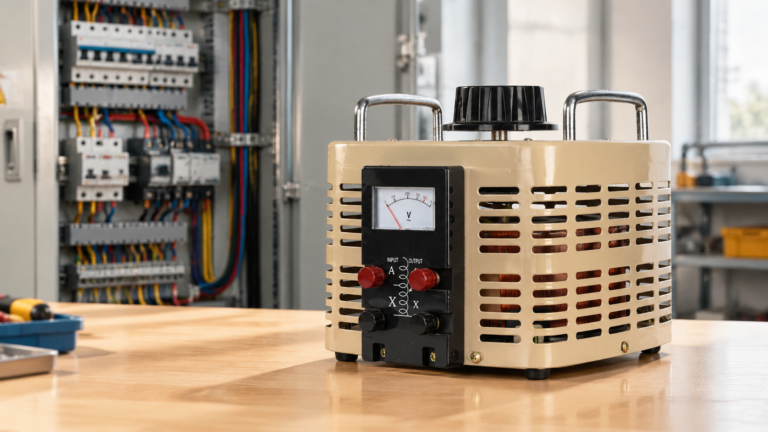
How a buck-boost transformer works: series-winding polarity, differential kVA sizing with single-phase and three-phase examples, and the five limits that decide when it is the wrong tool.
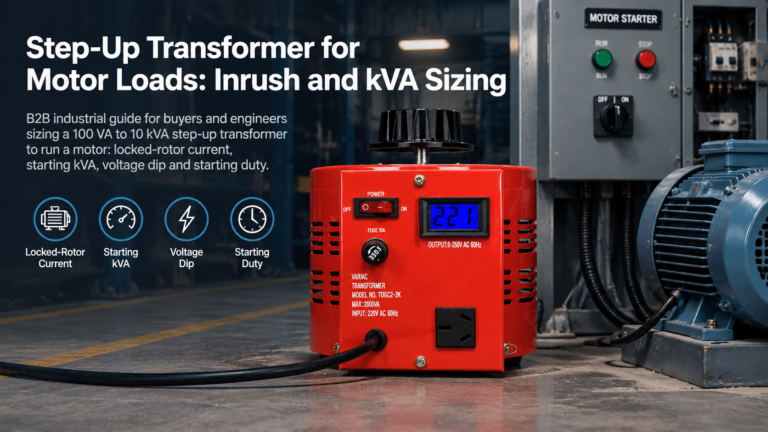
How to size a step-up transformer for a motor: locked-rotor current, kVA code letters, starting kVA by method, voltage-dip and thermal-duty checks, plus the traps most guides miss.
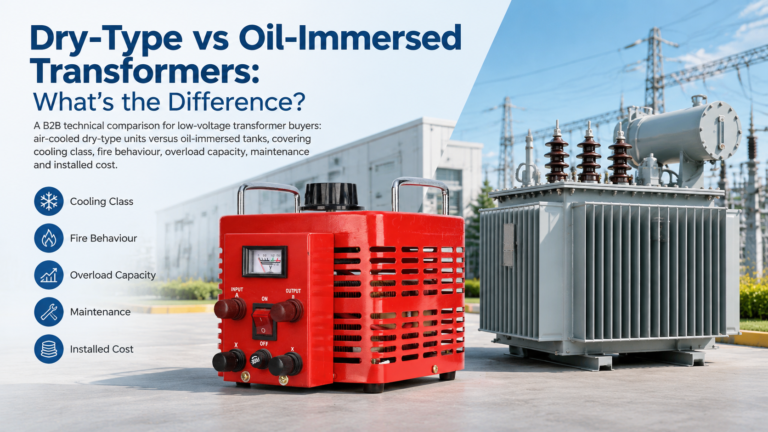
A practical dry-type vs oil-immersed transformer comparison for low-voltage buyers: cooling class, fire safety, overload, maintenance and installed cost, plus a ten-minute selection sequence.