Ask how many tipos de transformadores exist and you will get answers ranging from four to forty. Both can be right, because the number depends entirely on which axis you classify along. Sort by function and you get a handful; sort by function, construction, cooling and application together and the list multiplies quickly.
This guide gives you the classification framework rather than a single number. It sets out the four axes engineers actually use, lists the types you will meet when specifying or buying, and finishes with a decision path that gets you from load requirements to the right type. If you have not read the basics yet, start with qué es un transformador.
Why there is no single answer
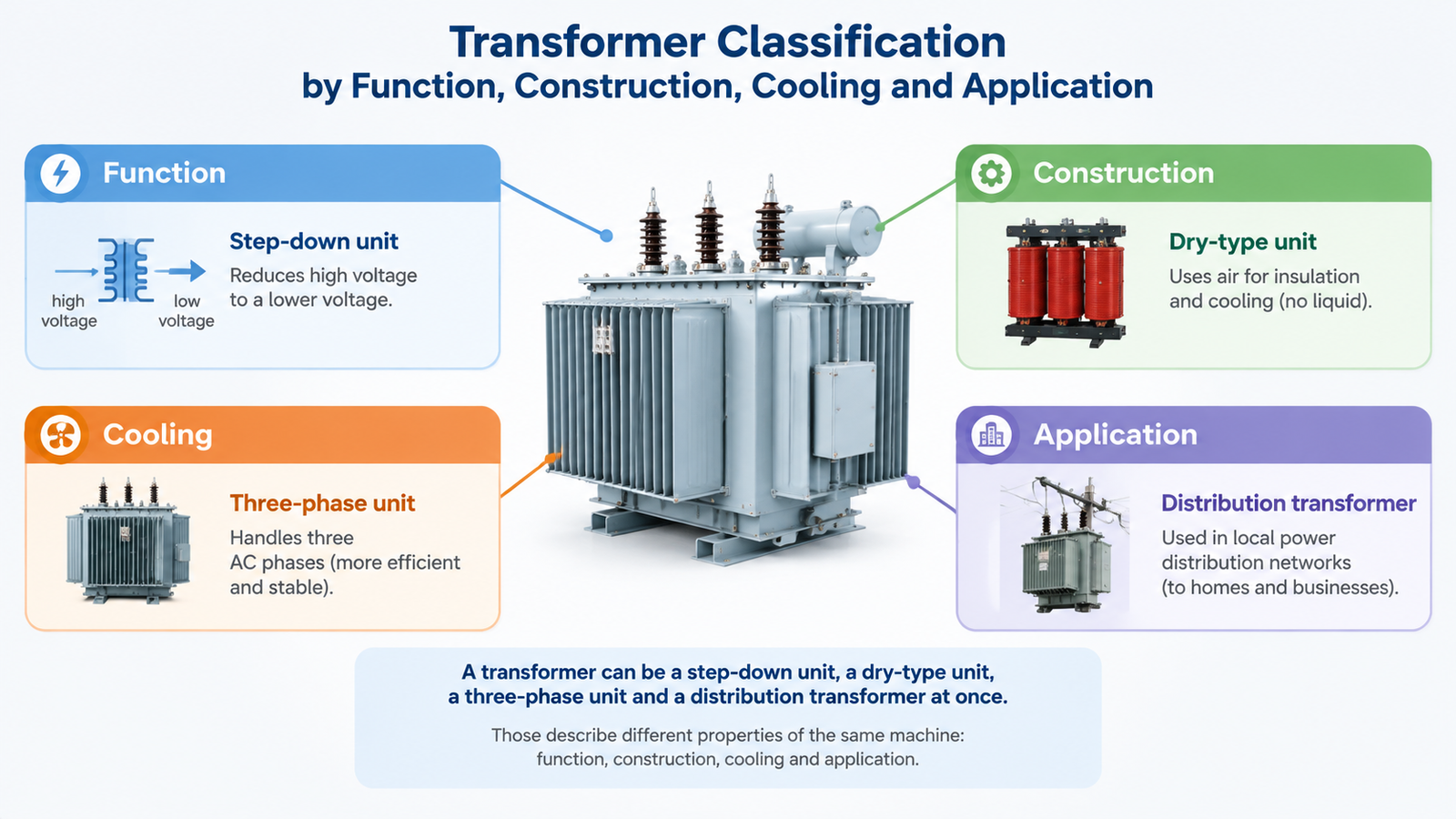
A transformer can be a step-down unit, a dry-type unit, a three-phase unit and a distribution transformer all at once. Those are not competing categories — they describe different properties of the same machine. Once you separate the axes, the confusion disappears:
Función — what the transformer does to voltage or to the circuit.
Construcción — how the core, windings and insulation are built.
Refrigeración — how heat is removed, which also sets the rating stages.
Aplicación — where it sits in the network and what duty it sees.
Most published “types of transformer” lists quietly mix these axes together, which is why two authoritative sources rarely give the same count. A specification that names all four axes, on the other hand, describes one machine precisely and leaves nothing to interpretation at the quotation stage.
By function: what the transformer does
This is the axis buyers use first, because it follows directly from the job.
Transformador elevador — raises voltage from primary to secondary, used at generation and for feeding equipment that needs a higher supply than the site provides.
Step-down transformer — lowers voltage; the standard choice for running imported 110 V equipment on a 230 V supply, and for distribution generally.
Transformador de aislamiento — 1:1 ratio, no voltage change, used to break the galvanic path for safety, noise reduction and sensitive electronics.
Autotransformador — a single tapped winding rather than two isolated windings; smaller and cheaper for modest ratio changes, but without galvanic isolation.
Control transformer — feeds control circuits and machine panels, built to hold voltage under the inrush of contactors and solenoids.
Instrument transformers — current transformers and voltage (potential) transformers that scale down quantities for metering and protection.
The distinction between an isolating and a non-isolating design is the one with the biggest safety consequence. Autotransformers share a conductor between primary and secondary, so a fault on one side appears on the other — see what an autotransformer is and where it is used.
By construction: how it is built
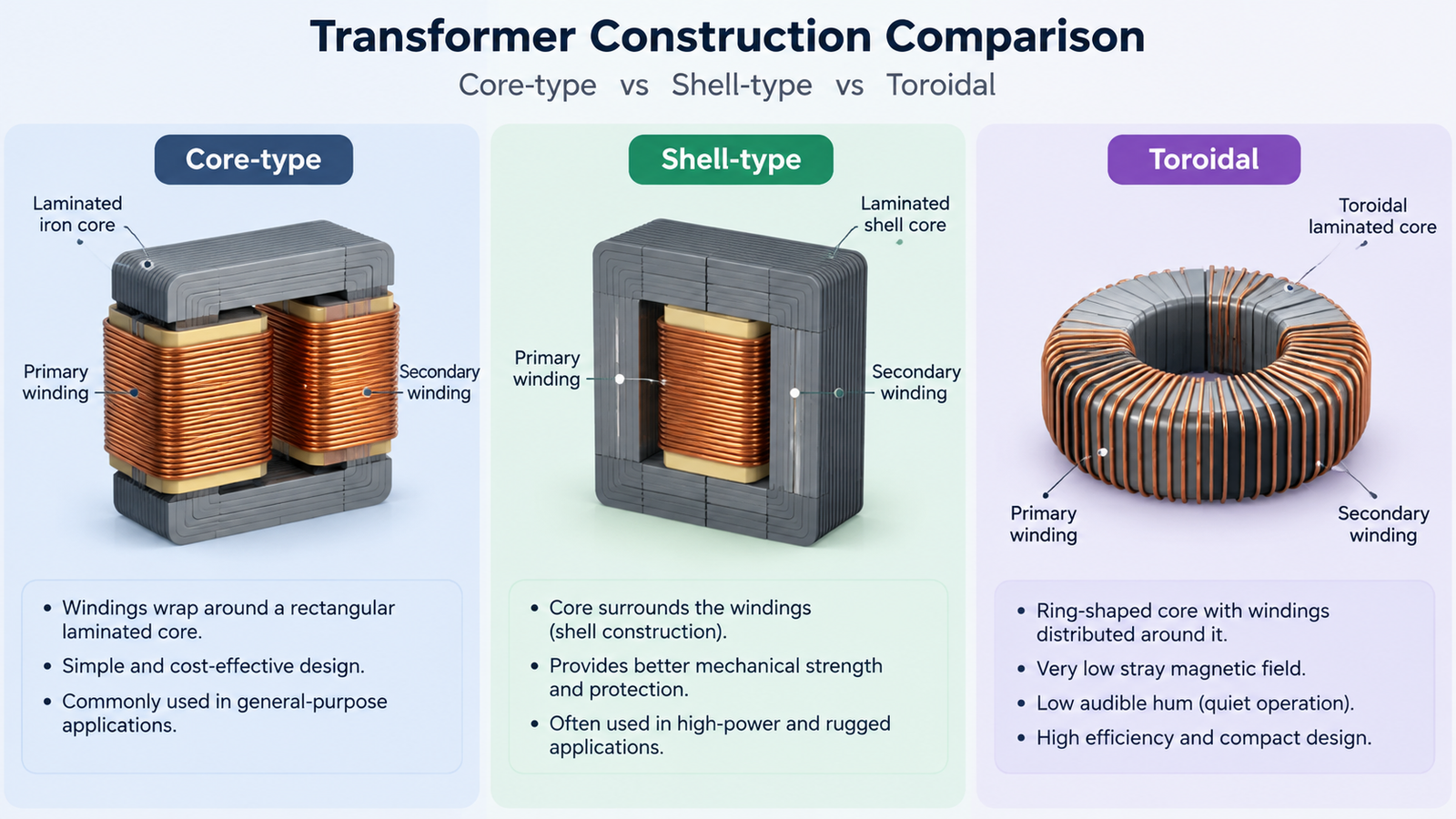
Core-type — windings wrapped around a rectangular laminated core; the most common construction for distribution ratings.
Shell-type — the core surrounds the windings, giving better mechanical strength against short-circuit forces.
Toroidal — a ring core with the winding distributed around it; low stray field, low audible hum and compact, which is why it is favoured in audio and medical equipment.
Dry-type — air-cooled with cast resin or vacuum-pressure impregnated insulation; the default for indoor installations where fire risk rules out oil.
Oil-filled (liquid-filled) — mineral oil or ester fluid for insulation and cooling; standard for outdoor and high-power distribution.
Toroidal construction is worth a second look where space, noise or stray field matter — the trade-offs are covered in what toroidal transformers are used for.
By cooling: how heat is removed
Cooling class is printed on the nameplate as a short code, and on larger units it also determines the multiple kVA ratings.
Code
Meaning
Uso típico
AN / AA
Air natural — self-cooling by convection
Indoor dry-type
AF
Air forced — fans added, raises the rating
Dry-type with overload stages
ONAN
Oil natural, air natural
Standard oil-filled distribution
ONAF
Oil natural, air forced
Oil-filled with fan-assisted stages
OFAF
Oil forced, air forced
Grandes transformadores de potencia
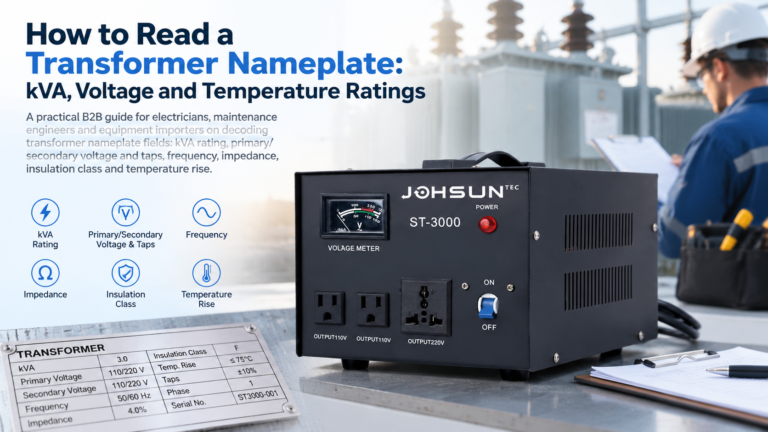
If a nameplate shows two kVA figures, the lower one is the natural-cooled rating and the higher one applies only with the forced-cooling equipment running. Where to find all of this on a real plate is set out in how to read a transformer nameplate.
By phase and connection
Single-phase transformers serve residential and light commercial loads and the majority of imported-equipment conversion duties. Three-phase units serve industrial loads and distribution networks, and they carry an extra descriptor: the vector group.
The vector group — Dyn11, Yyn0 and similar — states how each winding is connected and the phase displacement between them. It matters because two transformers can only be paralleled when their vector groups are compatible, and because the secondary neutral availability depends on whether that side is wye-connected. Getting this wrong is not a size problem, it is a short-circuit problem, so treat the vector group as a fixed requirement when you replace an existing unit.
By application: where it sits in the network
The last axis is the one utilities and large industrial buyers lead with, because it drives the design priorities: efficiency at high load, low no-load loss, or tolerance of a hostile duty.
Power transformer — large units at generation and transmission interfaces, optimised for efficiency at high load.
Distribution transformer — delivers the final voltage to consumers; optimised for low no-load loss because it is energised continuously.
Furnace transformer — very high secondary current, heavy mechanical design.
Rectifier transformer — feeds DC conversion equipment, designed for harmonic-rich duty.
Pulse and traction transformers — specialised duty in electronics and rail.
Master reference: the types buyers actually meet
Tipo
Primary purpose
Where you see it
Spec to check first
Step-up / step-down
Match supply to equipment voltage
Imported machinery, export equipment
Voltage ratio, tap range, kVA
Aislamiento
Safety, noise, galvanic separation
Medical, lab, marine, CNC panels
Insulation class, screening, leakage current
Autotransformador
Small ratio change, compact and cheap
230/110 V conversion, motor starting
Whether isolation is required
Controlar
Stable voltage for control circuits
Machine panels, PLC cabinets
Regulation under inrush, kVA
Toroidal
Low noise, low stray field, compact
Audio, medical, instrumentation
Inrush current, mounting
Dry-type distribution
Indoor distribution without oil
Buildings, tunnels, plants
Cooling class, IP rating, temperature rise
Oil-filled distribution
Outdoor and high-power distribution
Substations, padmounts
Cooling class, BIL, oil type
Current / voltage transformer
Metering and protection
Switchgear, metering panels
Accuracy class, burden, ratio
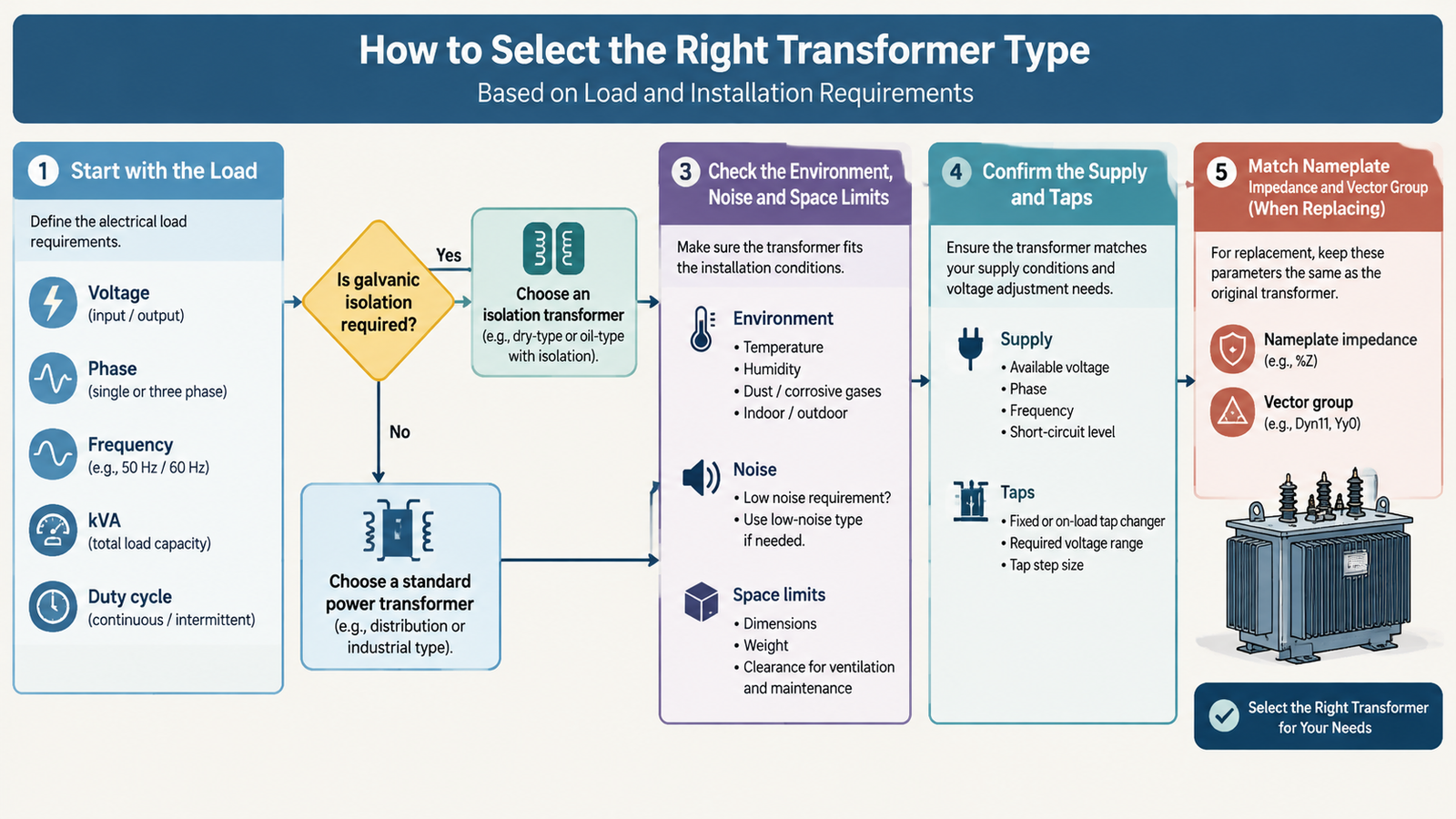
How to choose the right type
Start with the load. Voltage, phase, frequency, kVA and duty cycle. Everything else follows.
Decide whether you need galvanic isolation. If yes, an autotransformer is off the table.
Check the environment. Indoor, oil-free requirements and fire codes push towards dry-type; outdoor and high power push towards oil-filled.
Check noise and space limits. Toroidal or specially damped designs win where hum or footprint matter.
Confirm the supply. 50 Hz or 60 Hz, available voltage, and whether taps are needed for site variation.
Read the nameplate of whatever you are replacing and match impedance and vector group, not only kVA.
There is no single number of transformer types — classify along function, construction, cooling and application instead.
Function comes first: step-up, step-down, isolation, auto, control or instrument.
Construction and cooling decide where the unit may be installed and what its real continuous rating is.
Whether you need galvanic isolation eliminates or enables the autotransformer option immediately.
Always match replacements on impedance, vector group and thermal class, not on kVA alone.
Still unsure which type fits your load? Send us the supply voltage, the equipment voltage and the load in kVA or amps, and we will tell you which category you actually need.
Frequently asked questions
How many types of transformer are there?
There is no fixed number. Classified by function there are about six common types — step-up, step-down, isolation, autotransformer, control and instrument. Add construction, cooling and application axes and the practical list runs to a dozen or more categories used in procurement.
What is the difference between a power transformer and a distribution transformer?
Power transformers handle large blocks of energy at transmission interfaces and are optimised for efficiency near full load. Distribution transformers deliver final utilisation voltage and are optimised for low no-load loss, because they stay energised around the clock.
Which transformer type is best for indoor installation?
Usually dry-type with natural air cooling (AN), because it needs no oil and carries a much lower fire risk. Check the enclosure IP rating and the room ventilation before sizing the rating.
Do I need an isolation transformer or is an autotransformer enough?
If you only need a modest voltage change and the installation does not require galvanic separation, an autotransformer is smaller and cheaper. If you need safety separation, noise reduction or protection of sensitive electronics, specify a true isolation transformer.
Learn how to read a transformer nameplate: decode the kVA rating, voltage and taps, frequency, impedance, insulation class and temperature rise before you install or replace a unit.
Compare copper vs aluminum transformer windings on conductivity, cost, weight, size, losses and termination reliability, with the numbers behind each trade-off.