Comprendre les principes de fonctionnement des transformateurs basse tension
Publié le : Auteur : Johsuntech
In industrial and commercial applications, transformateurs basse tension (LVTs) play a crucial role in ensuring safe and reliable power supply for sensitive electrical systems. Whether you’re an engineer designing a control panel, a procurement manager sourcing reliable transformer suppliers, or a manufacturer integrating them into automation systems, understanding how these compact devices operate can help you make smarter purchasing decisions and achieve better performance.
Let’s take a deep dive into the inner workings, operating modes, and key considerations when selecting or sourcing low voltage transformers for your project.
What Is a Low Voltage Transformer?
A transformateur basse tension is an electrical device that reduces high AC voltage to a lower, usable level — typically below 1000V — suitable for industrial control equipment, lighting systems, HVAC units, and many other low‑power circuits. These transformers are built with safety and energy efficiency in mind, often according to IEC or UL standards for international compatibility.
In simple terms, the transformer transfers electrical energy between two windings — known as the primary et secondary coils — without making direct electrical contact. Thanks to induction électromagnétique, voltage changes while the frequency remains constant.
The magic lies in the ratio of turns between the coils: if the secondary winding has fewer turns than the primary, the voltage steps down proportionally. And that’s exactly what happens inside every low voltage transformer.
How Low Voltage Transformers Work
At its core, the working principle of a low voltage transformer relies on Faraday’s Law of Electromagnetic Induction. When alternating current flows through the primary coil, a changing magnetic field forms around it. That magnetic field cuts across the secondary coil, inducing a new voltage proportional to the turns ratio.
Composant
Fonction
Notes for Buyers
Enroulement primaire
Receives input (high) voltage.
Choose quality insulation to handle voltage stress.
Cœur de métier
Conducts magnetic flux between windings.
Silicon steel or ferrite cores reduce energy loss.
Enroulement secondaire
Outputs reduced (low) voltage.
Choose based on your target output (e.g., 24V, 48V).
Isolation
Ensures electrical safety and separation.
Important for durability under load.
The operational cycle is continuous: energy is transferred from the primary to the secondary side with minimal loss, providing stable low‑voltage power for downstream devices.
A well‑designed transformer minimizes eddy current et hysteresis losses, ensuring high efficiency (often above 95%) — a crucial factor for industrial buyers and sustainability‑focused manufacturers.
Key Types and Operating Modes
Low voltage transformers come in various styles depending on their use cases and installation environments. Understanding which operating mode suits your business helps improve performance and prevent downtime.
1. Isolation Transformers
These provide galvanic isolation between circuits. They’re used in control panels, medical devices, and sensitive electronics where safety and signal noise suppression are priorities.
2. Control Transformers
Compact and rugged, control transformers are common in motor control centers and automation panels. They’re designed to withstand sudden load fluctuations, ensuring consistent secondary voltage for control circuits.
3. Auto Transformers
Auto transformers use a single winding for both primary and secondary sides, offering compact size and cost efficiency. However, they provide less isolation, so their use is limited to non‑critical applications.
4. Buck‑Boost Transformers
These adjust secondary voltage up or down slightly — ideal for fine voltage correction in equipment sensitive to small fluctuations.
Type de transformateur
Typical Voltage Range
Ideal Use Case
Price Range (Approx.)
L'isolement
230V / 400V to 24–120V
Medical, control panels
$40–$300
Contrôle
230V / 480V to 24–240V
Industrial automation
$25–$250
Auto
110V–480V
Power distribution
$30–$180
Buck‑Boost
12V–48V adjustment
LED lighting, HVAC
$20–$150
(Note: Prices vary by manufacturer, winding material, and level of customization.)
Materials and Engineering Design
The efficiency, size, and durability of a low voltage transformer largely depend on its construction. Leading manufacturers and wholesalers often customize core materials and winding configurations to match client needs.
Core Materials: Usually made from laminated silicon steel or ferrite to minimize losses and magnetic leakage. For high‑frequency applications, toroidal cores are preferred.
Windings: Copper remains the industry standard, but aluminum is increasingly used to reduce cost.
Encapsulation: Epoxy resin or varnish protects internal windings from dust, moisture, and vibration.
Customization Options: Suppliers can tailor input/output voltages, terminal types, enclosure ratings (IP20–IP65), and even color‑coding for OEM branding.
If you’re sourcing for large‑scale projects or equipment integration, requesting custom designs directly from transformer manufacturers can save both cost and time. You might even receive better wholesale pricing when ordering bulk quantities.
Applications industrielles
Low voltage transformers appear in diverse B2B environments where electrical safety and reliability matter.
Automation systems: To provide control voltage for PLCs and relays.
Lighting systems: For LED and halogen lighting in architectural and landscape designs.
Renewable energy: Used in inverters and energy storage systems.
Marine and railway: Power auxiliary circuits requiring isolation.
Data centers: For low‑voltage DC conversion and UPS inputs.
For engineers, selecting the correct transformer means balancing load capacity, efficiency, operating temperature, et certification compliance. For procurement professionals, partnering with verified low voltage transformer suppliers ensures consistent quality, timely delivery, and after‑sales support.
Advantages of Using Low Voltage Transformers
Enhanced safety: Reduces the risk of electric shock and equipment damage.
Efficacité : Step‑down conversion with minimal power losses.
Customizability: Tailored to meet OEM and project requirements.
Cost‑effectiveness: Prolongs equipment lifespan and minimizes maintenance.
The best suppliers offer added value through technical documentation, testing reports, et engineering consultations — critical factors for professional buyers and system integrators.
How to Choose a Reliable Supplier or Manufacturer
When ordering low voltage transformers, it’s not just about the technical spec sheet; it’s also about partnership and reliability. Look for suppliers with:
Transparent pricing and MOQ (Minimum Order Quantity) policies.
Short lead times and consistent production capacity.
Engineering support for design customization.
Good trade references or prior international project experience.
Pro tip: Always request a sample unit before large‑volume procurement to verify quality and performance against your application’s standards.
Here’s a quick comparison to help guide supplier evaluation:
Criteria
Local Supplier
Overseas Manufacturer
Wholesaler
Délai d'exécution
Short
Modéré
Varies by stock
Personnalisation
Limited
Highly flexible
Modéré
MOQ
Faible
Higher
Faible à modéré
Price
Higher
More competitive
Negotiable
After‑sales support
Strong
Depends on vendor
Modéré
Common Mistakes Buyers Should Avoid
Many engineers or purchasers overlook key variables during specification selection:
Ignoring ambient temperature limits. Overheating shortens lifespan.
Undersizing the transformer. Always allow 20–25% headroom in load.
Skipping enclosure ratings. Industrial sites need adequate IP protection.
Not consulting manufacturers. Custom variants may solve problems more effectively.
Taking time to review these factors with a professional transformer supplier often prevents costly downtime or replacement.
Low voltage transformateurs may look simple, but their engineering precision keeps factories running, lights glowing, and systems protected. Understanding their working principles and operating modes helps engineers design safer circuits, guides procurement teams toward high‑performance components, and allows manufacturers to produce more energy‑efficient equipment.
If you’re sourcing for your upcoming project, don’t hesitate to reach out to trusted low voltage transformer manufacturers for technical assistance or customized quotation requests. Choosing a reliable partner ensures not just power conversion — but long‑term stability and trust.
FAQ
u003cstrongu003eWhat voltage range defines a low voltage transformer?u003c/strongu003e
Usually, any transformer operating at output voltages below 1000V AC falls into this category — common outputs include 12V, 24V, 48V, and 120V.
u003cstrongu003eCan I customize input and output ratings?u003c/strongu003e
Yes. Most u003cstrongu003emanufacturersu003c/strongu003e offer custom ratio and enclosure designs based on project requirements or regional grid standards.
u003cstrongu003eAre low voltage transformers energy‑efficient?u003c/strongu003e
Absolutely. Modern designs achieve efficiencies up to 98%, depending on load and material quality.
Prices depend on u003cstrongu003epower rating, material quality, certifications,u003c/strongu003e and u003cstrongu003ecustom featuresu003c/strongu003e like encapsulation or special mounting brackets.
u003cstrongu003eHow do I place an inquiry?u003c/strongu003e
You can contact reliable u003cstrongu003esuppliers or wholesalersu003c/strongu003e directly via their online inquiry forms. Providing load data, operating environment, and preferred shipping terms will help you receive accurate quotations faster.
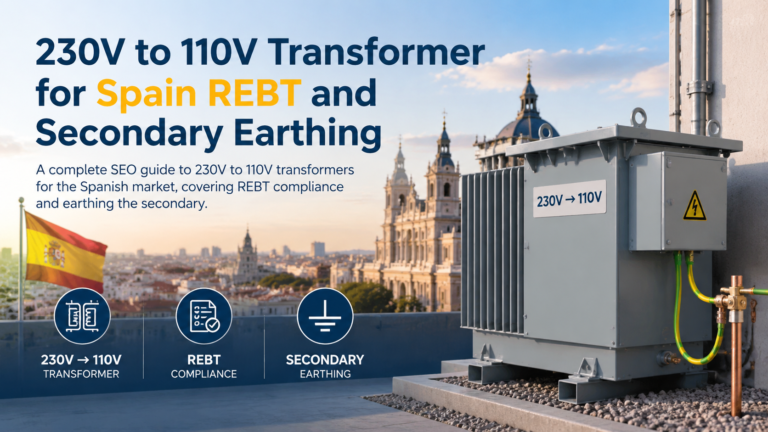
Transformateur 230 V à 110 V pour l'Espagne : conformité à la norme REBT, aux normes ITC-BT-18 et ITC-BT-24, mise à la terre du secondaire et documentation conforme à la norme UNE-EN CEI 61558.
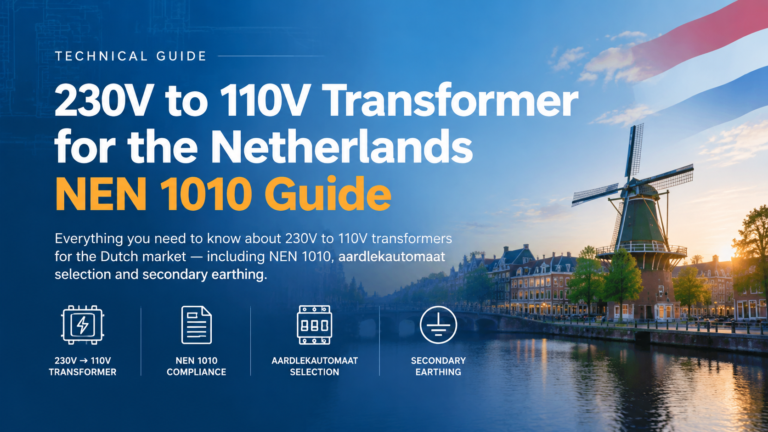
Transformateur 230 V vers 110 V pour les Pays-Bas : norme NEN 1010, règles relatives aux disjoncteurs différentiels de 30 mA, « aardlekschakelaar » ou « aardlekautomaat » et mise à la terre secondaire.
Transformateur 230 V vers 110 V pour la France : norme NF C 15-100, mise à la terre TT, protection différentielle de 30 mA et quand mettre le secondaire à la terre.