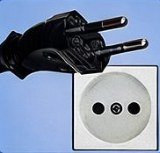
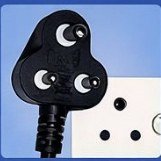
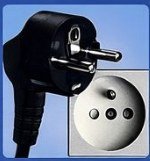
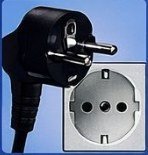
World Guide to Various Types of Plugs and Usage Recommendations
Fifteen plug types cover the whole world. Find the plug your destination country uses, its mains voltage and frequency, and the step up / step down transformer — or voltage stabilizer — that keeps imported equipment running safely.
15 plug types. Two mains voltages. One correctly sized transformer.
There are 15 world plug socket types, and every country runs on one of two mains voltages. This guide shows which plug type each country uses, its voltage and frequency, whether a plug adapter is enough or you need a voltage converter — and the step up / step down transformer that keeps imported equipment running safely.
15
plug types
2
mains voltages
50 / 60
Hz worldwide
100 VA – 2000 kVA
transformer range
The 15 plug types at a glance
Select a type to jump to its full specification, the countries that use it and the conversion equipment it implies.
Every market runs on one of two voltage bands. The plug tells you the country; the voltage tells you whether you need to step up or step down.
110–127 V · 60 Hz
North America, Japan, Mexico, Central America and the Caribbean. Plugs A et B. Equipment built for this band needs a step up transformer where the local supply is 220–240 V.
220–240 V · 50 / 60 Hz
Europe, the UK, the Middle East, Africa, South Asia, Southeast Asia, Australia and China. Plugs C à N. Equipment built for this band needs a transformateur abaisseur on a 110–127 V supply.
One correctly sized transformer
Transformers are rated in VA, not watts, and motors and compressors draw three to four times their running current at start-up. Size on the worst case rather than the steady state, then add headroom.
Type de charge
Typical power
Recommended transformer
Why
LED / electronic device
50–200 W
150–300 VA
Start-up inrush is low
Laptop, TV, small appliance
100–300 W
300–500 VA
Add 30% headroom
Refrigerator / freezer
150–400 W
600–1200 VA
Motor start-up draws 3–4× running current
Air conditioner (1–1.5 HP)
700–1200 W
2000–3000 VA
Compressor surge dominates
Pump / compressor
500–1500 W
2000–4500 VA
Size on locked-rotor current
Power tools, welder
1000–3000 W
3000–6000 VA
Duty cycle matters
Restaurant / bakery equipment
2000–5000 W
5000–12000 VA
Continuous load — do not overload
CNC / machine panel
2000–10000 W
5000–20000 VA
Whole-panel supply with stable output
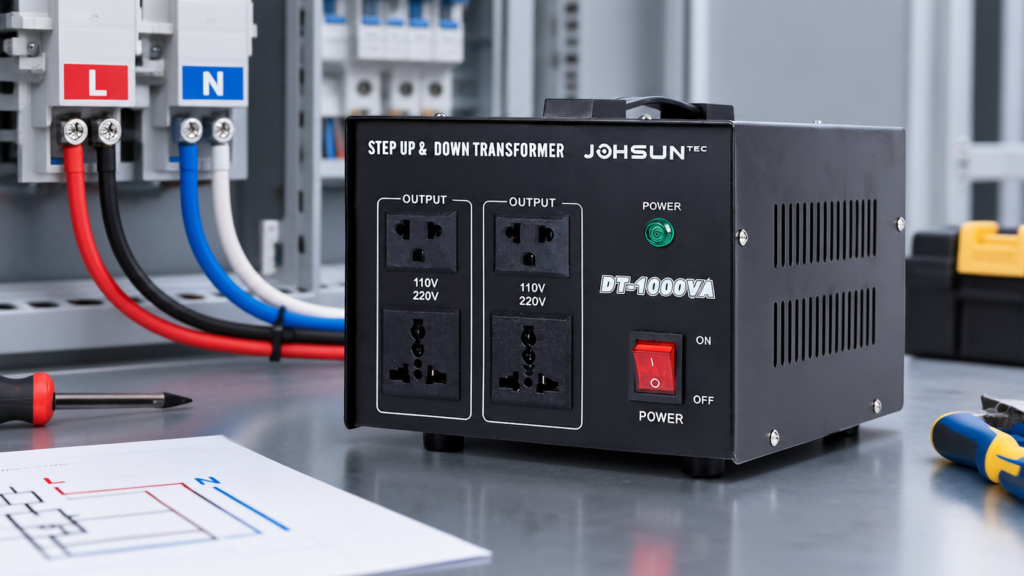
Our DT/ST series covers 100 VA to 10 kVA with US, EU, UK and AU socket options; larger panel and industrial ratings are built in the TC/THG series. Send us the appliance nameplate and the destination country and we will size it for you.
Plug and socket types in detail.
Specifications, grounding, current rating, socket compatibility and the conversion equipment each type implies.
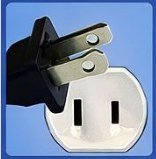
Type A
2 flat parallel pins, ungrounded
Pins 2
Grounding Non
Actuel 15 A
Tension 100–127 V
Socket fits Type A socket only
Where it is used: United States, Canada, Mexico, Japan, and most of Central America and the Caribbean
Where it is used: Germany, Austria, Netherlands, Spain, Portugal, Sweden, Norway, Finland, Russia, Ukraine, Turkey
The European 220 V standard. US 110 V appliances need step down conversion — match the transformer socket to Type F for plug-and-play.
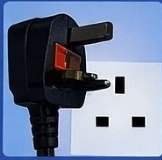
Type G
3 rectangular pins (BS 1363)
Pins 3
Grounding Oui
Actuel 13 A
Tension 220–250 V
Socket fits Type G socket only
Where it is used: United Kingdom, Ireland, Cyprus, Malta, Malaysia, Singapore, Hong Kong, UAE, Saudi Arabia, Qatar, Kenya, Bangladesh, Pakistan
UK and Gulf markets run 230 V. US 110 V equipment needs a transformateur abaisseur; specify a Type G outlet so no adapter is needed.
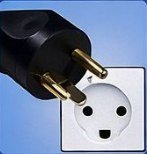
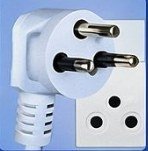
Type H
3 flat pins in a V arrangement (SI 32)
Pins 3
Grounding Oui
Actuel 16 A
Tension 220–240 V
Socket fits Type H socket only
Where it is used: Israel, Palestine
Israel runs 230 V / 50 Hz with a unique flat-pin standard — we build to Type H on request. See ODM ET OEM.
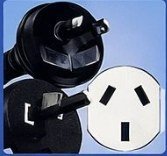
Type I
2 or 3 flat pins, angled (AS/NZS 3112 / GB 2099)
Pins 2–3
Grounding Yes (3-pin)
Actuel 10 A
Tension 220–240 V
Socket fits Type I socket only
Where it is used: Australia, New Zealand, China, Argentina, Fiji, Papua New Guinea, Solomon Islands
Australia, China and Argentina all run 220–240 V. Imported 110 V gear needs 220 V to 110 V conversion.
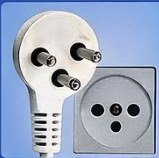
Type J
3 round pins in a triangle (SEV 1011)
Pins 3
Grounding Oui
Actuel 10 A
Tension 220–240 V
Socket fits Types C and J sockets
Where it is used: Switzerland, Liechtenstein
Swiss sockets take Type C and Type J. US 110 V appliances need a step down transformer; Type J outlet available to order.
Type K
3 round pins (DS 60884-2-D1)
Pins 3
Grounding Oui
Actuel 16 A
Tension 220–240 V
Socket fits Types C and K sockets
Where it is used: Denmark, Greenland, Faroe Islands, and parts of West Africa
Denmark runs 230 V / 50 Hz. Grounded Type K plugs need a K-compatible socket — we can fit one on request.
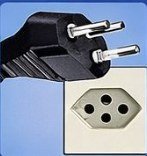
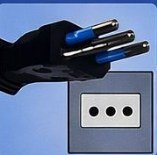
Type L
3 round pins in a line (CEI 23-50)
Pins 3
Grounding Oui
Actuel 10–16 A
Tension 220–240 V
Socket fits Types C and L sockets
Where it is used: Italy, San Marino, Vatican City, Chile, Uruguay, Libya, Syria, Ethiopia
Italian 10 A and 16 A sockets differ in pin spacing — confirm before ordering. 110 V appliances need a step down transformer.
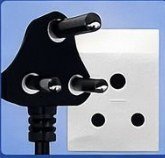
Type M
3 large round pins (BS 546, 15 A)
Pins 3
Grounding Oui
Actuel 15 A
Tension 220–240 V
Socket fits Types M and D sockets
Where it is used: South Africa (older installations), India, Nepal, Sri Lanka, Botswana, Lesotho, Namibia
Heavy 15 A legacy standard. For 110 V imports use a step down transformer rated well above the appliance load.
Type M2
3 large round pins, South African standard
Pins 3
Grounding Oui
Actuel 16 A
Tension 220–240 V
Socket fits Type M2 socket
Where it is used: South Africa (current standard)
South Africa runs 230 V / 50 Hz. A Type M2 outlet can be fitted on request so imported equipment plugs straight in.
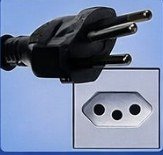
Type N
3 round pins (IEC 60906-1 / NBR 14136)
Pins 3
Grounding Oui
Actuel 10–20 A
Tension 220–240 V
Socket fits Types C and N sockets
Where it is used: Brazil, South Africa
Brazil uses 127 V or 220 V depending on the region — check the local supply before specifying a step up or step down transformer. Ask us to size it.
Adapter vs voltage converter: what each one can and cannot do
A plug adapter only changes the shape of the pins. It does nothing about voltage or frequency.
110 V appliance + 230 V socket = destroyed appliance. This is the single most common failure we see in export markets.
Check the appliance nameplate first. If it says 100–240 V, an adapter is enough. If it says 120 V or 230 V only, you need a transformer.
Frequency cannot be converted by a transformer. 50 Hz loads on a 60 Hz grid — and the reverse — need a frequency converter, not a transformer.
Tell us the appliance nameplate, the destination country and the quantity. We reply within 24 hours with the correct voltage converter rating and the matching socket.
The markets we ship to most often. If your country is not listed, send us the destination and we will confirm the plug standard and voltage.
Country / region
Plug type
Tension
Fréquence
Note
United States
A, B
120 V
60 Hz
100–127 V appliances; needs step up for 220 V imports
Canada
A, B
120 V
60 Hz
Same as US
Mexico
A, B
127 V
60 Hz
Grounded 3-pin common
Japan
A, B
100 V
50 / 60 Hz
Two grid frequencies — 100 V is the lowest mains in the world
Brazil
C, N
127 / 220 V
60 Hz
Voltage varies by city — verify before ordering
United Kingdom
G
230 V
50 Hz
BS 1363 fused plug
Germany / France / Spain / Netherlands
C, E, F
230 V
50 Hz
Schuko and French sockets both accept Type C
Italy
C, F, L
230 V
50 Hz
10 A and 16 A Type L differ in pin spacing
Switzerland
C, J
230 V
50 Hz
Type J grounded
Denmark
C, K
230 V
50 Hz
Type K grounded
Russia / Ukraine / Kazakhstan
C, F
220 V
50 Hz
Schuko standard
Turkey
C, F
230 V
50 Hz
European standard
India
C, D, M
230 V
50 Hz
Wide frequency of voltage swings — stabilizer often required
Pakistan
C, D
230 V
50 Hz
Severe voltage fluctuation, 150–270 V common
Bangladesh
A, C, D, G, K
220 V
50 Hz
Mixed legacy standards in the same building
Sri Lanka / Nepal
D, M
230 V
50 Hz
Old British 3-pin standard
Nigeria
D, G
230 V
50 Hz
Frequent brownouts and surges
Kenya / Tanzania / Ghana
G
240 V
50 Hz
UK standard
Egypt / Morocco / Algeria
C, F
220 V
50 Hz
European standard
South Africa
C, M, M2, N
230 V
50 Hz
Three standards coexist
Saudi Arabia / UAE / Qatar
G
220–230 V
60 Hz
UK standard, 60 Hz — check motor-driven loads
Israel
C, H
230 V
50 Hz
Type H flat-pin standard
Indonesia
C, F
230 V
50 Hz
Voltage drop common in industrial estates
Thailand / Vietnam / Philippines
A, B, C / A, C, G
220 V
50 / 60 Hz
Philippines is 60 Hz — a frequency difference, not just voltage
Malaysia / Singapore / Hong Kong
G
230 V
50 Hz
UK standard
China
A, C, I
220 V
50 Hz
Type I is the modern standard
Australia / New Zealand
I
230 V
50 Hz
AS/NZS 3112
Colombia
A, B
110 V
60 Hz
One of the few 110 V markets in South America
Chile / Argentina / Peru
C, L / I, C / A, C
220 V
50 / 60 Hz
Peru is 60 Hz
Choosing the right transformer rating (VA)
Transformers are rated in VA, not watts. Motors and compressors draw several times their running current at start-up, so the VA rating must be sized on the worst case, not the steady state.
Type de charge
Typical power
Recommended transformer
Why
LED / electronic device
50–200 W
150–300 VA
Start-up inrush is low
Laptop, TV, small appliance
100–300 W
300–500 VA
Add 30% headroom
Refrigerator / freezer
150–400 W
600–1200 VA
Motor start-up draws 3–4× running current
Air conditioner (1–1.5 HP)
700–1200 W
2000–3000 VA
Compressor surge dominates
Pump / compressor
500–1500 W
2000–4500 VA
Size on locked-rotor current
Power tools, welder
1000–3000 W
3000–6000 VA
Duty cycle matters
Restaurant / bakery equipment
2000–5000 W
5000–12000 VA
Continuous load — do not overload
CNC / machine panel
2000–10000 W
5000–20000 VA
Whole-panel supply with stable output
Our DT/ST series covers 100 VA to 10 kVA with US, EU, UK and AU socket options. Larger panel and industrial ratings are built in the TC/THG series.
Where a transformer alone is not enough
In several of our largest markets the problem is not the wrong voltage — it is voltage that will not stay still.
Countries with heavy voltage fluctuation
Pakistan, Nigeria, Bangladesh, parts of India, Iraq, Yemen, Myanmar and Indonesia’s industrial estates routinely swing from 150 V to 270 V on a 230 V nominal supply.
In that situation a step down transformer simply passes the swing through to the appliance. The correct architecture is stabilizer first, transformer second — or a wide-input stabilizer that outputs a stable 220 V directly.
Typical applications for step up / step down transformers
Import & distribution
Appliance importers who need 220 V to 110 V conversion for North American stock sold into 230 V markets, with the right socket already fitted.
Machines industrielles
CNC machines, pumps and production lines imported from a 380–480 V country into a 220 V market, or the reverse — whole-panel supply with stable output.
Hospitality & retail
Restaurants, bakeries, hotels and salons running US or European equipment on local mains, where downtime is expensive.
Solar & off-grid
Where the grid is unreliable, an inverter ou UPS plus a transformer gives both back-up and voltage matching.
OEM & private label
Transformers and stabilizers built to your brand, your socket standard and your packaging — see ODM ET OEM.
Project supply
Mixed ranges shipped in one consignment with one set of documents. See our solutions page.
world plug socket types FAQ
Can I just use a plug adapter instead of a transformer?
No. A plug adapter only changes the physical pin shape — it does not change voltage or frequency. A 110 V appliance plugged into a 230 V socket through an adapter will be destroyed. Adapters are only safe when the appliance is dual-voltage (100–240 V) and the frequency matches.
How do I know whether I need a step up or a step down transformer?
Read the appliance nameplate first. Step down = 220–240 V mains, 110–120 V appliance. Step up = 110–120 V mains, 220–240 V appliance. The nameplate voltage, not the plug shape, decides.
Do your transformers come with the socket I need?
Yes. Tell us the destination country and we will fit the matching socket — Type B (US), Type F (EU), Type G (UK), Type I (AU/CN), Type D or M (India/South Africa) — so imported equipment plugs in directly without a separate adapter.
What about countries where the voltage fluctuates badly?
In markets such as Pakistan, Nigeria, Bangladesh and parts of India, a transformer alone is not enough — the input itself swings from 150 V to 270 V. Combine the transformer with an automatic voltage stabilizer (servo motor type for ±1% accuracy, relay type for cost-sensitive loads) or use a wide-input stabilizer as the first stage.
The appliance is 50 Hz but the country is 60 Hz — is that a problem?
For resistive loads such as heaters, lamps and most switch-mode electronics, no. For motor-driven loads — pumps, compressors, turntables, clocks — 50/60 Hz mismatch changes the speed and can overheat the motor. Transformers cannot convert frequency; that requires a frequency converter, which is a different product. Tell us the load type and we will advise.
How much headroom should I allow on the VA rating?
A minimum of 30% for resistive loads, 2–3× for appliances with motors or compressors because of start-up inrush. When in doubt, send us the appliance nameplate and we will size it for you at no cost.
Can you supply the whole range in one shipment for a project?
Yes. We build step up / step down transformers from 100 VA to 10 kVA in the DT/ST series and up to much larger ratings in the TC/THG series, variable transformers (variac) from 0.5 kVA to 5 kVA, and stabilizers from 0.5 kVA to 2000 kVA. Mixed-carton shipments and OEM branding are both available.
Is Type C the same as Type F?
No. Type C (Europlug) has two round pins and no earth connection, so it is only used on double-insulated appliances up to 2.5 A. Type F (Schuko) has the same two round pins but adds side earth clips and is rated to 16 A. A Type C plug fits a Type F socket, but a Type F plug will not fit a Type C socket.
Can I use a 220–240 V appliance in the US with an adapter?
No. A plug adapter only changes the pin shape. US mains is 120 V, so a 220–240 V appliance needs a step up transformer rated at least 1.3× its nameplate wattage — or 2–3× for anything with a motor or compressor. Using an adapter alone will under-power the appliance and can damage the motor.
Which countries use Type G plugs?
Type G (BS 1363, three rectangular pins with a fuse) is used in the United Kingdom, Ireland, Cyprus, Malta, Malaysia, Singapore, Hong Kong, the UAE, Saudi Arabia, Qatar, Kenya, Pakistan and Bangladesh — all on 230 V, with the Gulf states on 60 Hz.
Not sure which plug and transformer you need?
Send us the appliance nameplate, the destination country and the quantity. We will confirm the plug type, the mains voltage, the transformer rating and the socket we will fit — within 24 hours.
×
Obtenir un devis gratuit
Nous répondrons à votre demande dans les 24 heures
Nous accordons de l'importance à votre vie privée
Nous utilisons des cookies pour améliorer votre expérience de navigation, vous proposer un contenu personnalisé et analyser notre trafic.