Os transformadores são dispositivos fixos essenciais para a transferência eficiente de energia elétrica entre circuitos.
Eles alteram a tensão do lado da entrada, chamado de primário, para o lado da saída, conhecido como secundário, a fim de atender a diferentes necessidades. Um transformador elevador aumenta a tensão na saída, enquanto um transformador redutor a diminui.
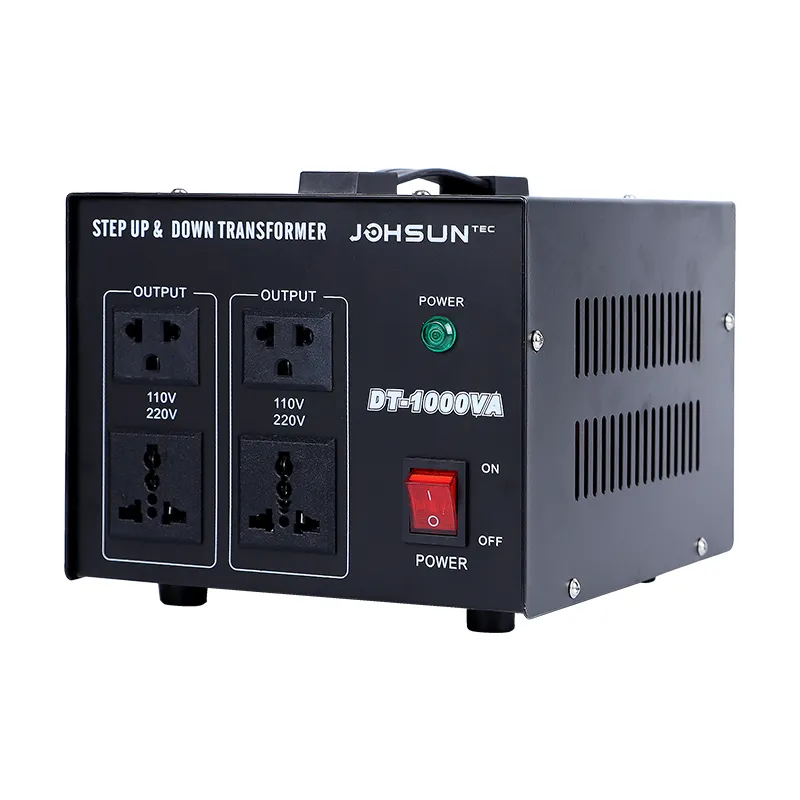
Este artigo explica o projeto e a função de ambos Transformador de subida e descida e aborda os princípios básicos da transmissão de energia elétrica.
O que é um transformador redutor?
A Transformador abaixador reduz a tensão de um nível mais alto no lado primário para um nível mais baixo no lado secundário.
Por exemplo, se um prédio for alimentado com energia trifásica a 480 volts, mas precisar de energia trifásica a 208 volts para uma máquina, utiliza-se um transformador redutor para diminuir a tensão de 480 para 208 volts, garantindo que o equipamento receba a tensão adequada.
O que é um transformador elevador?
A transformador elevador aumenta a tensão ao apresentar uma tensão mais baixa no lado primário e uma tensão mais alta no lado secundário. Por exemplo, se a instalação elétrica do seu prédio fornece 208 volts, mas uma máquina de grande porte requer 480 volts, é necessário um transformador elevador para aumentar a tensão de 208 para 480 volts.
Princípio de funcionamento do transformador
Um transformador possui duas bobinas de fio: o enrolamento primário, que recebe energia, e o enrolamento secundário, que fornece energia. Ambas as bobinas estão enroladas em torno de um núcleo magnético de ferro composto por finas chapas laminadas, a fim de reduzir a perda de energia no interior do núcleo causada pelas variações dos campos magnéticos.
Quando a corrente passa pelo enrolamento primário, ela cria um campo magnético que induz tensão e corrente no enrolamento secundário por meio da indução mútua. A tensão no lado secundário depende da relação entre o número de espiras das bobinas secundária e primária.
Essa relação é expressa pela fórmula:
V₁V₂ = N₁N₂ = I₂I₁V2V1=N2N1=I1I2z
onde V1V1 e V2V2 são as tensões nos enrolamentos primário e secundário, N1N1 e N2N2 é o número de espiras nas bobinas primária e secundária, e I1I1 e I2I2 são as correntes nos enrolamentos primário e secundário, respectivamente.
Princípio de funcionamento do transformador elevador
Um transformador elevador aumenta a tensão no enrolamento secundário em relação ao lado primário. De acordo com a fórmula de transformação de tensão, para que a tensão secundária V₂V_2V2 seja maior do que a tensão primária V₁V_1V1, o número de espiras na bobina secundária N₂N_2N2 deve ser maior do que na bobina primária N₁N_1N1. Isso significa que:
N2>N1N_2 > N_1N2>N1
V2>V1V_2 > V_1V2>V1
I2 < I1 I_2 < I_1 I2 < I1
Embora o transformador aumente a tensão, ele diminui a corrente no lado secundário, pois a potência total em ambos os lados é igual. A espessura do fio reflete a capacidade de corrente: a bobina primária, que conduz mais corrente, utiliza fio de cobre isolado mais grosso, enquanto a bobina secundária utiliza fio mais fino. Os transformadores são classificados em kVA (kilovolt-amperes), um produto da tensão pela corrente.
Por exemplo, com um transformador de relação 1:10, ao aplicar 10 V no enrolamento primário:
N1=1N_1 = 1N1=1
N2=10N_2 = 10N2=10
V1=10VV_1 = 10VV1=10V
A tensão secundária é calculada da seguinte forma: V₂ = (N₂ / N₁) × V₁ = 100 V V₂ = frac{N_2}{N_1} vezes V₁ = 100 V V₂ = (N₁ / N₂) × V₁ = 100 V
Assim, a tensão secundária é dez vezes maior que a tensão de entrada.
Vantagens
Fácil de manter
Altamente eficiente
Inicialização rápida
Útil para a transmissão de energia
Desvantagens
Precisa de um sistema de refrigeração
Funciona apenas com corrente alternada (CA)
Tamanho grande
Princípio de funcionamento do transformador redutor
Um transformador redutor diminui a tensão no enrolamento secundário em relação ao lado primário. De acordo com a fórmula de transformação de tensão, para que a tensão secundária V₂ seja menor que a tensão primária V₁, o número de espiras na bobina secundária N₂ deve ser menor que o da bobina primária N₁. Isso significa que:
N2 < N1N_2 < N_1N2 < N1
V2 < V1V_2 < V_1V2 < V1
I2>I1I_2 > I_1I2>I1
Embora o transformador reduza a tensão, ele aumenta a corrente no lado secundário. A bobina secundária conduz mais corrente, por isso utiliza fio de cobre isolado mais grosso, enquanto a bobina primária utiliza fio mais fino. Os transformadores redutores são frequentemente utilizados em aplicações de baixa tensão, como na iluminação paisagística.
Por exemplo, com um transformador de 100:1, ao aplicar 10 V no enrolamento primário:
N1=100N_1 = 100N1=100
N2=1N_2 = 1N2=1
V1=10VV_1 = 10VV1=10V
A tensão secundária é: V₂ = N₂/N₁ × V₁ = 0,1 V V₂ = frac{N_2}{N_1} vezes V₁ = 0,1 V V₂ = N₁/N₂ × V₁ = 0,1 V
Isso significa que a tensão secundária é 100 vezes menor do que a tensão primária.
Vantagens
Durável e confiável
Custo-benefício
Eficiente
Fornece diferentes tensões para uso doméstico
Desvantagens
Requer manutenção regular
Funciona apenas com corrente alternada (CA)
Aumente o desempenho do seu sistema com nossos confiáveis transformadores elevadores e redutores. Entre em contato com nossa equipe agora mesmo para identificar o melhor produto para a sua operação.
<strong>Transformadores de alta qualidade para uma transmissão de energia eficiente</strong>
Aumente o desempenho do seu sistema com nossos confiáveis transformadores elevadores e redutores. Entre em contato com nossa equipe agora mesmo para identificar o melhor produto para a sua operação.
Um transformador pode operar no sentido inverso, em que o enrolamento secundário é alimentado por uma fonte de corrente alternada e o enrolamento primário alimenta a carga. Isso significa que um transformador elevador pode funcionar como redutor e vice-versa.
No entanto, para uma operação eficiente e segura, cada enrolamento deve ser utilizado dentro dos limites originais de tensão e corrente para os quais foi projetado. A utilização incorreta de um transformador fora desses limites pode causar ineficiência ou danos devido a tensão ou corrente excessivas.
Aplicativos
Transformadores step-up
Os transformadores elevadores possuem fios de cobre com isolamento espesso no lado primário e elevam a tensão para 11.000 volts ou mais. Eles são essenciais para necessidades especiais de energia, como a operação de Aparelhos de raios X, micro-ondas e usinas de energia. Esses transformadores também são usados para aumentar a tensão em linhas de transmissão de alta potência e para alimentar dispositivos eletrônicos.
Transformadores abaixadores
Os transformadores redutores são comumente encontrados em aparelhos do dia a dia, como CD-plays, televisores e campainhas. Eles também são utilizados em estabilizadores de tensão, inversores, redes de distribuição de energia, carregadores de celular e linhas de transmissão.
Perguntas frequentes
u003cstrongu003eQual é a principal diferença entre um transformador elevador e um redutor?u003c/strongu003e
Um transformador elevador aumenta a tensão do enrolamento primário para o secundário, enquanto um transformador redutor diminui a tensão.
u003cstrongu003eÉ possível usar um transformador ao contrário?u003c/strongu003e
Sim, um transformador pode funcionar ao contrário — usando o secundário como entrada e o primário como saída —, mas deve permanecer dentro dos limites originais de tensão e corrente para evitar danos e ineficiência.
u003cstrongu003ePor que os transformadores elevadores têm fios mais grossos no enrolamento primário?u003c/strongu003e
Os transformadores elevadores conduzem uma corrente mais alta no lado primário; por isso, utiliza-se fio de cobre com isolamento mais espesso para conduzir a corrente com segurança.
u003cstrongu003eOnde os transformadores redutores são comumente utilizados?u003c/strongu003e
Eles são encontrados em aparelhos eletrônicos domésticos, como TVs e carregadores, estabilizadores de tensão, inversores e redes de distribuição de energia.
u003cstrongu003ePor que os transformadores funcionam apenas com corrente alternada (CA)?u003c/strongu003e
Os transformadores dependem de campos magnéticos variáveis, que só ocorrem com corrente alternada (CA); portanto, não podem funcionar com corrente contínua (CC).
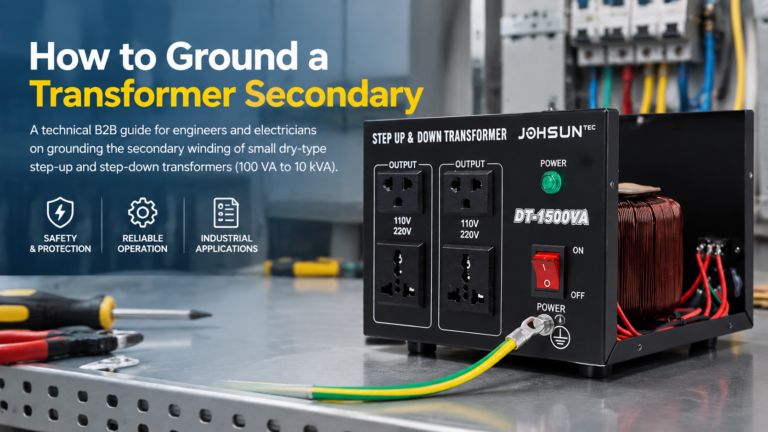
A practical guide to grounding the secondary of small dry-type step-up and step-down transformers — which conductor to bond, how to verify it, and mistakes to avoid.
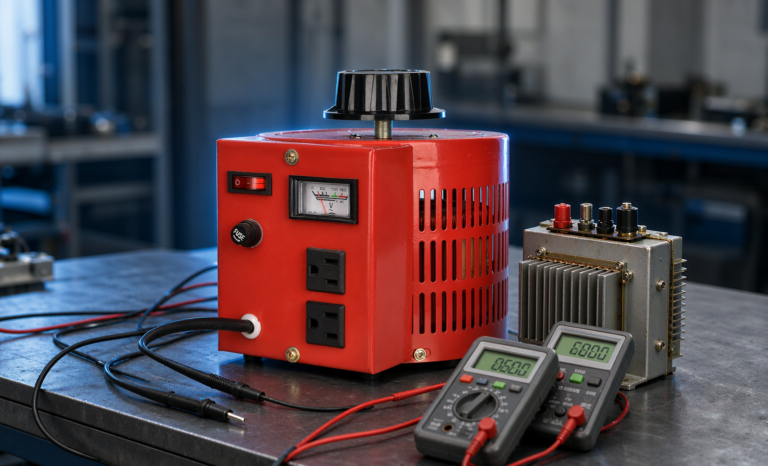
A practical guide to transformer turns ratio testing on low voltage units - the applied-voltage method with a variac, tolerance limits, tap checks, and when to call for a ratio tester.
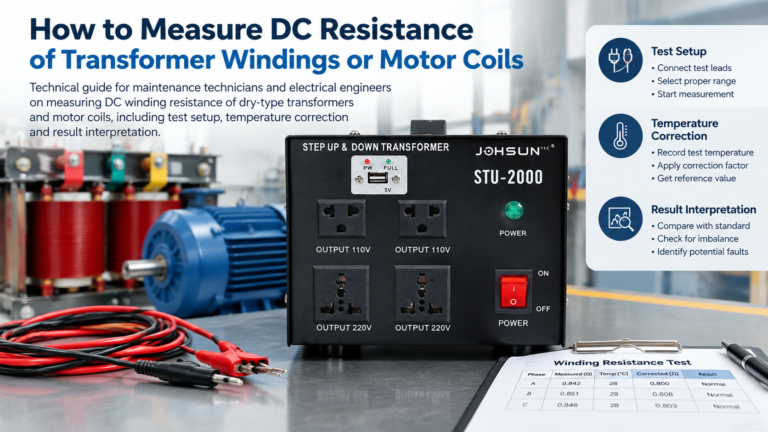
A practical guide to measuring the DC resistance of transformer windings and motor coils, covering four-wire setup, test current selection, temperature correction and pass/fail limits.