






230V to 110V Transformer for Spain: REBT and Secondary Earthing
230V to 110V transformer for Spain: REBT compliance, ITC-BT-18 and ITC-BT-24, earthing the secondary and UNE-EN IEC 61558 documentation.
Read More
 English
Transformers are stationary devices vital for transferring electric power efficiently between circuits.
They change the voltage from the input side, called the primary, to the output side, known as the secondary, to meet different requirements. A step-up transformer increases the voltage at the output, while a step-down transformer lowers it.
This article explains the design and function of both Step up and down transformer and covers basic principles of electrical transmission.
A step-down transformer reduces voltage from a higher level on the primary side to a lower level on the secondary side.
For example, if a building gets 3-phase power at 480 volts but needs 208 volts 3-phase power for a machine, a step-down transformer is used to lower the voltage from 480 to 208 volts, ensuring the equipment receives the proper voltage.

A step-up transformer increases voltage by having a lower voltage on the primary side and a higher voltage on the secondary side. For instance, if your building’s wiring supplies 208 volts but a large machine requires 480 volts, a step-up transformer is needed to raise the voltage from 208 to 480 volts.

A transformer includes two wire coils: the primary winding, which receives power, and the secondary winding, which delivers power. Both coils are wrapped around a magnetic iron core made of thin laminated sheets to reduce energy loss within the core caused by changing magnetic fields.
When power flows through the primary winding, it creates a magnetic field that induces voltage and current in the secondary winding through mutual induction. The voltage on the secondary side depends on the ratio of turns between the secondary and primary coils.
This relationship is expressed by the formula:
V1V2=N1N2=I2I1V2V1=N2N1=I1I2z
where V1V1 and V2V2 are the voltages on the primary and secondary windings, N1N1 and N2N2 are the number of turns in the primary and secondary coils, and I1I1 and I2I2 are the currents in the primary and secondary windings, respectively.

A step-up transformer raises the voltage in the secondary winding compared to the primary side. According to the voltage transformation formula, for the secondary voltage V2V_2V2 to be higher than the primary voltage V1V_1V1, the number of turns in the secondary coil N2N_2N2 must be greater than in the primary coil N1N_1N1. This means:
While the transformer increases voltage, it decreases current on the secondary side because the total power on both sides is equal. The wire thickness reflects current capacity: the primary coil, carrying more current, uses thicker insulated copper wire, and the secondary coil uses thinner wire. Transformers are rated in kVA (kilo-volt amperes), a product of voltage and current.
For example, with a 1:10 transformer applied 10V on the primary winding:
The secondary voltage is calculated as:V2=N2N1×V1=100VV_2 = frac{N_2}{N_1} times V_1 = 100VV2=N1N2×V1=100V
Thus, the secondary voltage is ten times the input voltage.
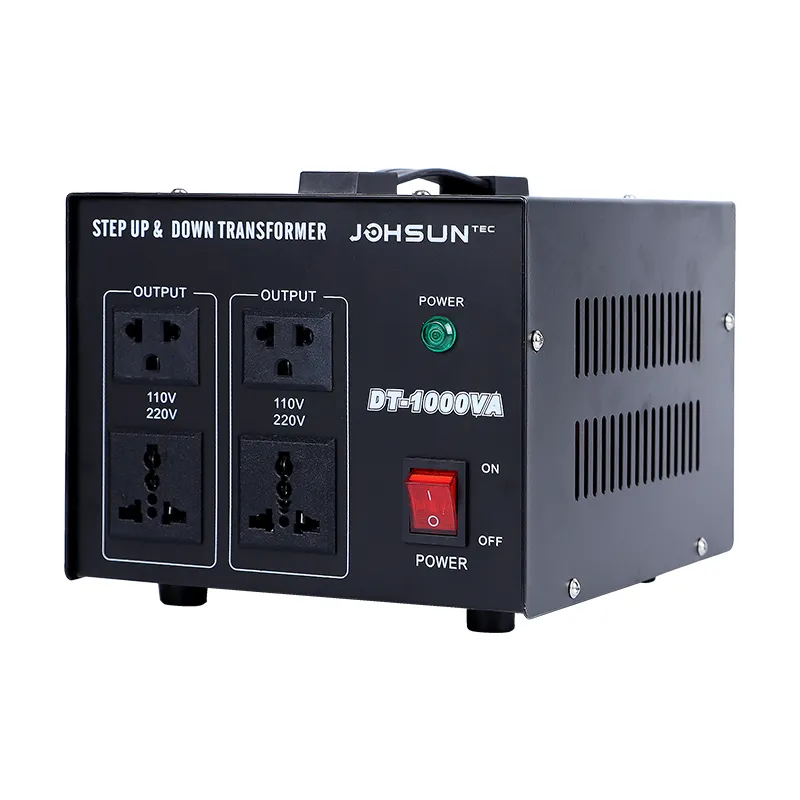
A step-down transformer lowers the voltage at the secondary winding compared to the primary side. According to the voltage transformation formula, for the secondary voltage V2V_2V2 to be less than the primary voltage V1V_1V1, the number of turns in the secondary coil N2N_2N2 must be fewer than in the primary coil N1N_1N1. This means:
While the transformer reduces voltage, it increases current on the secondary side. The secondary coil carries more current, so it uses thicker insulated copper wire, while the primary coil uses thinner wire. Step-down transformers are often used in low voltage applications, such as for landscape lighting.
For example, with a 100:1 transformer applied 10V on the primary winding:
The secondary voltage is:V2=N2N1×V1=0.1VV_2 = frac{N_2}{N_1} times V_1 = 0.1VV2=N1N2×V1=0.1V
This means the secondary voltage is 100 times lower than the primary voltage.
Boost your system’s performance with our reliable step-up and step-down transformers. Speak with our team now to identify the best product for your operation.
Boost your system’s performance with our reliable step-up and step-down transformers. Speak with our team now to identify the best product for your operation.
A transformer can operate in reverse, where the secondary winding is powered by an AC source and the primary winding supplies the load. This means a step-up transformer can work as a step-down, and vice versa.
However, for efficient and safe operation, each winding must be used within its original voltage and current design limits. Using a transformer backward outside these limits can cause inefficiency or damage due to excessive voltage or current.

Step-up transformers have thick insulated copper wire on the primary side and raise voltage to 11,000 volts or higher. They are essential for special power needs such as operating X-ray machines, microwaves, and power plants. These transformers are also used to increase voltage in high-power transmission lines and to boost electronic devices.
Step-down transformers are commonly found in everyday devices, including CDs, televisions, and doorbells. They are also used in voltage stabilizers, inverters, power distribution networks, mobile phone chargers, and transmission lines.
A step-up transformer increases voltage from the primary to the secondary winding, while a step-down transformer decreases the voltage.
Yes, a transformer can operate backward—using the secondary as the input and the primary as the output—but it must stay within the original voltage and current limits to avoid damage and inefficiency.
Step-up transformers carry higher current on the primary side, so thicker insulated copper wire is used to handle the current safely.
They are found in household electronics like TVs and chargers, voltage stabilizers, inverters, and power distribution networks.
Transformers rely on changing magnetic fields, which only occur with AC, so they cannot function with direct current (DC).