Transformer overheating is one of the most common causes of equipment failure in industrial plants and control panels, because it attacks the weakest point first: the insulation. A unit that runs too hot ages quietly and then stops at the worst possible moment. Once winding insulation degrades, the stage is set for short circuits, transformer failure, and costly downtime. This guide explains the main transformador overheating causes, the damage heat can do, and how to catch the problem early.
What Happens When a Transformer Overheats?
Heat is a normal by-product of transformer operation: copper loss in the windings and core loss always produce some temperature rise above ambient. The problem starts when the unit cannot shed that heat fast enough and internal temperature climbs past the design limit. The failure chain is then predictable:
- Insulation damage. Heat accelerates the chemical aging of enamel, paper, and resin insulation until it becomes brittle and loses dielectric strength.
- Arcing. Weakened insulation can no longer separate the windings reliably, so internal arcs begin.
- Short circuit. The arc carbonizes nearby insulation and eventually bridges turns or phases, producing a hard electrical fault.
- Catastrophic failure. The transformer trips, smokes, burns, or fails permanently — often taking connected equipment down with it.
The sequence can take years — or minutes during a severe fault. That is why temperature is monitored so closely on critical units.
The Main Causes of Transformer Overheating
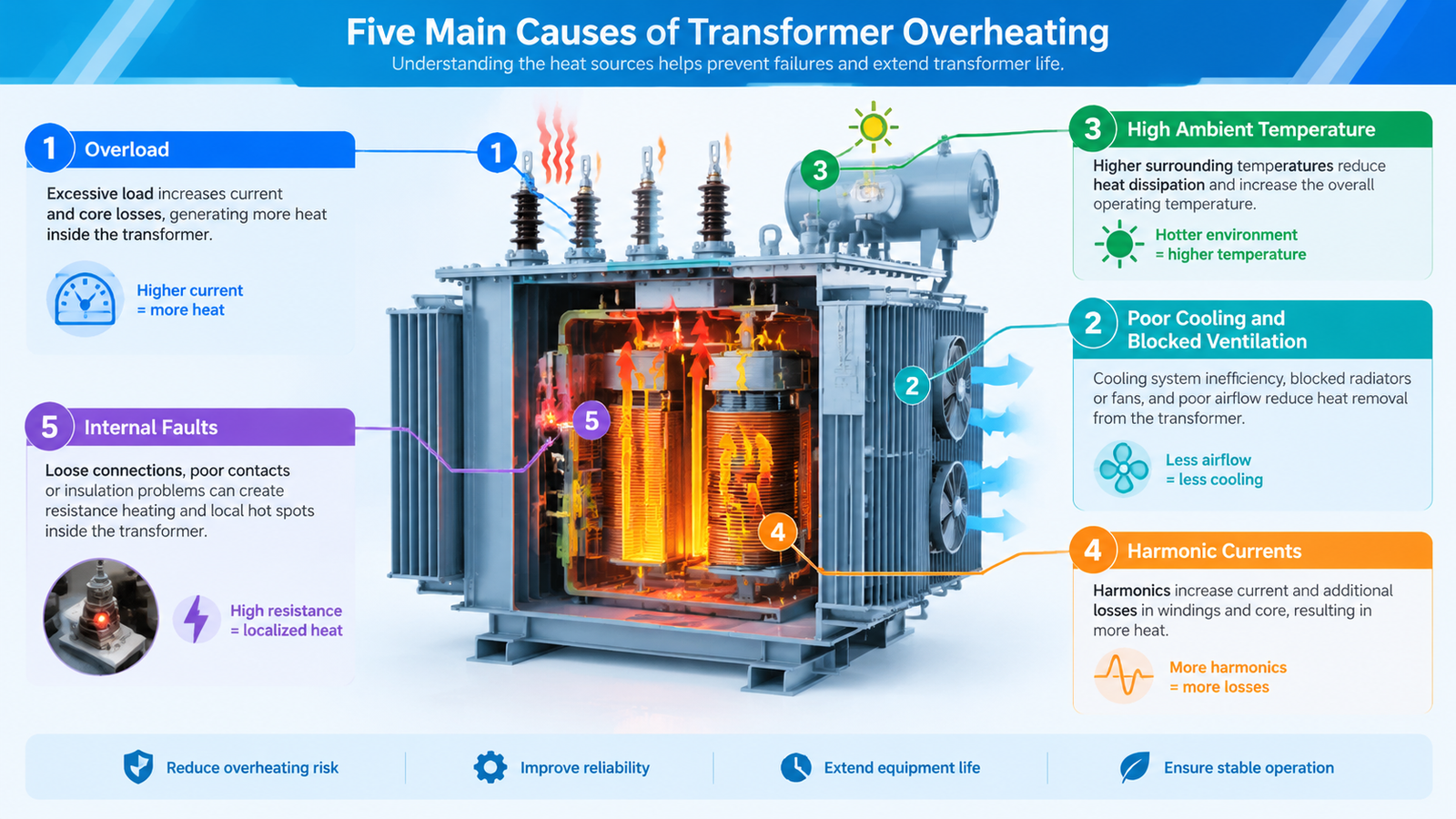
Most overheating starts with one of five conditions — recognize them early and you can correct the cause before the temperature rises.
1. Overload and Sustained High Load
Operating a transformer above its rated kVA is the most common cause of overheating. Copper loss rises with the square of the current, so a 20% overload produces roughly 44% more winding heat. A unit pushed past its rating for hours may not trip immediately, but its insulation life is consumed much faster. If you suspect the load is the problem, learn how to calculate the overload of a transformer so you can confirm it with measured current instead of guessing.
2. Poor Cooling and Blocked Ventilation
A transformer can only dissipate as much heat as its cooling path allows. Dust-covered fins, painted-over ventilation slots, stopped fans, or an enclosure stuffed with cables all trap heat inside. Small encapsulated and dry-type units are especially sensitive because they rely entirely on surface area and airflow.
3. High Ambient Temperature and Poor Installation
The rating of a transformer assumes a maximum ambient temperature, typically 40°C. Install a unit in direct sunlight, next to a furnace, inside a sealed cabinet, or above a hot motor, and the available temperature margin shrinks. Two identical units with the same load can run at very different internal temperatures depending on where they are mounted.
4. Harmonic Currents from Non-Linear Loads
Variable frequency drives, rectifiers, and other electronic loads draw non-sinusoidal current. Harmonics increase eddy-current and stray losses in the core and windings, adding heat that a transformer sized only for the fundamental current was never designed to handle. The effect shows up as overheating at perfectly normal load levels.
5. Internal Faults, Loose Connections, and Aging
Localized hot spots often come from inside the unit: shorted core laminations, turn-to-turn faults, loose or oxidized terminal connections, or old insulation that has lost its thermal margin. These faults do not raise the overall load but create small regions of intense heat that burn outward until they cause transformer failure.
What Damage Does Overheating Cause?
Overheating does not damage a transformer uniformly. Each degree of sustained temperature rise shortens insulation life, raises losses, and increases the chance of a sudden fault. The main hazards and how they develop are summarized below.
| Hazard |
How It Develops |
Worst-Case Outcome |
| Insulation damage |
Heat accelerates aging; insulation becomes brittle and loses dielectric strength |
Turn-to-turn or phase-to-phase short circuit |
| Reduced efficiency |
Higher winding resistance at temperature increases copper loss |
More heat and an even higher operating temperature |
| Accelerated aging |
Sustained temperature above the limit shortens insulation life |
Premature replacement of a unit that should have lasted decades |
| Fire and safety risk |
Charred insulation and hot connections can ignite nearby materials |
Equipment fire, smoke damage, and operator hazard |
| Unplanned downtime |
Thermal overload trips breakers or burns out the unit with no warning |
Stopped production while a replacement is sourced |
Of all these, insulation damage matters most, because it converts a slow aging problem into a sudden electrical fault — and the rest of the damage follows from it.
How Hot Is Too Hot? Temperature Limits Explained
Transformer insulation is classified by the maximum winding temperature it can withstand continuously. Exceeding the class limit for even a few hours noticeably shortens life; exceeding it repeatedly can destroy a unit in months.
| Insulation Class |
Maximum Winding Temperature |
Uso típico |
| Class A |
105°C |
Older oil-immersed and impregnated units |
| Class B |
130°C |
Common in dry-type and encapsulated transformers |
| Class F |
155°C |
Industrial control and step up/step down transformers |
| Class H |
180°C |
High-temperature and high-ambient applications |
A widely used engineering rule of thumb: every 8–10°C of sustained temperature rise above the rated hottest-spot temperature halves the remaining life of the insulation. The hottest point inside the windings — not the surface temperature — is the figure that matters, and it is why transformers are rated in kVA rather than kW: the kVA figure reflects the current that actually heats the windings.
How to Detect Transformer Overheating Early
Overheating is almost always detectable before it becomes a failure — if the right checks are done on a schedule:
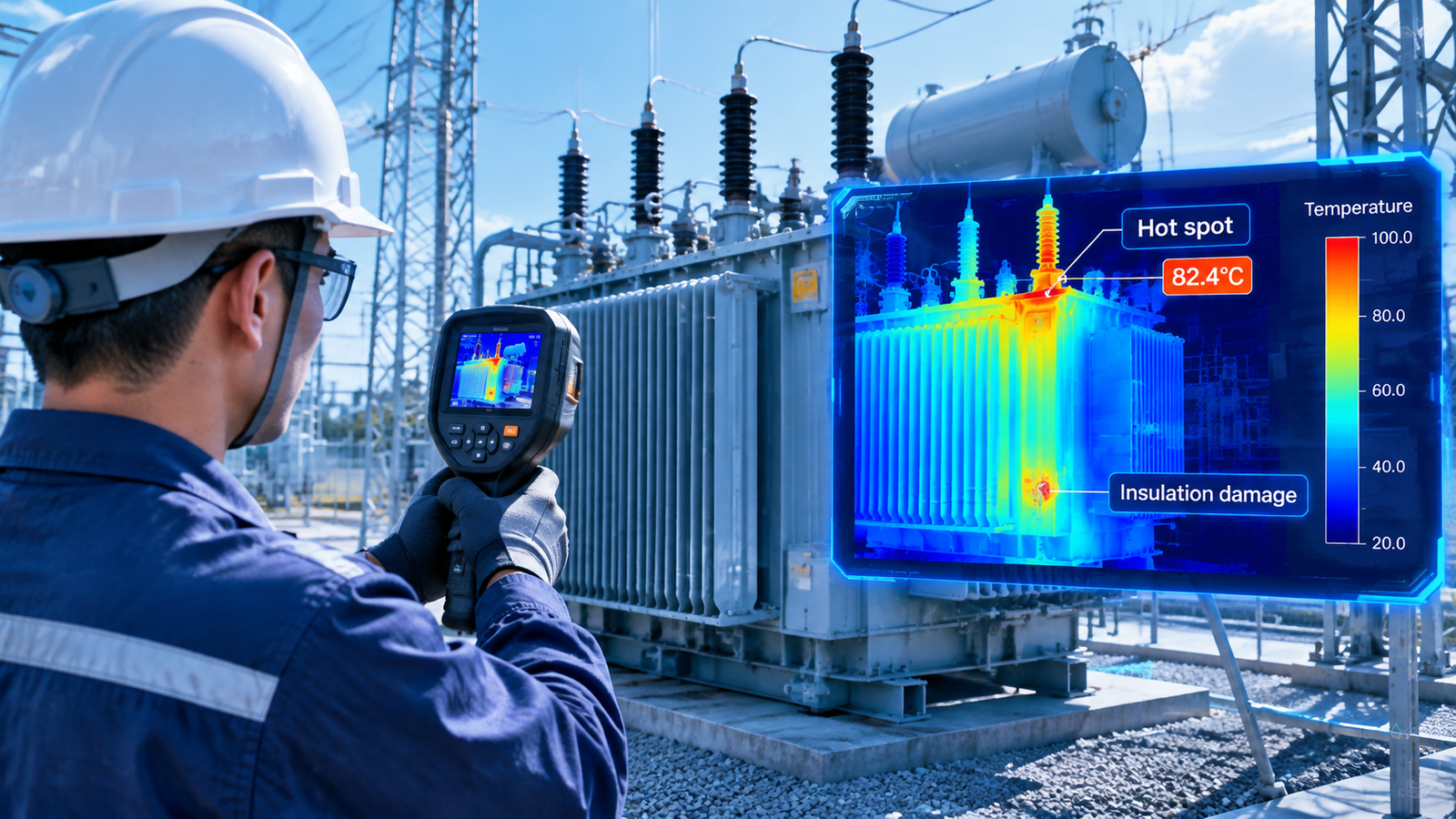
- Thermal imaging. A handheld infrared camera quickly reveals hot spots; comparing readings with previous scans exposes a slow upward trend.
- Embedded temperature sensors. RTDs or thermistors in the windings read the hottest point directly and can trigger alarms.
- Load monitoring. Recording actual current over time shows whether the unit regularly runs near or above its rating.
- Physical inspection. Discolored varnish, a burnt smell, cracked insulation, or a hot enclosure all indicate trouble inside.
- Oil analysis for liquid-filled units. Dissolved gas analysis detects the early breakdown products of overheated insulation long before failure.
For controlled load tests and thermal-rise checks, feeding the unit from an adjustable supply lets you ramp voltage and current gradually while watching temperature. A TDGC2J series variable transformer is a practical tool for this kind of bench verification.
How to Prevent Transformer Overheating
Prevention is far cheaper than repair. The checklist below catches most overheating problems while they are still cheap to fix:
- Keep the load below the rating. Run continuous loads at no more than about 80% of rated capacity and reserve headroom for starting surges.
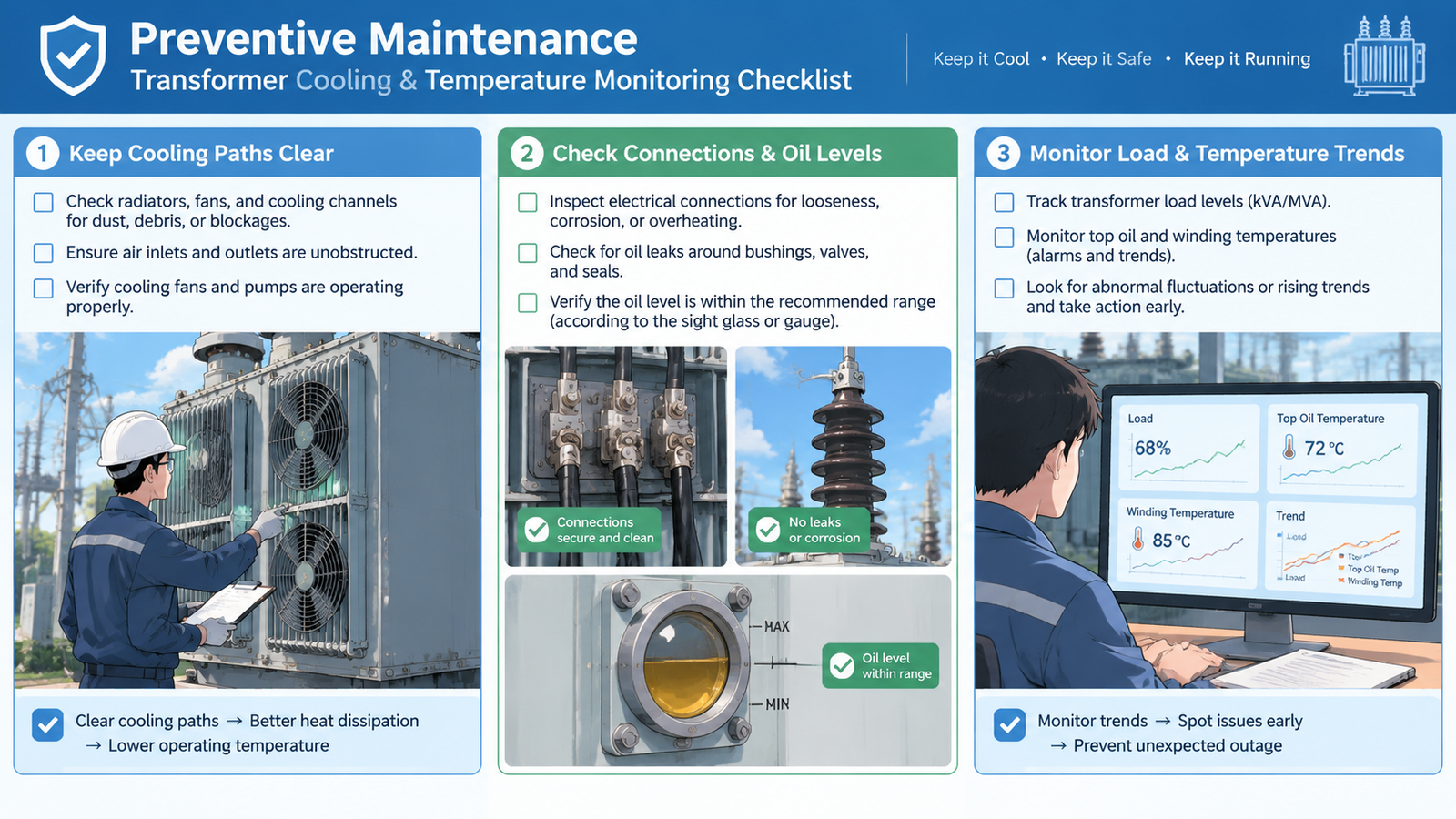
- Keep cooling paths clear. Clean fins and ventilation slots regularly; verify fans start and oil levels stay correct.
- Respect the environment. Leave the recommended clearances around the unit and avoid mounting heat sources nearby.
- Check connections. Torque terminals to spec and look for discoloration or corrosion at least once a year.
- Watch for leaks. On oil-filled units, a drop in oil level from a transformer leakage problem reduces cooling capacity and leads straight to overheating.
- Monitor the trend. Log temperature readings during routine rounds so a slow upward drift becomes visible before it becomes sudden.
Correct sizing at purchase is the most effective prevention of all. If loads have grown over the years, compare actual demand against the nameplate and plan an upgrade while the old unit is still healthy — for smaller panel and control applications, a properly sized low-voltage transformer with built-in thermal margin will outlast an undersized one many times over.
Final Thoughts on Transformer Overheating
Transformer overheating is rarely a mystery. It comes from overload, blocked cooling, high ambient temperature, harmonics, or internal faults — and it destroys insulation before it destroys the transformer. Keep the load within rating, keep the cooling path clear, check connections and oil levels on a schedule, and watch the temperature trend instead of waiting for a trip.
Choosing a unit with the right rating for your actual load and environment is the best way to avoid the problem from day one. Contact us with your load details and operating conditions, and the Johsun engineering team will help you select a transformer that runs cool for the life of your equipment.
Perguntas frequentes
What are the main causes of transformer overheating?
Overload, poor cooling or blocked ventilation, high ambient temperature, harmonic currents from non-linear loads, and internal faults such as loose connections or aging insulation. Overload is the most frequent cause in industry.
What happens if a transformer gets too hot?
Heat degrades the winding insulation and reduces its dielectric strength. If temperatures stay high, the insulation can crack and arc over, causing short circuits and permanent failure — often with fire risk and downtime.
What temperature is too hot for a transformer?
It depends on the insulation class: Class A is rated to 105°C, Class B to 130°C, Class F to 155°C, and Class H to 180°C maximum winding temperature. The hottest-spot temperature is the limiting figure.
How long can a transformer run overloaded?
Only briefly, within manufacturer limits that depend on prior load, ambient temperature, and cooling. Continuous overload is never acceptable — it rapidly accelerates insulation damage and leads to early failure.
How do I know if my transformer is overheating?
Scan with an infrared camera for hot spots, feel the enclosure and terminals for abnormal heat, and monitor load current against the rating. A consistently rising temperature trend is the clearest warning.
Can overheating be prevented?
Yes. Correct transformer sizing, regular cleaning of cooling surfaces, and annual connection and oil-level checks prevent most overheating.
Recommended Models for Transformer Overheating Prevention
If you are specifying a unit rather than reading theory, start here. These models cover the capacity bands most often requested for transformer overheating prevention, and each links straight to its specification and price range.
Tell us the input voltage, output voltage, phase and continuous kVA you need, and we will confirm the matching model, price and lead time within one business day. Non-standard ratings are handled through OEM/ODM custom transformer manufacturing.