What Is the Difference Between Single-Phase and Three-Phase Transformers?
Publicado: Autor: Lisa
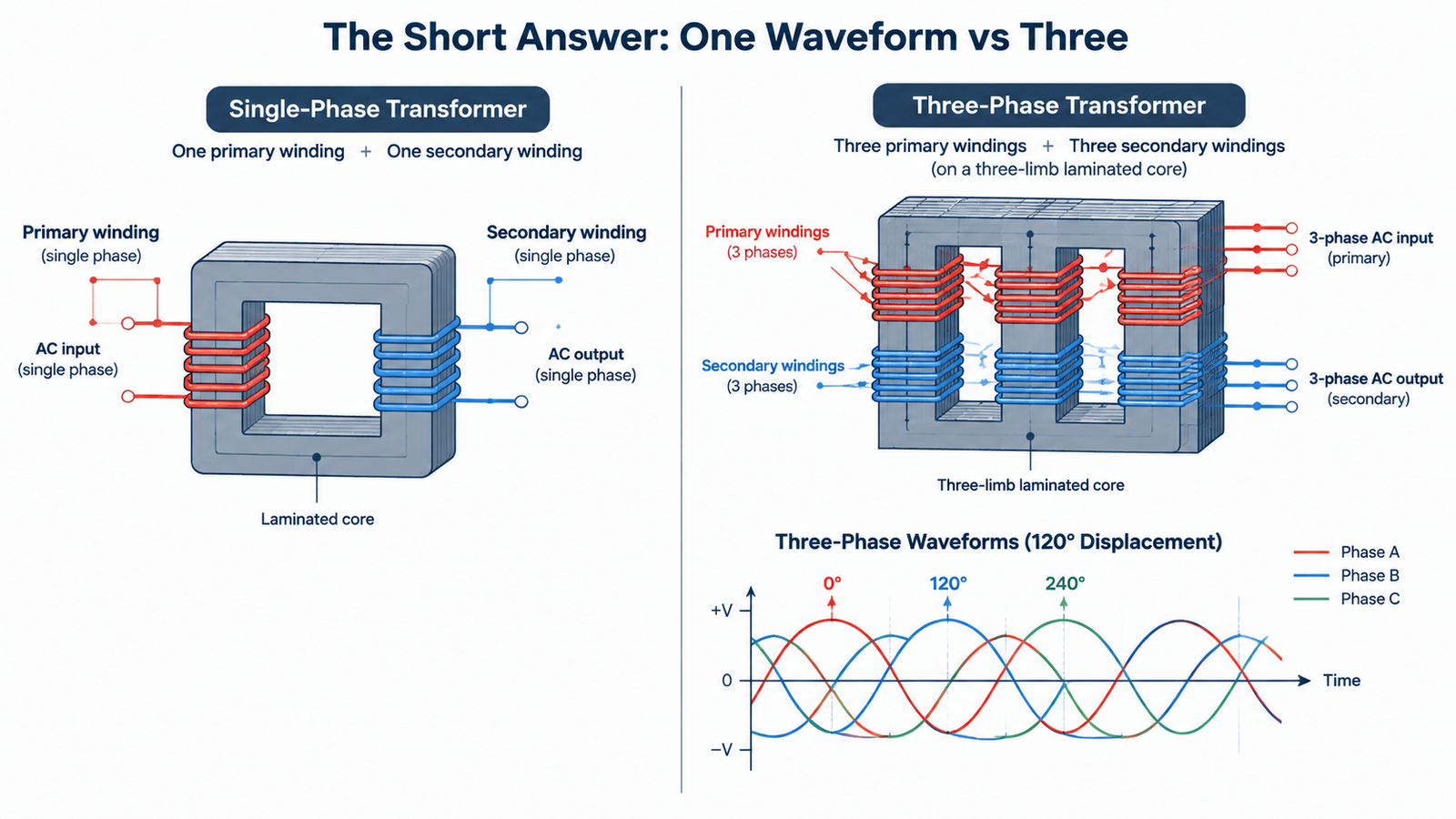
Choosing between a single-phase and a three-phase transformer comes down to one question: how many alternating voltage waveforms must the unit handle? A single-phase transformer works with one AC waveform and one primary/secondary winding pair. A three-phase transformer handles three waveforms offset by 120 electrical degrees, using three winding sets on a shared magnetic circuit.
That difference drives capacity, voltage stability, efficiency, footprint, and cost per kVA. For buyers comparing single-phase and three-phase transformers, the choice follows the load: single-phase units suit lighting, outlets, and control circuits; three-phase units are standard for motors, pumps, and large balanced loads.
The Short Answer: One Waveform vs Three
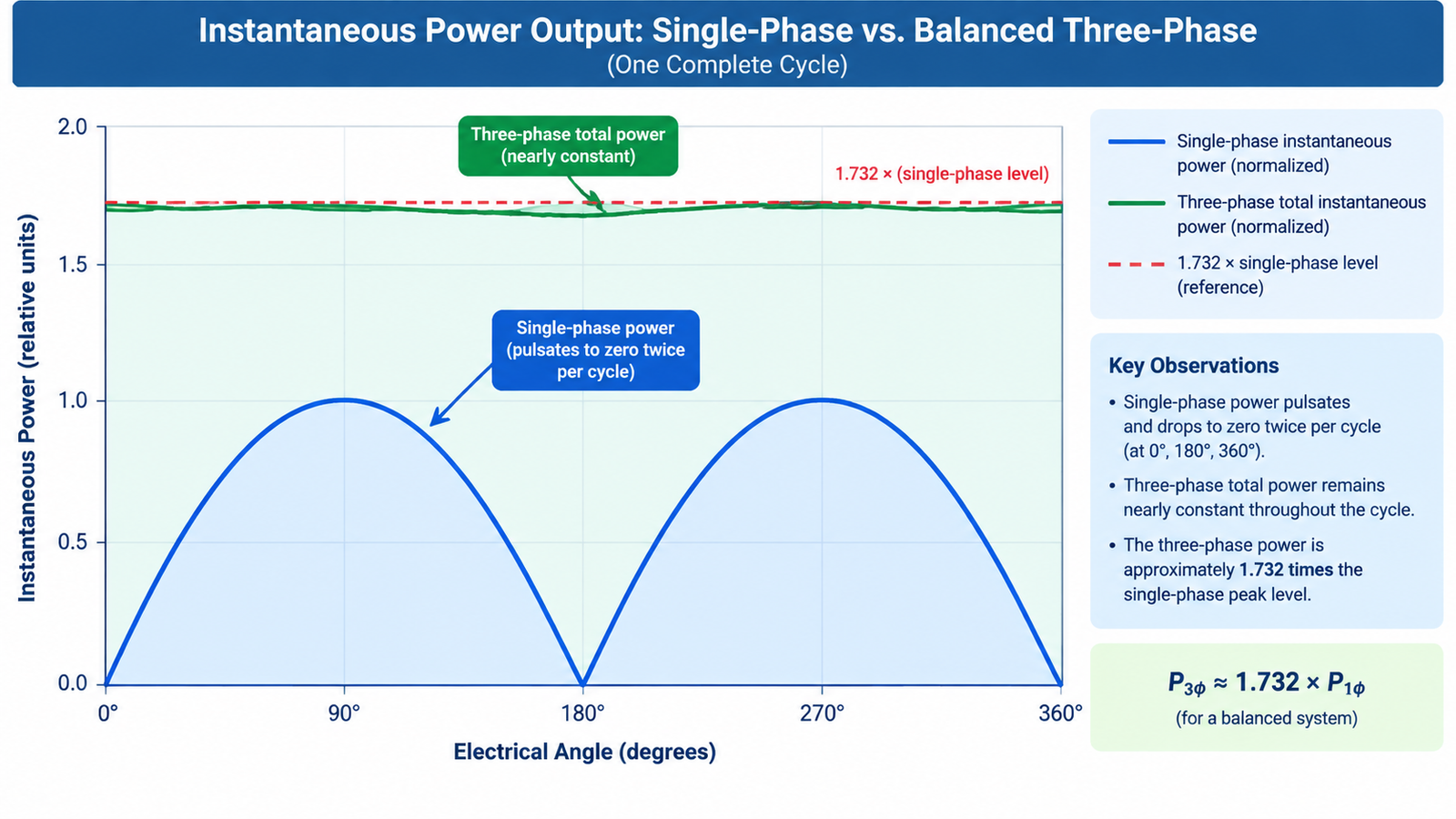
A single-phase transformer converts one AC voltage. A three-phase transformer converts three at once and delivers power far more smoothly. A single-phase supply follows one sine wave, so its instantaneous power drops to zero twice per cycle. With three waves offset by 120°, the three-phase output stays nearly constant.
Recurso
Single-Phase Transformer
Transformador trifásico
Number of phases
1
3
Enrolamentos
One primary, one secondary
Three primaries, three secondaries
Phase displacement
None (0°)
120° between phases
Núcleo
Two-limb, shell or core type
Three-limb (or five-limb) core
Typical capacity range
Roughly 0.5 kVA to 100 kVA
Roughly 100 kVA up to several MVA
Power delivery
Pulsating; drops to zero twice per cycle
Nearly constant when balanced
Winding connections
Simple two-wire
Delta, Wye, Delta-Wye, Wye-Delta
Aplicações típicas
Lighting, outlets, control circuits, small equipment
Motors, pumps, HVAC, data centers, substations
Conductor use per kVA
Mais alto
Mais baixo
How Each Transformer Is Built
Both types use the same principle: a changing magnetic flux in a laminated steel core induces a voltage in the secondary winding. They differ in winding count and core shape.
A single-phase transformer has one primary and one secondary winding on a two-limb or shell-type core. With a single magnetic circuit to manage, it is simpler, cheaper, and easier to repair. Low-power versions also come in toroidal form, wrapping a ring-shaped core to cut leakage flux and noise.
A three-phase transformer has three primary and three secondary windings sharing one magnetic circuit — usually a three-limb core, one phase per limb. The fluxes are displaced 120° in time, which produces balanced output. A bank of three separate single-phase units in Delta or Wye is an alternative where transport limits or spare-part strategy outweigh compactness.
Why Three-Phase Transformers Deliver More Capacity
The capacity gap comes from arithmetic, not marketing.
In a single-phase system, instantaneous power rises and falls with the voltage and reaches zero twice per cycle, so power flow is never steady. With three waves offset by 120°, when one phase passes through zero the other two still deliver, so the sum stays constant.
There is also a conductor advantage. For the same line voltage and current, a balanced three-phase system carries about 1.732 times the power of a single-phase system — the square root of three (√3 ≈ 1.732). That is why three-phase transformers need less copper and core steel per kVA.
Holding voltage and current constant, the three-phase advantage is:
Parâmetro
Monofásico
Trifásico
Line voltage
240 V
240 V
Line current
20 A
20 A
Power factor
1.0
1.0
Apparent power
4.8 kVA
8.3 kVA
Relative capacity
1.00×
1.73×
Same voltage, same current, 73% more capacity — from the phase relationship alone. This is also why capacity is rated in kVA: the rating reflects the voltage and current the windings can carry, independent of the connected load’s power factor. See why transformers are rated in kVA.
Voltage Stability and Motor Performance
Single-phase supplies are more sensitive to load changes. When a compressor or welder starts, the current surge causes a voltage dip — visible as dimming lights and enough to reset sensitive equipment. It worsens when several single-phase loads share one supply, because they do not start and stop in step. Three-phase systems compensate: with currents offset by 120°, fluctuations on one phase are partly absorbed by the other two.
That matters most for motors. A three-phase induction motor generates its own rotating magnetic field, so it starts unaided with no starting capacitor. A single-phase motor cannot, and needs a capacitor or auxiliary winding — extra parts that can fail and lower efficiency. This is the main reason industrial sites stay on three-phase power even when the total load would fit on single-phase.
Efficiency, Size, and Cost Compared
Efficiency is not simply “three-phase is better.” Three-phase units usually win on material use and losses at higher capacities, but at low capacity the difference is small. What matters for a specific unit is rated capacity, no-load loss, load loss, impedance, cooling method, insulation system, and the real load profile. A well-designed single-phase unit can beat a poorly specified three-phase unit.
Fator
Single-Phase Transformer
Transformador trifásico
Conductor and core material per kVA
Mais alto
Mais baixo
Total losses at high capacity
Mais alto
Mais baixo
Unit purchase cost at low capacity
Mais baixo
Mais alto
Cost per kVA at high capacity
Mais alto
Mais baixo
Footprint for the same total capacity
Maior
Menor
Wiring and installation
Simpler
More complex; needs three-phase supply and protection
Redundancy and maintenance
One phase serviceable independently in a bank
Usually requires full offline servicing
The cost comparison also depends on how you count. Three separate single-phase transformers may cost less per unit, which helps smaller operations with limited capital and phased upgrades. But total cost of ownership includes space, cable runs, switchgear, maintenance, and lifetime energy losses — and at higher capacities those usually favour one integrated three-phase unit.
Winding Connections and Phase Shift
A single-phase transformer uses a simple primary-to-secondary configuration; the only design variable is the turns ratio that sets the voltage step up or step down. Three-phase transformers need a connection scheme, and the two fundamentals are:
Delta (Δ): Three windings form a closed triangle with no neutral point. Delta handles high currents well and is common on the high-voltage side of distribution transformers.
Wye / Star (Y): One end of each winding connects to a common neutral point, providing an accessible neutral so the transformer can also supply single-phase line-to-neutral loads.
Combining them gives the nameplate vector groups: Delta-Wye, Wye-Delta, Delta-Delta, and Wye-Wye. Delta-Wye, often specified as Dyn11, is common in distribution because it provides a three-phase secondary with a neutral. The vector group also sets the phase shift between primary and secondary — a real constraint when transformers are paralleled. Our guide to three-phase transformer connections covers the wiring.
Which One Does Your Site Need?
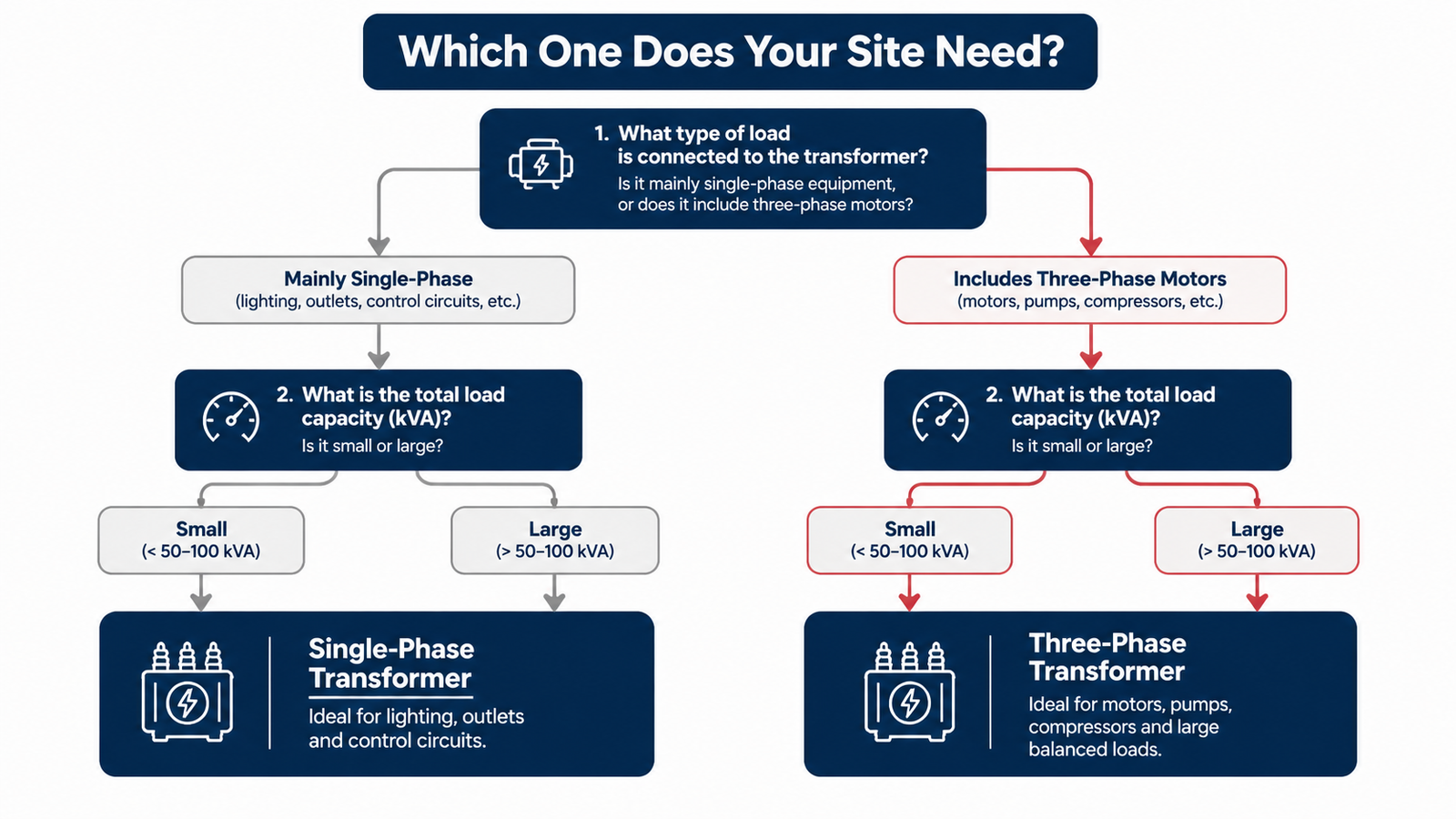
Work through the load first, then confirm against the supply you actually have.
Choose single-phase when: the supply is single-phase; equipment is mainly single-phase (lighting, outlets, small appliances, control circuits); total load is small, roughly under 50 to 100 kVA; or the site is residential, light commercial, or remote.
Choose three-phase when: you are supplying three-phase motors, pumps, compressors, or CNC equipment; the load is large or growing, as in plants, commercial buildings, and data centers; you need balanced distribution across a mixed load profile; or you need a neutral for combined loads.
Aplicativo
Recommended
Residential lighting and outlets
Single-phase
Household appliances and small office equipment
Single-phase
Control circuits and instrumentation
Single-phase
Small agricultural or remote site loads
Single-phase
Industrial motors and production machinery
Three-phase
Pumps, compressors, and large HVAC
Three-phase
Commercial buildings and data centers
Three-phase
Substations and renewable energy tie-ins
Three-phase
For low-power work in the 100 VA to a few kVA range, a single-phase conversion unit is usually enough. The DT-1000VA step-up and step-down transformer handles voltage conversion for imported equipment, test benches, and small machinery without a three-phase supply; the DT-5000VA covers the mid range for larger single-phase loads.
Most selection errors come from treating the two types as interchangeable at the same kVA rating.
Assuming kVA ratings are directly comparable. A 10 kVA single-phase unit and a 10 kVA three-phase unit are not the same load capability — a three-phase rating is usually total capacity, so the per-phase figure is roughly one third.
Connecting a single-phase transformer across two phases. This works electrically in some configurations, but the load becomes unbalanced, available capacity drops, and the transformer is not designed for those phase conditions.
Ignoring load balance. Three-phase systems tolerate unbalance better than separate single-phase circuits, but not indefinitely — persistent unbalance causes circulating currents, uneven heating, and reduced service life.
Choosing on purchase price alone. The cheaper unit at the outset is often the more expensive one once losses, cable, switchgear, and maintenance are counted.
Forgetting neutral and grounding requirements. A Delta secondary has no neutral; if you need line-to-neutral loads or a grounded system, specify a Wye secondary.
Conclusão
The difference comes down to how many AC waveforms the unit handles and how evenly it delivers power. A single-phase transformer is simpler, cheaper at low capacity, and right for lighting, outlets, control circuits, and small equipment. A three-phase transformer delivers roughly 1.732 times the power for the same line current, holds voltage steadier, uses less material per kVA, and is the only practical option once motors and large loads are involved.
Match the transformer to the load and supply you have, then confirm capacity with a proper load calculation. To select a conversion transformer, compare the full linha de transformadores elevadores e redutores or contact us with your supply voltage and load type.
PERGUNTAS FREQUENTES
Can a single-phase transformer be used on a three-phase supply?
Only in limited configurations. You can connect it across two phases or between one phase and neutral and it will work, but the load becomes unbalanced and only part of the supply capacity is usable. Continuous three-phase loads need a three-phase transformer.
Is a three-phase transformer more efficient than a single-phase transformer?
At higher capacities, generally yes — it uses less core steel and copper per kVA and produces lower losses than three separate single-phase units of equal capacity. At low capacity the difference is small, so compare losses and the real load profile rather than phase configuration alone.
Can three single-phase transformers replace one three-phase transformer?
Yes. Three units connected in Delta or Wye can deliver three-phase power, sometimes preferred for transport limits, spare-part stocking, or phased replacement. The trade-offs are a larger footprint, more connection work, and higher aggregate losses.
How do I know whether my site has single-phase or three-phase power?
Check the service panel and meter. A single-phase service typically has two main conductors plus a neutral; a three-phase service has three plus a neutral. Nameplate voltages are another clue — 208/120 V, 400/230 V, or 480/277 V is three-phase, while 120/240 V is common residential single-phase.
Which is cheaper, a single-phase or a three-phase transformer?
For small loads, single-phase has a lower purchase and installation cost. For larger loads, a three-phase unit is usually cheaper per kVA even though the unit price is higher, because it uses less material and needs less cable. Compare total cost of ownership, not unit price.
Recommended Models for Single-Phase vs Three-Phase Selection
If you are specifying a unit rather than reading theory, start here. These models cover the capacity bands most often requested for single-phase vs three-phase selection, and each links straight to its specification and price range.
Tell us the input voltage, output voltage, phase and continuous kVA you need, and we will confirm the matching model, price and lead time within one business day. Non-standard ratings are handled through OEM/ODM custom transformer manufacturing.
Transformador de 230 V para 110 V para a Espanha: em conformidade com a norma REBT, ITC-BT-18 e ITC-BT-24, aterramento do lado secundário e documentação conforme a norma UNE-EN IEC 61558.
Transformador de 230 V para 110 V para a Holanda: norma NEN 1010, regras de 30 mA para disjuntores de fuga à terra, disjuntor de fuga à terra versus disjuntor automático de fuga à terra e aterramento secundário.