Princípio de conversão do transformador de subida e descida
Publicado: Autor: Johsuntech
In modern power systems, transformers play an extremely important role. Whether it’s efficiently transmitting electricity generated at power plants over long distances or converting high voltage into safe, usable low voltage for homes and industries, transformers are indispensable devices. Especially the Transformador de subida e descida, which can flexibly adjust voltage to ensure safe and stable power transmission and usage, has become a core component of the electrical industry.
If you are a power equipment buyer or looking for high-quality transformer suppliers, understanding how these transformers work and their application scenarios will help you make smarter decisions. This article will explain the structure, working mechanism, and role of Step-up and Step-down Transformers in energy transmission in a clear and accessible way. We will also provide practical symbol illustrations for your reference, helping you fully grasp this key technology.
Basic Principle of Transformers
A transformer mainly consists of a core and two sets of windings (primary coil and secondary coil). Its operation is based on the principle of electromagnetic induction: when alternating current (AC) flows through the primary coil, it creates a changing magnetic field in the core, which induces voltage in the secondary coil.
Alternating current (AC) is essential for transformer operation because only a changing magnetic field can induce voltage in the secondary coil.
The voltage change depends on the turns ratio between the primary and secondary coils.
By adjusting the turns ratio, transformers can step voltage up or down.
Below is a typical transformer symbol diagram to help you understand its structure and working relationship:
Transformador elevador
What is a Step-up Transformer?
A step-up transformer’s main function is to increase a lower voltage to a higher voltage. Its secondary coil has more turns than the primary coil, using electromagnetic induction to raise the voltage.
How It Works
AC flows into the primary coil, generating a changing magnetic field.
The changing magnetic field passes through the core to the secondary coil.
Because the secondary coil has more turns, the induced voltage is higher than the primary voltage.
As voltage increases, current decreases accordingly to keep power roughly constant.
Cenários de aplicativos
Long-distance power transmission to reduce line losses.
Power plants stepping up voltage from generators for transmission.
Specialized equipment like microwave ovens and X-ray machines.
Key Parameters
Parâmetro
Descrição
Turns ratio (N2/N1)
Secondary coil has more turns than primary coil
Voltage relation (V2 > V1)
Secondary voltage is higher than primary voltage
Current relation (I2 < I1)
Secondary current is lower than primary current
Transformador abaixador
What is a Step-down Transformer?
A step-down transformer reduces high voltage to low voltage, suitable for safe use in homes and industries. Its secondary coil has fewer turns than the primary coil.
How It Works
High voltage AC flows into the primary coil, creating a changing magnetic field.
The magnetic field transfers to the secondary coil.
The secondary coil, having fewer turns, induces a lower voltage than the primary.
Voltage decreases while current increases to meet the power needs of devices.
Cenários de aplicativos
Power supply for household appliances like TVs and refrigerators.
Voltage regulation for industrial equipment.
Low-voltage lighting and electronic devices.
Key Parameters
Parâmetro
Descrição
Turns ratio (N2/N1)
Secondary coil has fewer turns than primary coil
Voltage relation (V2 < V1)
Secondary voltage is lower than primary voltage
Current relation (I2 > I1)
Secondary current is higher than primary current
Energy Transmission Principle of Step-up and Down Transformer
The core value of transformers lies in efficient energy transmission. Although voltage and current change at both ends, power (voltage × current) remains approximately the same (ignoring losses).
Inverse relationship between voltage and current: When stepping up voltage, current decreases; when stepping down voltage, current increases.
Power conservation: Input power ≈ output power, ensuring high energy transmission efficiency.
Transformers have no moving parts, operate quietly, and have long service lives.
Transformer efficiency typically exceeds 95%, making them one of the most energy-efficient devices in power systems.
Step-up and Down Transformer Symbol and Diagram References
Understanding Step-up and Down Transformer circuit symbols helps in designing and reading electrical schematics. Common transformer symbols include:
Single-phase transformer symbol: Simplified drawing of two coils and a core.
Three-phase transformer symbols: Three sets of coils, commonly connected in star (Y) or delta (Δ) configurations.
Step-up and Step-down identification: Distinguished by turns ratio.
Recommended resources:
Electrical Technology transformer symbol library
All About Circuits transformer section
Symbol libraries in professional electrical design software
Industrial and Commercial Applications of Transformers
Step-up and Down Transformer are widely used across industries, especially in:
Power transmission and distribution: Stepping up voltage at power plants and stepping down at user ends to maintain grid stability.
Fabricação: Providing different voltage levels for diverse equipment needs.
Buildings and infrastructure: Safe voltage conversion for building electrical systems.
Renewable energy: Voltage regulation in wind and solar power systems.
As a professional transformer supplier, Johsun Tec offers a wide range of Step-up and Down Transformer featuring:
High efficiency and low loss
Premium materials and advanced manufacturing processes
Strict safety certifications
Customized solutions tailored to your needs
Feel free to contact us for expert advice and quotes to support your projects.
After reading this article, you should have a clear understanding of the voltage conversion and energy transmission principles of Transformador de subida e descida. Transformadores are not only the “bridge” of power systems but also the key to ensuring efficient and safe energy transmission.
Whether you need to increase voltage to reduce transmission loss or decrease voltage to ensure equipment safety, choosing the right step-up or step-down transformer is crucial. Johsun Tec is committed to providing high-performance, reliable transformers. Contact us anytime for professional support and customized solutions.
Let’s work together to promote efficient development in the power industry!
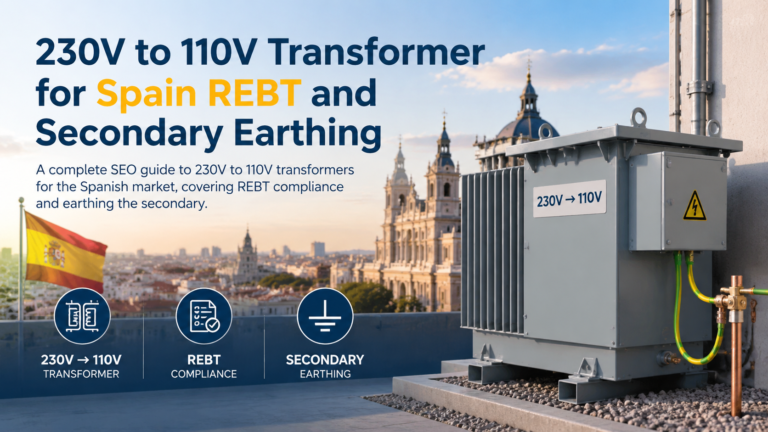
Transformador de 230 V para 110 V para a Espanha: em conformidade com a norma REBT, ITC-BT-18 e ITC-BT-24, aterramento do lado secundário e documentação conforme a norma UNE-EN IEC 61558.
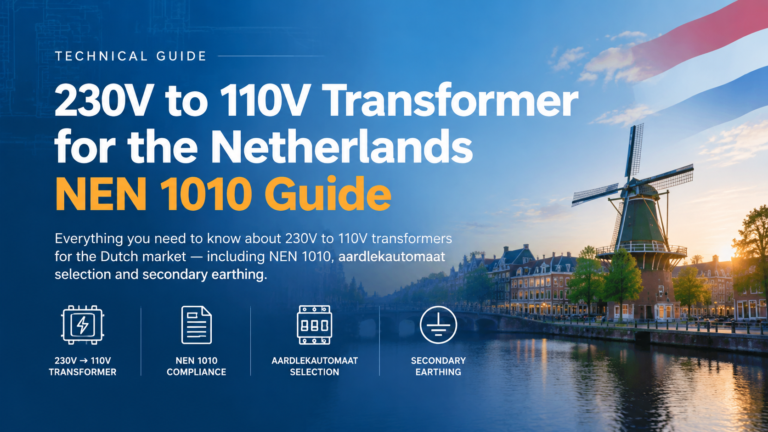
Transformador de 230 V para 110 V para a Holanda: norma NEN 1010, regras de 30 mA para disjuntores de fuga à terra, disjuntor de fuga à terra versus disjuntor automático de fuga à terra e aterramento secundário.