Copper vs Aluminum Transformer Windings: Cost, Weight and Performance
Опубликовано: Автор: Лиза
The debate over copper vs aluminum transformer windings is one of the oldest in electrical purchasing, and it is usually settled with a rule of thumb rather than numbers. Copper is “better”, aluminium is “cheaper”, and the discussion stops there. That shortcut is why so many buyers end up with a unit that is either over-specified for the job or quietly wrong for the installation.
Winding material drives four things that show up on a purchase order and later in service: material cost, transformer weight, physical size, and long-term joint reliability. This guide puts numbers against each one so you can decide on the application rather than the habit. It applies to dry-type and oil-filled distribution units as well as to the повышающие и понижающие трансформаторы used to run imported machinery on a local supply.
What the winding material actually changes
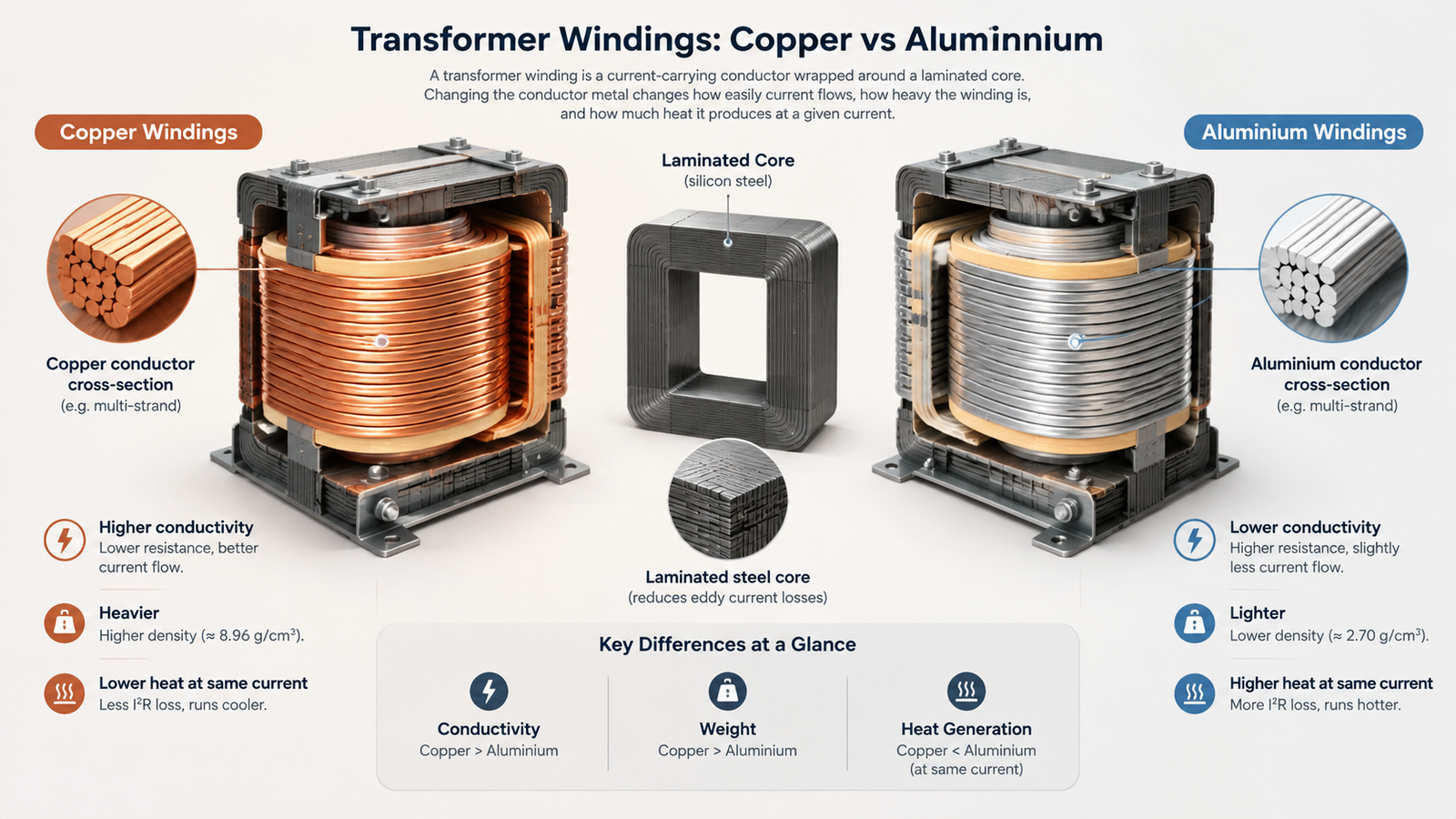
A transformer winding is a current-carrying conductor wrapped around a laminated core. Change the conductor metal and you change three physical properties at once: how easily current flows, how heavy the winding is, and how much heat it produces at a given current.
Everything downstream — core size, tank or enclosure volume, cooling class, shipping cost, and termination method — follows from those three. That is why material choice is a design decision, not a line-item saving applied at the end.
The physical numbers that matter
Property
Copper (Cu)
Aluminium (Al)
Practical consequence
Electrical conductivity
~100% IACS
~61% IACS
Aluminium needs a larger cross-section for the same current
Resistivity
~1.7 × 10⁻⁸ Ω·m
~2.8 × 10⁻⁸ Ω·m
Higher resistive loss per metre in aluminium
Density
~8.96 g/cm³
~2.70 g/cm³
Aluminium winding is about a third the weight
Conductivity per unit weight
Baseline
About twice copper
Weight-critical designs favour aluminium
Thermal expansion
Нижний
Выше
Aluminium joints need more careful design
Raw material price
Higher and volatile
Lower and steadier
Aluminium reduces exposure to copper price swings
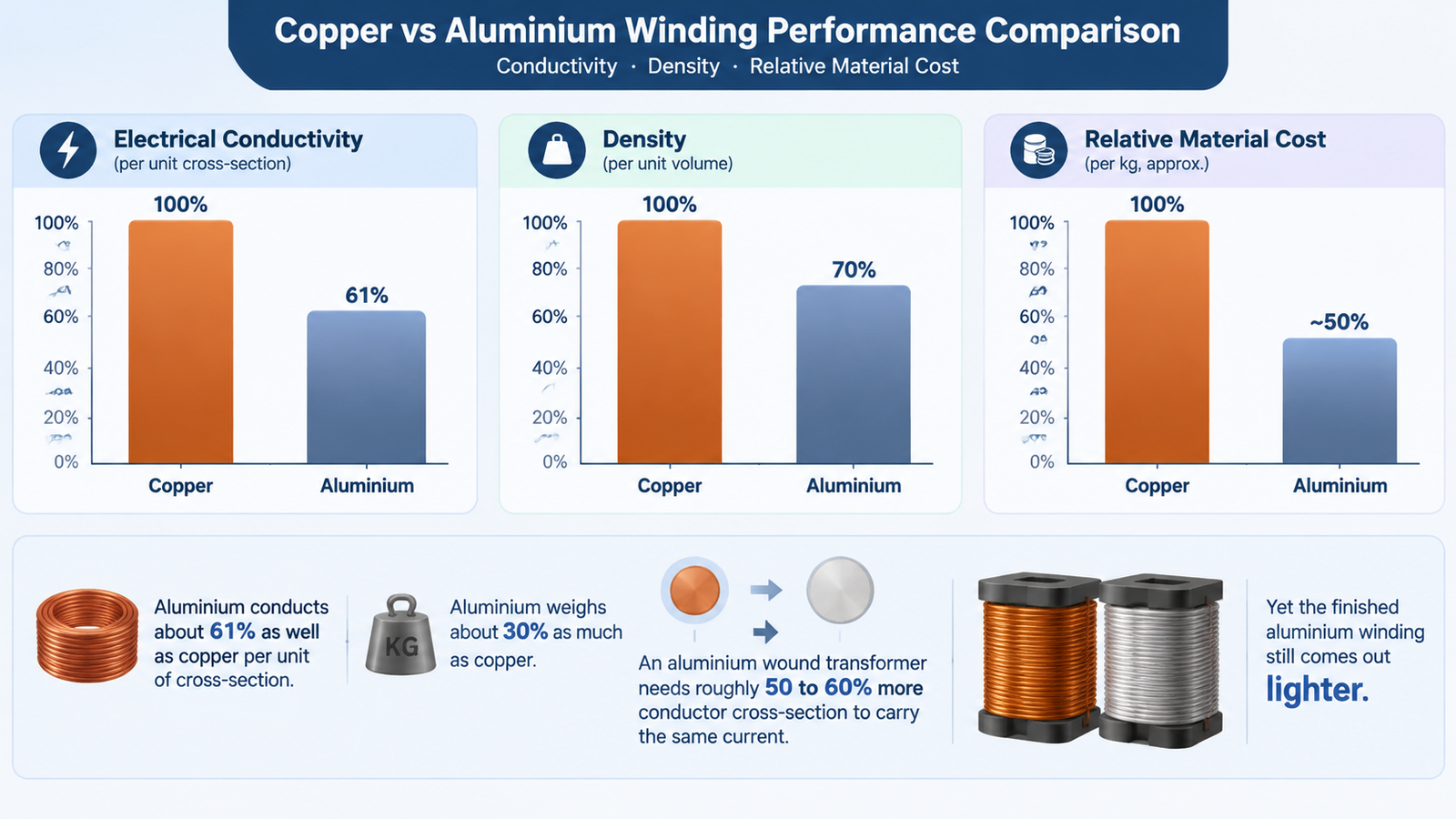
The single most useful takeaway from that table: aluminium conducts about 61% as well as copper per unit of cross-section, but weighs about 30% as much. In practice an aluminium-wound transformer needs roughly 50–60% more conductor cross-section to carry the same current, yet the finished winding still comes out lighter.
Cost: why aluminium usually wins on price
Aluminium is cheaper per kilogram than copper by a wide margin, and it is far less volatile on the commodities market. For a manufacturer quoting a batch of units, that translates into a lower and more predictable material cost, part of which is passed on to the buyer.
But the purchase price saving is not the whole cost picture. Two other factors move in the opposite direction:
More conductor volume. The larger cross-section means more material is needed, which eats part of the per-kilogram advantage.
Larger core and enclosure. Bigger windings require a larger window in the core and a bigger housing, so iron, steel, insulation and cooling all scale up slightly.
The net result in most distribution sizes is a genuine but moderate price advantage for aluminium — typically meaningful on a 10 kVA class unit, smaller on very small control transformers where conductor cost is a minor share of the total.
Weight: where it genuinely matters
This is the clearest win for aluminium. A transformer weight reduction of 20–40% is common for the same rating, and that has knock-on effects buyers often forget to price in:
Freight cost, especially for air freight or consolidated container shipments.
Handling on site — whether a two-person lift becomes a one-person lift, or whether a crane is still needed.
Structural requirements for wall-mounted, pole-mounted or ceiling-mounted installations.
Portable and mobile equipment where every kilogram matters to the operator.
For a fixed indoor installation with a prepared foundation, weight rarely decides the purchase. For portable units, export shipments, or installations on lightweight structures, it often does.
Performance: losses, heat and size
Load loss — the copper loss in the windings — is a function of winding resistance. Because aluminium has higher resistivity, an aluminium-wound transformer designed to the same loss class will be physically larger. Designed to the same physical size, it will run hotter.
Most manufacturers resolve this by keeping the losses within the same standard class and accepting a slightly larger footprint. That is the honest comparison to make: at equal efficiency class, aluminium units are bigger but perform the same; at equal size, they are less efficient and run warmer.
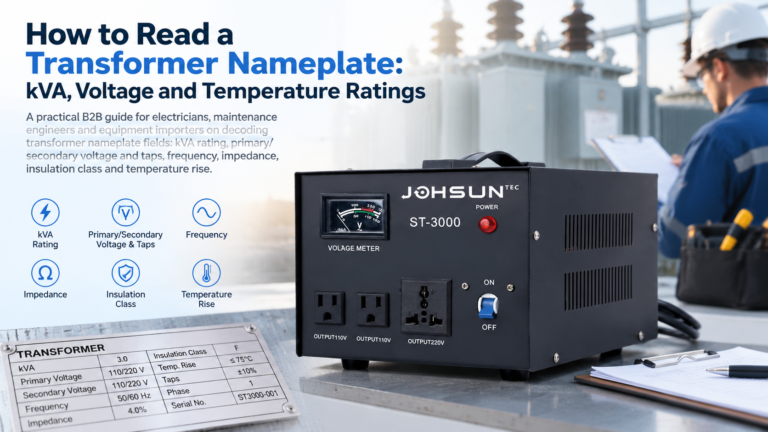
Operating temperature feeds straight into insulation life, which is why winding material and thermal class belong in the same conversation. If you are comparing units across materials, check the insulation class and temperature rise on the plate rather than assuming — the method is set out in how to read a transformer nameplate. Persistent overheating, whichever metal is used, is covered in causes and hazards of transformer overheating.
Terminations: the risk buyers underestimate
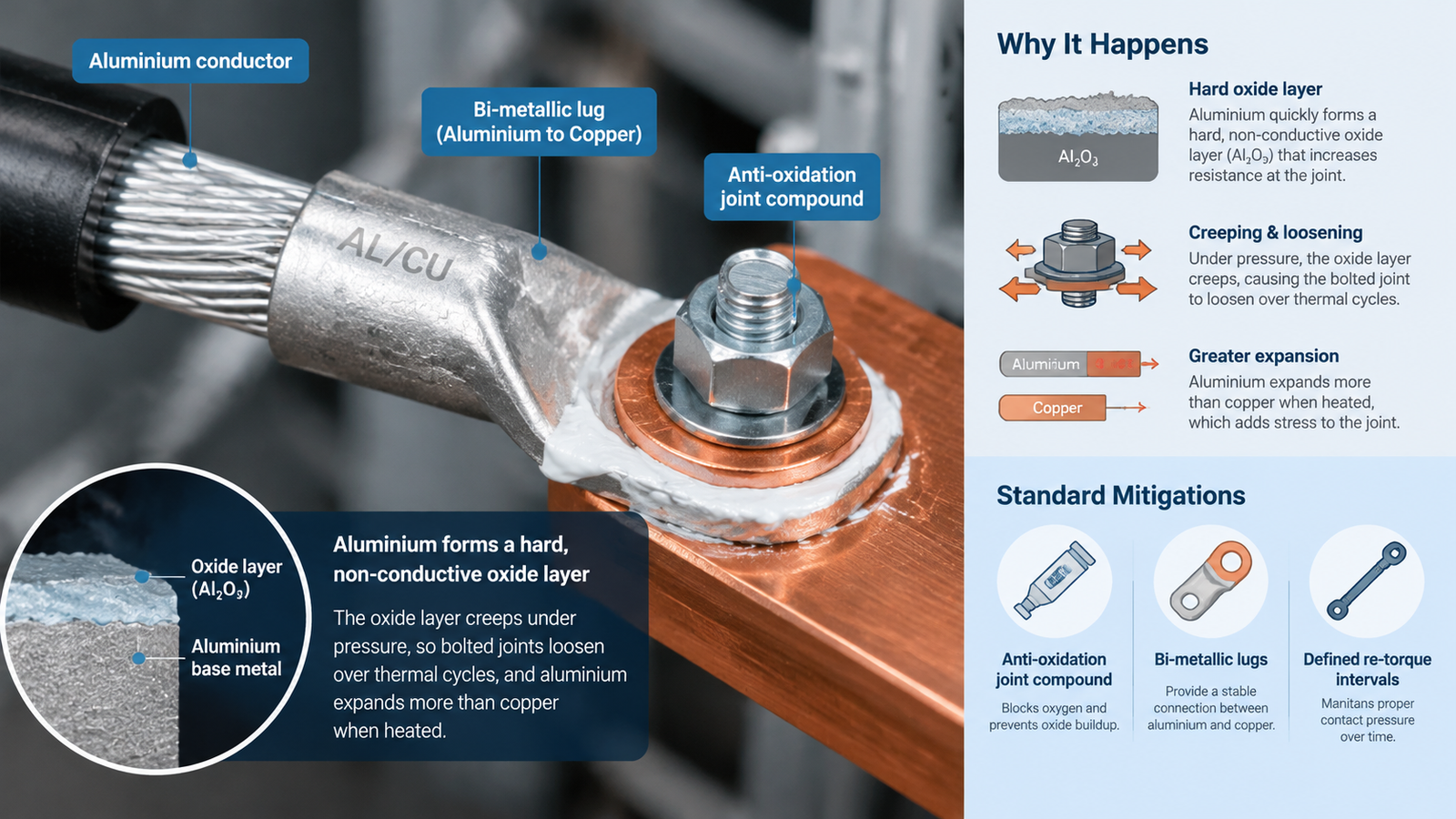
Almost every aluminium winding failure that reaches a service engineer starts at a joint, not in the winding itself. Aluminium behaves differently from copper at a connection in three ways:
It forms a hard, non-conductive oxide layer within minutes of exposure to air.
It creeps under pressure, so bolted joints loosen over thermal cycles unless designed for it.
It expands more than copper when heated, which accelerates that loosening.
Joining aluminium directly to copper without protection creates a galvanic couple that corrodes the joint. The standard mitigations are well established: anti-oxidation joint compound, bi-metallic lugs or transition washers, correctly rated compression terminations, and a defined re-torque interval during maintenance.
When copper is the right call
Confined installations where the enclosure footprint is fixed and the unit must fit an existing space.
High duty cycles with sustained full load, where lower resistive loss pays back over the service life.
Critical loads where an unplanned outage costs far more than the material premium.
Sites without a torque-maintenance regime — copper joints are more forgiving of neglect.
Specifications that name copper , which is common in marine, mining and some utility standards.
When aluminium is the right call
Weight-limited installations such as wall mounting, mobile equipment or long export shipments.
Budget-sensitive projects where the efficiency class is fixed and the footprint has margin.
Large-volume procurement where copper price volatility makes budgeting difficult.
Intermittent duty where the load loss difference never accumulates into meaningful energy cost.
What to put in the specification
Whichever material you choose, make the comparison explicit instead of implied. Ask suppliers for:
Winding material stated separately for HV and LV — mixed designs exist and are rarely volunteered.
Load loss and no-load loss at a stated reference temperature, so the figures are comparable.
Insulation class and temperature rise, not just the kVA rating.
Overall dimensions and transformer weight, since these differ between materials at equal rating.
Termination method and torque specification, plus whether bi-metallic transition hardware is included.
That list turns a price-only comparison into a like-for-like one. It also protects you when two quotations look similar but describe very different transformers — a point we return to in low-voltage transformer core specs and selection checklist.
Key takeaways
Aluminium conducts about 61% as well as copper per cross-section but weighs roughly a third as much.
At equal efficiency class aluminium units are larger; at equal size they run hotter and lose more.
The real cost gap is narrower than the raw metal price gap once extra conductor and a larger enclosure are counted.
Most aluminium field failures originate at terminations, not in the winding — specify the jointing method.
Decide by application: footprint, duty cycle, weight limit and maintenance capability, not by habit.
If you are sizing a high-capacity unit where weight and price both matter, our DT-10000VA step-up and step-down transformer is a useful reference point — send us your load profile and installation constraints and we will quote both winding options side by side.
Frequently asked questions
Are aluminium transformer windings as reliable as copper?
Yes, when the transformer is designed for aluminium and the terminations are built and maintained correctly. Most aluminium-related failures trace back to poorly made joints, not to the winding conductor itself.
Why do aluminium transformers weigh less?
Aluminium has roughly a third the density of copper. Even though the aluminium conductor needs a larger cross-section to carry the same current, the finished winding and the core built around it are still lighter overall.
Do aluminium windings run hotter?
Not if the transformer is designed to the same loss and temperature-rise class — the manufacturer compensates with more conductor cross-section. Problems appear when an aluminium unit is built to a copper-sized frame without that compensation.
Can I connect aluminium windings directly to copper cable?
Not without protection. Use bi-metallic lugs or transition washers plus anti-oxidation compound, and follow the manufacturer’s torque values with a defined re-torque interval.
Learn how to read a transformer nameplate: decode the kVA rating, voltage and taps, frequency, impedance, insulation class and temperature rise before you install or replace a unit.
Мы используем файлы cookie для улучшения вашего пользовательского опыта, предоставления персонализированного контента и анализа посещаемости нашего сайта.