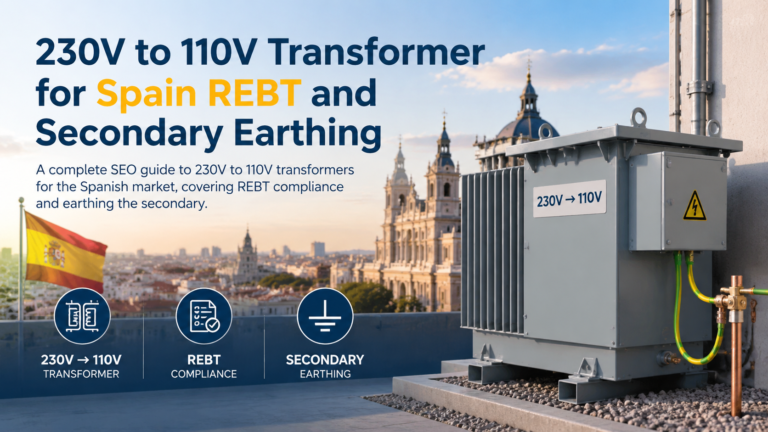







230V to 110V Transformer for Spain: REBT and Secondary Earthing
230V to 110V transformer for Spain: REBT compliance, ITC-BT-18 and ITC-BT-24, earthing the secondary and UNE-EN IEC 61558 documentation.
Read More
 English
Transformers are essential electrical devices used to change voltage levels in power systems. At their core, transformers work on the principle of electromagnetic induction, allowing them to either step up or step down voltage efficiently without changing the frequency.
When alternating current flows through the primary winding, it creates a changing magnetic field in the core. This changing field induces a voltage in the secondary winding. The amount of voltage change depends on the turns ratio — the ratio of the number of windings on the primary coil to those on the secondary coil.
Transformers obey the law of power conservation (ignoring minor losses), meaning the output power is nearly equal to the input power. As a result:
This relationship ensures efficient voltage conversion without wasting energy.
Transformers are highly efficient devices, often ranging between 95% to 99%. However, some minor losses still occur due to:
Understanding these basics and the working principles of step-up and step-down transformers is crucial for selecting the right transformer for any power transformer application.

A step-up transformer is an electrical device designed to increase voltage from the primary winding to the secondary winding. This is achieved by having more turns of wire on the secondary coil than on the primary coil, which raises the output voltage higher than the input voltage. Thanks to the transformer turns ratio, when voltage goes up, the current decreases proportionally to maintain power balance.
Key characteristics of step-up transformers include:
In real-world applications, step-up transformers play a vital role in power generation and transmission. Power plants use them to boost low-voltage electricity to high voltages suitable for long-distance transmission, reducing power loss along the grid. This makes step-up transformers crucial for efficient, large-scale energy distribution systems.
For those interested in reliable transformer options for power solutions, models like the STU Series transformers offer a range of voltages and wattages suitable for many step-up transformer needs.
Step-down transformers are designed to decrease voltage from a higher level to a lower level. They achieve this by having fewer turns in the secondary winding compared to the primary winding. This reduction in turns lowers the output voltage while increasing the output current, making them ideal for safely powering devices that require less voltage.
The main features of step-down transformers include a lower output voltage paired with a higher current capacity. This allows them to efficiently supply power to everyday electronics and household appliances like phone chargers, televisions, and kitchen gadgets, which typically operate at standard household voltage levels.
If you want to learn more about transformer basics and components, you might find this guide on what is a transformer useful for deeper insights.
Step-down transformers are essential in ensuring that sensitive electronic equipment receives the correct voltage, improving safety and performance across countless applications worldwide.
Understanding how step-up and step-down transformers differ is essential when choosing the right transformer for your needs. Here’s a clear comparison of their main features:
| Feature | Step-Up Transformer | Step-Down Transformer |
|---|---|---|
| Turns Ratio | Secondary coil has more turns than primary | Secondary coil has fewer turns than primary |
| Voltage Change | Increases voltage | Decreases voltage |
| Current Change | Output current is lower | Output current is higher |
| Winding Thickness | Primary winding thicker (handles higher current) | Secondary winding thicker |
| Typical Uses | Power generation, high-voltage transmission | Household appliances, electronics |
For a deeper dive into transformer winding and components, check out this detailed explanation of small household transformers, which helps clarify how these elements affect performance.
Knowing these differences helps avoid common mistakes and ensures you get the right voltage converter transformer for your application.
Step-up and step-down transformers play crucial roles across many areas of power use and distribution. In power transmission and distribution grids, step-up transformers increase voltage for efficient long-distance electricity transfer, while step-down transformers lower voltages for safe delivery to homes and businesses.
At home, household and small appliances like phone chargers, power tools, and kitchen devices rely on step-down transformers to safely convert high voltage to the levels these gadgets need. For example, a household voltage converter makes sure your devices run smoothly without damage.
Industrially, transformers are vital in machinery and welding equipment, where precise voltage control ensures proper operation and safety. Step-up transformers may be used to feed high-voltage equipment, while step-down units provide suitable voltage for control circuits.
Travelers often use international power adapter transformers to convert between 110V and 220V power systems, protecting devices when crossing regions with different standards. These transformers make on-the-go voltage conversion easy, avoiding damage and inconvenience.
In renewable energy systems like solar and wind, custom transformers adapt generated power to grid or battery storage levels, optimizing energy use. Step-up transformers can boost inverter output, while step-down ones help charge batteries safely.
If you’re interested in reliable power transformers designed for various applications—ranging from custom transformers to small household units—explore options like the STU Series transformers for dependable performance in power conversion and distribution.
Picking the right transformer is key for smooth, safe power delivery. Here’s what to focus on:
| Step | What to Do |
|---|---|
| 1 | Calculate total load wattage of connected devices |
| 2 | Add a surge allowance (usually 2-3 times load) for motors and starting currents |
| 3 | Pick a transformer wattage rating equal or above this total |
For detailed specs and selection advice, check the low voltage transformers core specs and selection checklist.
Choosing wisely ensures your step-up & step-down transformers deliver power reliably without wasting energy or risking safety.
Choosing the right transformer can seem tricky, but focusing on a few key points makes it easier. First, wattage selection is crucial. Always calculate your total power needs and avoid under-sizing. A common pitfall is ignoring surge currents; for motors or heavy equipment, select a transformer rated 2-3 times your average load to handle startup spikes safely.
Next, pay close attention to material quality. Copper windings generally offer better conductivity and durability compared to aluminum. This means higher efficiency and longer life—important factors when buying household transformers or small transformers for electronics.
Certifications are another must-check. Look for transformers with safety and quality certifications ensuring durability and compliance with international standards. This reduces risks and guarantees reliable performance.
When it comes to where to buy, trust reputable suppliers who offer transparent transformer prices and solid after-sales service. Johsun Tec stands out as a leading provider of custom transformers, household models, and industrial small transformers. Their products deliver consistent quality and come with detailed support, making them a great choice for global customers looking for reliability and competitive pricing.
For those interested in more detailed options like autotransformers or specialty designs, Johsun Tec’s range includes certified models to fit diverse industrial and household applications, ensuring you get exactly what you need (learn more about Johsun Tec autotransformers).
When it comes to step-up and step-down transformers, Johsun Tec stands out as a reliable supplier offering a wide range of products. Whether you need custom transformers, household models, or small transformers for industrial use, Johsun Tec has you covered.
| Transformer Type | Application | Features |
|---|---|---|
| Step-Up Transformers | Power transmission, renewable energy | High voltage output, durability |
| Step-Down Transformers | Household appliances, electronics | Safe voltage reduction, compact |
| Custom Transformers | Specialized industrial equipment | Tailored design, reliable performance |
Partnering with experienced transformer suppliers like Johsun Tec means you get not only a product but also peace of mind, efficient service, and support tailored to your exact requirements. Check out their detailed range of step-up and step-down transformers to find the perfect fit for your project.
Proper maintenance and safety practices are key to keeping your step-up & down transformers working smoothly and lasting longer. Here’s what to keep in mind:
Following these simple steps helps ensure the efficiency and safety of your transformers, whether for household use or industrial applications. For reliable and durable transformers, consider options like the AK Series 500VA to 3000VA transformers built with high-quality components for long-lasting performance.
Step-up transformers increase voltage by having more turns on the secondary winding, resulting in higher output voltage and lower current. Step-down transformers do the opposite, reducing voltage with fewer secondary turns, giving lower voltage but higher current. This fundamental difference defines their use across various applications.
Yes, technically a transformer can be reversed to step voltage up or down, but it’s not always efficient or recommended. Using transformers in reverse can lead to improper voltage levels or overload. It’s best to use a transformer designed specifically for your voltage requirements.
Calculate the total power load of your devices in watts, then add a margin (usually 2-3 times the load) if you’re powering motors or surge-heavy equipment. This ensures the transformer handles peak demands without overheating or failure.
Absolutely. Johsun Tec offers a range of custom voltage transformers built for international standards, including common conversions like 110V to 220V transformers. Their products are designed with quality and durability, making them reliable for travel and global use.
Other common questions:
For detailed insights, check out our guide on the step-up and down transformer conversion principle and understand the structural differences between step-up and down transformers to help you choose the right transformer for your needs.