What Causes a Transformer to Blow and How Long It Takes to Fix It
Yayın tarihi: Yazar: Lisa
A transformer blowout is one of those events that stops a site cold: a bang, a breaker trip, often smoke or oil on the floor, and no power on the secondary side. The immediate question is never academic — it is “what happened, and when are we running again?”
This article answers both. It sets out the failure mechanisms that actually cause transformers to fail catastrophically, ranked by how often they appear in the field, and then gives realistic downtime ranges for each so you can plan a repair or a replacement instead of waiting on one. The focus is on distribution and yükseltici ve düşürücü transformatörler in industrial and commercial installations.
What “blown” actually means
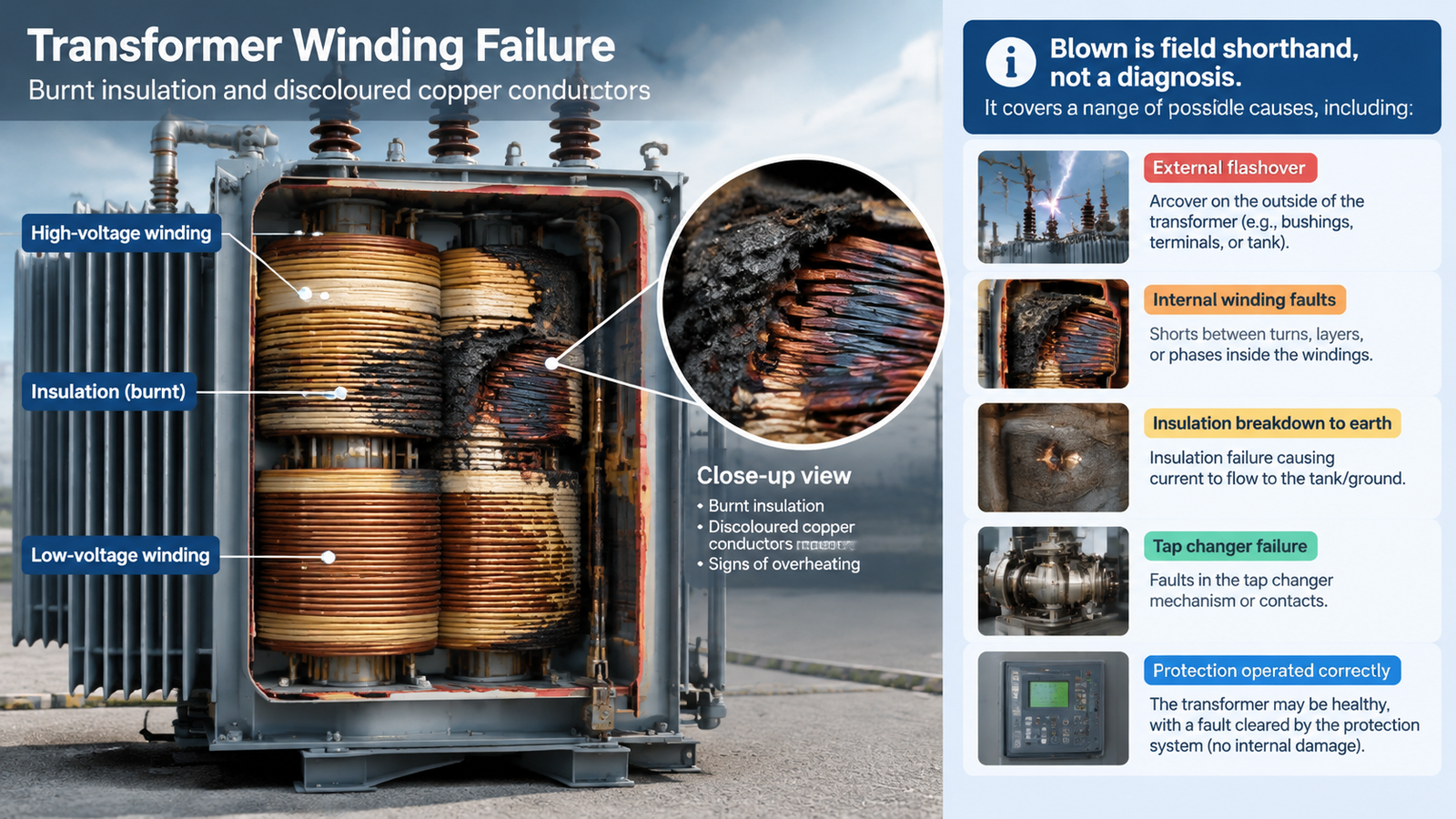
“Blown” is field shorthand, not a diagnosis. It covers several distinct failure modes with very different repair paths, and the mode determines the downtime far more than the size of the unit.
Failure mode
Typical symptom
Usually repairable?
External flashover at bushings or terminations
Loud bang, visible arc marks, breaker trips, unit may still measure open-circuit
Often yes — cleaning and re-termination
Internal winding fault (turn-to-turn or phase-to-phase)
Burnt smell, discoloured oil or smoke, ratio test fails
That last row matters more than it sounds. A meaningful share of “blown transformer” callouts turn out to be a downstream fault that the transformer’s protection cleared correctly. Confirm the diagnosis before you condemn the unit.
The quickest way to separate the two is to look at which protection operated. An earth-fault or overcurrent device on the secondary side usually indicates a downstream problem, while a differential or Buchholz operation points inside the transformer. Where only a simple fuse or breaker is fitted, the insulation resistance test and a ratio check are what settle the question.
The six causes that account for most failures
1. Overvoltage and switching surges
Sustained overvoltage pushes the core towards saturation, which drives magnetising current up sharply and heats the iron fast. Switching surges — from capacitor banks, large motor starts, or breaker operations upstream — produce steep-fronted transients that stress turn insulation. Neither needs lightning to happen.
2. Lightning and transient overvoltage
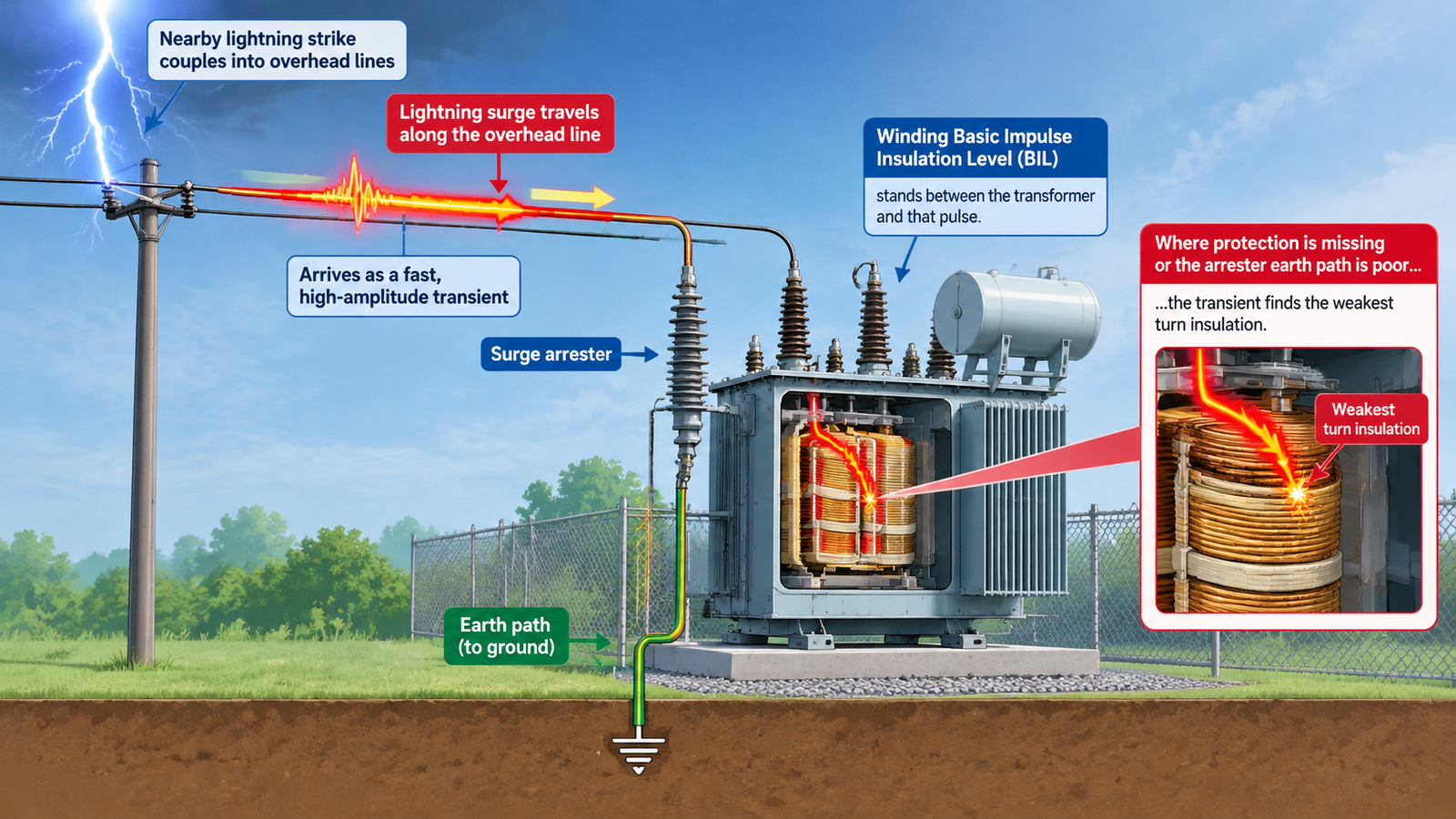
A nearby strike couples into overhead lines and arrives as a fast, high-amplitude transient. The winding’s Basic Impulse Insulation Level (BIL) is what stands between your transformer and that pulse; where protection is missing or the arrester earth path is poor, the transient finds the weakest turn insulation instead. This is the single most common cause of unexplained failures on rural and exposed sites.
3. Overload and thermal runaway
Sustained loading above the nameplate rating raises winding temperature, and insulation ageing accelerates sharply once the class limit is exceeded. The failure is rarely instant — it is the last few degrees after months of running warm. The thermal mechanism is set out in causes and hazards of transformer overheating, and the calculation method in transformatör aşırı yükü nasıl hesaplanır.
4. Short circuits and through-faults
A fault on the secondary side subjects the windings to currents many times rated for the few cycles it takes protection to operate. The mechanical forces are enormous, and repeated through-faults progressively deform windings until insulation is breached. Percent impedance is the parameter that limits this current — it is worth knowing yours, and how to read a transformer nameplate shows where to find it.
5. Insulation ageing, moisture and contamination
Insulation degrades with heat and time, and moisture accelerates it dramatically. Condensation in idle units, blocked ventilation, conductive dust, and degraded oil or resin all lower the margin until a routine switching surge becomes a failure. On oil-filled units, low oil level from a leak removes cooling and insulation at the same time — see transformer leakage: what to do.
6. Wrong connections, wrong tap, wrong frequency
Mis-set primary links, an incorrect tap position, or a 60 Hz machine fed from a 50 Hz supply (and vice versa) will destroy a transformer that was otherwise correctly sized. These are commissioning errors, and they usually fail within hours or days of energising rather than after years of service.
How long the fix takes
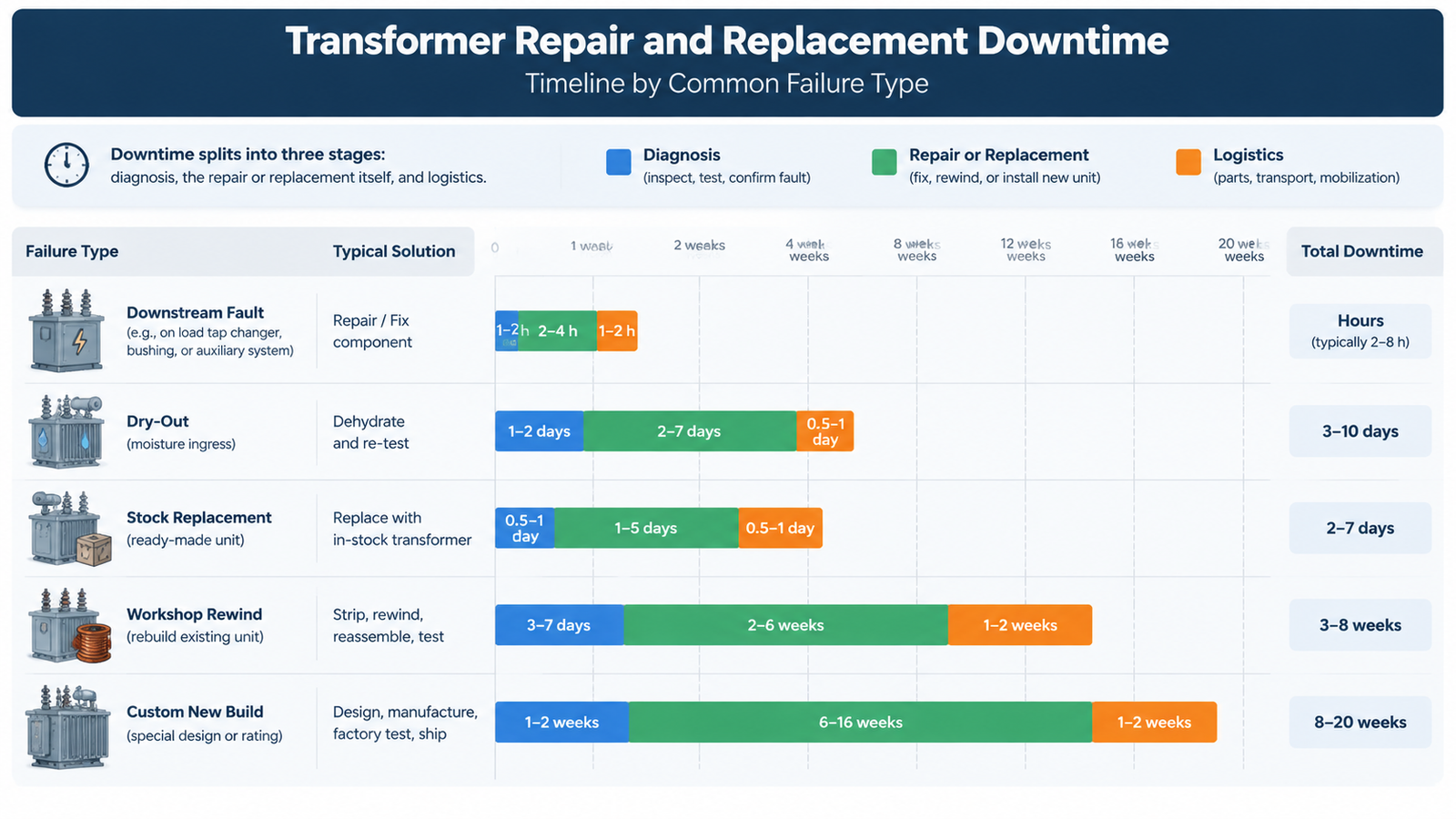
Downtime splits into three components: diagnosis, the repair or replacement itself, and the logistics of getting a unit on site. Diagnosis is usually quick once someone competent is on site. The other two vary enormously, and the ranges below assume a competent contractor, no unusual access constraints, and standard ratings rather than custom-built units.
Failure type
Typical resolution
Realistic downtime
Downstream fault, transformer healthy
Find and clear the fault, reset
Hours
External flashover / dirty bushings
Clean, re-terminate, test
Same day to 2 days
Terminal or tap link failure
Replace hardware, re-test
1–3 days
Insulation breakdown, unit dry-out possible
Dry out, test, return to service
3–10 days
Internal winding fault, stock replacement
Swap in equivalent unit
2–7 days including delivery
Internal winding fault, rewind
Workshop rewind
3–8 weeks
Large or custom unit, new build
Manufacture to order
8–20 weeks
The pattern is clear: whether you can source an equivalent unit quickly matters more than how badly the failed one is damaged. A stocked standard rating turns a six-week outage into a one-week outage.
What to do in the first hour
Make it safe. Isolate, lock out, and verify dead on both sides. Do not re-energise a unit that has tripped on a fault.
Photograph everything — the nameplate, the terminations, any arc marks, and the protection settings that operated.
Record the protection operation. Which device tripped and on what setting tells you whether the fault was internal or downstream.
Do a visual and smell check. Burnt insulation odour, discolouration, or oil on the floor points to an internal fault.
Insulation resistance test winding to winding and winding to earth, after safe isolation and discharge.
Call the supplier with the nameplate data. Serial number, kVA, voltages, vector group and impedance are what they need to quote a like-for-like replacement.
Repair or replace?
For small and medium dry-type units, replacement is usually the faster and more predictable option — a rewind costs a significant fraction of a new unit and takes weeks. Repair becomes competitive when the unit is large, custom-built, or has a long lead time that a rewind can beat.
Whichever route you take, the replacement must match electrically, not just in kVA. Voltage ratio and taps, frequency, vector group, impedance within roughly 10%, insulation class, and physical footprint all have to line up. If you are replacing a unit that runs imported 110 V equipment on a 230 V supply, our DT-5000VA step-up and step-down transformer is one standard option to check against your nameplate.
Preventing the next one
Fit and maintain surge protection with a low-impedance earth path; check arrester condition after any nearby strike.
Keep loading within the nameplate rating and derate in hot or enclosed locations.
Check termination torque on a schedule — loose joints are a leading cause of localised overheating and flashover.
Keep ventilation paths clear and enclosures free of conductive dust.
Test insulation resistance periodically and trend the results; a falling trend is the cheapest early warning you will get.
Record nameplate data for every unit on site before you need it.
Key takeaways
Confirm the failure mode before condemning the transformer — protection often trips correctly for a downstream fault.
Overvoltage, lightning, overload, through-faults, moisture and commissioning errors cover most catastrophic failures.
Downtime is dominated by replacement logistics, not repair complexity; a stocked equivalent rating is the best insurance.
Match replacements on impedance, vector group and thermal class, not only on kVA.
Surge protection, torque checks and insulation trending prevent more failures than any monitoring system.
If you have a failed unit and need a like-for-like replacement, send us the nameplate photo and the protection that operated — we can usually confirm an equivalent rating the same day.
Frequently asked questions
What causes a transformer to blow?
The most common causes are transient overvoltage from lightning or switching, sustained overvoltage, prolonged overload that degrades insulation, short-circuit through-faults, and moisture or contamination in the insulation system. Commissioning errors such as a wrong tap or wrong frequency fail early.
Can a blown transformer be repaired?
Yes in principle, but rewinds take weeks and cost a large share of a new unit. For small and medium standard ratings, replacing with an equivalent unit is usually faster and more predictable.
How long does it take to replace a transformer?
With a stocked equivalent rating, typically 2–7 days including delivery and testing. A workshop rewind runs 3–8 weeks, and a custom-built large unit can take 8–20 weeks.
Does a surge protector prevent transformer failure?
It substantially reduces the risk from lightning and switching transients, but only if the arrester is correctly rated and its earth path is low impedance. It does not protect against sustained overvoltage or overload.
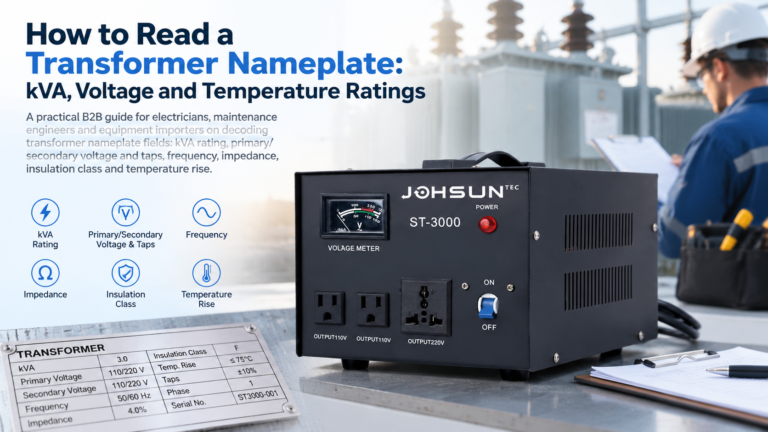
Learn how to read a transformer nameplate: decode the kVA rating, voltage and taps, frequency, impedance, insulation class and temperature rise before you install or replace a unit.
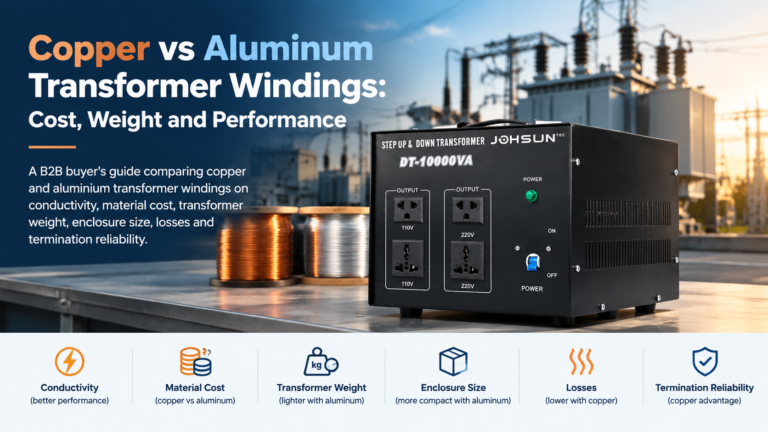
Compare copper vs aluminum transformer windings on conductivity, cost, weight, size, losses and termination reliability, with the numbers behind each trade-off.