Isolation Transformers: Enhancing Safety & Power Quality
Ngày đăng: Tác giả: Lisa
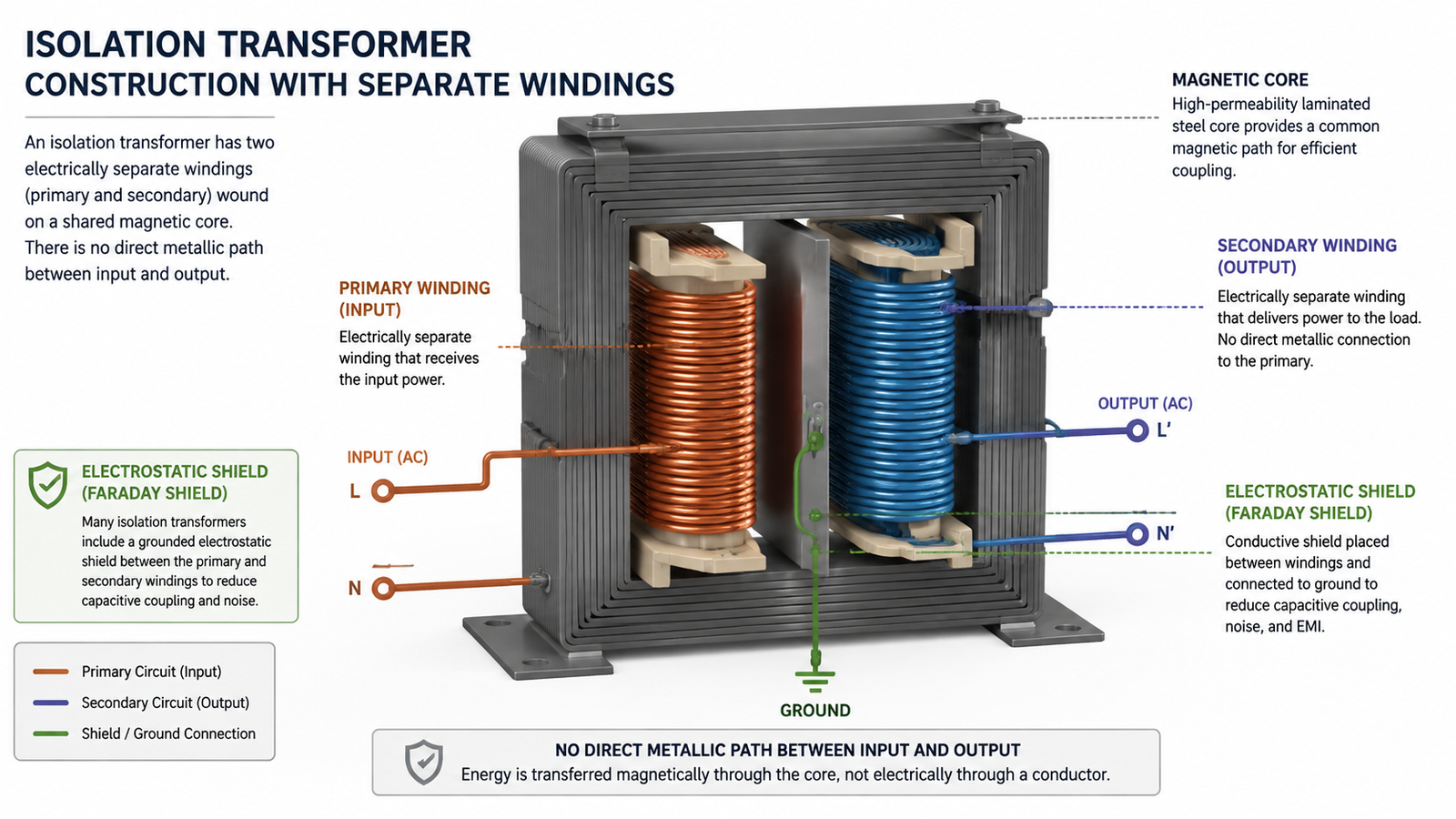
Một máy biến áp cách ly is a two-winding transformer whose primary and secondary coils are electrically separated, so power crosses the magnetic core instead of through any direct metallic path. That separation — known as galvanic isolation — is why these units appear wherever electrical safety and clean power are non-negotiable: hospital rooms, industrial control cabinets, data centers, and precision test benches. In this guide, we explain how an isolation transformer works, how it enhances both safety and power quality, how it differs from an autotransformer, and what to verify when specifying one for your equipment.
What Is an Isolation Transformer?
An isolation transformer transfers AC power between two circuits with no direct electrical connection between them. Energy still moves exactly the way it does in any transformer — by electromagnetic induction through a shared core, a principle covered in our primer on Biến áp là gì? — but the primary and secondary windings are physically separate coils separated by high-grade insulation. There is no shared turn, no common conductor, and no DC path from input to output.
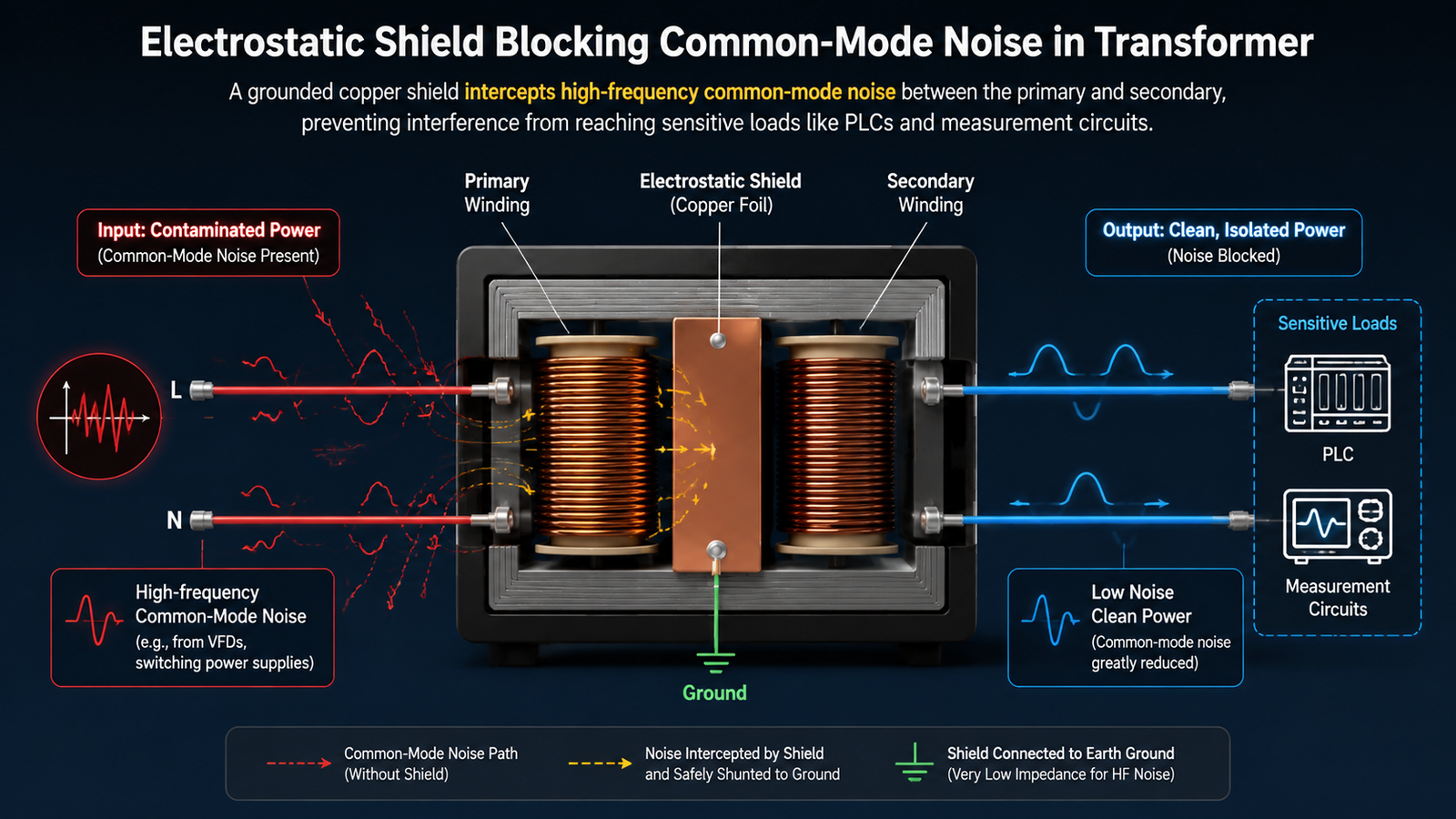
Two practical points are worth knowing. First, isolation transformers do not have to change voltage: a 1:1 unit provides pure isolation, while step-up and step-down versions combine voltage conversion with the same electrical separation. Second, many industrial units add an electrostatic (Faraday) shield — a grounded copper or aluminum sheet placed between the two windings — which strongly improves their noise rejection, as explained below.
How Isolation Transformers Enhance Safety
The safety value of galvanic isolation comes from breaking every unintended current path, not just the intended one. Because the secondary winding is not electrically tied to the utility neutral or ground, a person touching a single output conductor cannot complete a circuit back through the earth. The secondary side becomes a separately derived source, which means you can also re-establish a clean, local ground reference instead of inheriting whatever noisy, fault-prone grounding exists upstream.
Fault containment works the same way. A ground fault or a large potential difference on the supply side cannot propagate directly into your load, because the only coupling between the two circuits is magnetic. In medical isolated power systems this property is pushed further: equipment keeps running safely even after a first line-to-ground fault, because the fault current has no low-impedance return path.
Electrical hazard
How galvanic isolation helps
Electric shock from a single live conductor
No conductive path back to the supply earth through the load circuit
Upstream ground faults and potential differences
Faults cannot cross the core; the load sees a separately derived source
Noisy or degraded building grounding
Secondary ground can be re-established locally and cleanly
First ground fault in critical systems
Isolated circuits continue operating while the fault is located
How Isolation Transformers Improve Power Quality
The same construction that protects people also cleans up the power delivered to sensitive loads. Three mechanisms do most of the work.
Common-mode noise attenuation. High-frequency noise riding on the supply tries to reach the secondary through the small inter-winding capacitance. An electrostatic shield between the windings intercepts this noise and drains it to ground, cutting the coupling dramatically and protecting measurement circuits, PLC inputs, and communication equipment.
Ground loop elimination. When two devices on different grounding points share a signal or power connection, circulating ground currents cause hum, measurement drift, and data errors. Because the isolation transformer breaks the direct electrical connection between the grounds on either side, the loop simply cannot form — the classic fix in professional audio systems and industrial control networks alike.
Transient buffering. Winding impedance and the magnetic coupling process attenuate fast voltage spikes before they reach downstream electronics. An isolation transformer is not a substitute for a dedicated surge protective device, and the two are normally deployed together, but the transformer materially reduces the electrical stress that reaches the load during switching events.
Isolation Transformer vs. Autotransformer
The most common — and most consequential — confusion is between isolation transformers and autotransformers. An máy biến áp tự động uses a single continuous winding shared by input and output. It is smaller, lighter, and cheaper for a given rating, but input and output are electrically connected: there is no galvanic isolation at all. For a side-by-side breakdown, see our comparison of the step-up/step-down transformer vs autotransformer.
Attribute
Máy biến áp cách ly
Biến áp tự động
Cấu trúc cuộn dây
Separate primary and secondary coils
Single shared winding
Galvanic isolation
Yes — no DC or direct fault path
No — input and output connected
Noise and ground loop control
Strong, especially with electrostatic shield
Số lượng có hạn
Size and cost at equal rating
Larger and more expensive
Smaller and cheaper
Best suited for
Safety-critical, noisy, or sensitive loads
Voltage matching where isolation is not required
Where Isolation Transformers Are Used
In practice, you will find isolation transformers wherever at least one of three conditions applies: personnel safety is regulated, the load is electrically sensitive, or the grounding environment is poor. Typical sectors include:
Medical and laboratory equipment , where isolated power protects patients and keeps diagnostic instruments running through first faults.
Industrial control and automation , giving PLCs, sensors, and control panels clean power inside electrically noisy cabinets.
Data centers and telecommunications , decoupling server and network loads from upstream disturbances.
Professional audio and broadcast , eliminating ground-loop hum in interconnected equipment racks.
Imported 110V/220V equipment and test benches , where a two-winding step-up/step-down unit converts voltage and isolates the device under test at the same time.
How to Choose the Right Isolation Transformer
Selection comes down to a short checklist. Match the voltage ratio — whether a pure 1:1 barrier or a step-up/step-down combination. Size the power rating with 20–25% headroom above the connected load, remembering that capacity is specified in VA or kVA, not watts. Specify an electrostatic shield when the load includes measurement or communication circuitry. Then verify the details that decide long-term reliability: insulation class and dielectric strength, 50/60 Hz compatibility, enclosure protection for the installation environment, and the safety standards and certifications your market requires.
Kết luận
An isolation transformer enhances safety by eliminating conductive fault paths between the supply and the load, and it enhances power quality by blocking common-mode noise, breaking ground loops, and buffering transients. For equipment that must run on a 110V/220V site while keeping that protection, a two-winding toroidal unit such as the Biến áp tăng áp và giảm áp ST-3000VA delivers voltage conversion and galvanic isolation in one package. Send your voltage, load, and compliance requirements to get a matched specification and quotation.
Câu hỏi thường gặp
Does an isolation transformer provide surge protection?
Partially. Its windings attenuate fast transients, but it is not a dedicated surge protective device. For full protection against lightning-induced or large switching surges, pair the transformer with an SPD on the appropriate side.
Can an isolation transformer be 1:1?
Yes. A 1:1 unit outputs the same voltage it takes in and exists purely to provide galvanic isolation. Step-up and step-down versions add voltage conversion while keeping the same electrical separation.
Why is an autotransformer not an isolation transformer?
Because its single shared winding leaves a direct electrical connection between input and output. An autotransformer can change voltage efficiently, but it cannot block fault paths, DC, or common-mode noise the way two separate windings can.
Do isolation transformers improve power quality?
Yes. By separating the circuits magnetically and re-establishing a local ground, they reduce common-mode noise, eliminate ground loops, and attenuate transients — all of which stabilize voltage and signal conditions for sensitive loads.
When is an isolation transformer required for medical equipment?
Medical standards for patient-connected equipment typically require isolated power to limit leakage current and to keep life-critical devices operating through a first ground fault. Exact requirements depend on the equipment class and the applicable medical electrical safety standard, so confirm them with your compliance engineer.
Recommended Models for Isolation Transformer Specification
If you are specifying a unit rather than reading theory, start here. These models cover the capacity bands most often requested for isolation transformer specification, and each links straight to its specification and price range.
Vui lòng cung cấp cho chúng tôi thông tin về điện áp đầu vào, điện áp đầu ra, pha và công suất kVA liên tục mà quý khách cần; chúng tôi sẽ xác nhận mẫu sản phẩm phù hợp, giá cả và thời gian giao hàng trong vòng một ngày làm việc. Các thông số kỹ thuật không theo tiêu chuẩn sẽ được xử lý thông qua Sản xuất máy biến áp theo yêu cầu theo mô hình OEM/ODM.
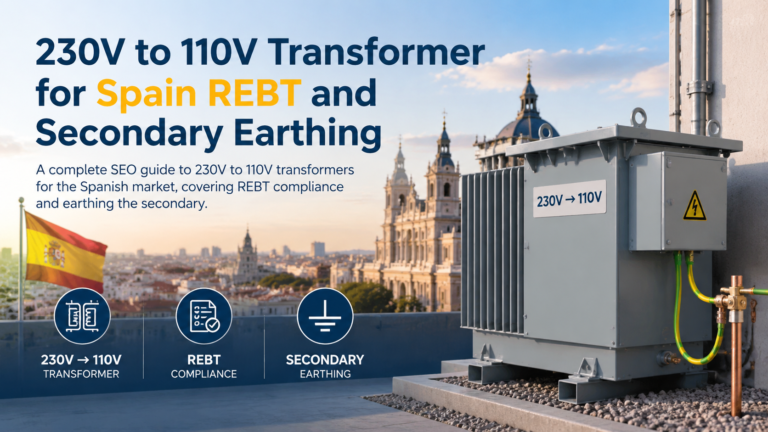
Biến áp 230V sang 110V dành cho Tây Ban Nha: Tuân thủ tiêu chuẩn REBT, ITC-BT-18 và ITC-BT-24, nối đất cho cuộn thứ cấp và tài liệu theo tiêu chuẩn UNE-EN IEC 61558.
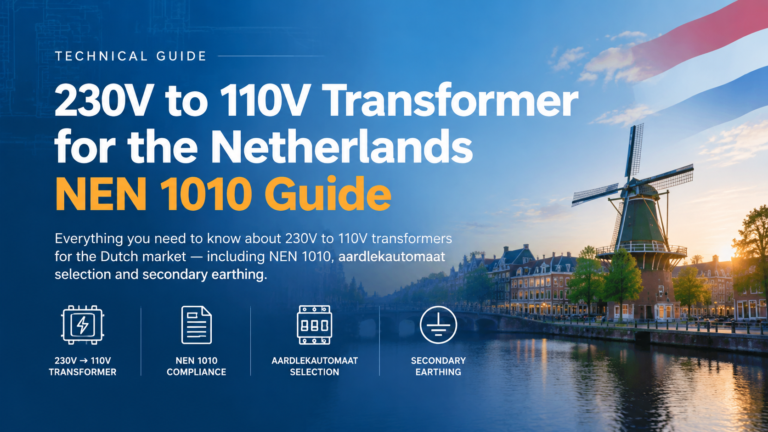
Biến áp 230V sang 110V dành cho Hà Lan: Tiêu chuẩn NEN 1010, quy định về dòng rò 30 mA, sự khác biệt giữa công tắc ngắt dòng rò (aardlekschakelaar) và bộ ngắt tự động dòng rò (aardlekautomaat), cùng với hệ thống nối đất thứ cấp.
Biến áp 230V sang 110V dành cho Pháp: Tiêu chuẩn NF C 15-100, nối đất theo tiêu chuẩn TT, bảo vệ chênh lệch dòng điện 30 mA và khi nào cần nối đất cho cuộn thứ cấp.