محول من 230 فولت إلى 110 فولت لإسبانيا: REBT والتأريض الثانوي
تاريخ النشر: المؤلف: ليزا
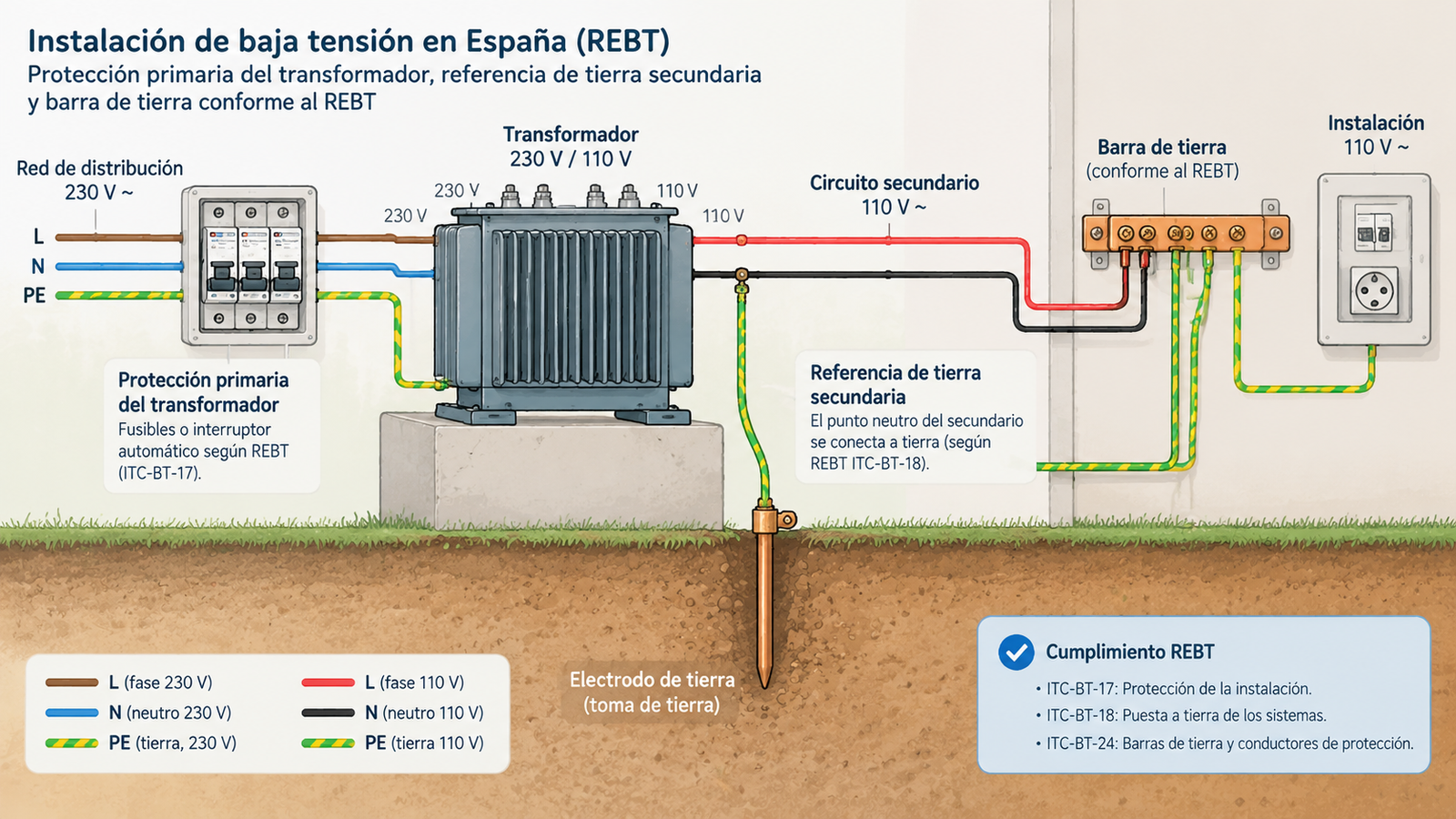
Spain’s low-voltage regulation gives the 230 V to 110 V transformer a specific job that is easy to overlook: providing a defined reference for the secondary circuit so that indirect contact protection actually works. Under the REBT, earthing the secondary of a step-down transformer is not an optional detail — it is the mechanism that makes fault disconnection possible. This guide covers what that means for a 230V to 110V transformer installed on a Spanish site.
It is written for electrical designers, installers and buyers integrating imported US machinery or a permanent 110 V supply in Spain. For the Spanish-language version, see Transformador 230V 110V.
Spain’s supply: 230 V nominal, with 220 V still in the field
Spain’s declared low-voltage supply is 230 V / 50 Hz. The reason you still see “transformador 220V 110V” as a search term is history: Spain harmonised from 220 V to 230 V, and a large installed base of equipment and documentation still refers to 220 V. The practical difference is 4.5 % and sits inside normal supply tolerance, but it does matter for two things:
Load voltage. A transformer with a 230 V primary and a 110 V secondary, fed at 220 V, delivers about 105 V. If the load is sensitive, specify a 115 V or 120 V secondary so the delivered voltage lands where the equipment expects it.
Nameplate matching. Older Spanish equipment may be marked 220 V. Verify actual supply voltage at the point of connection rather than working from documentation.
المعلمة
Spanish practice
Consequence for the transformer
Nominal voltage
230 V / 50 Hz
Primary rated 230 V; legacy 220 V in older installations
Socket system
Type F (Schuko) and Type C in older installations
Primary plugging to match; 16 A typical
Earthing arrangement
Predominantly TT for low-voltage installations
Earth fault protection relies on residual current devices
Installation regulation
REBT, RD 842/2002, with the ITC-BT instructions
Governs earthing, indirect contact protection and protective devices
What the REBT requires of the installation
The Reglamento Electrotécnico para Baja Tensión and its complementary technical instructions set out the rules a Spanish inspector will check. Two of them drive the transformer design directly.
Instruction
Subject
Relevance to a step-down transformer
ITC-BT-18
Puesta a tierra — earthing installations
Defines how exposed conductive parts and, where applicable, the secondary reference are earthed; requires earth continuity to be verifiable
ITC-BT-24
Protección contra contactos indirectos
Requires automatic disconnection of supply, or an equivalent measure, when a fault raises touch voltage
ITC-BT-22 / -23
Overcurrent and overvoltage protection
Sizes primary protection and surge measures for the feed
The interaction between these two is the crux. ITC-BT-24 relies on fault current returning to the source through the protective conductor so that a protective device operates. In a transformer with isolated windings, that return path does not exist on the secondary unless you create it. Which brings us to the earthing decision.
Earthing the secondary: the decision, step by step
Confirm the earthing arrangement. For most Spanish low-voltage installations this is TT: source neutral earthed at the transformer station, installation exposed parts on a local earth electrode.
Determine whether the load needs galvanic separation. Medical, laboratory and instrumentation loads generally do. Heating, lighting and simple motor loads usually do not.
If separation is required, decide how the secondary will be protected. Two viable routes: reference the secondary neutral to the installation earth at a single point — which allows a residual current device on the secondary to operate — or leave it isolated and install permanent insulation monitoring.
If separation is not required, an auto-transformer is the economical answer. With a shared winding, the primary protection covers the secondary circuit, which simplifies compliance considerably.
Verify earth continuity between enclosure, terminal box and the installation earth bar before energising. This is the check that most often fails on imported equipment.
التكوين
Secondary treatment
Fault disconnection
Where it fits
Auto-transformer
No discrete secondary earth
Via primary protection
Heating, lighting, simple motors
Earthed isolated secondary
Neutral bonded to earth at one point
Via secondary RCD
Permanent 110 V distribution
Floating isolated secondary
Isolated, monitored
First fault does not disconnect
Laboratory, bench, diagnostic work
Note the counter-intuitive result: a 30 mA residual current device on the primary feed of an isolated transformer will not clear a secondary earth fault. The fault current returns through the earth electrode system, bypassing the primary current transformer. If secondary protection is needed, it must exist on the secondary. The verification method is covered in how to ground a transformer secondary, and the final connection must be made by an authorised installer working to the REBT.
UNE-EN IEC 61558: the standard behind the CE mark
التطبيق
Spanish designation
What it covers
General requirements and tests
IEC 61558-1 / UNE-EN IEC 61558-1
Base safety standard for the whole series
Isolating transformers
UNE-EN IEC 61558-2-4
Separate windings, general applications
Safety isolating transformers
UNE-EN IEC 61558-2-6
Additional limits on output voltage and current
Auto-transformers
UNE-EN IEC 61558-2-13
Step-up and step-down auto configurations
CE marking
Directives 2014/35/EU (LVD) and 2014/30/EU (EMC)
EU declaration of conformity
For a Spanish technical review, ask for the declaration of conformity naming the specific model on the order plus the test record. Where the machine falls under the Machinery Directive, a transformer without a type-specific test record becomes a documentation gap in the technical file — the kind of finding that surfaces during CE marking review rather than at goods-in.
Construction choice
الإنشاءات
Separation
Typical Spanish application
Auto-transformer
لا شيء
HVAC auxiliaries, lighting, resistance heating
Isolating transformer
Full galvanic
Imported machine control, test benches, packaging lines
Safety isolating transformer
Full, limited output
Portable tools, wet locations, maintenance work
حلزوني
Model dependent
Audio, medical, low stray field
For continuous duty in an enclosure, the DT/ST range covers 100 VA to 10 kVA with consistent terminal labelling across the series: transformer DT/ST series 100VA–10KVA. Where a machine programme spans several power ratings, staying inside one series matters more than the per-unit price difference.
Sizing for Spanish industrial loads
Transformers are rated in VA. In Spanish industrial work the loads that most often cause an undersizing problem are motors with hard starts, refrigeration compressors and packaging machinery with switched-mode drives.
Resistive load: +20 % on the VA figure
Motor and compressor load: +100 % (factor 2) — higher for hard-start compressors
Switched-mode supplies and drive inputs: +30 to +50 %
First fault undetected; indirect contact protection incomplete under ITC-BT-24
Reference the secondary at one point or install insulation monitoring
Expecting the primary RCD to cover the 110 V circuit
Secondary earth faults never cleared
Design secondary protection explicitly
Assuming 220 V when the supply is 230 V
Delivered voltage off target
Measure at the point of connection
Reading appliance watts as VA
Undersized transformer, thermal trips
Use the VA figure with margin
No earth continuity check at commissioning
Protection ineffective despite correct design
Verify enclosure-to-earth-bar continuity before energising
Next step
On Spanish projects the transformer is a well-understood component. The compliance question is where the value sits: choose the construction that matches the separation requirement, decide deliberately how the secondary is earthed, size in VA with margin for inrush, and hold the documentation that proves it.
Send the supply voltage measured on site, the frequency, the load profile and the earthing arrangement and we will come back with the matching type: اتصل بنا.
الأسئلة الشائعة
Is the secondary of a 230V to 110V transformer required to be earthed in Spain?
It depends on the application. Where the transformer provides a permanent 110 V supply, earthing the secondary at a single point is normally the route that allows fault disconnection under ITC-BT-24. Where the load needs separation for safety or measurement reasons, an isolated and monitored secondary is a legitimate alternative.
Why is a 220V 110V transformer still sold in Spain?
Because of the historical 220 V supply. The harmonised nominal voltage is 230 V, and a 230 V primary unit fed at 220 V delivers about 105 V. If the load needs closer to 110 V, specify a 115 V or 120 V secondary.
Does a primary RCD protect the 110 V circuit?
No. With isolated windings, a secondary earth fault returns through the earth electrode system rather than the primary circuit, so the primary residual current device sees no imbalance. Secondary protection must be provided on the secondary side.
Which standards apply?
IEC 61558 in its Spanish implementation, UNE-EN IEC 61558 — 2-4 for isolating transformers, 2-6 for safety isolating transformers and 2-13 for auto-transformers — plus CE marking under the Low Voltage and EMC Directives. Installation follows the REBT (RD 842/2002) and its ITC-BT instructions, notably ITC-BT-18 for earthing and ITC-BT-24 for indirect contact protection.
Is an auto-transformer acceptable?
Yes for non-critical loads such as heating, lighting and simple motor circuits, where the primary protection covers the secondary by virtue of the shared winding. It is not acceptable where galvanic separation is required.
How much margin should be allowed?
Size at 70–80 % of rated VA for continuous duty. Add 20 % on resistive loads, a factor of 2 on motor and compressor loads, and 30–50 % on switched-mode supply loads.
How a buck-boost transformer works: series-winding polarity, differential kVA sizing with single-phase and three-phase examples, and the five limits that decide when it is the wrong tool.
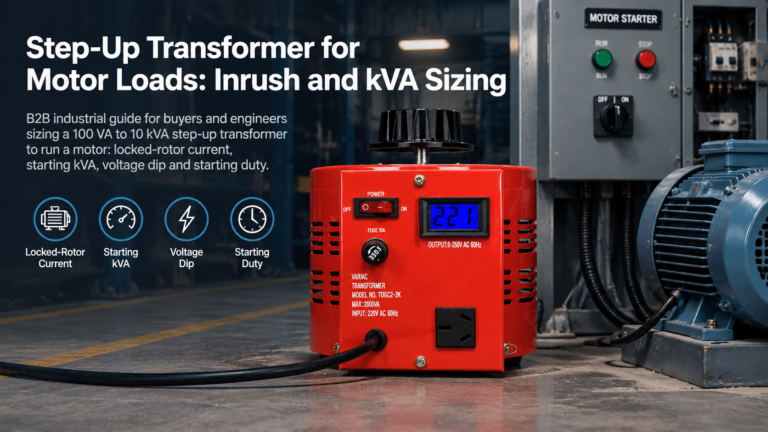
How to size a step-up transformer for a motor: locked-rotor current, kVA code letters, starting kVA by method, voltage-dip and thermal-duty checks, plus the traps most guides miss.
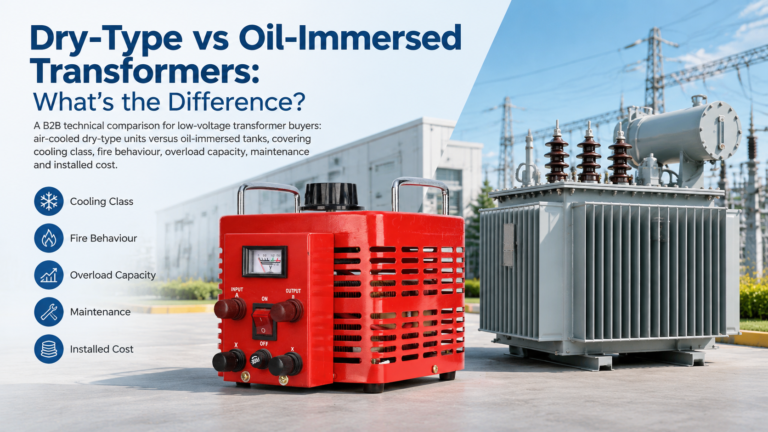
A practical dry-type vs oil-immersed transformer comparison for low-voltage buyers: cooling class, fire safety, overload, maintenance and installed cost, plus a ten-minute selection sequence.