Transformateur 230 V à 110 V pour l'Allemagne : conforme aux normes VDE et CE
Publié le : Auteur : Lisa
If you are sourcing a 230V to 110V transformer for a German site, the technical selection is the easy part. The hard part is documentation: German procurement teams and machine integrators expect the standard reference on the datasheet, the declaration of conformity for the exact type ordered, and a test record that survives an audit. This guide covers what that means in practice.
It is written for buyers, electrical designers and maintenance engineers who need a 230 V to 110 V transformer to sit inside a German installation — for imported US machinery, a test bench, workshop tools or a permanent 110 V circuit. For the German-language version of this guide, see Spannungswandler 230V 110V.
What a 230V to 110V transformer does — and what it does not
The device is a step-down transformer: a passive magnetic component that reduces 230 V AC to 110 V AC (commonly tapped at 115 V or 120 V). Two windings share a magnetic core, and the turns ratio sets the voltage ratio. There is no active regulation.
Three consequences matter in German projects:
Frequency is untouched. A 60 Hz US motor on the German 50 Hz grid runs roughly 17 % slower and hotter. A transformer cannot fix this.
Secondary voltage sags under load. A unit specified at 110 V no-load typically delivers 105–110 V at full load. If the load has tight tolerances, specify a 115/120 V secondary tap.
Regulation is not part of the job. The transformer delivers a fixed ratio. Overload protection belongs to the load or to an upstream protective device.
The German supply and plug reality
Germany runs a nominal 230 V / 50 Hz supply. DIN EN 50160 defines the voltage characteristics of the public network with a ±10 % tolerance band, so a transformer specified at exactly 230 V primary must tolerate roughly 207–253 V at the input. That is well within the design envelope of a correctly rated transformer, but it is a reason not to run a unit at 100 % of its VA rating continuously.
Paramètres
German practice
Consequence for the transformer
Nominal voltage
230 V / 50 Hz
Primary rated 230 V; allow ±10 %
Socket system
Type F (Schuko, CEE 7/3)
Primary plug to match; 16 A per circuit typical
Plug current limit
16 A standard socket circuit
A 3.6 kVA load is the practical socket limit
Installation code
DIN VDE 0100 series
Governs final wiring, protection and earthing
Machine electrical equipment
DIN EN 60204-1
Applies to the machine the transformer feeds
The standard that actually governs your purchase
German buyers usually ask for “the 61558 reference”. The IEC 61558 series is the transformer safety standard, and its German implementation carries both a DIN EN IEC number and a VDE 0570 number. Which part applies depends on the transformer construction.
Application
German designation
What it covers
General requirements and tests
DIN EN IEC 61558-1 (VDE 0570-1)
Base standard for all parts
Separating transformers
DIN EN IEC 61558-2-1
General-purpose separation
Isolating transformers
DIN EN IEC 61558-2-4 (VDE 0570-2-4)
Galvanic separation for general applications
Safety isolating transformers
DIN EN IEC 61558-2-6 (VDE 0570-2-6)
Additional limits on output voltage and current
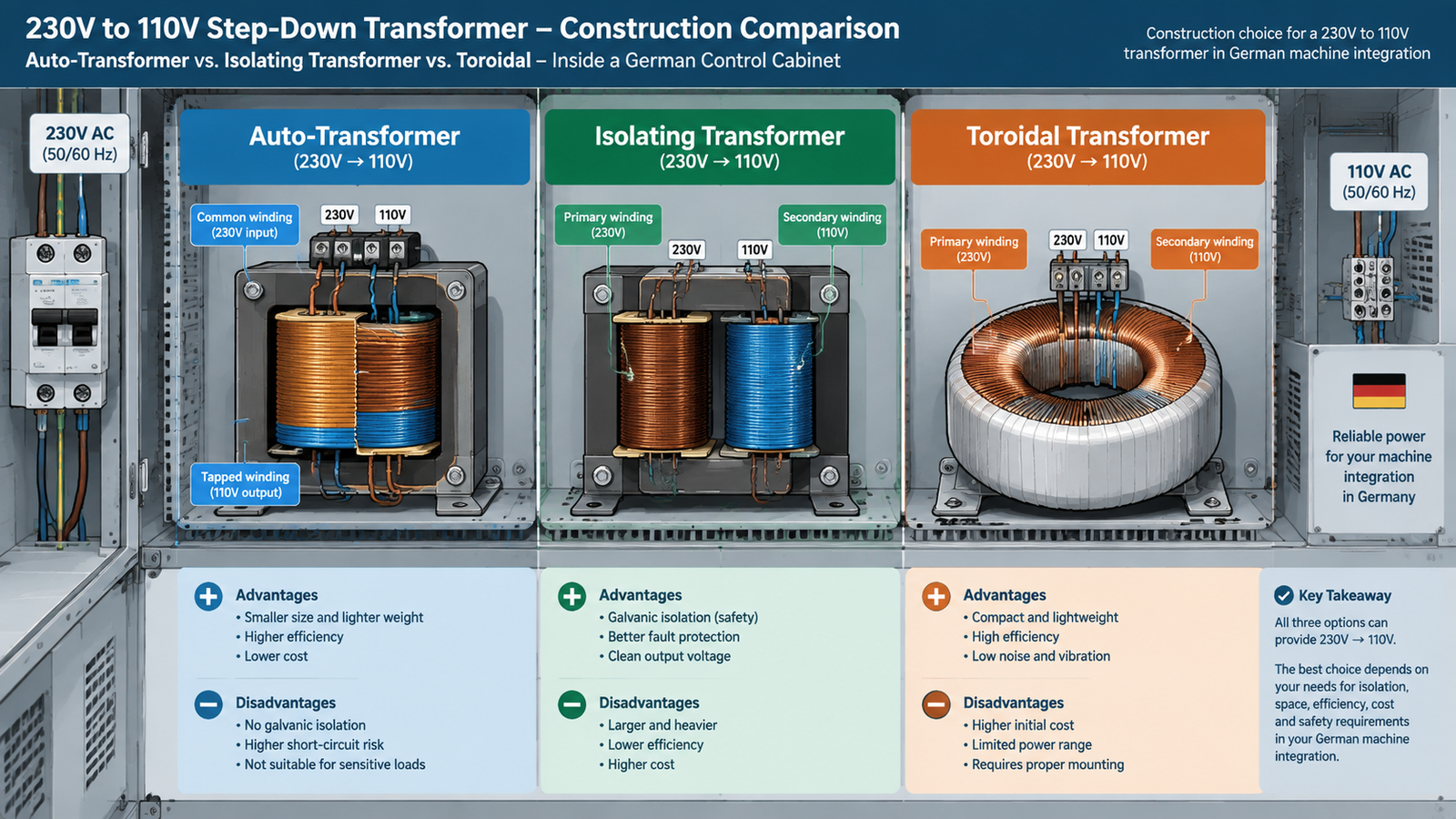
Auto-transformers
DIN EN IEC 61558-2-13
Step-down/step-up auto configurations
When a supplier claims “VDE approved”, ask which part number and for which type. A DIN EN IEC 61558-2-13 test report for an auto-transformer does not transfer to the isolation unit you actually ordered.
Practical note: for a 230 V to 110 V auto-transformer (Spartransformator), the 2-13 route is correct and cost-effective. As soon as the load needs galvanic separation — medical, laboratory, marine or any circuit where fault current must not reach the primary — you are in 2-4 or 2-6 territory and the product changes construction.
CE marking, LVD, EMC and ErP: what the paperwork must show
Exigence
Legislation
What a German buyer will check
Low Voltage Directive
2014/35/EU
EU declaration of conformity naming the type
EMC Directive
2014/30/EU
Emissions and immunity evidence for the finished unit
Ecodesign (small transformers)
ErP Regulation (EU) 2019/1782
Efficiency and no-load loss data, product information sheet
RoHS
2011/65/EU
Material compliance statement
Type test record
Supplier quality system
Turns ratio, insulation resistance, no-load current per unit or per batch
The ErP angle is where buyers most often get caught out. The EU ecodesign regulation for external power supplies and small transformers requires published no-load power consumption and efficiency figures. If a supplier cannot produce that data, the unit is likely a generic export product that was never documented for the European market.
Earthing and RCD behaviour in German installations
Wiring follows a consistent pattern: supply to the primary terminals (H1, H2), load to the secondary terminals (X1, X2), and both the enclosure and the terminal box bonded to the site earth bar. The protective conductor goes to the enclosure, never to a secondary terminal.
The subtle part is the secondary. Whether it is earthed at all depends on the system:
TN or TT site system: the secondary neutral is normally referenced to the installation potential at a single point. Without that reference, a fault on the secondary side cannot be detected by a residual current device, because the fault current has no return path through the primary circuit.
Protective separation (IT behaviour): the secondary stays isolated. A first fault to earth trips nothing — deliberate on test benches and in laboratories, unacceptable in continuous production use.
Auto-transformer: there is no separation. Primary and secondary are electrically linked, so a discrete “secondary earth” does not exist as a concept.
This is the single most misunderstood point in the whole topic: a 30 mA RCD on the primary feed cannot protect an isolated secondary circuit. If secondary protection is required, it has to be designed on the secondary side. The step-by-step method is documented in how to ground a transformer secondary. Final wiring must be carried out by a qualified electrician working to DIN VDE 0100.
Construction choice: isolation or auto?
La construction
Galvanic separation
Efficacité
Best fit in German projects
Auto-transformer
No — common winding
Very high
Heating, lighting, non-critical motor loads
Isolating transformer
Yes — separate windings
Haut
Machine control, test equipment, noise filtering
Safety isolating transformer
Yes, with limited output
Haut
Hand tools, wet or confined locations
Torique
Model dependent
Very high
Audio, medical, low stray field requirements
For continuous duty in a machine or control cabinet, the DT/ST range covers 100 VA to 10 kVA in a consistent series: transformer DT/ST series 100VA–10KVA. Keeping the same series across the power range is what makes terminal labelling, accessories and spare-part holding predictable across a German machine programme.
Sizing in kVA for German machine integration
Transformers are rated in VA, not watts. On resistive loads the two are close; on motors, pumps and switched-mode supplies the power factor is below 1 and the transformer has to be larger. Add inrush current on top:
Resistive load: +20 % on the VA figure
Motor load: +100 % (factor 2)
Switched-mode supplies, inverter inputs: +30 to +50 %
Multiple simultaneous loads: sum the ratings — the largest single load is not the reference
Standard part number: the exact DIN EN IEC 61558 part for the construction you are buying.
Type-specific declaration: EU declaration of conformity naming the ordered type, not a generic certificate.
ErP data: no-load loss and efficiency figures for the ErP regulation.
Test record: turns ratio, insulation resistance and no-load current per unit or batch.
German-language documentation: datasheet, dimensional drawing, terminal diagram and safety notes in German — an audit point for machine documentation under the Machinery Directive.
Series consistency: the 100 VA and 10 kVA versions from the same range, so terminal labelling does not change as the machine scales.
The export catalogue is here: Johsun step-up and step-down transformer supplier. For custom windings, non-standard terminals, enclosure forms or OEM branding, the route is ODM / OEM — useful when one transformer needs to cover several primary and secondary voltages to reduce SKU count.
Erreurs courantes
Erreur
Consequence
Avoid by
Reading the appliance wattage as VA
Overheating, thermal cut-out
Use the VA figure and add margin
Auto-transformer on a load that needs separation
No galvanic isolation, no noise filtering
Specify 61558-2-4 or 2-6 construction
Assuming a primary RCD covers the secondary
Secondary earth faults are never cleared
Define the protection concept before wiring
No ErP or test documentation
Fails supplier audit
Request data per type at quotation stage
Running continuously at 100 % VA
Reduced service life, high case temperature
Size at 70–80 % of rated VA for continuous duty
Next step
German-market selection comes down to three things: the correct DIN EN IEC 61558 part for the construction, a VA rating that matches the real load profile including inrush, and a protection and earthing concept that holds up in a TN or TT installation. Documentation for the exact type is what separates a compliant supply from a future audit finding.
Send us the primary voltage, frequency, load profile and mounting situation and we will come back with the matching type: nous contacter.
FAQ
Which standard applies to a 230V to 110V transformer in Germany?
The IEC 61558 series, published in Germany as DIN EN IEC 61558 with the parallel VDE 0570 designation. Part 2-4 covers isolating transformers, part 2-6 safety isolating transformers and part 2-13 auto-transformers. DIN VDE 0100 governs installation.
Is an auto-transformer acceptable for a 230 V to 110 V conversion in Germany?
Yes, for non-critical loads such as heating, lighting and simple motor loads. It is not acceptable where galvanic separation is required, which includes medical equipment, laboratory instrumentation and any circuit where a fault current must be prevented from reaching the primary side.
Do I need a 230 V to 110 V transformer if the US machine has a dual-voltage input?
Often not — many US machines accept 200–240 V directly through a selector or a terminal change. Check the nameplate before ordering a transformer, because a dual-voltage machine may only need the correct plug and a wiring change.
Can a primary-side RCD protect the 110 V secondary circuit?
No. With isolated windings, the secondary fault current returns through the earthing system rather than through the primary current transformer, so the RCD sees no imbalance. Secondary protection must be provided on the secondary side.
What documentation should a German buyer request?
The DIN EN IEC 61558 part number, the EU declaration of conformity for the ordered type, ErP no-load loss and efficiency data, a test record with turns ratio and insulation resistance, and German-language datasheet and terminal diagram.
How much margin should a continuous-duty transformer have?
Size at roughly 70–80 % of rated VA for continuous duty, add 20 % on resistive loads and a factor of 2 on motor loads to cover inrush current.
How a buck-boost transformer works: series-winding polarity, differential kVA sizing with single-phase and three-phase examples, and the five limits that decide when it is the wrong tool.
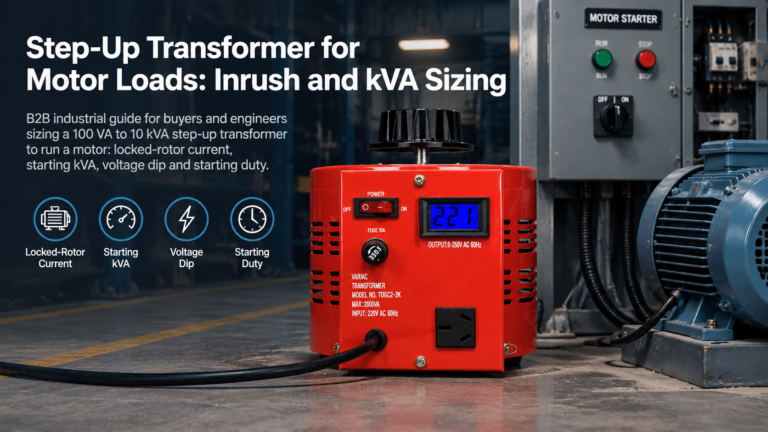
How to size a step-up transformer for a motor: locked-rotor current, kVA code letters, starting kVA by method, voltage-dip and thermal-duty checks, plus the traps most guides miss.
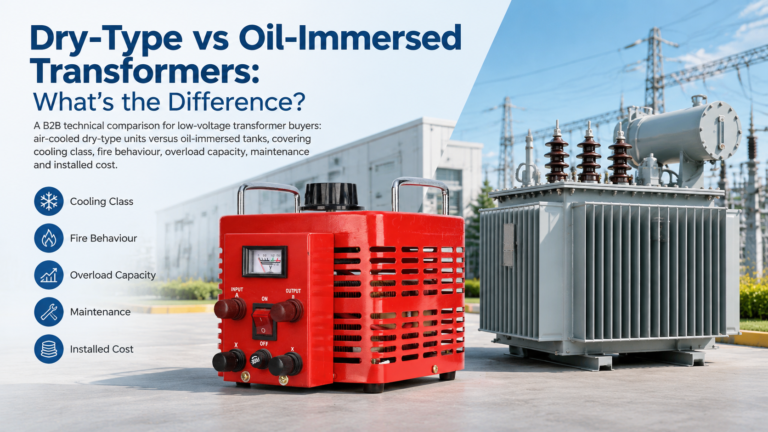
A practical dry-type vs oil-immersed transformer comparison for low-voltage buyers: cooling class, fire safety, overload, maintenance and installed cost, plus a ten-minute selection sequence.