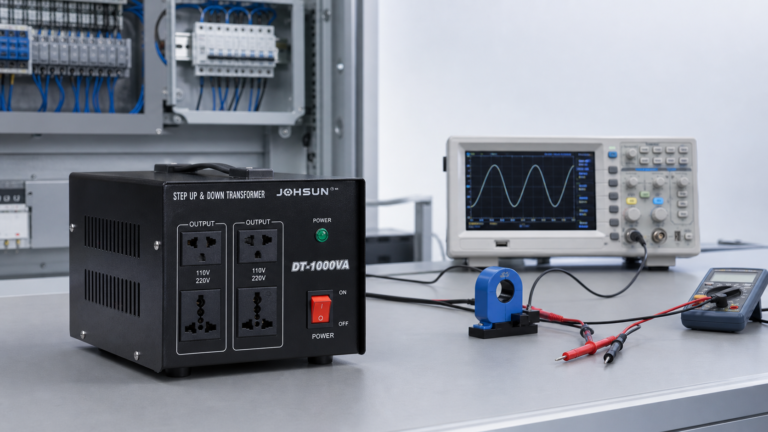
Step Up Voltage Converter vs Step Down Converter Differences
Publié le : Auteur : Lisa
A step up voltage converter increases a lower AC supply voltage to the higher voltage required by an appliance. A step down voltage converter does the opposite: it reduces a higher supply voltage for a lower-voltage appliance. The correct choice depends on only two voltage labels—the voltage available at the wall and the input voltage printed on your equipment—but safe selection also requires the right VA capacity, frequency compatibility, plug configuration, grounding, and protection.
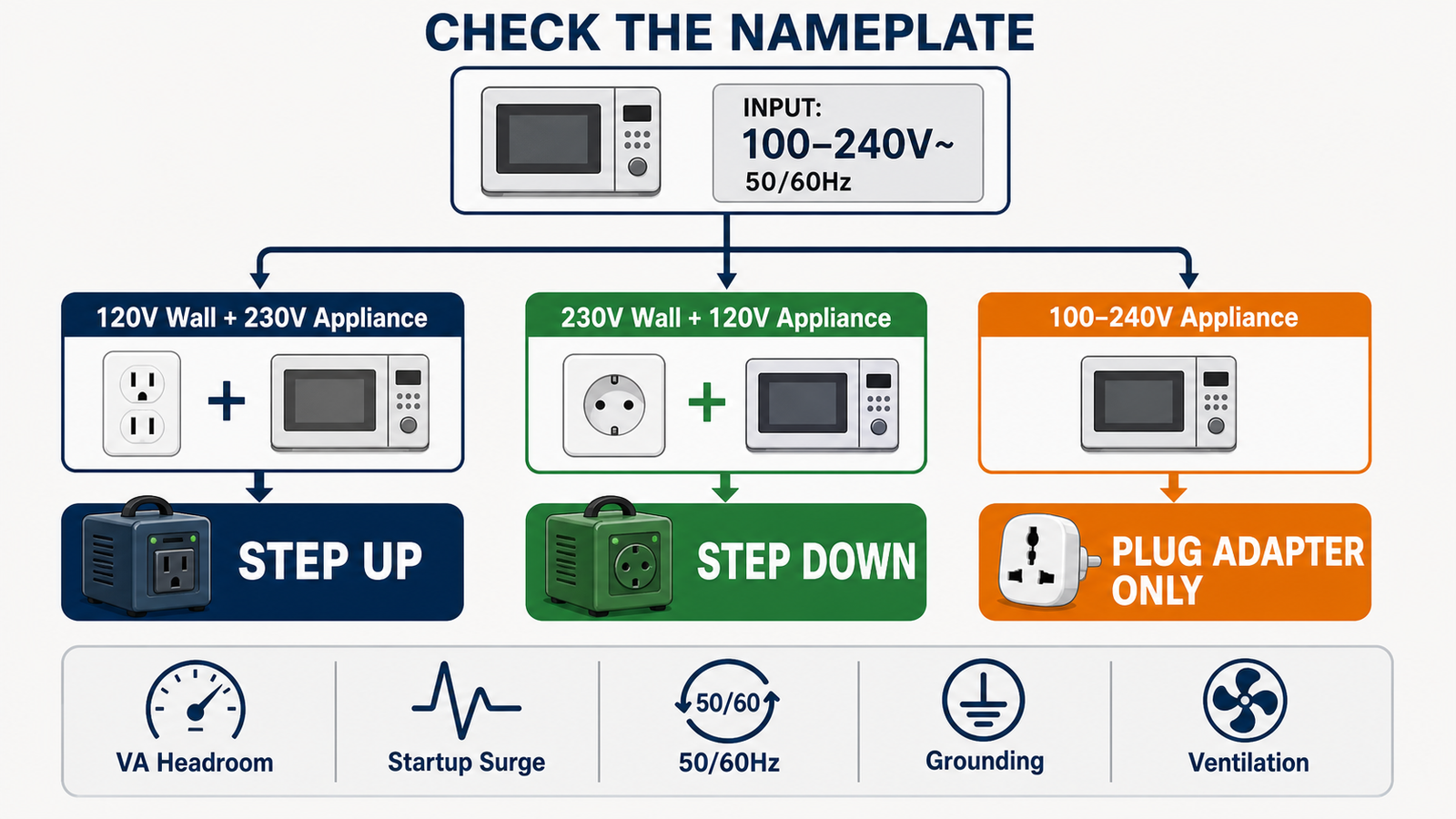
The quick rule is simple. If the wall supply is 110–120V and the appliance requires 220–240V, use a step-up converter. If the wall supply is 220–240V and the appliance requires 110–120V, use a step-down converter. If the appliance label says “INPUT: 100–240V, 50/60Hz,” it is already dual voltage and normally needs only a suitable plug adapter.
Step Up vs Step Down Voltage Converter at a Glance
Comparison
Step up voltage converter
Step down voltage converter
Fonction
Raises AC voltage
Lowers AC voltage
Common conversion
110–120V to 220–240V
220–240V to 110–120V
Utilisation typique
Running a 230V appliance in a 120V country
Running a 120V appliance in a 230V country
Enroulement secondaire
More turns than the primary
Fewer turns than the primary
Ideal current change
Output current decreases as voltage rises
Output current increases as voltage falls
Conversion de fréquence
Normally no
Normally no
How Does a Step Up Voltage Converter Work?
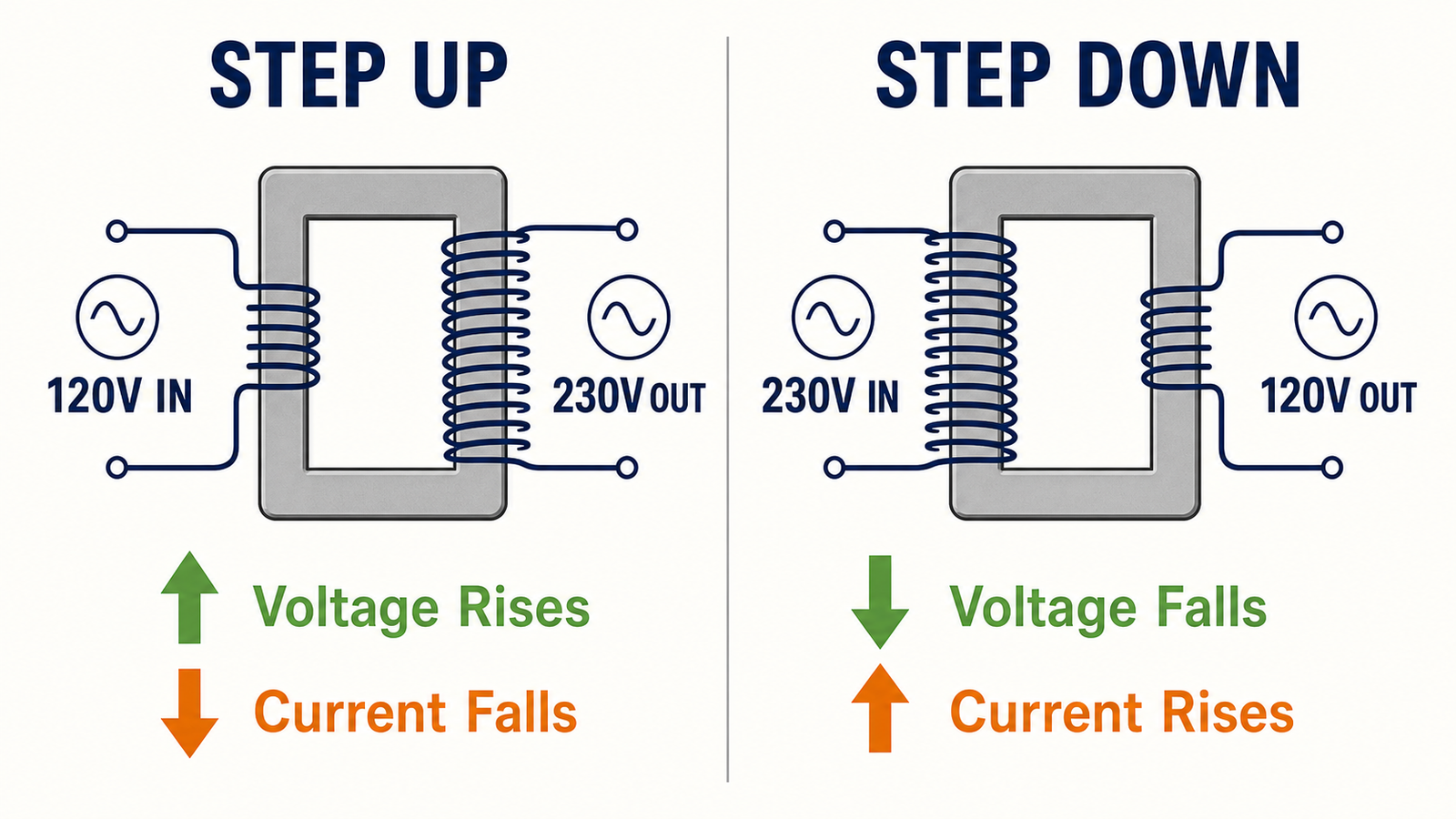
For a conventional AC transformer, the input winding creates an alternating magnetic flux in the core. That changing flux induces voltage in the output winding. The voltage ratio follows the winding turns ratio:
Vsecondary ÷ Vprimary ≈ Nsecondary ÷ Nprimary
A step-up transformer has more turns on the secondary winding than on the primary winding, so its output voltage is higher. In a 110V-to-220V unit, the ideal voltage ratio is about 1:2. Because a transformer does not create power, the available output current is lower than the input current, and actual output power is slightly lower because of electrical and magnetic losses.
A typical use is operating a single-voltage 220V appliance in the United States, Canada, Japan, or another market with approximately 100–120V mains. Examples include imported laboratory instruments, audio equipment, small production machines, and selected household appliances.
How Does a Step Down Voltage Converter Work?
A step-down transformer uses the same electromagnetic principle with the winding relationship reversed. Its secondary winding has fewer turns, so the output voltage is lower than the input. A 220V-to-110V converter allows a single-voltage North American appliance to operate from a 220–240V supply when the appliance’s wattage, frequency, and load characteristics are compatible.
In the ideal transformer relationship, lower output voltage allows higher output current for the same apparent power. However, the load cannot exceed the converter’s rated VA or current. The converter supplies only the current demanded by the appliance; it does not force excess current into a correctly rated load.
Which Direction Do You Need?
Never choose by the destination country name alone. Read the appliance nameplate and confirm the actual local supply. Then compare the two values:
120V wall + 230V appliance: choose step up.
230V wall + 120V appliance: choose step down.
100–240V appliance: voltage conversion is normally unnecessary.
DC appliance or battery system: use the correct AC adapter or DC-DC converter, not a mains transformer selected only by voltage.
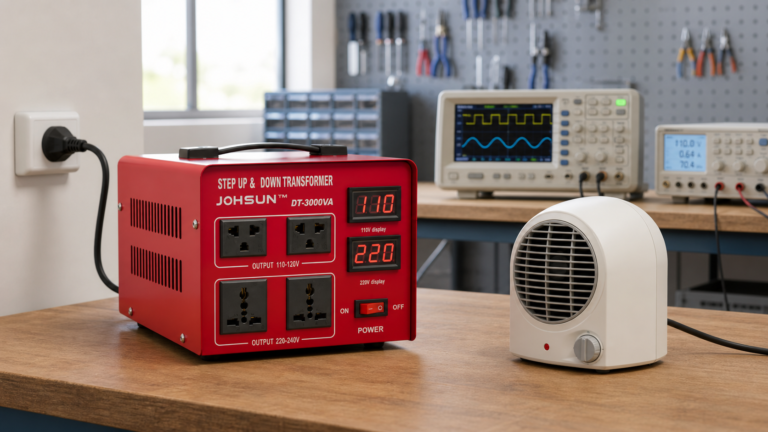
A bidirectional step-up/step-down transformer can support both directions when it is designed and labeled for that purpose. The user must still connect the source and load to the correct terminals or sockets and set any input selector before applying power.
How to Size a Step Up or Step Down Converter
1. Find the appliance’s maximum power
Use the wattage shown on the nameplate or in the manufacturer’s specifications. If only voltage and current are provided, estimate watts with W = V × A. For several devices, add the maximum wattages of everything that may operate at the same time.
2. Add continuous-load headroom
Do not select a converter whose rating exactly matches the load. For a straightforward electronic or resistive load, a practical starting point is at least 20–25% capacity above the maximum continuous demand. A 700W load, for example, should not be placed on a 700VA converter; moving to a 1000VA model provides more useful operating margin.
3. Account for startup surge
Motors, compressors, pumps, power tools, refrigerators, and some audio amplifiers can briefly draw much more than their running power. Use the equipment manufacturer’s starting-watt or inrush-current specification. If it is unavailable, ask the appliance or transformer supplier rather than relying on a universal multiplier.
4. Understand watts and VA
Transformer capacity is commonly stated in volt-amperes. For a purely resistive load, watts and VA are close. Motors and electronic power supplies can have a power factor below 1, so their VA demand may be higher than their real power in watts. When power factor is known:
Required VA ≈ watts ÷ power factor
Size against the converter’s continuous rating and confirm how the manufacturer defines short-term or surge capability. A large number printed on the enclosure is not useful unless the duty rating and test conditions are clear.
Frequency: The Difference a Transformer Does Not Fix
A normal step up voltage converter changes voltage but does not change 50Hz into 60Hz. The same is true for a standard step-down transformer. Many switch-mode power supplies and modern electronics accept both frequencies, but frequency-sensitive motors, clocks, turntables, tape machines, pumps, and timing equipment may run at the wrong speed, overheat, or perform poorly.
Check for “50/60Hz” on the appliance label. If the device is marked for only one frequency, confirm with its manufacturer whether it can operate on the local grid. When frequency must change, a true frequency converter or suitable regenerated power source is required.
Plug Adapter vs Voltage Converter
A plug adapter changes the physical shape of a plug so it fits a different socket. It does not increase or decrease voltage. A voltage converter changes the electrical voltage. Some travel products combine both functions, but you must verify the specifications rather than assume that a universal-looking socket provides voltage conversion.
Always preserve protective grounding for equipment that requires it. Avoid loose multi-adapter stacks, overloaded power strips, and daisy-chained converters. High-power and permanently installed equipment should be assessed by a qualified electrician.
Can One Transformer Step Voltage Up and Down?
Many transformer windings are electrically reversible, and purpose-built bidirectional products provide labeled connections for both 110–120V and 220–240V operation. However, reversibility does not mean every transformer can be safely connected backward. Protection, taps, wiring, insulation, connectors, and voltage selector design all matter.
Use only the directions listed by the manufacturer. Before connecting power, check the input setting, correct output socket, total load, fuse or breaker, and ventilation. Never change a voltage selector while the converter is energized.
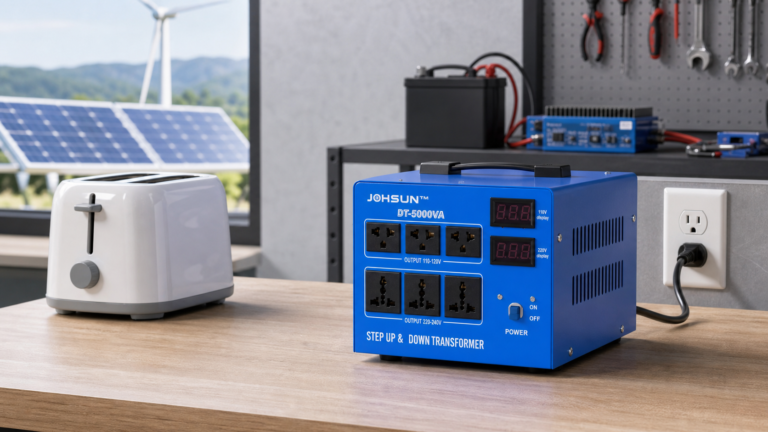
For still higher demand, review the DT-5000VA voltage converter transformer. These are comparison examples, not automatic recommendations. Confirm input/output voltage, continuous VA, surge requirements, frequency, outlet type, grounding, and the appliance manufacturer’s instructions before selecting a model.
Erreurs courantes en matière de sélection
Reversing the logic: select from wall voltage to appliance voltage, not from appliance voltage to wall voltage.
Ignoring dual-voltage labeling: many chargers already accept 100–240V.
Matching capacity exactly: heat, power factor, and startup current require headroom.
Assuming voltage conversion changes frequency: standard transformers normally preserve input frequency.
Using a compact travel converter for any load: some are limited to short-duration resistive appliances.
Blocking ventilation: transformer losses create heat, even with no overload.
Using the wrong input selector position: this can damage the converter and connected appliance.
Choose a step up voltage converter when the available AC voltage is lower than the appliance requirement. Choose a step-down converter when the available voltage is higher. Then verify capacity, surge, frequency, grounding, sockets, protection, and duty rating before use.
Do I need step up or step down for a 220V appliance in the USA?
If the local supply is about 120V and the appliance accepts only 220–240V, you need a step-up converter. Also verify wattage and 50/60Hz compatibility.
Do I need step up or step down for a 110V appliance in Europe?
If the local supply is 220–240V and the appliance accepts only 110–120V, use a step-down converter with enough continuous and surge capacity.
Does a higher-VA converter send too much power to my appliance?
No. A correctly connected appliance draws the current it requires. A higher converter capacity provides available headroom; the voltage still must match the appliance.
Can a step up voltage converter run continuously?
Only when the model is rated for continuous duty at the actual load and has proper ventilation. Follow the manufacturer’s temperature, placement, and duty-cycle instructions.
Will a 110V-to-220V converter also change 60Hz to 50Hz?
No. A standard transformer changes voltage, not frequency. Use equipment rated for the local frequency or a suitable frequency-conversion solution.
Découvrez comment un convertisseur courant-tension utilise un amplificateur opérationnel, une résistance de rétroaction et une rétroaction négative pour transformer le courant d'un capteur en tension.