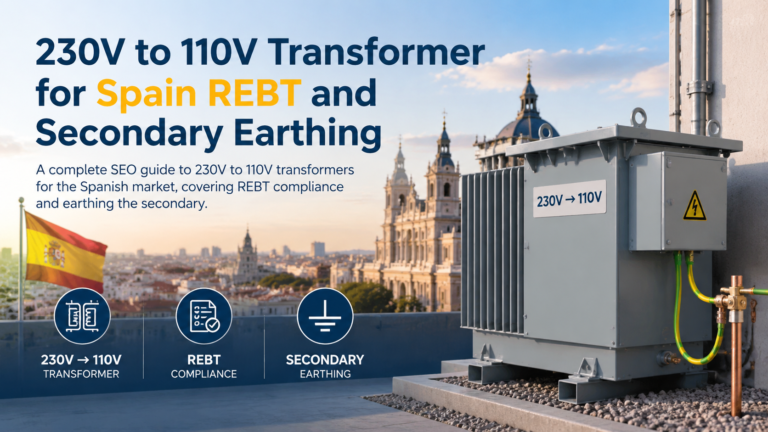







230V to 110V Transformer for Spain: REBT and Secondary Earthing
230V to 110V transformer for Spain: REBT compliance, ITC-BT-18 and ITC-BT-24, earthing the secondary and UNE-EN IEC 61558 documentation.
Read More
 English
A 3000 watt step up down heavy duty transformer is not just a voltage accessory. It is a capacity decision, a load-matching decision, and in many cases a risk-control decision for buyers who need to run 110V equipment on 220V power, or 220V equipment on 110V power, without guessing.
If you choose too small a unit, the problem is not only shutdown or poor output. You may also run into fuse trips, overheating, unstable startup, or shortened equipment life. This guide will help you distinguish step up vs step down transformer logic, judge whether 3000W is enough, compare 3000W with 5000W, and understand what a distributor, supplier, OEM buyer, or project purchaser should confirm before placing an order.
A step up transformer raises voltage from a lower input to a higher output. A step down transformer does the opposite. A dual-use step up and step down transformer is designed so the same unit can be used in either direction, depending on how the input and output are selected.
For a buyer, that distinction matters more than theory. What you really need to check is the rated voltage of the equipment, the voltage available at the installation site, and whether the transformer is designed for the exact conversion path you need.
| Term | What it means in practice | What you should verify |
|---|---|---|
| Step up transformer | Converts lower input voltage to higher output voltage | Equipment input rating, local supply voltage |
| Step down transformer | Converts higher input voltage to lower output voltage | Plug standard, output socket, current draw |
| Step up and step down transformer | Supports both directions on one unit | Switching method, terminal labeling, safe operating instructions |

When buyers search for terms like step up and step down transformer symbol or step up and step down transformer pdf , they are usually trying to answer a practical question: “How do I connect this correctly, and how do I confirm the direction?” On a PDF manual or wiring diagram, the symbol alone is not enough. The safer approach is to read the nameplate, the input/output label, and the connection instructions together.
Johsun Tec lists a dedicated step up/down transformer category and a DT-3000VA product page, while its broader DT/ST and STU product lines extend from smaller ratings up to 10KVA or 5KVA depending on the series. The available product snippets also describe these units as 110V/220V step up and down transformers for 50/60Hz operation, with protection features such as fuse or MCB configurations on listed models.
The most common buying mistake is to match the transformer to the device label and stop there. That works only for stable loads with low startup demand. It does not work well for motor-driven equipment, compressors, heating elements with cycling peaks, or devices that pull a brief surge at startup.
A better selection method is to ask four questions:
| Load type | Typical behavior | Is 3000W usually suitable? | Selection note |
|---|---|---|---|
| Resistive load | Stable draw, low startup surge | Often yes | Keep reasonable headroom for continuous use |
| Electronic power supply | Usually moderate variation | Often yes | Check peak current and input tolerance |
| Motor-driven load | High startup demand | Sometimes not | Size for startup, not only running watts |
| Compressor or pump | Sharp inrush current | Often risky at exact rating | Move up if startup is uncertain |
If your equipment runs at 1800W or 2200W and does not have a strong startup spike, a 3000 Watt Step Up Down Heavy Duty Transformer may be the right middle range. If the same nominal wattage is attached to a motor or compressor load, 3000W can become too tight very quickly.
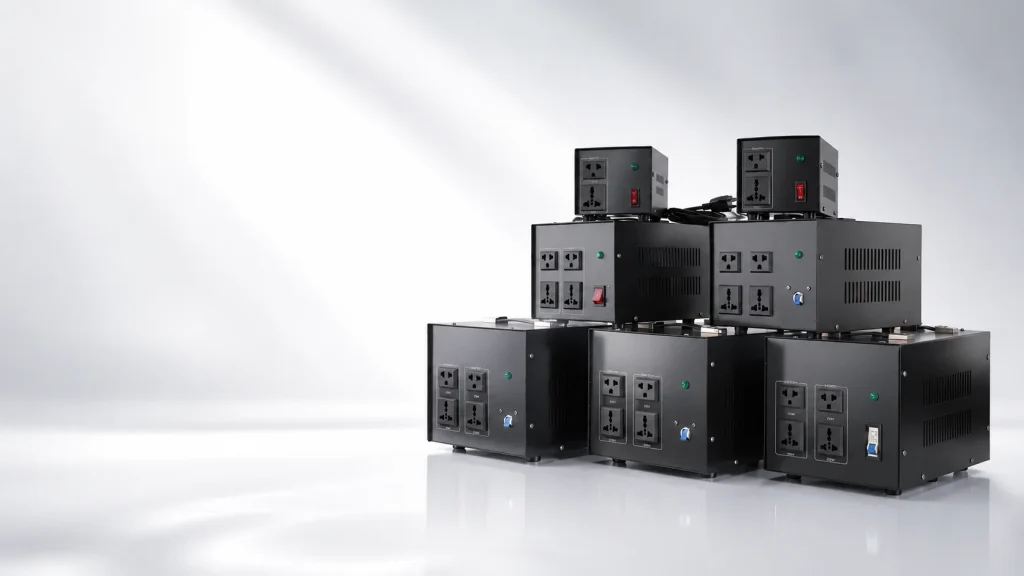
That is why a 3000 watt step up down heavy duty transformer should be treated as a capacity band, not a universal answer. For buyers who already know their application falls within that band, Johsun Tec’s DT-3000VA step up and step down transformer is one direct reference point within its listed product range.
Many buyers still confuse “step up vs step down transformer” because they think the name should follow the product, not the installation. In practice, the direction follows the relationship between the available power source and the equipment’s required input voltage.
The same logic applies when buyers try to distinguish between step up and step down transformer types from catalog text, packaging, or symbol references. Do not rely on a generic drawing or a sales title alone. Check the exact input/output labeling and the supported voltage pairs.
The second major decision is 3000W vs 5000W.
| Factor | 3000W class | 5000W class |
|---|---|---|
| Best fit | Stable medium-load devices | Higher-demand or surge-heavy devices |
| Margin for startup current | Limited if load is inductive | Better buffer for difficult starts |
| Size and shipping | Easier to handle | Heavier and less compact |
| Budget | Lower entry cost | Higher upfront cost |
| Buying logic | Works when the load is understood | Safer when the load is uncertain |
A 3000W model is often enough when the application is clearly defined and the operating load stays below the rating with margin. A 5000W unit becomes the safer choice when the equipment has startup spikes, uncertain real-world loading, or future expansion risk.
That is also where capacity-range links make sense naturally. If you are comparing 3000W with larger options, the DT/ST Series 100VA–10KVA and the STU Series 100VA–5KVA are useful for seeing how the supplier structures capacity steps beyond a single model.
For a retail user, the question is often “Will this run my device?” For a B2B buyer, the question is broader: “Will this model range fit my market, reduce claims, and simplify procurement?”
That changes the selection criteria. A distributor, wholesaler, or exporter should not only compare wattage. They should also check destination voltage standards, plug and socket versions, labeling language, packaging requirements, warranty handling, and whether the factory supports stable replenishment.
| Buyer type | Main concern | What to confirm first |
|---|---|---|
| Distributor or wholesaler | Fewer returns and simpler stock planning | Voltage mix, common load range, local plug format |
| OEM / ODM buyer | Product fit and brand control | Labeling, enclosure, packaging, private label options |
| Export project buyer | Site compatibility | Destination voltage, duty cycle, shipment configuration |
| Procurement team | Price with fewer after-sales issues | True load range, protection method, operating environment |
This is where product families matter more than a single SKU. A distributor covering small appliance conversion and light-duty resale may need lower-capacity options such as the ST Series 100VA–1500VA, while buyers targeting mid-range conversion demand may compare the STU Series 100VA–3KVA before moving into heavier units. Johsun Tec also presents these transformer lines within a broader power-products portfolio that includes voltage stabilizers, UPS systems, inverters, and battery chargers, which supports its positioning as a manufacturer and supplier rather than a single-product trader.
Common selection mistakes usually come from procurement shortcuts:
| Mistake | What happens | Better check |
|---|---|---|
| Treating watts and VA as identical in every case | Capacity may be misread | Confirm rating method and real load profile |
| Ignoring startup current | Unit trips or overheats at startup | Ask whether the load is motor-driven or surge-heavy |
| Choosing by price only | Lower cost turns into higher after-sales risk | Compare protection, duty cycle, and use case |
| Skipping input/output confirmation | Wrong conversion direction | Read the nameplate and local supply voltage first |
If you are preparing a distributor quote, wholesale order, or OEM/ODM inquiry, confirm the target voltage, load type, duty cycle, socket format, and labeling requirements before you ask for a final price. That one step usually does more to reduce returns than arguing over a small price difference.
A good buying decision is rarely about choosing the biggest transformer or the cheapest one. It is about matching the real load, the startup behavior, the destination voltage, and the operating pattern.
If your application has a stable medium load and the actual demand sits comfortably below the limit, a Johsun Tec 3000 watt step up down heavy duty transformer is often the right choice. If the load is uncertain, surge-heavy, or likely to grow, move up in capacity early and treat that extra margin as protection for both the equipment and the purchase.
It can usually support medium-load equipment when the real running demand stays below the rated capacity with margin. The key issue is not only the listed wattage of the device, but also whether it has a high startup surge.
Look at the power available at the site first, then compare it with the equipment’s required input voltage. If the source is lower than the equipment requirement, you need step up; if the source is higher, you need step down.
Sometimes yes, but often not at the exact rating. Motor-driven and compressor loads can pull a strong startup current, so capacity should be chosen with headroom rather than by running watts alone.
The real difference is not only 2000W on paper. A 5000W unit gives more room for startup current, uncertain loading, and longer-duty operation, while a 3000 Watt Step Up Down Heavy Duty Transformer unit is usually more compact and more economical when the load is clearly known.
That depends on the actual load level, ventilation, and the design limits of the unit. Continuous operation near the upper limit leaves less safety margin than moderate continuous loading.
They should confirm voltage standard, plug and socket format, target wattage range, labeling, packaging, and whether private label, OEM, or ODM support is required. For channel buyers, product-range planning matters almost as much as the individual model.