240V 120V Step Up Down Transformer Selection for Buyer
Published: Author: Lisa
A 240V 120V step up down transformer matters when your equipment voltage and your wall supply do not match, because the wrong choice can do more than stop a device from working: it can trip protection, overheat the transformer, or shorten the life of the load. This article will help you decide whether you need step up or step down conversion, how to size the unit for real load conditions, and when to move from a simple watt-based search to a more accurate supplier discussion.
What a 240V 120V Step Up Down Transformer Actually Does
A step up down transformer is not just a plug adapter. It changes the supply voltage so a 120V-rated device can run from a 220V–240V source, or a 220V–240V device can run from a 110V–120V source.
That sounds simple, but many buying mistakes start here. Search terms such as “240V 120V,” “220V to 110V,” and “110 220” often describe the same selection problem from different directions, so the nameplate on the equipment matters more than the wording in the search box.
Step up vs. step down Transformer
Use step up when the local supply is lower than the equipment’s rated input voltage. Use step down when the local supply is higher than the equipment’s rated input voltage.
A fast way to avoid confusion is to ask one question first: what voltage does the device require at its input terminals? Once that is clear, the transformer direction usually becomes obvious.
Local supply
Device rating
What you need
Typical use case
120V
220V–240V
Step up
Imported appliance or equipment test
220V–240V
110V–120V
Step down
North American device used overseas
110V–120V or 220V–240V
Mixed devices
Step up/down model
Service bench or export support setup
Why the voltage label is only the first filter
A transformer that can convert voltage is not automatically the right transformer for your load. Startup current, duty cycle, total wattage, and whether the device contains a motor, heater, compressor, or sensitive electronics all affect sizing.
This is why a “step up down transformer 1000W” search can be useful at the beginning but not at the end. A 1000W label may describe the running load, while the actual starting demand may be much higher for some equipment.
How to Size a 240V 120V Step Up Down Transformer
The most common sizing mistake is to match the transformer exactly to the appliance’s listed wattage. In real applications, you usually need margin for startup current, line fluctuation, heat, and continuous operation.
If the load is simple and resistive, such as some heaters or basic tools, the running wattage may be a reasonable starting point. If the load contains a motor, compressor, pump, or other inductive element, the transformer should be chosen with more headroom because startup demand can briefly rise far above the steady-state number.
A practical sizing rule
Start with the device’s rated input voltage and running wattage. Then check whether the load is resistive, electronic, or motor-driven, and whether it will run for a few minutes or for hours at a time.
The right unit is usually not the cheapest model that matches the headline watt number. It is the model that can handle the actual load pattern without running too close to its limit.
Load type
What to check
Better sizing logic
Common risk if undersized
Resistive load
Running wattage
Add safety margin above rated watts
Heat buildup and nuisance trips
Electronics
Input voltage stability, surge behavior
Avoid sizing too tightly
Unstable operation
Motor or compressor load
Startup current
Size above running watts with clear margin
Failure to start, overheating
Continuous-use equipment
Runtime and ventilation
Choose extra headroom for long duty cycles
Reduced service life
When 1000W, 3000VA, or 5000VA makes sense
A 1000W search usually points to lighter-duty or smaller single-load applications. A 3000VA class model becomes more relevant when the equipment is heavier, the startup demand is less predictable, or the transformer may run longer each day.
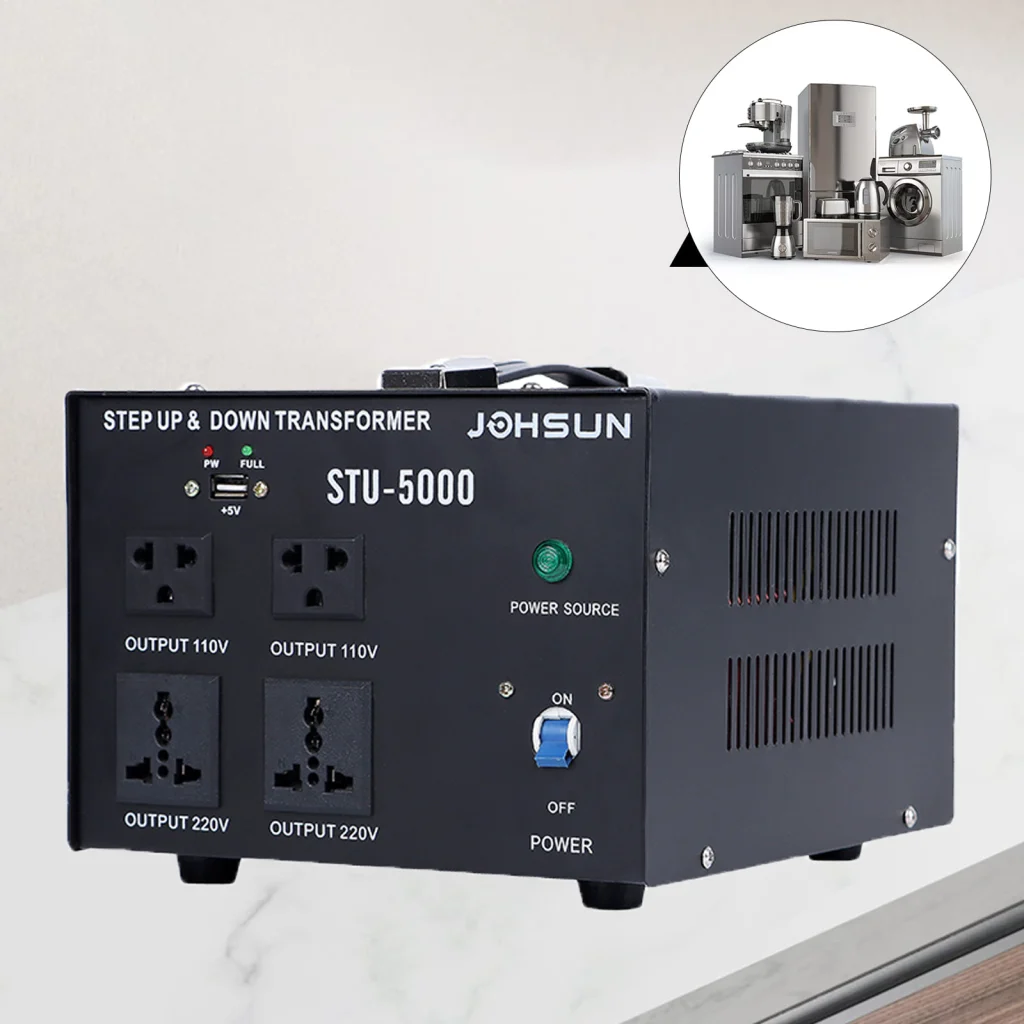
For buyers comparing mid-range options, the DT-3000VA Step Up and Step Down Transformer is presented on the site as part of the DT/ST toroidal step-up/step-down transformer family, while the broader DT/ST range is shown as covering 100VA–10KVA for 110V–220V conversion. For higher-capacity comparisons, Johsun Tec also shows an ST 5000W page and STU series pages extending to 5000VA, which is useful when the load is heavier or the buyer wants a wider capacity range before RFQ.
1000W and 1000VA are not always the same buying decision
In day-to-day sourcing, buyers often treat watt and VA numbers as if they were interchangeable labels. That shortcut can work for some simple loads, but it becomes risky when the connected equipment has a poor power factor, variable startup demand, or longer operating cycles.
For B2B procurement, a better approach is to send the supplier the equipment type, rated input, running current or watts, and whether the unit starts under load. That gives a manufacturer, exporter, or OEM supplier enough information to recommend a safer range instead of guessing from one number.
DT, ST, and STU Series: How to Compare the Options
Once the voltage direction is clear, the next question is not “Which keyword should I search?” but “Which product range best fits my power level and use case?” On Johsun Tec site, the step-up and step-down transformer pages are already grouped into ranges that make this comparison easier.
The DT/ST family is shown as a toroidal step-up/step-down transformer range from 100VA to 10KVA, while the ST-specific page focuses on 100VA to 1500VA, and the STU pages cover 100VA to 3000VA and 100VA to 5000VA for 110V–220V conversion scenarios.
Useful when load is heavier or future margin is needed
For example, if the requirement is still vague, a wide-range page makes sense. If the buyer already knows the project is in the low-power band, a narrower series page saves time and reduces confusion.
What Buyers Should Confirm Before Sending an RFQ
This is where many inquiries break down. A supplier cannot make a precise recommendation from “I need a 240V 120V Step Up Down Transformer” alone, because the same phrase may describe a small bench setup, a replacement unit for export support, or a bulk order for distributor channels.
Before contacting a manufacturer, trading company, or factory, prepare the following:
Input voltage at the installation site.
Required output voltage of the equipment.
Running wattage or current.
Whether the load has startup surge.
Expected runtime, temporary or continuous.
Plug, socket, and frequency requirements.
Quantity, target market, and whether OEM, ODM, private label, or white-label packaging is needed.
Common mistakes before supplier comparison
One mistake is treating “near me” as a technical filter. Local availability may reduce lead time, but it does not fix a wrong voltage direction, an undersized capacity, or a missing startup margin.
Another mistake is requesting price before defining the application. For wholesale, distribution, export, or bulk procurement, the more useful first step is not “What is the cheapest model?” but “What is the correct range for this load and market?”
Buyer mistake
What happens next
Better approach
Only sends wattage
Supplier guesses the rest
Send voltage, load type, and runtime
Confuses 220V/110V with 240V/120V keywords
Wrong direction may be quoted
Confirm the equipment nameplate first
Chooses exact watt match
Transformer runs too close to limit
Add real operating margin
Requests price before specs
Quote is incomplete or misleading
Build a short RFQ checklist first
Before you ask for a quotation, confirm the actual operating conditions and then compare the product range that fits them. If you are reviewing options for export supply, distribution, or OEM procurement, it helps to send the voltage, load profile, runtime, and quantity first so the supplier can point you to the right series instead of a generic watt-only recommendation.
The clearest selection logic is this: choose by voltage direction first, by real load behavior second, and by product series third. If those three points are correct, price comparison becomes meaningful; if they are not, even a low quote can become an expensive mistake after installation.
If you are comparing 240V 120V Step Up Down Transformer options for export, wholesale, or OEM supply, confirm the voltage, load type, runtime, and quantity first, then contact us for model matching and quotation support.
FAQ
Can a 240V 120V step up down transformer convert 220V to 110V?
Yes, that is one of the most common use cases. In practice, you still need to confirm the exact input and output ratings on the equipment nameplate rather than assuming every 220V/110V search result fits the same application.
How do I choose between a step up down transformer 1000W, 3000VA, and 5000VA?
Start with the device’s actual running load, then check whether it has startup surge or continuous-duty use. Smaller watt-based models may fit simple loads, while 3000VA and 5000VA options make more sense when the equipment is heavier, starts under load, or needs more operating margin.
Is the DT-3000VA model suitable for mid-range applications?
It is a useful reference point when your requirement sits above small bench or travel-type loads but below higher-capacity ranges. The site presents the DT-3000VA page within a DT/ST toroidal step-up/step-down range that spans 100VA–10KVA, which makes it a reasonable mid-range checkpoint during comparison.
What is the difference between ST and STU transformer pages on the site?
The ST page shown in the product results focuses on a 100VA–1500VA range, while the STU pages shown in the results extend to 3000VA and 5000VA. For the buyer, that difference is useful because it helps separate smaller-load comparison from broader mid- to higher-capacity review.
Can I use a step up down transformer for motor or compressor loads?
Sometimes yes, but this is exactly where undersizing becomes common. Motor and compressor loads often need extra capacity headroom because starting demand can rise well above the running number.
What should I send a supplier before requesting price?
Send the local input voltage, required output voltage, running watts or current, startup behavior, runtime, plug standard, frequency, and quantity. If the order is for wholesale, export, OEM, ODM, or private label supply, include the target market and packaging requirement so the quote matches the business case as well as the electrical requirement.
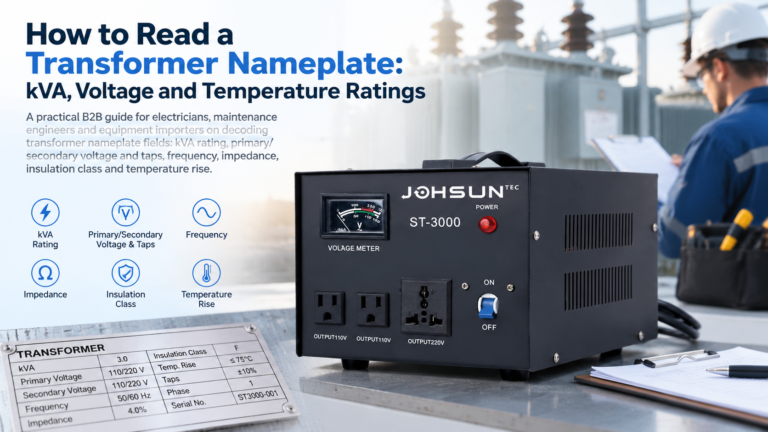
Learn how to read a transformer nameplate: decode the kVA rating, voltage and taps, frequency, impedance, insulation class and temperature rise before you install or replace a unit.