An oil test report arrives with twelve numbers and no verdict. Moisture, acid number, interfacial tension, breakdown voltage, seven dissolved gases, sometimes furans. Somewhere in that grid is a decision you have to make: accept the unit, treat the oil, or reject it.
Most guides to transformer oil testing explain what each parameter means and stop there. This one is organised around the three decisions the report actually forces on you. Is the sample even valid? Which layer is failing: the oil, the paper, or an active fault? And what should you do about it? We also cover the case a lot of buyers run into, where the equipment in front of them has no oil to test at all.
What Transformer Oil Testing Can and Cannot Tell You
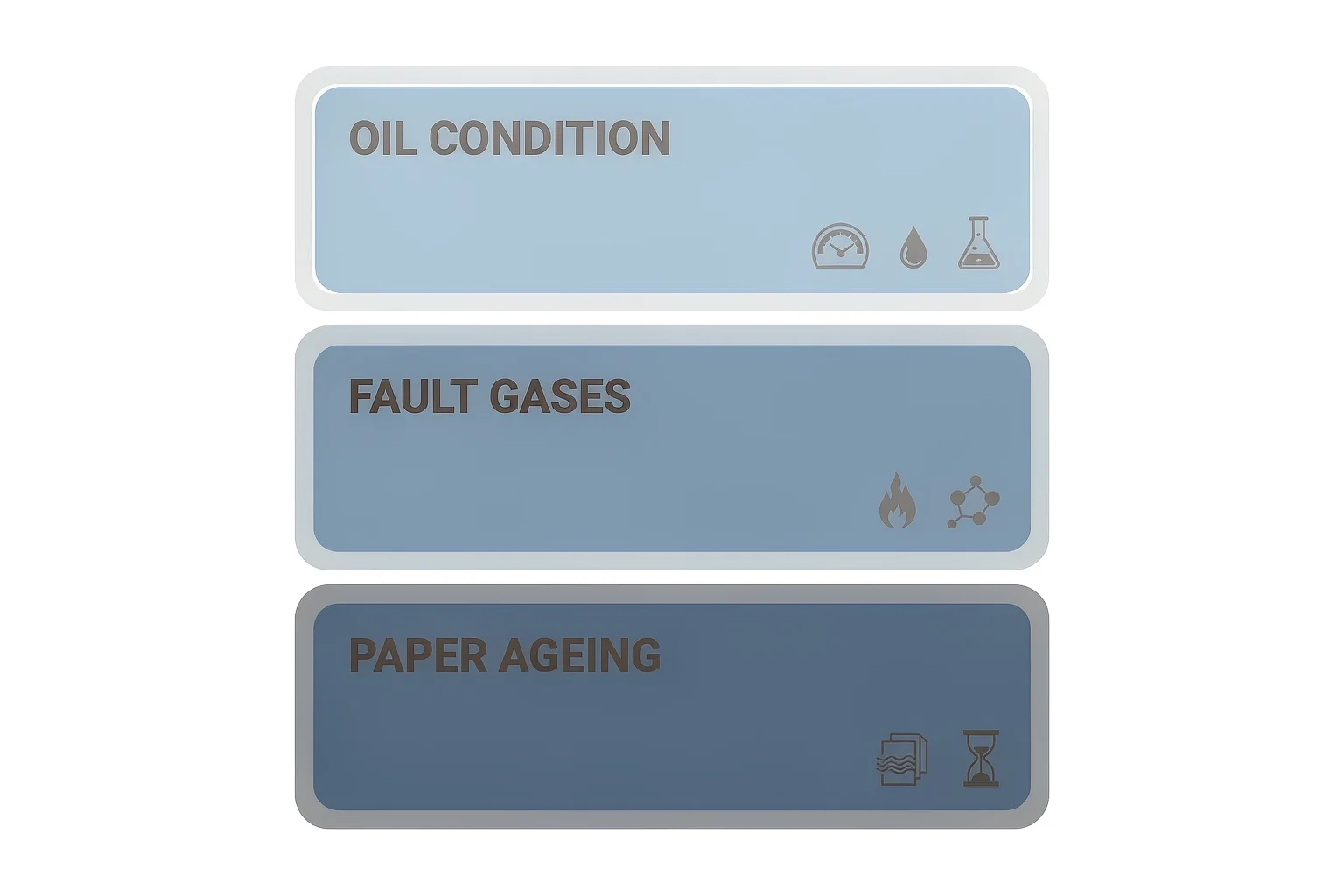
An oil report is really three reports stapled together. They answer different questions and fail in different ways, and reading them as a single health score is the most common interpretation mistake in the field.
| Layer |
Typical tests |
Question answered |
What it cannot tell you |
| Oil condition |
Breakdown voltage, moisture, acidity, interfacial tension, tan delta, resistivity |
Is the insulating medium still fit for duty? |
Why it degraded, or whether a fault is active |
| Fault gases |
DGA: H2, CH4, C2H6, C2H4, C2H2, CO, CO2 |
Is something overheating or arcing inside? |
How much life the insulation has left |
| Paper condition |
Furans (2-FAL), CO/CO2 ratio |
How far has the solid insulation aged? |
Where the ageing is concentrated |
A transformer can have excellent oil and dead paper, or clean oil and an active arc. Once you separate the layers, most confusing reports stop being confusing: you are looking at one healthy layer and one failing layer, not a contradictory single score. All of this applies to oil-immersed equipment, so if you are choosing between construction types, the maintenance consequences are set out in dry-type versus oil-immersed transformers.
Step Zero: Is the Sample Valid?
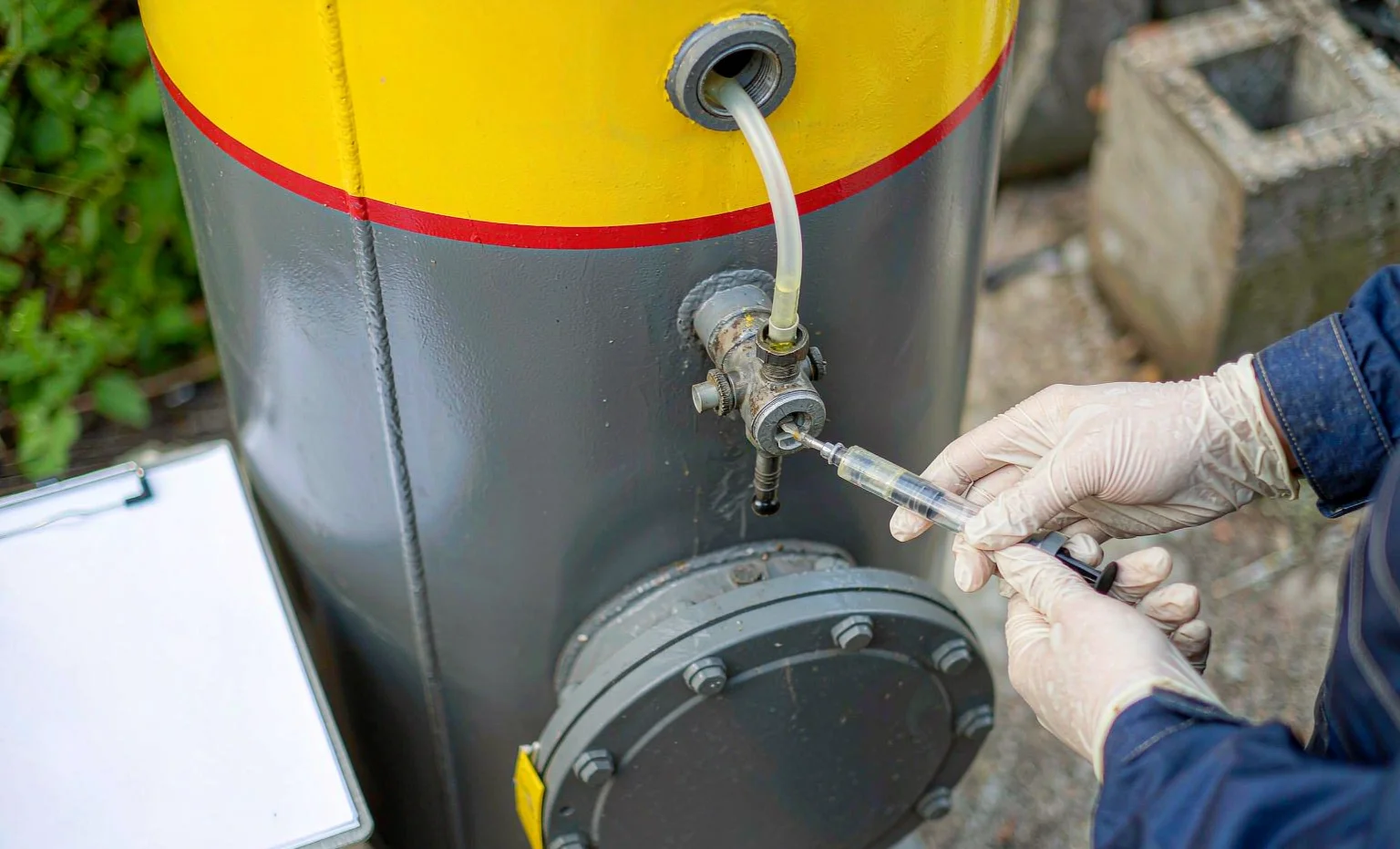
More bad maintenance decisions come from bad samples than from bad interpretation. DGA is unforgiving: a few microlitres of air in the syringe shifts the nitrogen and oxygen readings enough to mask a real pattern.
- Draw from the bottom drain valve, not the top filter connection. Gas and water accumulate low.
- Flush two to three litres first, and never take the first flush.
- Use a gas-tight glass syringe for DGA. Bottles suit breakdown voltage and moisture only, filled with no headspace.
- Record oil temperature at sampling, because gas solubility and water saturation both depend on it.
- Get DGA to the laboratory within about four days, and never sample straight after oil top-up or filtration.
Two signatures say resample before you act: a DGA showing atmospheric nitrogen and oxygen well above what a sealed unit should contain, and a breakdown voltage spread of more than about fifteen percent between consecutive tests on the same container.
| Sampling fault |
Effect on results |
How to spot it |
| Air ingress in syringe |
N2 and O2 inflated, hydrocarbon gases diluted |
O2/N2 ratio close to ambient air |
| First flush not discarded |
Stale oil from the valve body, low gas readings |
Results inconsistent with the previous sample’s trend |
| Wet container |
Moisture and BDV both wrong, always pessimistic |
Moisture spikes while acidity and furans stay flat |
| Held too long before testing |
Light gases migrate, acetylene under-reported |
Laboratory receipt date far from sampling date |
| Sampled cold |
Gas and water under-reported |
Sampling temperature missing from the report |
Reading Dielectric Strength Without Overreacting
Breakdown voltage is measured between two electrodes at a fixed gap while voltage is raised until the oil fails, normally six times, with the mean reported. Two details decide whether the number means anything: the electrode geometry and gap, and which standard was used.
| Method |
Electrodes |
Gap |
Typical new-oil result |
Behaviour |
| IEC 60156 |
VDE, spherical capped |
2.5 mm |
at least 30 kV |
Balanced; the usual field reference |
| ASTM D877 |
Flat disks |
2.54 mm |
at least 30 kV |
Reads high; extremely sensitive to particles |
| ASTM D1816 |
VDE |
1 mm / 2 mm |
at least 25 / 45 kV |
Sensitive to moisture; used for higher classes |
A D877 result and a D1816 result at 1 mm are not comparable, and D877 typically reads 10 to 20 kV higher on the same oil. If two laboratories disagree, check the method column before you check the oil.
Dielectric strength is also a lagging and non-specific indicator. It confirms that something contaminated the oil without saying what, which is why breakdown voltage alone should never trigger an oil change.
Reading DGA: Which Gas Points to Which Fault
Dissolved gas analysis works because each fault temperature produces a characteristic molecule. The pattern, not the individual numbers, carries the diagnosis.
| Gas |
Indicates |
Approximate temperature |
Urgency |
| H2 |
Partial discharge, corona |
Low energy |
Trend it; investigate if rising |
| CH4 |
Thermal fault in oil |
Under 300 °C |
Check loading and cooling |
| C2H6 |
Thermal fault in oil |
300 to 700 °C |
Check loading and cooling |
| C2H4 |
Hot metal, severe local heating |
Above 700 °C |
Act within days |
| C2H2 |
Arcing |
Above 1000 °C |
Act immediately |
| CO, CO2 |
Cellulose involvement |
Paper degradation |
Read with furans |
Absolute levels are the least informative part of the report. Two things carry the diagnosis: the gas pattern, which gives the fault type, and the gassing rate, which tells you whether the fault is stable or running. A unit at twice the normal ethylene but flat for three years is a very different asset from one that doubled in six months. A single DGA without a baseline is close to useless.
Ratio methods such as the IEC 60599 three-ratio scheme and the Duval triangle compress the pattern into a fault zone. They are useful shortcuts, but they assume one dominant fault. Simultaneous faults and non-mineral fluids such as ester or silicone fall outside their validity.
Acetylene deserves a separate rule. Any C2H2 above the detection limit means a temperature no healthy transformer reaches, so do not wait for a trend. The one legitimate exception is a unit sharing oil between tank and on-load tap changer, where tap changer arcing contaminates the main sample.
Cross-Reading the Report: Four Combinations That Change the Verdict
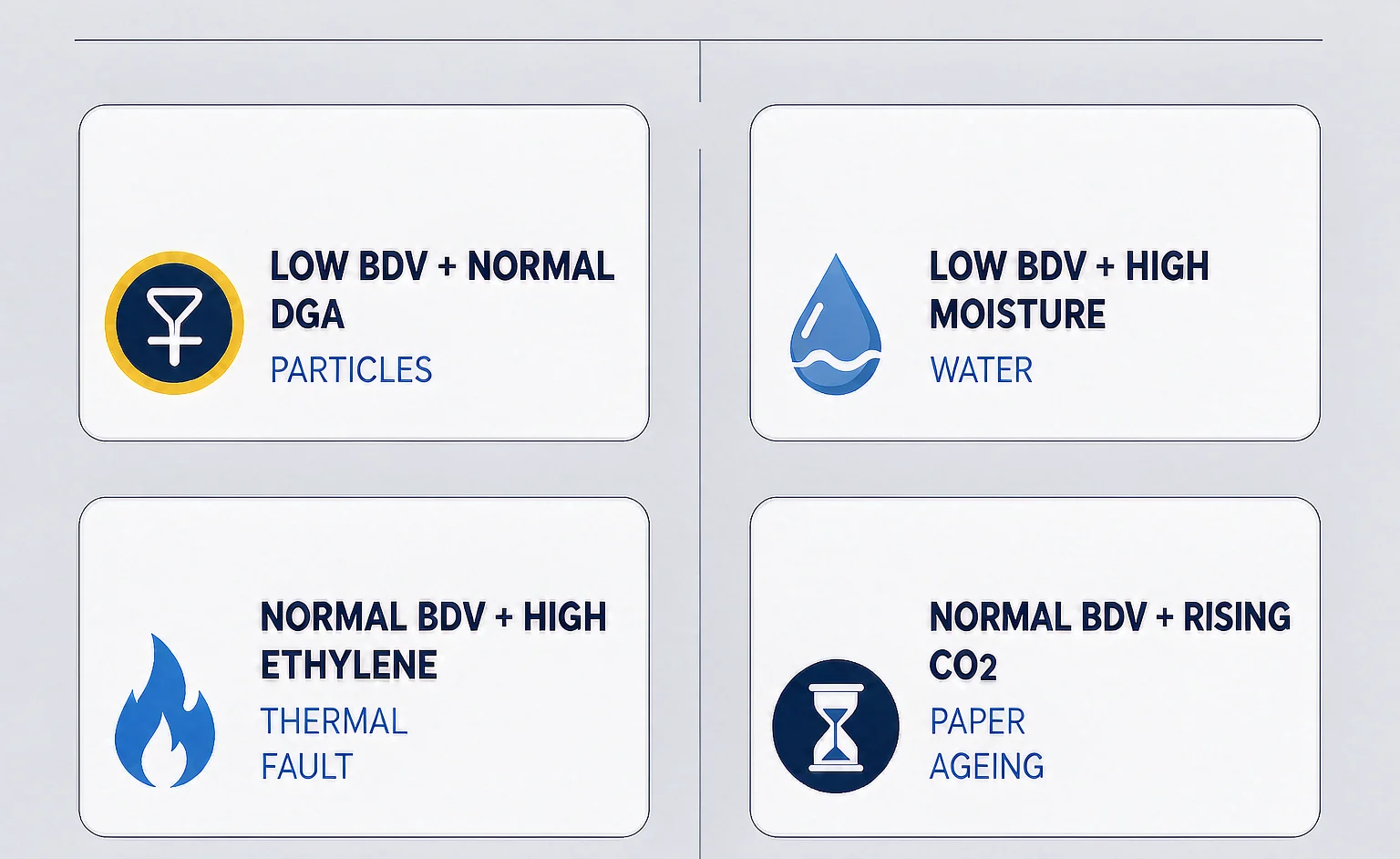
Reading the layers together is where the report becomes a decision. These four combinations cover most of what you will actually see.
| BDV |
Moisture |
DGA |
Most likely cause |
First action |
| Low |
Normal |
Normal |
Particulate, carbon or sludge |
Filter the oil; find the particle source |
| Low |
High |
Normal |
Water ingress |
Dry the oil; find and seal the leak |
| Normal |
Normal |
High C2H4, CH4 |
Active thermal fault |
Reduce load, check cooling; oil is not the problem |
| Normal |
Normal |
Rising CO, CO2, furans |
Paper ageing |
Plan replacement; treatment buys time only |
The rule underneath the table is simple. Treat the oil only when the oil is the problem. In the bottom two rows the oil is doing its job and is being damaged by something else, so filtration or replacement will restore the numbers and leave the cause in place. If the pattern points to water, the sequence for locating and stopping the entry path is covered in what to do about transformer leakage.
Furans: The Part of the Report Buyers Skip
Furfuraldehyde, usually reported as 2-FAL, is a degradation product of cellulose. It exists in the oil only because paper is breaking down, which makes it the closest thing to an odometer for the solid insulation. This matters because oil can be reconditioned and paper cannot.
Furan values are read in bands rather than against a single limit, and the bands shift with transformer class and paper type, so use the standard your laboratory cites rather than a figure from a blog. What matters operationally is direction. A stable low level on a twenty-year-old unit is reassuring; a value that has doubled over two annual samples is a retirement signal even inside the band.
Rising furans alongside rising CO and CO2 usually means the paper is being cooked rather than chemically aged, which points back at loading and cooling. The signs to look for on site are in transformer overheating warning signs.
Accept, Treat or Reject: The Buyer’s Decision
For a procurement or engineering team, an oil report matters at three distinct moments, and the comparison baseline differs at each one.
| Moment |
Compare against |
Reasonable response |
| Factory acceptance, before shipment |
New-oil specification and type test data |
Reject marginal breakdown voltage or acidity before the unit leaves |
| Commissioning, on arrival |
Factory values plus transport exposure |
Dry or filter on site; document the delta |
| In service, annual |
The unit’s own previous samples |
Trend decides; absolute limits only trigger investigation |
Three clauses are worth writing into the purchase order, because they turn an argument into a procedure. Specify the test methods and the standard revision, not just the limits. Require the sampling point and oil temperature on the certificate. And require the laboratory’s accreditation reference, so a result can be defended inside warranty.
The report also has to be read against the rating it claims to meet. A breakdown voltage figure means nothing without the voltage class and nameplate data behind it, which is why the reading order is nameplate first, oil report second. Those fields are explained in how to read a transformer nameplate.
When Oil Testing Does Not Apply: 100 VA to 10 kVA
A large share of the low-voltage transformers sold into industrial and export projects never see an oil test, because they contain no oil. Sealed, air-cooled step-up and step-down units in the 100 VA to 10 kVA range, such as the ST-3000VA 110 V to 220 V converter, have no drain valve, no conservator, and no gas space to sample.
They still get verified, but with a different test set:
- Insulation resistance and polarisation index at a defined test voltage.
- Turns ratio on every tap position, compared with the nameplate ratio.
- DC resistance on each winding, checked for balance.
- No-load loss and no-load current, which expose core and inter-lamination problems.
- Temperature rise at rated load, then a thermal check under real load on site.
One warning for buyers. If a supplier offers an oil test report for a sealed dry-type unit in this class, treat it as a documentation problem rather than a quality bonus. Either the unit is not what the datasheet says, or the report belongs to a different product. Where oil-immersed equipment is specified, the nameplate impedance sets the fault level the protection must clear, as covered in transformer percent impedance.
The Short Version
Read the report in a fixed order. Confirm the sample is valid before you read a single number. Separate the three layers so you know whether the oil, the paper, or a fault is the subject. Then cross-read breakdown voltage against moisture and gas pattern to find the cause rather than the symptom. Trending beats thresholds, and the gassing rate beats the absolute gas level every time.
If you are specifying low-voltage transformers and want to know which verification data should accompany the unit, or whether an oil programme applies to your design at all, send us the nameplate details and our engineering team will tell you what the acceptance test set should contain. Start from the transformer range.
FAQ
How often should transformer oil be tested?
Annual DGA plus moisture and breakdown voltage is the normal baseline for in-service oil-immersed units. Move to six-monthly sampling once a fault is indicated, and sample immediately after any protection operation or repair.
What dielectric strength is acceptable for transformer oil?
For equipment up to about 72.5 kV, in-service oil is commonly held at 30 kV minimum under IEC 60156, with new oil well above that. Higher voltage classes carry higher limits. Compare only against the same method.
What does acetylene in transformer oil mean?
Acetylene indicates arcing above roughly 1000 °C. Any reading above the detection limit warrants immediate investigation rather than trending, unless the sample came from a shared tap changer compartment.
Do small low-voltage transformers need oil testing?
Only if they are oil-immersed. Most sealed units between 100 VA and 10 kVA are dry-type and have no sampling point. Verify them with insulation resistance, turns ratio, DC resistance and temperature rise instead.