Dry-Type vs Oil-Immersed Transformers: What’s the Difference?
Published: Author: Lisa
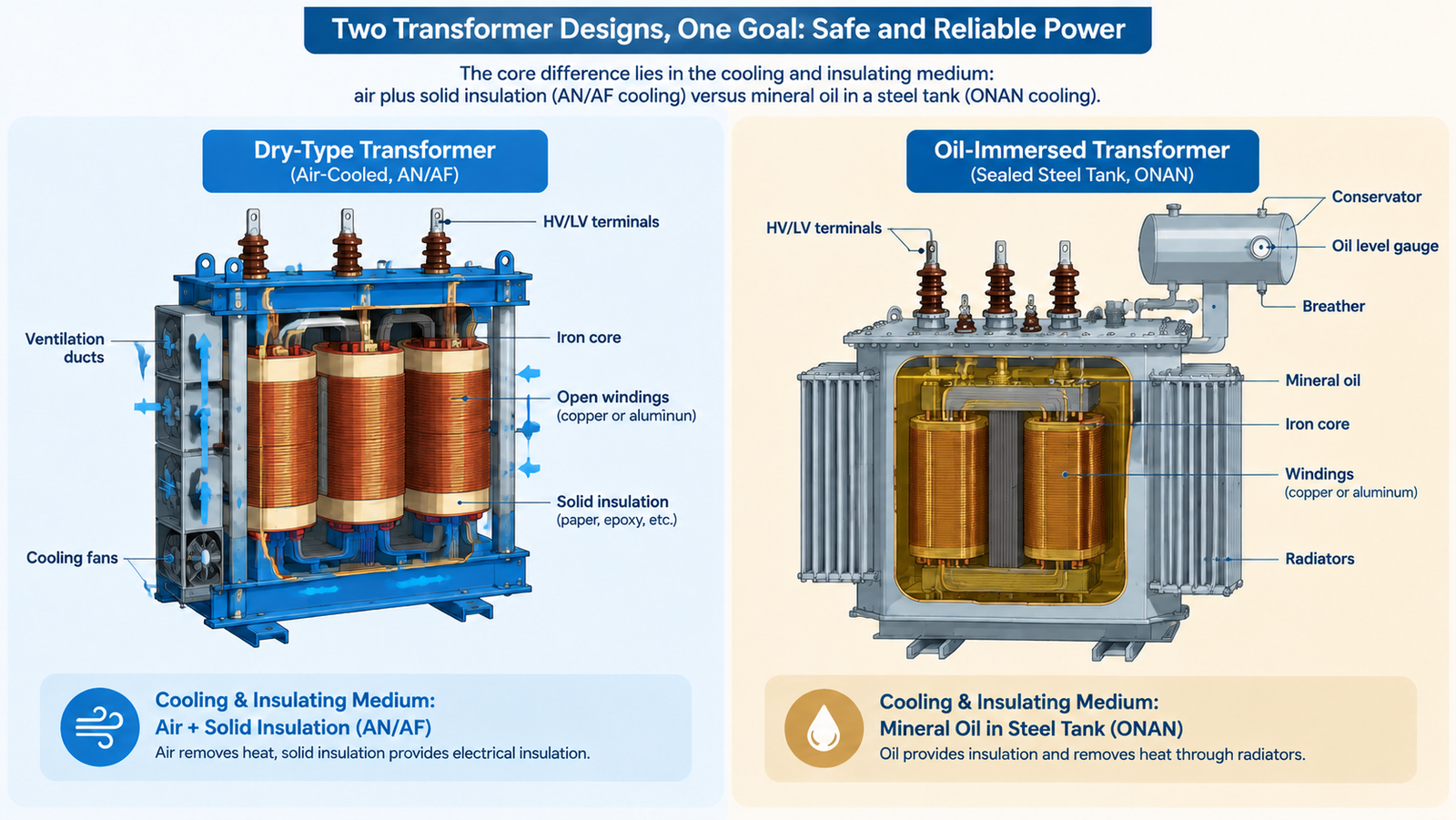
The difference between a dry-type transformer and an oil-immersed transformer comes down to one thing: what surrounds the core and windings. A dry-type unit relies on air and solid insulation; an oil-immersed unit submerges the active part in oil that also carries heat away. Fire behaviour, installation rules, overload tolerance, maintenance and cost all follow from that choice.
Most comparisons online are written for 10 kV and 35 kV distribution transformers rated in the hundreds of kVA. If you are specifying 100 VA to 10 kVA for equipment or a control panel, that advice only half applies. Here is the engineering comparison, then a ten-minute decision sequence for low-voltage buyers.
Dry-Type vs Oil-Immersed: The Short Answer
A dry-type transformer uses air as the cooling medium and solid insulation — impregnated paper, varnish, cast epoxy resin or encapsulated windings — to isolate the turns. Cooling is described as AN (natural air) or AF (forced air with fans). There is no liquid to leak, test or replace.
An oil-immersed transformer places the core and coils inside a steel tank filled with mineral oil or a natural ester. The oil insulates the windings and transfers heat to the tank walls and radiators. Cooling classes run from ONAN through ONAF to OFAF, and the tank brings extra hardware: conservator, breather, oil level gauge and pressure relief device.
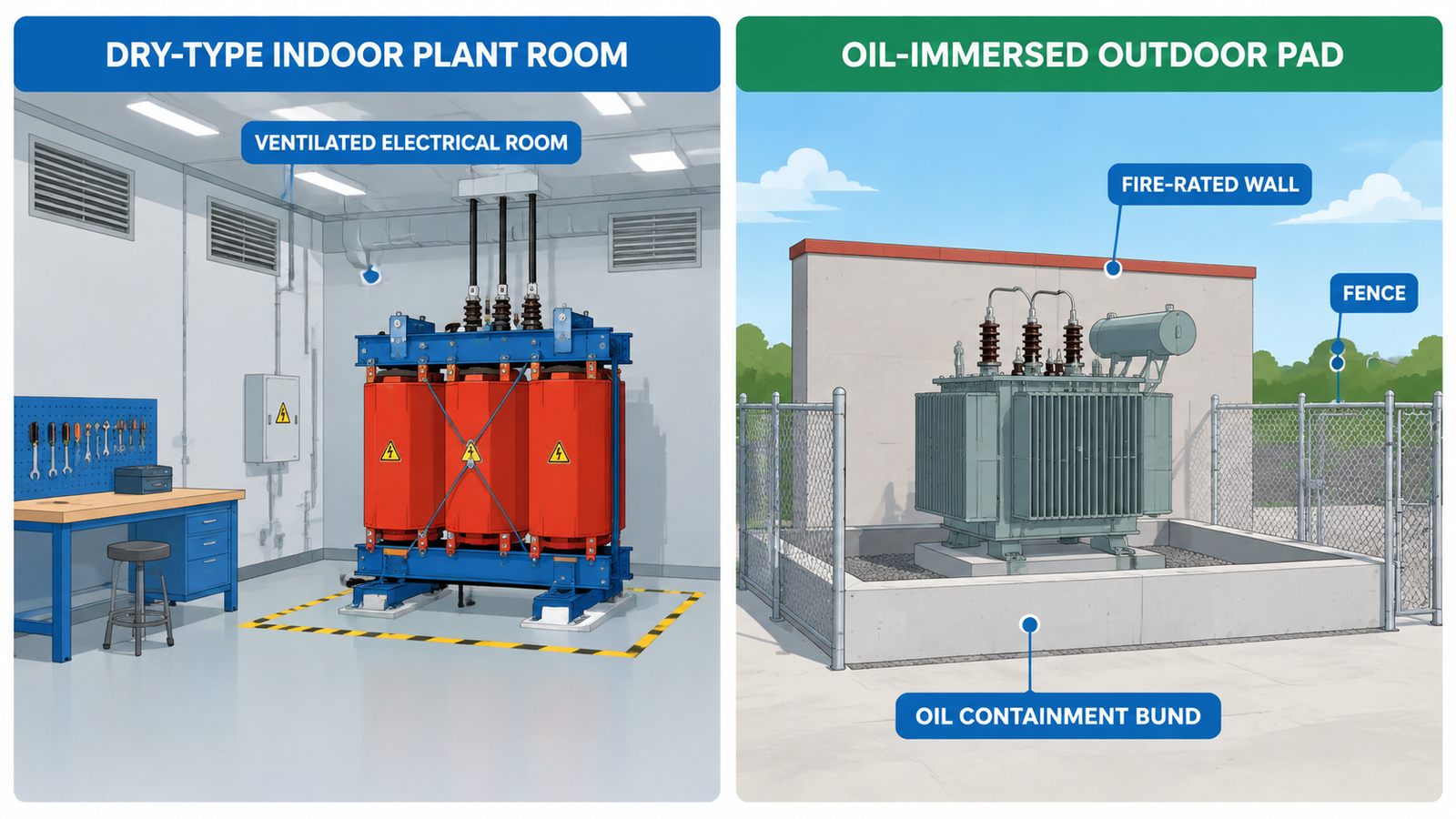
If the unit goes inside a building where people work, dry-type is usually the default. If it goes outdoors in a fenced compound and the budget is tight, oil-immersed is usually cheaper per kVA. Those two sentences cover most projects; the rest of this article covers the cases where the choice is close.
What Actually Differs: Six Engineering Points
1. Insulation and cooling
Air is a weaker dielectric than oil and a poorer heat carrier. A dry-type unit therefore runs at a higher temperature rise and needs wider ducts and a larger footprint. Dry-type designs are commonly built to 80 K rise on Class F insulation or 100–125 K on Class H; oil-immersed units are usually specified at 55–60 K top-oil rise. Cooling class is printed on the rating plate — an AF-rated unit will not deliver nameplate kVA with the fans off.
2. Fire behaviour and installation permission
Cast-resin dry-type transformers are self-extinguishing and produce limited smoke; open ventilated types are flammable but carry far less fuel than a tank of oil. Oil-immersed units contain a combustible liquid, so most codes require a fire-rated vault, oil containment, suppression or a less-flammable ester liquid before the unit may go indoors. This is the largest hidden cost driver: the transformer is cheaper, the room around it is not.
3. Overload capacity and thermal behaviour
Oil has high thermal mass and circulates by convection, so an oil-immersed unit tolerates short overloads and high ambient temperatures more gracefully. A dry-type unit heats and cools faster: it responds quickly to load changes but reaches its hot-spot limit sooner in a sustained overload. If the load includes frequent starting currents, size for the peak and review the failure modes in our guide to transformer overheating.
4. Maintenance
A dry-type unit needs periodic duct cleaning plus torque and insulation checks. Dust, humidity and conductive contamination are its real enemies — in a foundry, a clogged duct is a slow-motion failure. An oil-immersed unit needs oil level checks, breather silica gel replacement, gasket inspection and periodic oil testing for dielectric strength, moisture and dissolved gas.
5. Efficiency, losses and noise
At the same rating and efficiency class, both designs land within a fraction of a percent on full-load losses; the difference appears at part load. Noise is the other trade-off: a steel tank muffles core hum, so an open dry-type unit in a plant room is usually louder.
6. First cost versus installed cost
Above roughly 100 kVA an oil-immersed unit is usually cheaper to buy. Below that the gap narrows and sometimes reverses, because tank fabrication and oil filling do not scale down well. Compare installed cost: the oil unit may need a fire-rated enclosure, bunding and a maintenance contract; the dry unit may need a ventilated room.
Factor
Dry-type
Oil-immersed
Insulation and cooling
Air plus solid insulation; AN or AF
Oil plus solid insulation; ONAN, ONAF, OFAF
Fire risk
Low; cast resin self-extinguishing
Combustible liquid; vault or suppression indoors
Indoor installation
Normal choice, close to the load
Restricted by code unless ester-filled
Short-time overload
Moderate; fast hot-spot rise
High; large thermal mass
Maintenance
Cleaning, torque and insulation checks
Oil tests, breather, gaskets, leak repair
Typical service life
20–25 years
25–30 years with a maintenance programme
First cost per kVA
Higher above ~100 kVA
Lower above ~100 kVA
Why Most Advice Misses Low-Voltage Buyers
Search this topic and you land on cast-resin SC(B) and S11 distribution transformers rated 30 kVA to 2,500 kVA at 10 kV or 35 kV. Useful for a substation, misleading for a 1 kVA isolating unit in a control cabinet.
At low voltage the landscape changes in three ways. Oil-immersed designs are rare below about 10 kVA, because tank, oil volume and sealing hardware cannot be justified. The meaningful sub-choice inside “dry-type” is construction, not medium: open ventilated, encapsulated in cast resin, or fully sealed. And the governing standard shifts from IEC 60076-11 towards IEC 61558 for small isolating transformers, which changes the temperature limits and tests you should ask for.
So the real question at low voltage is rarely “dry or oil”. It is which dry-type construction, at what insulation class and IP rating. Our overview of how many types of transformer are there puts this comparison in context.
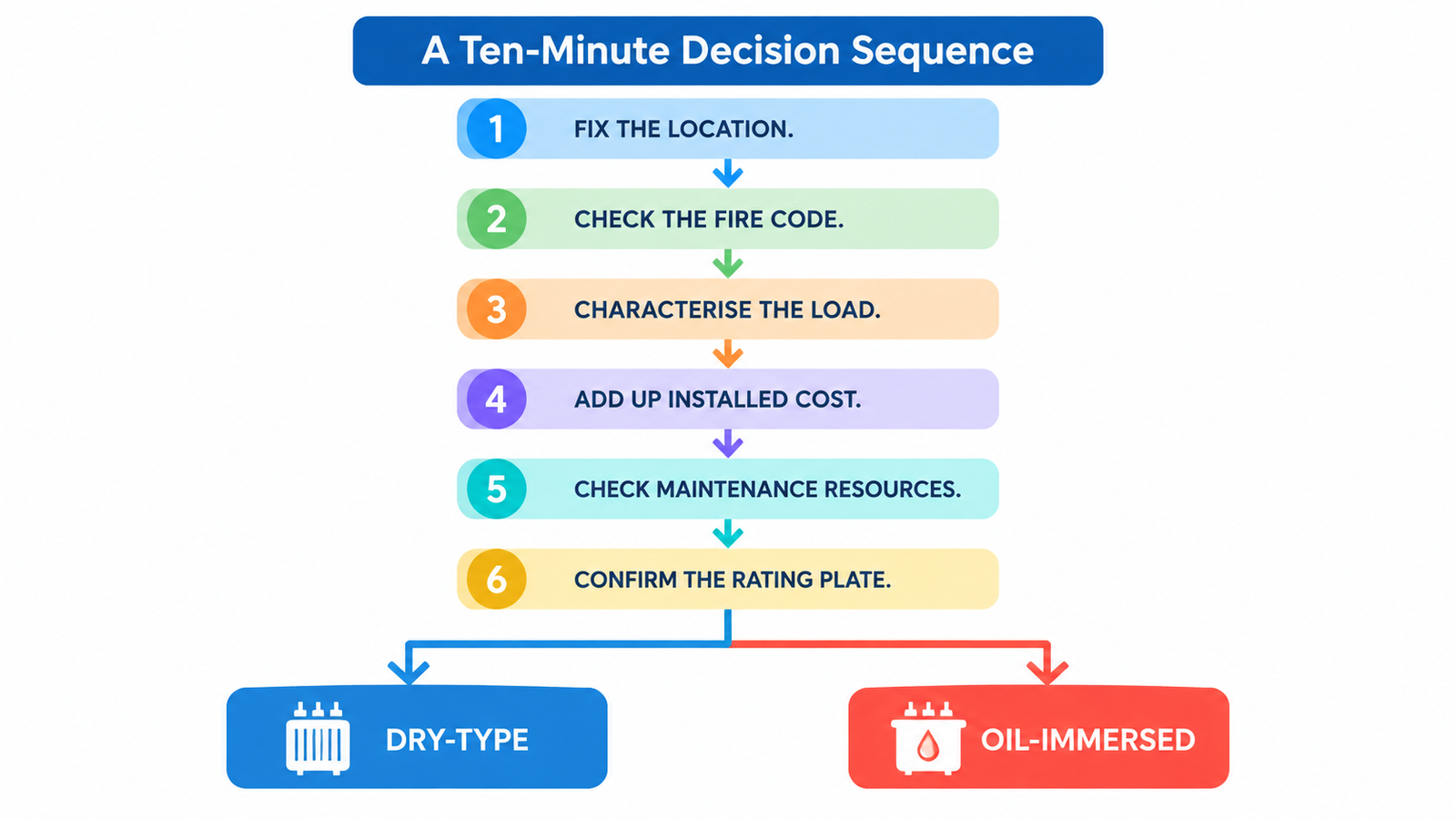
A Ten-Minute Decision Sequence
Fix the location first. Indoors in an occupied building, basement or tunnel: dry-type. Outdoor compound with fire separation: either.
Check the code, not the catalogue. Confirm what local fire codes permit indoors. If ester-filled units are accepted, the oil option reopens.
Characterise the load. Steady electronic or lighting load favours dry-type. Motor starting, welding or cyclic impact load favours the thermal mass of oil, or a larger dry-type frame.
Add up installed cost. Unit, room, bunding, ventilation, cabling and ten years of maintenance labour.
Check who maintains it. No oil-testing capability on site is a strong argument for dry-type.
Confirm the rating plate matches the application. Cooling class, temperature rise, IP rating, ambient and altitude. Our guide to reading a transformer nameplate covers each field.
Your situation
Recommended choice
Indoor plant room, hospital, school, data hall
Cast-resin or encapsulated dry-type
Basement or space-limited electrical room
Dry-type, compact frame, AF cooling
Outdoor pad or fenced compound, cost-driven
Oil-immersed, ONAN
Dusty, humid or washdown environment
Sealed or high-IP dry-type, or oil-immersed outdoors
Motor starting and cyclic impact loads
Oil-immersed, or dry-type oversized 25–40%
No maintenance team on site
Dry-type
Bench or test-bay use with adjustable output
Dry-type variable transformer
Where Oil-Immersed Still Wins at Low Voltage
Two genuine advantages survive below the distribution scale. The first is harsh-environment durability: a sealed tank tolerates dust, humidity, salt air and wide temperature swings that would choke an air-cooled winding, which is why pad-mounted units dominate coastal distribution. The second is short-time overload for motor and welding duty, where the oil’s thermal buffer absorbs inrush events that would push a dry-type hot-spot towards its limit.
Everything else at this scale is dry-type territory. A 0.5–5 kVA variable transformer for a test bench is air-cooled by necessity: the brush track and exposed winding could not work immersed, and the application needs adjustable output rather than a fixed ratio. Units such as the TDGC2J series 0.5 kVA to 5 kVA variable transformer show how much of the low-voltage market is settled by construction rather than by cooling medium.
Specifications to Put on the RFQ
An RFQ that leaves these fields open returns quotes you cannot compare:
Rated kVA, primary and secondary voltage, phase count, frequency
Cooling class (AN, AF, ONAN, ONAF) and whether nameplate kVA assumes fans running
Temperature rise and insulation class
Site ambient temperature and altitude
IP rating and enclosure finish for the actual environment
Winding material and conductor type
Applicable standard and the factory test report you expect
Termination type, cable entry and mounting arrangement
Cooling class sets the usable continuous rating, and ambient temperature quietly derates any unit in a hot plant room. Get those wrong and the transformer is correct on paper but undersized in service. The physical differences behind them are covered in our note on transformer construction and iron core structure.
Common Selection Mistakes
Buying on unit price. The cheaper tank often arrives with a fire-rated room and a bund attached.
Assuming dry-type means maintenance-free. It means no oil programme. Duct cleaning still matters; a clogged air path is a fire risk.
Ignoring the fans. An AF-rated unit with failed fans is an overloaded unit. Specify fan failure alarming or size for AN.
Conclusion
Choose dry-type when the transformer lives indoors, near people or near the load, and when you want a short maintenance list. Choose oil-immersed when the unit lives outdoors, the load is harsh and cyclic, and the site can support an oil inspection programme. At 100 VA to 10 kVA the decision is usually made for you by location; the engineering effort belongs in cooling class, insulation class and IP rating.
If you are narrowing down a specific rating, the step-up and step-down transformer range covers dry-type units from 100 VA to 10 kVA in single-phase and three-phase versions, and our team can confirm the cooling class and derating for your ambient conditions before you commit to a frame size.
FAQ
Can an oil-immersed transformer be installed indoors?
Only where the local code allows it. Most codes require a fire-rated vault, oil containment, suppression or an ester liquid. For a normal indoor electrical room, a dry-type unit avoids the question.
Is a dry-type transformer more expensive?
Above roughly 100 kVA the dry-type unit usually costs more to buy; below that the gap narrows. On installed cost the comparison often flips, because the oil unit needs fire separation, bunding and an oil programme.
Which type handles overload better?
Oil-immersed. The oil’s thermal mass absorbs short overloads and high ambient temperatures better. Dry-type units heat quickly, so size them for the actual peak.
Do dry-type transformers need a ventilated room?
Yes, unless sealed. Air-cooled units need clearance for convection and a supply of clean, cool air. Poor ventilation derates the unit and shortens insulation life.
Which lasts longer?
With proper maintenance, an oil-immersed transformer typically reaches 25–30 years and a dry-type 20–25. In practice, installation environment and loading matter more than the nominal figures.
How to size a step-up transformer for a motor: locked-rotor current, kVA code letters, starting kVA by method, voltage-dip and thermal-duty checks, plus the traps most guides miss.
What medical-grade really requires for a 100 VA–5 kVA isolation transformer: IEC 60601-1 limits, 2×MOPP dielectric tests, leakage current budgets and the documents to demand from a supplier.
A spec-by-industry guide to transformer applications in power distribution, industrial, medical and renewable projects: which function, kVA rating, duty cycle and enclosure each vertical actually needs.