






230V to 110V Transformer for Spain: REBT and Secondary Earthing
230V to 110V transformer for Spain: REBT compliance, ITC-BT-18 and ITC-BT-24, earthing the secondary and UNE-EN IEC 61558 documentation.
Read More
 English
Selecting the wrong step-up transformer can leave your equipment underpowered, cause nuisance tripping, accelerate insulation failure, or create a fire hazard. Unlike a general-purpose transformer, a step-up transformer must be chosen with specific attention to voltage ratio, VA sizing, inrush behavior, and core construction. Many engineers and procurement teams rely on rule-of-thumb sizing, which works until it does not. This guide replaces guesswork with a structured evaluation framework — from nameplate ratings to application-specific sizing logic — so you can confidently specify the right unit for your voltage conversion needs.
A step-up transformer raises the input voltage to a higher output voltage. Common scenarios that call for a step-up configuration include:
If your application involves any of these situations, the rest of this guide will help you narrow down the correct specifications.
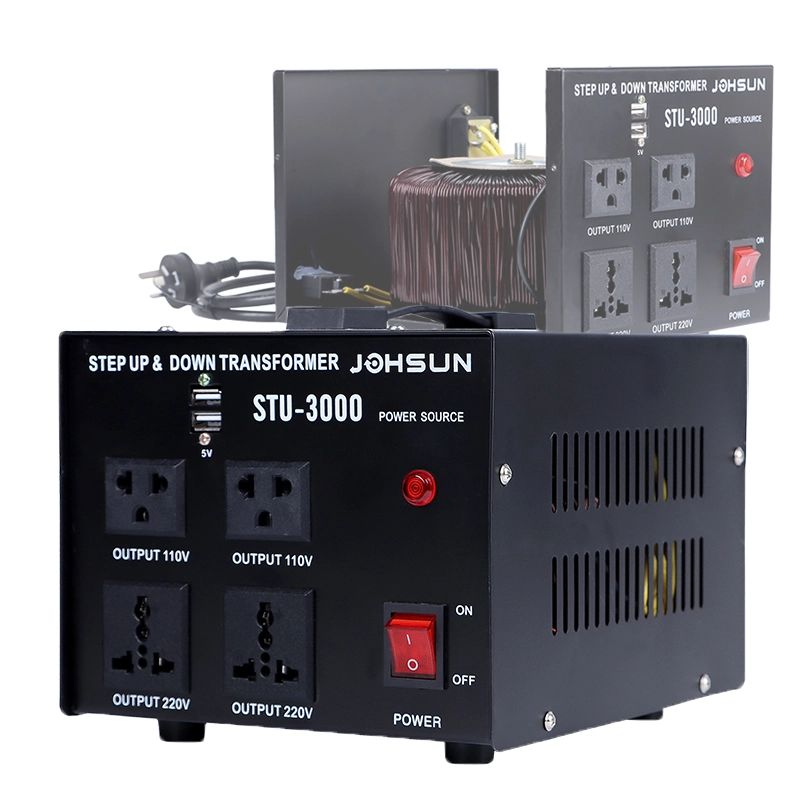
Every step-up transformer has a nameplate with critical data. Here is what each rating means and how it affects your selection.
The apparent power rating (VA or kVA) represents the maximum load the transformer can handle continuously. Unlike kW, kVA accounts for both real power and reactive power. For resistive loads (heaters, incandescent lighting), VA equals wattage. For inductive loads (motors, compressors), VA is higher than the watt rating.
The turns ratio between the primary and secondary windings determines the voltage step-up. For example, a transformer with a 1:2 ratio converts 110V to 220V. Verify that both the input supply and the output load voltage match the nameplate ratings. Many step-up transformers on the market also support reverse operation as step-down units, but you should confirm this with the manufacturer before assuming bidirectional capability.
A transformer designed for 50Hz will run hotter on 60Hz due to increased core losses, and a 60Hz unit operated on 50Hz will saturate the core magnetically, drawing excessive current. Always match the frequency to your local grid standard or verify the transformer supports dual-frequency operation.
Single-phase step-up transformers are common for residential, commercial, and light industrial applications up to about 10kVA. Three-phase step-up transformers are used for heavy machinery, industrial plants, and large commercial buildings. Using a single-phase transformer on a three-phase system without proper configuration will cause voltage imbalance.
| Parameter | What to Check | Why It Matters |
|---|---|---|
| VA / kVA | Total continuous load + safety margin | Prevents overload and overheating |
| Voltage ratio | Primary input / Secondary output | Correct voltage for equipment |
| Frequency | 50Hz or 60Hz | Prevents core saturation or overheating |
| Phase | Single-phase or three-phase | Avoids voltage imbalance |
The internal design of a step-up transformer directly affects its efficiency, size, cost, and suitability for specific applications.
An isolation transformer has separate primary and secondary windings with no electrical connection between them. It provides galvanic isolation, which protects against electric shock and filters noise. An autotransformer shares a single continuous winding, making it smaller and cheaper but offering no isolation. For applications where safety separation is required—medical equipment, sensitive electronics, or code compliance—choose an isolation-type step-up transformer.
Most step-up transformers use grain-oriented silicon steel laminations. High-efficiency designs may use amorphous metal cores, which reduce no-load losses by up to 70% but come at a higher initial cost. For continuous-duty applications where energy costs accumulate over years, amorphous cores can offer a compelling total cost of ownership.
Copper windings provide lower resistance, better conductivity, and higher mechanical strength than aluminum. Aluminum windings are lighter and less expensive but require larger cross-sections to carry the same current. For commercial and industrial step-up transformers where reliability and efficiency matter, copper is the preferred choice.
Efficiency is typically highest near the full-load rating and drops off at light loads. Temperature rise ratings (e.g., 115°C, 150°C) indicate how much the internal temperature increases above ambient at full load. A lower temperature rise extends insulation life—every 10°C reduction can double the lifespan of the winding insulation.
Sizing a step-up transformer correctly requires more than adding up nameplate wattages. Here is a practical method.
Record the running wattage or VA of every device the transformer will supply. For motors and compressors, use the locked-rotor or starting VA, not just the running rating.
If load ratings are in watts (resistive loads), VA equals the watt value. For inductive loads, divide the wattage by the power factor (typically 0.7 to 0.85 for motors) to get VA.
Add at least 25% headroom for general loads. For loads with high inrush current—pumps, elevators, HVAC compressors—use a margin of 50% or more.
| Load Type | Safety Margin | Example |
|---|---|---|
| Resistive (heaters, lights) | 20–25% | 2000W load → 2500VA transformer |
| Inductive (motors, pumps) | 30–50% | 3000W motor → 4500VA transformer |
| High inrush (compressors, elevators) | 50–100% | 5000VA compressor → 7500–10000VA transformer |
Verify the selected transformer’s primary input matches your supply and its secondary output matches your equipment’s requirement.
These three devices serve different functions, and mixing them up is one of the most common sourcing errors.
| Device | Primary Function | Voltage Change | Isolation | Regulation |
|---|---|---|---|---|
| Step-up transformer | Permanent voltage increase | Fixed turns ratio | Yes (isolation type) | No |
| Autotransformer | Voltage adjustment (small range) | Fixed or variable | No | No |
| Voltage stabilizer | Output voltage regulation | Varies automatically | Depends on design | Yes |
If your need is simply to raise a stable supply voltage to a higher fixed voltage, a step-up transformer is the correct device. If the supply voltage itself fluctuates, you may need a voltage stabilizer in addition to or instead of a step-up transformer.
For a 2000W resistive load, use at least a 2500VA transformer. For a 2000W motor load, use at least a 3000VA transformer to account for power factor and starting current.
Some models support reverse operation, but it depends on the winding design and whether the primary side has taps rated for the higher voltage. Confirm with the manufacturer before reverse-wiring any transformer.
A step-up transformer has separate primary and secondary windings and provides galvanic isolation. An autotransformer uses a single shared winding, is smaller and cheaper, but offers no electrical isolation between input and output.
A voltage stabilizer regulates voltage but does not change its level. If your supply voltage is stable but too low, you need a step-up transformer. If the supply fluctuates, you may need both devices in series.
For three-phase: kVA = (Volts × Amps × 1.732) / 1000. Multiply the line voltage by the line current by the square root of three, then divide by 1000.
Only if the manufacturer specifies dual-frequency capability. A 50Hz transformer run on 60Hz will run cooler but deliver lower output voltage. A 60Hz transformer run on 50Hz will saturate and overheat.
Choosing the right step-up transformer comes down to matching five variables: VA rating with proper margin, voltage ratio, frequency, phase configuration, and core construction type. Start with your load calculation, apply the right safety margin for your load type, then verify that the transformer’s certifications and environmental ratings fit your installation site. For applications requiring galvanic isolation, choose an isolation-type transformer over an autotransformer. If your project involves equipment voltage matching, long-distance power distribution, or solar system integration, Johsun Tec offers a range of step-up and step-down transformers with CE and IEC certifications to meet your specifications. If you are unsure about your load profile, voltage requirements, or the difference between isolation and autotransformer designs for your specific application, contact the Johsun Tec technical team to review your parameters and receive a correctly sized recommendation.