






230V to 110V Transformer for Spain: REBT and Secondary Earthing
230V to 110V transformer for Spain: REBT compliance, ITC-BT-18 and ITC-BT-24, earthing the secondary and UNE-EN IEC 61558 documentation.
Read More
 English
A 110V 220V Step Up and Step Down Transformer is often treated as a simple accessory for imported equipment. In practice, choosing the wrong unit can cause overheating, blown protection devices, unstable startup, or equipment damage. The problem is not only voltage direction. Buyers also need to confirm frequency, load type, continuous power, startup surge, plug configuration, and local electrical standards.
This guide explains how a step up and step down transformer works, how to size it correctly, when a voltage stabilizer is the better choice, and what B2B buyers should confirm before placing a bulk order.
A step up and step down transformer changes AC voltage between common single-phase ranges:
A bidirectional unit can perform both functions, but the user must set the input voltage correctly before connecting the equipment. This is why a step down step up transformer should never be selected only by its output socket style.
110V 220V Step up and step down transformer working is based on the winding ratio between the primary and secondary coils. More turns on the output winding increase voltage; fewer turns reduce voltage.
The transformer changes voltage, but it does not automatically change everything else about the power supply. It does not convert AC to DC, and a standard transformer does not convert 50Hz to 60Hz or 60Hz to 50Hz.
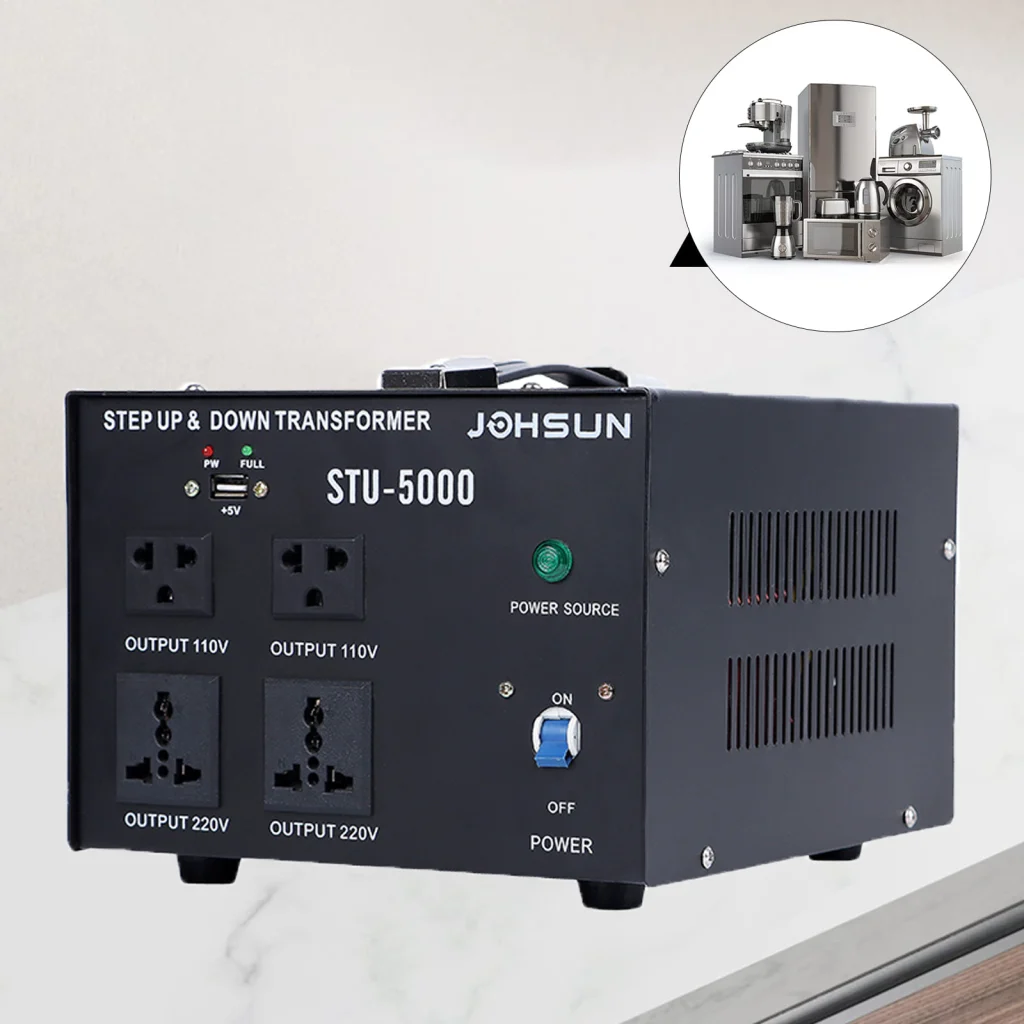
A 110V 220V step up and step down transformer symbol usually shows two windings separated by a magnetic core. The symbol helps identify isolation and winding structure, but it does not guarantee the actual voltage direction in an installed system.
Always verify:
| Local Supply Voltage | Equipment Rated Voltage | Required Direction | Typical Situation |
|---|---|---|---|
| 110V or 120V | 220V or 230V | Step up | Operating imported 220V equipment in North America |
| 220V or 230V | 110V or 120V | Step down | Using US-rated equipment in Asia, Europe, or the Middle East |
| 240V | 120V | Step down | Commercial equipment installed in a 240V market |
| 120V | 240V | Step up | Exported equipment designed for 240V operation |
A voltage mismatch is not the same as an unstable power supply. This distinction matters because using the wrong product may leave the original problem unresolved.
| Product Type | Main Function | What It Changes | What It Does Not Change |
|---|---|---|---|
| Step up/down transformer | Matches voltage levels | 110V, 120V, 220V, 230V, or 240V | Frequency or AC/DC type |
| Voltage stabilizer | Corrects fluctuating input voltage | Voltage variation within a defined range | Major voltage-system mismatch or frequency |
| Frequency converter | Changes input frequency | 50Hz to 60Hz or 60Hz to 50Hz | Not necessarily the voltage range |
| AC/DC power supply | Provides DC output | AC input to controlled DC voltage | Does not replace an AC transformer for AC loads |
Use a transformer when the site voltage and equipment rated voltage are different but stable.
Use a stabilizer when the equipment voltage is correct, yet the mains supply rises and falls enough to affect operation. For example, a 220V device installed in an area with frequent voltage fluctuation may need a single-phase servo voltage stabilizer rather than a standard step-up or step-down transformer.
Use a frequency converter when the machine depends on a specific 50Hz or 60Hz supply. This is especially important for motors, compressors, timing devices, and some imported production equipment.
The most common purchasing mistake is matching transformer capacity directly to the wattage printed on the equipment label.
A transformer is often rated in VA, while the equipment may be rated in W. These values are related, but they are not always identical because power factor affects the usable relationship between real power and apparent power.
A practical starting point is:
Required transformer capacity = equipment running load × suitable safety margin
For resistive loads, such as heaters and basic lighting, a moderate margin is usually sufficient. For motors, pumps, fans, compressors, and other inductive loads, the transformer must account for startup current.
| Load Type | Typical Equipment | Startup Behavior | Recommended Selection Logic |
|---|---|---|---|
| Resistive load | Heater, hot plate, basic lighting | Low surge | Add reasonable continuous-load margin |
| Electronic load | Printer, monitor, control device | Variable inrush | Check peak input specification |
| Inductive load | Fan, pump, motor | Higher startup current | Select larger VA capacity |
| Compressor load | Refrigeration, HVAC equipment | Very high startup demand | Confirm starting current and duty cycle |
| Mixed load | Control panel with motors and electronics | Depends on load mix | Calculate each load separately |
The search term 3000VA 2550W 110V 220V Step Up and Step Down Transformer reflects a common question: can a 3000VA transformer power a 2550W device?
The answer depends on the load. A 2550W heating device may be workable with a suitable margin. A 2550W motor-driven machine may require a larger transformer because its startup demand can be much higher than its normal running power.

A step up and down transformer 5000W model is not automatically the correct choice for every machine below 5000W. The key question is whether the load is continuous, intermittent, resistive, inductive, or motor-driven.
For a continuous high-load application, avoid operating at the absolute maximum rating for long periods. Heat buildup, enclosure ventilation, ambient temperature, and service hours all affect real operating conditions.
For motors and compressors, size based on startup behavior rather than normal running current alone. A transformer that works during idle operation may trip protection or experience excessive voltage drop when the motor starts.
For lower-power test instruments, communication equipment, lighting controls, and temporary service work, buyers can compare 100VA–1500VA step up and down transformer options.
For distributors building a standard stock range for commercial users, 100VA–3000VA voltage converter models can cover many common small and mid-range requirements.
Projects involving larger single-phase loads should be evaluated against 100VA–5000VA transformer options after checking duty cycle, startup current, and actual equipment input data.
For broader capacity planning, custom voltage requirements, and export-market configuration, review 100VA–10KVA step up and step down transformer options.
Correct sizing is only one part of safe operation. Before energizing the system, confirm the following:
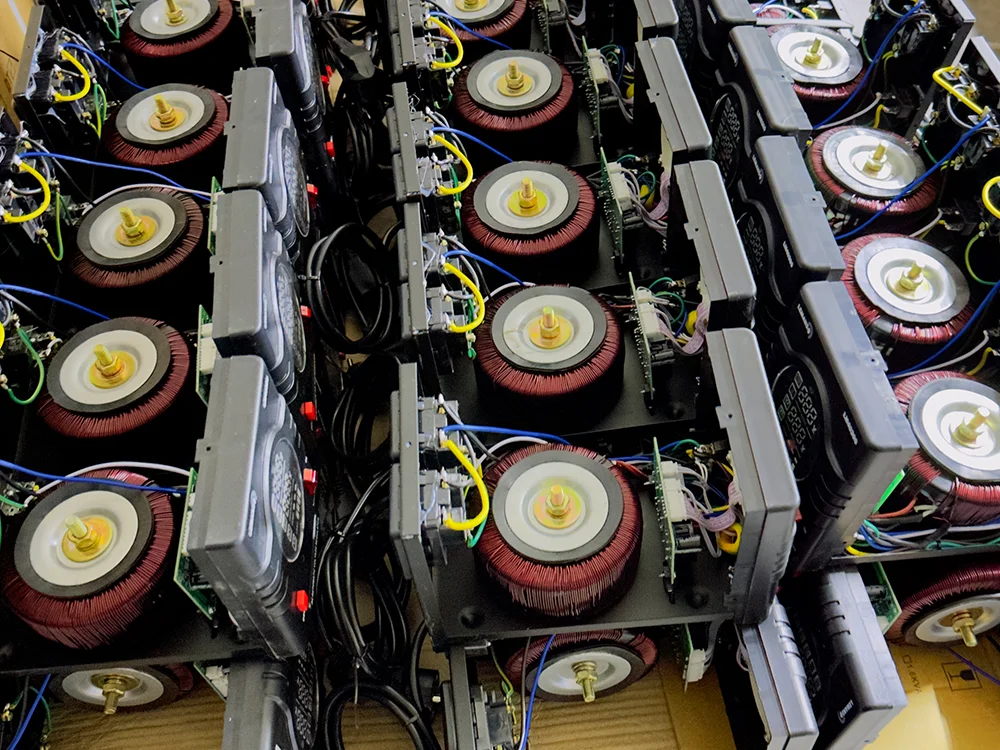
The right transformer depends on the equipment profile, not only the destination country, More attention should be paid to suppliers. Johsun Tec is a leading manufacturer committed to providing high-quality power products that meet the ever-changing needs of various industries, offering comprehensive solutions including voltage regulators, transformers, UPS systems, inverters, and battery chargers.
| Application | Main Concern | What to Confirm |
|---|---|---|
| Imported test equipment | Voltage and frequency compatibility | Nameplate voltage, frequency, continuous load |
| Control panels | Stable supply for auxiliary circuits | Control voltage, grounding, peak inrush |
| Workshop tools | Motor startup demand | Starting current, working cycle, cable size |
| Commercial appliances | Continuous heating or mixed loads | Running wattage, usage duration, ventilation |
| Distributor inventory | Coverage across customer demand | Common voltages, capacity mix, plugs, packaging |
| OEM export equipment | Target-market compliance | Voltage range, socket type, labels, manuals, private label requirements |
For panel builders and maintenance teams, a transformer can be useful when imported control equipment requires a different AC voltage than the local grid. For motor-based equipment, the transformer must be treated as part of the startup system, not merely as a voltage adapter.
For OEM projects, voltage conversion requirements should be confirmed during product design. Waiting until shipment creates avoidable problems with plugs, labels, manuals, packing, and final-market compliance.
| Common Mistake | Likely Result | Better Approach |
|---|---|---|
| Choosing by watts only | Overheating or protection trips | Confirm VA, power factor, and surge demand |
| Ignoring motor startup current | Transformer voltage drop at startup | Size for starting demand, not only running load |
| Assuming 220V and 230V are always identical | Incorrect output tolerance for sensitive equipment | Review equipment tolerance and local supply |
| Ignoring 50Hz and 60Hz | Motor speed or timing problems | Check whether the load is frequency-sensitive |
| Using a transformer for voltage fluctuation | Unstable equipment operation continues | Evaluate a stabilizer instead |
| Ordering before confirming plugs and sockets | Installation delays or unsafe adapters | Specify regional plug and outlet configuration |
Final Selection Checklist
Before selecting a 110V 220V Step Up and Step Down Transformer, confirm these points in order:
A professional Johsun Step Up and Step Down Transformer Supplier should receive enough technical information to recommend a workable configuration. Asking only for the lowest price often produces an incomplete comparison.
| Information to Provide | Why It Matters |
|---|---|
| Local input voltage | Determines required transformer direction |
| Equipment rated voltage | Confirms output requirement |
| Frequency requirement | Identifies whether a transformer alone is sufficient |
| Running watts and startup current | Supports proper VA sizing |
| Load type | Distinguishes resistive, electronic, and motor loads |
| Operating time per day | Helps assess continuous-load conditions |
| Plug and socket requirement | Avoids installation incompatibility |
| Destination market | Supports export labels, packaging, and electrical configuration |
Manufacturers, importers, wholesalers, distributors, and procurement companies should also confirm whether they need:
For a China factory or exporter, a complete RFQ produces a more accurate quotation than a simple request for a “best price.” It also reduces the risk of receiving a product that fits the budget but not the application.
The correct choice is not simply the largest transformer within budget. Start with voltage and frequency compatibility, then calculate the real load requirement, include startup margin, confirm safety configuration, and only then compare supplier pricing and delivery terms.
Before placing a bulk order, prepare the equipment nameplate details, local supply voltage, operating frequency, continuous load, and startup current. A technical review can help confirm the correct capacity, plug configuration, protection method, and export-market setup.
It changes AC voltage between lower-voltage and higher-voltage single-phase systems, such as 110V/120V and 220V/240V. It is used when the local power supply does not match the equipment’s rated input voltage.
Possibly, but only after checking the load type, power factor, startup current, and expected operating time. A resistive load may be suitable with margin, while a motor-driven machine may need more capacity.
Not automatically. Motors can draw several times their rated current during startup, so the correct transformer must be selected using startup current, frequency, duty cycle, and motor loading conditions.
No. A standard transformer changes voltage but does not change frequency. Frequency-sensitive equipment may require a dedicated frequency converter.
It is typically shown as two windings separated by a magnetic core. The symbol explains the transformer structure, but you must still verify actual voltage direction using terminals, labels, and the input selector.
Provide the local voltage, equipment voltage, frequency, load type, continuous power, startup current, plug requirement, destination market, and branding needs. For OEM, ODM, or private-label projects, also confirm packaging, labels, manuals, MOQ, and delivery schedule.