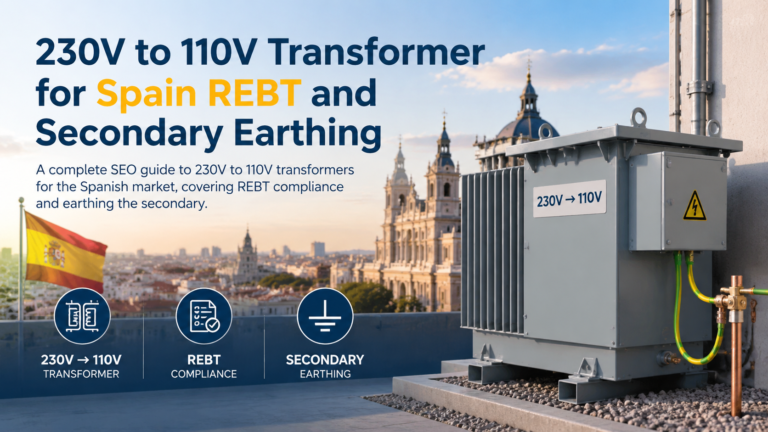







230V to 110V Transformer for Spain: REBT and Secondary Earthing
230V to 110V transformer for Spain: REBT compliance, ITC-BT-18 and ITC-BT-24, earthing the secondary and UNE-EN IEC 61558 documentation.
Read More
 English
When I talk with procurement teams about voltage conversion, the same problem keeps walking into the room wearing different shoes: the equipment is fine, the voltage is not. That is exactly where the Step Up & Down Transformer ST 5000 earns its keep. In Johsun’s DT/ST series, the platform covers 100VA to 10KVA, supports 110–120V and 220–240V conversion, runs on 50/60Hz, and uses a toroidal core for compact size, lower noise, and reduced EMI.
For buyer, that combination matters because a Step Up and Step Down Transformer is not just a box that changes voltage. It is also a risk-control device for imported machines, regional socket differences, pilot production lines, repair benches, test stations, and mixed-country equipment fleets. Johsun lists fuse or MCB protection, single-phase design, plug or terminal connection, a 0°C–40°C operating range, and a 12-month warranty for the DT/ST family, which is the sort of detail purchasing teams want before they release an inquiry instead of after someone has already ordered the wrong unit.
The nice part is that this is not a vague “power accessory” story. The ST/DT-5000 sits clearly in the product ladder at 5000W, and the series also offers OEM/ODM customization for voltage range, socket type, plug style, and housing design, with MOQ-based customization available. So yes, we can talk concept, but I would rather talk reality: what gets connected, how to choose the right size, and when the 5000VA step up and step down transformer is the smart buy instead of the “almost good enough” buy.
The ST/DT-5000 is the model I look at when the project is already past hobby territory and entering “please do not let this production cell stop at 4:50 p.m.” territory. Johsun places it inside a toroidal DT/ST range from 100VA to 10KVA, and the specific ST/DT-5000 package size is listed as 54.5 × 33 × 24.5 cm with 2 units per package.
Across the wider market, Step Up & Down Transformer ST 5000 products are commonly positioned as heavy-duty 5000W converters for 110/120V to 220/240V and 220/240V to 110/120V applications, often in single-phase format. That matters because buyers searching terms such as industrial voltage converter 5000W, heavy duty step up down transformer, or single phase 110V 220V transformer are usually not shopping for novelty; they are trying to keep imported equipment alive without teaching it a new nationality.
From a buyer’s angle, this makes the Step Up & Down Transformer ST 5000 especially relevant for import/export equipment programs. If your client ships a 110V machine into a 220V market, or a 220V unit into a 110V market, the transformer becomes the quiet hero that no one notices until it is missing. And honestly, in electrical procurement, “quiet hero” is a compliment.
What I also like here is the position of the 5000W class inside the series. Smaller models such as ST/DT-1000 are there for lighter duty, and ST/DT-10000 is there when the installation grows teeth, but ST/DT-5000 often hits the middle ground where buyers want enough capacity for serious equipment without immediately moving into a larger, heavier, more expensive frame.
This is the part buyers really care about, even if they pretend they only want the quotation first. A Step Up & Down Transformer ST 5000 is useful only when the input side matches the site supply and the output side matches the equipment nameplate. Johsun lists the DT/ST family as supporting plug or terminal connection, while general ST-5000 wiring practice emphasizes identifying the input and output terminals, connecting the source to the input side, the load to the output side, and checking markings and instructions before power-up.
In plain English, the wiring logic is simple even if the consequences of getting it wrong are not. If the local mains supply is 220–240V and the equipment needs 110–120V, you use the transformer in step-down mode; if the local mains supply is 110–120V and the equipment needs 220–240V, you use it in step-up mode. That bidirectional conversion is exactly what the DT/ST platform is built to do.
When I explain connection on the shop floor, I keep it in five moves. First, confirm the site voltage and the equipment voltage from their nameplates. Second, set or identify the correct input side. Third, land the incoming power on the input side and the load on the output side. Fourth, secure grounding and inspect the fuse or breaker status. Fifth, energize with no-load or light-load verification before full operation.
That sequence is boring, and boring is wonderful in power products. Generic ST-5000 products sold in the market often include dedicated 110V and 220V front outlets plus LED indication, which shows how common the dual-voltage operating concept is in this class. Johsun’s DT/ST line also lists plug or terminal connection, which is useful for B2B projects because some buyers want a socket-ready unit while others prefer a cleaner terminal-based installation into an equipment bay.
Queries such as 220V to 110V transformer for CNC machine, 110V to 220V voltage converter for industrial equipment, and Step Up & Down Transformer ST 5000 with fuse MCB protection are not academic; they usually come from engineers or sourcing staff who already know the load and just need the correct conversion path.

Now we get to the question that decides whether your order becomes useful or expensive decoration: which model should you pick. Johsun’s DT/ST table gives a clean ladder from ST/DT-100 at 100W up to ST/DT-10000 at 10000W, with ST/DT-5000 sitting near the upper middle of the range.
I usually tell buyers not to choose with emotion Step Up & Down Transformer ST 5000. “This one looks strong” is not a sizing method, although it is occasionally a very creative procurement strategy. The right model depends on the supply voltage, the equipment voltage, the total load you plan to connect, whether the installation is plug-based or terminal-based, and whether you need customized socket or plug standards for your destination market.
So, when should you choose the Step Up & Down Transformer ST 5000 specifically? I would choose it when the project has moved beyond small appliances and into commercial or industrial equipment that still stays within a single-phase 110/220V conversion framework. The DT/ST series is described as suitable for stable operation from light household appliances up to heavy industrial equipment, which tells me the series was built with a wide application window rather than a one-scene-only mindset.
If your inquiry list includes imported printers, testing instruments, packing machines, office devices, or mixed-use electric equipment, the 5KVA point often becomes the practical center of gravity. Johsun’s broader transformer product content also mentions common applications such as water dispensers, printers, rice cookers, fans, fax machines, air machines, and computers for related Step Up & Down Transformer ST 5000 ranges, which helps show the brand’s multi-load application focus. For buyers searching toroidal voltage transformer supplier or OEM step up down transformer manufacturer, the bigger selling point is not only voltage conversion but also configurable sockets, plugs, and housing details for different export markets.
Another reason B2B buyers like Step Up & Down Transformer ST 5000 this class is that the commercial conversation is clearer. A supplier who can offer 100VA–10KVA within one family, with single-phase 110–120V / 220–240V conversion, 50/60Hz support, fuse or MCB protection, and OEM/ODM options, is easier to standardize across multiple projects than a vendor with one isolated model and too many promises. Standardization may sound unromantic, but it saves a lot of romance with your budget.
Yes. The DT/ST series lists 110–120V and 220–240V as both input and output ranges for step-up and step-down use.
Yes, the DT/ST series is specified as single phase.
Yes. Johsun states OEM/ODM customization for voltage range, socket type, plug style, and housing design, with MOQ-based customization available.
It is both, depending on how you use it. The DT/ST series supports conversion between 110–120V and 220–240V in either direction, so the same model can serve step-up or step-down duty as long as the source side and load side are matched correctly.
Yes, if the site supply is 110–120V and the equipment requires 220–240V, that is exactly the step-up use case. The series is positioned for stable operation across a broad application range and is sold as a buck-boost transformer family for global compatibility.
That is the opposite direction, and the DT/ST platform also supports it. The key is not the machine category alone but the actual nameplate voltage, phase requirement, and total load you intend to place on the transformer.
The ST/DT-5000 sits in a 100VA–10KVA series and is presented as suitable from light household appliances up to heavy industrial equipment, so it clearly lives above casual-use territory. In the broader market, ST-5000 models are also commonly described as heavy-duty 5000W converters for continuous use.